

Free 5-minute toolbox talkSeasonal and holidaysEnglish and Spanish
Spring safety moment
Soil that held firm all winter can turn soft, trenches can fill with water, and winter damage shows up on ladders, scaffolds and equipment. What OSHA requires: OSHA has no specific standard for spring safety; the general duty to train still applies (29 CFR 1926.21(b)(2)).
A free spring safety moment, or a full spring safety toolbox talk, that you can read to your crew in about five minutes. Use it any week from March through May, when the ground thaws, storms roll in and the season gets busy.
Updated October 29, 2026 · Based on 29 CFR 1926.21
Read it out loud
Free 5-minute toolbox talk
Read it out loud to your crew. It takes about 5 minutes.
Start with a question
What changed on this site when the weather started to warm up?
Why it matters
Spring brings thawing ground, heavy rain, sudden storms and a busy schedule all at once. Soil that held firm all winter can turn soft, trenches can fill with water, and winter damage shows up on ladders, scaffolds and equipment. Many crews add new and returning workers in spring, so it is a good time to reset habits.
Key points
Respect thawing ground and wet trenches
Thawing, soaked soil gets soft, and trench walls and spoil piles can give way. When workers can be expected to be exposed, a competent person must inspect excavations daily before work starts, and again after every rainstorm or other event that increases the hazard.
More
Stay out of a wet trench until it has been checked.
Get down when storms and wind roll in
Spring storms can bring high winds, hail and lightning with little warning. Work on or from scaffolds is not allowed during storms or high winds unless a competent person has determined it is safe and workers are protected by a personal fall arrest system or wind screens.
More
When you hear thunder, get off ladders, lifts, roofs and steel, and go to a safe shelter.
Watch your footing in mud and rain
Mud on your boots makes ladder rungs, steps and steel slick. Clean your boots before you climb, and set ladders on firm, level ground. Ladders may not be used on slippery surfaces unless they are secured or have slip-resistant feet.
Know the plants and animals on site
Warm weather brings out ticks, stinging insects, snakes and plants like poison ivy. Where harmful plants or animals are present, employees who may be exposed must be told about the hazards, how to avoid injury and the first aid to use.
More
Wear long sleeves and pants in brush, check for ticks after work, and tell the foreman if you are allergic to stings.
Fix what winter broke
Freezing and thawing can crack concrete, shift scaffold footings and damage cords, hoses and ladders. Inspect tools, equipment and the site before the busy season, and take damaged gear out of service.
More
In construction, safety programs must provide for frequent and regular inspections of job sites, materials and equipment by competent persons. During spring cleanup, read the label before using cleaning chemicals, and never mix them.
Ease into the heat
The first warm days can hit hard because your body has not adjusted to heat yet. Drink water often, take breaks in the shade and watch each other for signs of heat illness. In construction, an adequate supply of drinking water must be provided in all places of employment.
Scenario
Picture this: after two days of hard rain, the sun is out and the schedule is behind. The trench for the water line has water in the bottom, and the spoil pile looks soft at the edge. The operator wants to send a laborer down to finish one connection before lunch. What has to happen before anyone goes in?
Ask the crew
- Where does water collect on this site after a rain, and who checks it?
- What is our plan when thunder or high wind shows up, and who makes the call?
- Has anyone seen ticks, snakes, wasp nests or poison ivy around here yet?
- What did winter damage that we have not fixed yet?
Takeaway
Spring conditions change fast, so inspect after every storm, stay out of wet trenches until they are checked, and stop work when the weather turns.
Trainer: ______________________ Date: ____________
Credit: ToolboxKits, https://toolboxkits.com/topics/spring-safety/ (CC BY-NC-SA 4.0)
The poster is also inside the paid kits.
Audit-ready records in 60 seconds
Fill in your crew and download a filled sign-in sheet for this talk. Everything is made in your browser. Names are never uploaded or stored.
Start a sign-off
Crew scan a QR code on their own phones, type their name and sign with a finger. You see the names arrive and download the signed sheet. Free, no account.
Kits
Get the kit
No subscription needed. Buy only the kit you need.
Toolbox talk kit
$4.99
- 5-minute talk, English PDF
- 5-minute talk, Spanish PDF
- Editable mini-deck (English and Spanish)
- One-page crew handout (English and Spanish)
- Bilingual sign-in sheet
- 3-question quiz with answer key (English and Spanish)
- One-page bilingual poster
- Audit-ready records in 60 seconds: fill in your crew and get a sign-in sheet and a certificate for every worker
Training kit
$9
Editable PowerPoint, 38 slides
- Editable PowerPoint with trainer notes on every slide
- Trainer guide PDF with timing and discussion tips
- 10-question quiz and answer key
- Sign-in sheet and certificate of completion with fillable fields
- One-page crew handout
- Full Spanish version of everything
- One-page bilingual poster
- Audit-ready records in 60 seconds: fill in your crew and get a sign-in sheet and a certificate for every worker
- Instant download
- Secure checkout by Stripe
- 30-day refund, no questions
Need many topics? All Access gives you every kit for $99 a year.
Inside the kit
See what is in the kit
What is in the kit
 Editable PowerPoint
- Trainer guide
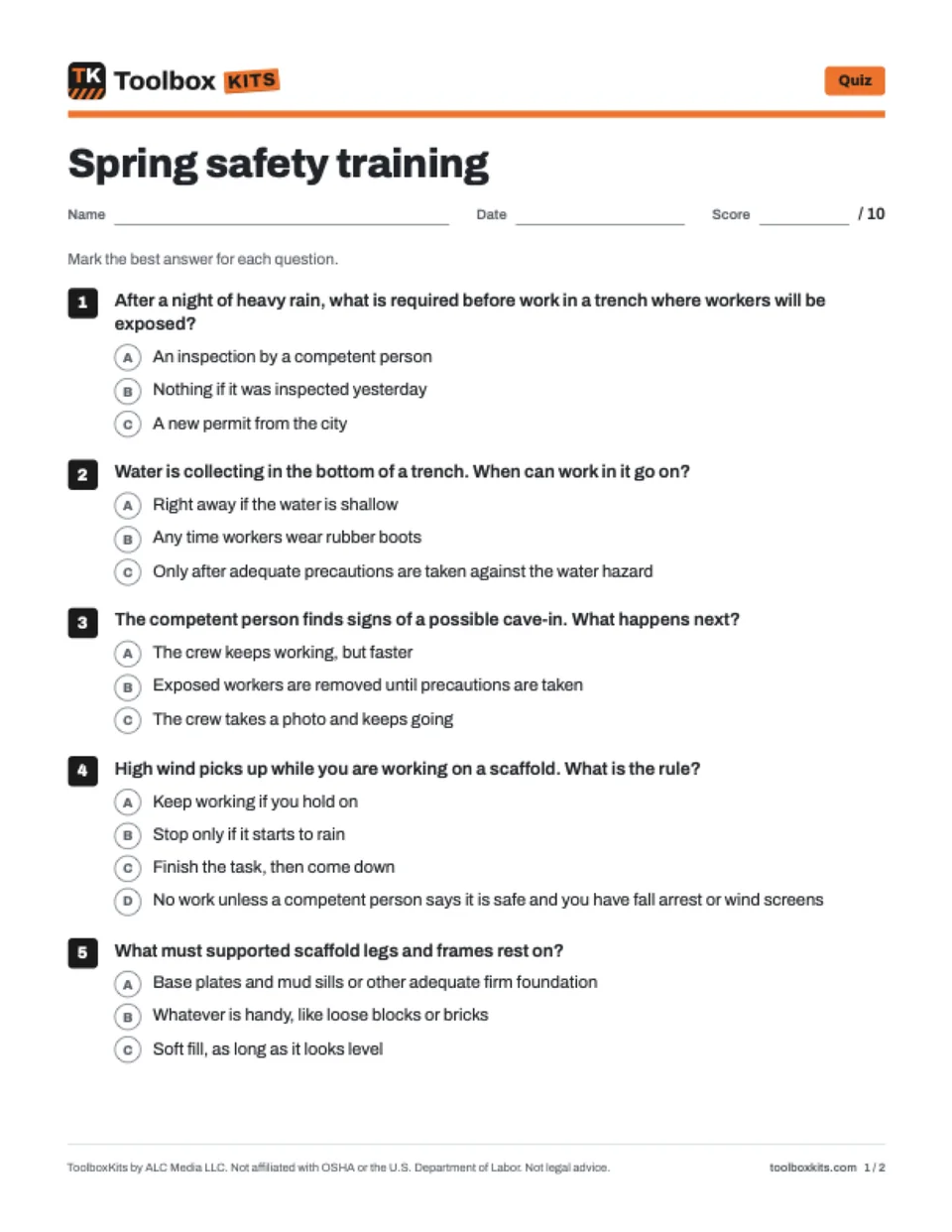 Quiz
- Answer key
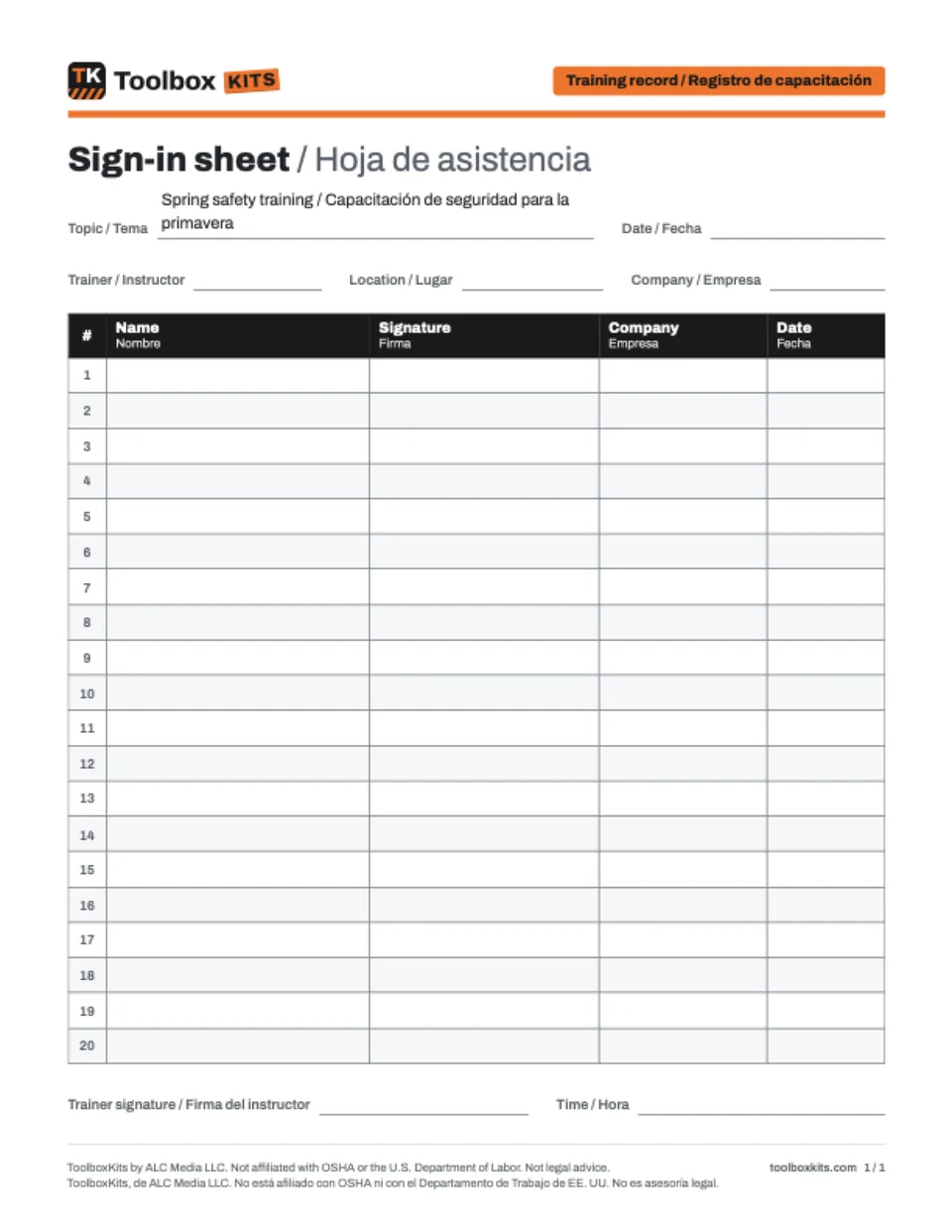 Sign-in sheet
 Certificate
- Crew handout
Try it
Try the quiz
Three questions from this topic. Pick an answer to see the right one and the OSHA paragraph.
Question 1 of 3
What does OSHA require at an excavation after every rainstorm?
The rule
What OSHA requires
Plain-language summary. Each line links to the exact paragraph of the regulation.
OSHA has no specific standard for spring safety; the general duty to train still applies. Construction employers must instruct each employee in recognizing and avoiding unsafe conditions and in the rules that apply to their work environment.
“The employer shall instruct each employee in the recognition and avoidance of unsafe conditions and the regulations applicable to his work environment to control or eliminate any hazards or other exposure to illness or injury.”
Where harmful plants or animals are present on the job site, employees who may be exposed must be instructed on the potential hazards, how to avoid injury and the first aid procedures to use if someone is hurt.
“employees who may be exposed shall be instructed regarding the potential hazards, and how to avoid injury, and the first aid procedures to be used in the event of injury.”
A competent person must inspect excavations, the areas next to them and protective systems daily, before work starts and as needed during the shift, and again after every rainstorm or other hazard-increasing event. These inspections are only required when employee exposure can be reasonably anticipated.
“Inspections shall also be made after every rainstorm or other hazard increasing occurrence.”
Employees may not work in excavations where water has accumulated or is accumulating unless adequate precautions have been taken against the hazards of water accumulation.
“Employees shall not work in excavations in which there is accumulated water, or in excavations in which water is accumulating, unless adequate precautions have been taken to protect employees against the hazards posed by water accumulation.”
Work on or from scaffolds is prohibited during storms or high winds unless a competent person has determined that it is safe and the employees are protected by a personal fall arrest system or wind screens.
For cranes and derricks, when a local storm warning has been issued, the competent person must decide whether the manufacturer's recommendations for securing the equipment need to be carried out.
“When a local storm warning has been issued, the competent person must determine whether it is necessary to implement manufacturer recommendations for securing the equipment.”
Ladders may not be used on slippery surfaces unless they are secured or have slip-resistant feet to prevent accidental displacement.
“Ladders shall not be used on slippery surfaces unless secured or provided with slip-resistant feet to prevent accidental displacement.”
Construction safety programs must provide for frequent and regular inspections of job sites, materials and equipment by competent persons designated by the employer.
“Such programs shall provide for frequent and regular inspections of the job sites, materials, and equipment to be made by competent persons designated by the employers.”
An adequate supply of drinking (potable) water must be provided in all places of employment.
“An adequate supply of potable water shall be provided in all places of employment.”
Common questions
Questions people ask
What are good safety moments and meeting topics for March, April and May?
March: thawing ground, mud and potholes, and inspecting what winter damaged. April: storms, lightning and wind, and water in trenches. May: the first hot days, drinking water, and ticks, bees and snakes. Pick the one that matches your site this week.
What are good spring safety moment ideas and meeting topics?
Good spring topics include trench safety after rain, your storm and lightning plan, ladder and scaffold checks after winter, insects, snakes and poison ivy, heat illness prevention and safe spring cleanup with chemicals. Rotate one a week through March, April and May so each one gets a full talk.
What should a spring weather toolbox talk cover?
Cover storms, lightning and high winds, slick surfaces, and water in trenches. Make sure the crew knows who calls a stop and where to shelter. Work on or from scaffolds during storms or high winds is prohibited unless a competent person has determined it is safe and workers are protected by a personal fall arrest system or wind screens (29 CFR 1926.451(f)(12)).
Are spring allergies a good safety moment topic?
Yes. Itchy eyes, sneezing and some allergy medicines can make people drowsy or distracted. Remind the crew to read medicine labels, and to tell the foreman before running equipment if a medicine makes them drowsy.
Does OSHA require a spring safety toolbox talk?
OSHA has no specific standard for spring safety; the general duty to train still applies (29 CFR 1926.21(b)(2)). Some spring hazards do have rules. Where harmful plants or animals are present, employees who may be exposed must be instructed on the hazards, how to avoid injury and the first aid to use (29 CFR 1926.21(b)(4)).
Free to share
Use this talk for free
You can print, share and adapt this talk at no cost under the Creative Commons BY-NC-SA 4.0 license. Please credit ToolboxKits with a link.