

Free 5-minute toolbox talkSeasonal and holidaysEnglish and Spanish
Summer safety moment and toolbox talk
Heat illness can come on fast, and a tired, overheated worker is more likely to make mistakes. What OSHA requires: In construction, the employer must instruct each employee in recognizing and avoiding unsafe conditions and the rules that apply to their work. There is no final federal OSHA heat standard; this general duty to train still applies (29 CFR 1926.21(b)(2)).
A 5-minute summer safety talk for June, July and August. It covers water and heat, sun, bugs and poison plants, storms, work near water and new summer workers.
Updated October 29, 2026 · Based on 29 CFR 1926.21
Read it out loud
Free 5-minute toolbox talk
Read it out loud to your crew. It takes about 5 minutes.
Start with a question
What changes about our work once the summer heat shows up?
Why it matters
Summer brings long days, high heat, strong sun, storms, bugs and new seasonal workers who do not know the site yet. Heat illness can come on fast, and a tired, overheated worker is more likely to make mistakes. There is no final federal OSHA heat standard, but water must be provided and the general duty to train still applies. Some states have their own heat rules, so check yours.
Key points
Water close to the work
An adequate supply of potable water must be provided at every place of employment. Keep it close to the work, not back at the trailer, and drink small amounts often, even before you feel thirsty. Rest in the shade when you can, and watch each other for headache, dizziness, cramps or confusion.
Ease new people into the heat
Workers who are new, or back from time off, have not built up to the heat yet. Give them lighter work and more breaks the first few days, and pair them with someone experienced. Walk summer hires through the site and its hazards before they start.
More
In construction, the employer must instruct each employee in recognizing and avoiding unsafe conditions.
Cover up against the sun
Wear a hat or a hard hat sun shade, light long sleeves made for hot weather, and sunglasses or tinted safety glasses where your site allows them. Use sunscreen and put more on during the day. Take breaks out of direct sun when you can.
Know the bugs, snakes and plants on site
On construction sites where harmful plants or animals are present, workers who may be exposed must be told the hazards, how to avoid injury and the first aid to use. Learn what poison ivy, ticks, stinging insects and snakes look like in this area.
More
Use repellent, check for ticks after work, and tell your foreman if you are allergic to stings.
Stop work for storms
Summer storms build fast. When you hear thunder, stop outdoor work and get inside a building or a hard-topped vehicle. Work on scaffolds is not allowed during storms or high winds unless a competent person decides it is safe and workers are protected by personal fall arrest or wind screens.
More
Wait until the storm has clearly passed before going back out.
Life jackets near water
S. Coast Guard-approved life jackets or buoyant work vests. Check the vest before and after each use, and do not use one that is damaged. Off the job, wear a life jacket on boats too.
Scenario
Picture this: It is the first hot week of July. A new summer hire is on day two, hauling material across an open lot. The water cooler is back at the trailer, and nobody has shown the new worker where it is. By early afternoon the worker feels dizzy and confused but keeps going so as not to look weak. What should the crew have done earlier, and what do you do right now?
Ask the crew
- Where are the water and shade on this job, and how far are they from the work?
- Who on our crew is new or just back from time off?
- What bugs, snakes or plants have we seen on this site?
- What is our plan when a storm rolls in?
Takeaway
Drink water, ease new people into the heat, cover up, know what bites and stings on your site, and stop work when a storm rolls in.
Trainer: ______________________ Date: ____________
Credit: ToolboxKits, https://toolboxkits.com/topics/summer-safety/ (CC BY-NC-SA 4.0)
The poster is also inside the paid kits.
Audit-ready records in 60 seconds
Fill in your crew and download a filled sign-in sheet for this talk. Everything is made in your browser. Names are never uploaded or stored.
Start a sign-off
Crew scan a QR code on their own phones, type their name and sign with a finger. You see the names arrive and download the signed sheet. Free, no account.
Kits
Get the kit
No subscription needed. Buy only the kit you need.
Toolbox talk kit
$4.99
- 5-minute talk, English PDF
- 5-minute talk, Spanish PDF
- Editable mini-deck (English and Spanish)
- One-page crew handout (English and Spanish)
- Bilingual sign-in sheet
- 3-question quiz with answer key (English and Spanish)
- One-page bilingual poster
- Audit-ready records in 60 seconds: fill in your crew and get a sign-in sheet and a certificate for every worker
Training kit
$9
Editable PowerPoint, 37 slides
- Editable PowerPoint with trainer notes on every slide
- Trainer guide PDF with timing and discussion tips
- 10-question quiz and answer key
- Sign-in sheet and certificate of completion with fillable fields
- One-page crew handout
- Full Spanish version of everything
- One-page bilingual poster
- Audit-ready records in 60 seconds: fill in your crew and get a sign-in sheet and a certificate for every worker
- Instant download
- Secure checkout by Stripe
- 30-day refund, no questions
Need many topics? All Access gives you every kit for $99 a year.
Inside the kit
See what is in the kit
What is in the kit
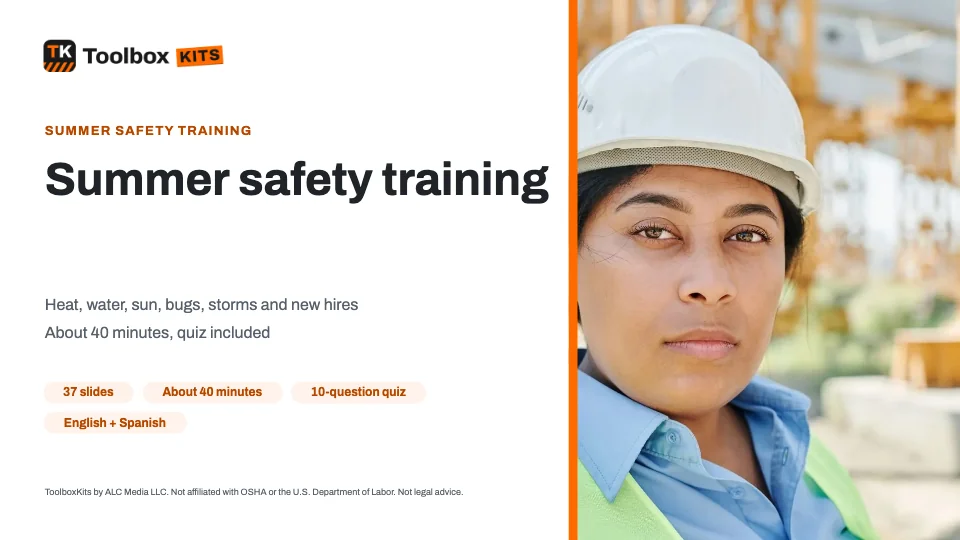 Editable PowerPoint
- Trainer guide
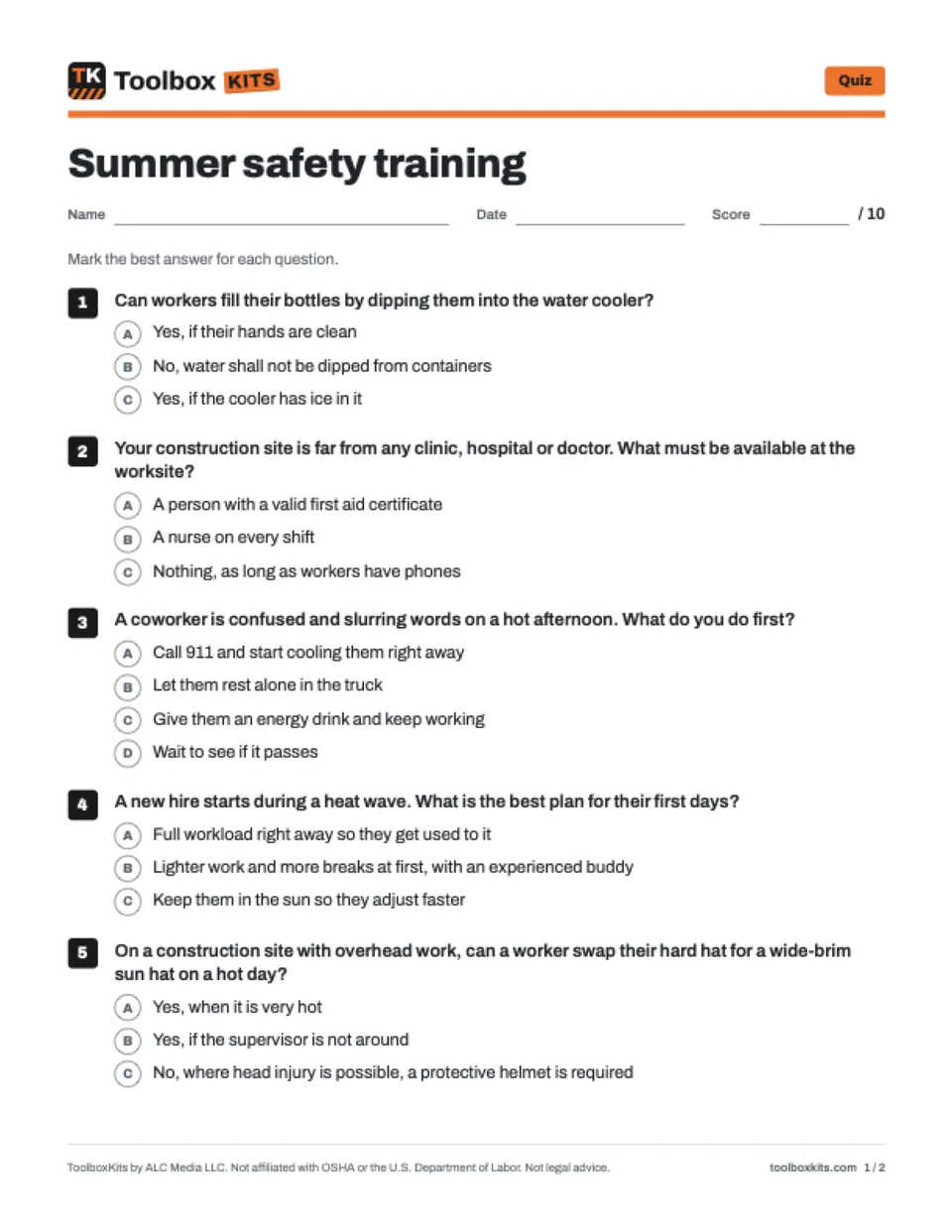 Quiz
- Answer key
 Sign-in sheet
 Certificate
- Crew handout
Try it
Try the quiz
Three questions from this topic. Pick an answer to see the right one and the OSHA paragraph.
Question 1 of 3
On a construction site, what must be provided in all places of employment?
The rule
What OSHA requires
Plain-language summary. Each line links to the exact paragraph of the regulation.
In construction, the employer must instruct each employee in recognizing and avoiding unsafe conditions and the rules that apply to their work. There is no final federal OSHA heat standard; this general duty to train still applies.
“The employer shall instruct each employee in the recognition and avoidance of unsafe conditions”
On construction sites, an adequate supply of potable water must be provided in all places of employment.
“An adequate supply of potable water shall be provided in all places of employment.”
In general industry, potable water must be provided in all permanent places of employment for drinking and washing.
“Potable water shall be provided in all places of employment, for drinking, washing of the person”
Portable drinking water containers must close tightly and have a tap, and water may not be dipped from them.
“Water shall not be dipped from containers.”
On construction sites where harmful plants or animals are present, workers who may be exposed must be told the hazards, how to avoid injury and what first aid to use.
“employees who may be exposed shall be instructed regarding the potential hazards, and how to avoid injury, and the first aid procedures to be used in the event of injury”
In construction, workers over or near water where there is a danger of drowning must be provided with U.S. Coast Guard-approved life jackets or buoyant work vests.
“Employees working over or near water, where the danger of drowning exists, shall be provided with U.S. Coast Guard-approved life jacket or buoyant work vests.”
In general industry, if there is no infirmary, clinic or hospital in near proximity, one or more people must be adequately trained to give first aid, and first aid supplies must be readily available.
“a person or persons shall be adequately trained to render first aid”
In construction, if no infirmary, clinic, hospital or physician is reasonably accessible, a person with a valid first aid training certificate from the U.S. Bureau of Mines or the American Red Cross, or equivalent training that can be verified by documents, must be available at the worksite to give first aid.
“shall be available at the worksite to render first aid”
Work on or from scaffolds is not allowed during storms or high winds unless a competent person has determined it is safe and workers are protected by a personal fall arrest system or wind screens.
“Work on or from scaffolds is prohibited during storms or high winds unless a competent person has determined that it is safe”
Who must be trained
In construction, each employee must be instructed in recognizing and avoiding unsafe conditions (29 CFR 1926.21(b)(2)). On construction sites where harmful plants or animals are present, each employee who may be exposed must be instructed on the hazards, how to avoid injury and the first aid to use (29 CFR 1926.21(b)(4)). In general industry, if there is no infirmary, clinic or hospital in near proximity, one or more people must be adequately trained to render first aid (29 CFR 1910.151(b)).
Common questions
Questions people ask
What is a good summer safety moment for work?
Pick one summer hazard and spend two minutes on it: water and heat, sun, bugs and poison plants, storms, or work near water. Tie it to something real on your site, like where the water cooler is or which area has ticks. The full talk on this page can be cut down to a quick summer safety moment.
What are good summer safety meeting topics for June, July and August?
In June, cover water, easing into the heat and onboarding summer hires. In July, cover sun, storms and lightning, plus fireworks safety off the job. In August, cover heat fatigue, bugs and poison plants. On construction sites, an adequate supply of potable water must be provided in all places of employment.
Is there a summer safety toolbox talk PDF?
Yes. Download this summer safety toolbox talk as a free printable PDF in English and Spanish, with a sign-in sheet for attendance. Read it at the start of the shift, before the hottest part of the day.
Is there a summer safety presentation or PowerPoint?
This talk is made to be read aloud from a printout, so you can use it in the field without a projector. If you want slides for a longer summer safety presentation, use the training kit option on this page. Keep it short and practical, and show the crew where the water and shade are.
What should a summer water safety talk cover?
At work, cover drinking water and staying hydrated, plus life jackets for anyone working over or near water. In construction, workers over or near water, where there is a danger of drowning, must be provided with U.S. Coast Guard-approved life jackets or buoyant work vests. Off the job, remind the crew to wear life jackets on boats and to swim only in safe, supervised areas.
Free to share
Use this talk for free
You can print, share and adapt this talk at no cost under the Creative Commons BY-NC-SA 4.0 license. Please credit ToolboxKits with a link.