

Free 5-minute toolbox talkSeasonal and holidaysEnglish and Spanish
Holiday safety toolbox talk
OSHA has no specific standard for holiday safety; the general duty to train still applies. What OSHA requires: In construction, the employer must instruct each employee in recognizing and avoiding unsafe conditions and the rules that apply to their work. There is no specific OSHA standard for holiday safety; this general duty to train still applies (29 CFR 1926.21(b)(2)).
A 5-minute talk for the weeks between Thanksgiving and New Year, when work speeds up and minds wander. Use it as a holiday safety moment before the break and again when the crew comes back.
Updated October 29, 2026 · Based on 29 CFR 1926.21
Read it out loud
Free 5-minute toolbox talk
Read it out loud to your crew. It takes about 5 minutes.
Start with a question
What is most likely to get someone hurt here before the holiday break?
Why it matters
The holidays bring deadlines, short days, cold weather, parties, travel and a lot on everyone's mind. Rushing to finish before the break can lead to skipped steps. Decorations, extra deliveries, cords and ladders show up in places they normally are not. OSHA has no specific standard for holiday safety; the general duty to train still applies.
Key points
Do not rush the last jobs before the break
Year-end deadlines can push people to cut corners. Plan the last week so nobody is racing the clock on a ladder, a lift or a forklift. Stress and short sleep make it worse, so look out for each other and speak up when you see someone skipping a step.
More
If a task cannot be done safely before the break, it waits.
Keep decorations away from exits
Exit routes must be kept free of explosive or highly flammable furnishings or other decorations. Keep paper decorations and dry trees away from exits, heaters and hot lights. Do not stack boxes, gift deliveries or party tables in hallways and doorways that lead out.
More
Keep fire extinguishers in plain view and easy to reach.
Inspect cords and holiday lights
Extension cords must be visually inspected before use on any shift for damaged insulation, crushed jackets, missing pins and loose parts. If a cord or a string of lights is damaged, take it out of service.
More
Do not staple cords or run them through doorways where they get pinched, and keep them out of walkways.
Use a ladder, not a chair
Hanging lights and decorations is work at height. Ladders must be inspected before initial use in each work shift. Face the ladder, keep at least one hand on it while climbing, and do not carry boxes that throw off your balance. Never stand on chairs, desks or boxes.
Watch for ice and early darkness
Walking and working surfaces must be kept free of hazards such as spills, snow and ice. Short days mean more work and driving in the dark, so light up work areas and slow down. Wear footwear with good tread, use handrails, and report icy spots right away.
Get home safe and come back focused
Never drive after drinking, and plan your ride home before any party starts. Travel and late nights add up, so rest before long drives and before your first shift back. On the first day back, walk the site, recheck equipment that sat idle, and go over the plan before work starts.
Scenario
Picture this: It is the last afternoon before the break, and everyone wants to leave early. Two coworkers hang a string of lights over the office door by standing on a rolling chair. They plug it into an old extension cord with tape over a split in the jacket and run the cord across the hallway. A few minutes later, someone carrying a stack of gift boxes comes around the corner. What went wrong here, and what should they have done instead?
Ask the crew
- What jobs are we tempted to rush before the break, and how do we slow them down?
- Where do decorations, deliveries or cords end up blocking our exits or walkways?
- How is everyone getting home after the holiday party?
- What should we check first when we come back after the break?
Takeaway
Slow down, keep exits and walkways clear, check cords and ladders, get home safe, and come back with your mind on the job.
Trainer: ______________________ Date: ____________
Credit: ToolboxKits, https://toolboxkits.com/topics/holiday-safety/ (CC BY-NC-SA 4.0)
The poster is also inside the paid kits.
Audit-ready records in 60 seconds
Fill in your crew and download a filled sign-in sheet for this talk. Everything is made in your browser. Names are never uploaded or stored.
Start a sign-off
Crew scan a QR code on their own phones, type their name and sign with a finger. You see the names arrive and download the signed sheet. Free, no account.
Kits
Get the kit
No subscription needed. Buy only the kit you need.
Toolbox talk kit
$4.99
- 5-minute talk, English PDF
- 5-minute talk, Spanish PDF
- Editable mini-deck (English and Spanish)
- One-page crew handout (English and Spanish)
- Bilingual sign-in sheet
- 3-question quiz with answer key (English and Spanish)
- One-page bilingual poster
- Audit-ready records in 60 seconds: fill in your crew and get a sign-in sheet and a certificate for every worker
Training kit
$9
Editable PowerPoint, 39 slides
- Editable PowerPoint with trainer notes on every slide
- Trainer guide PDF with timing and discussion tips
- 10-question quiz and answer key
- Sign-in sheet and certificate of completion with fillable fields
- One-page crew handout
- Full Spanish version of everything
- One-page bilingual poster
- Audit-ready records in 60 seconds: fill in your crew and get a sign-in sheet and a certificate for every worker
- Instant download
- Secure checkout by Stripe
- 30-day refund, no questions
Need many topics? All Access gives you every kit for $99 a year.
Inside the kit
See what is in the kit
What is in the kit
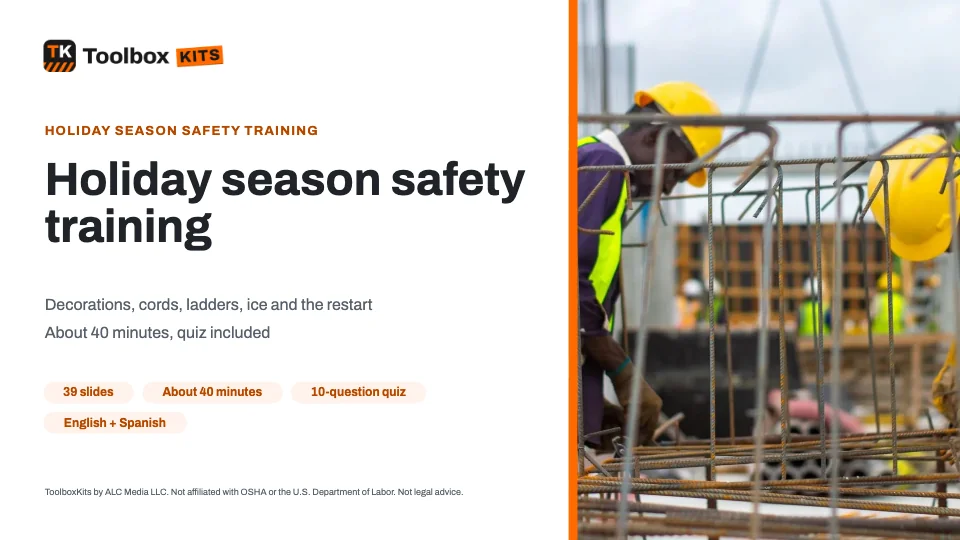 Editable PowerPoint
- Trainer guide
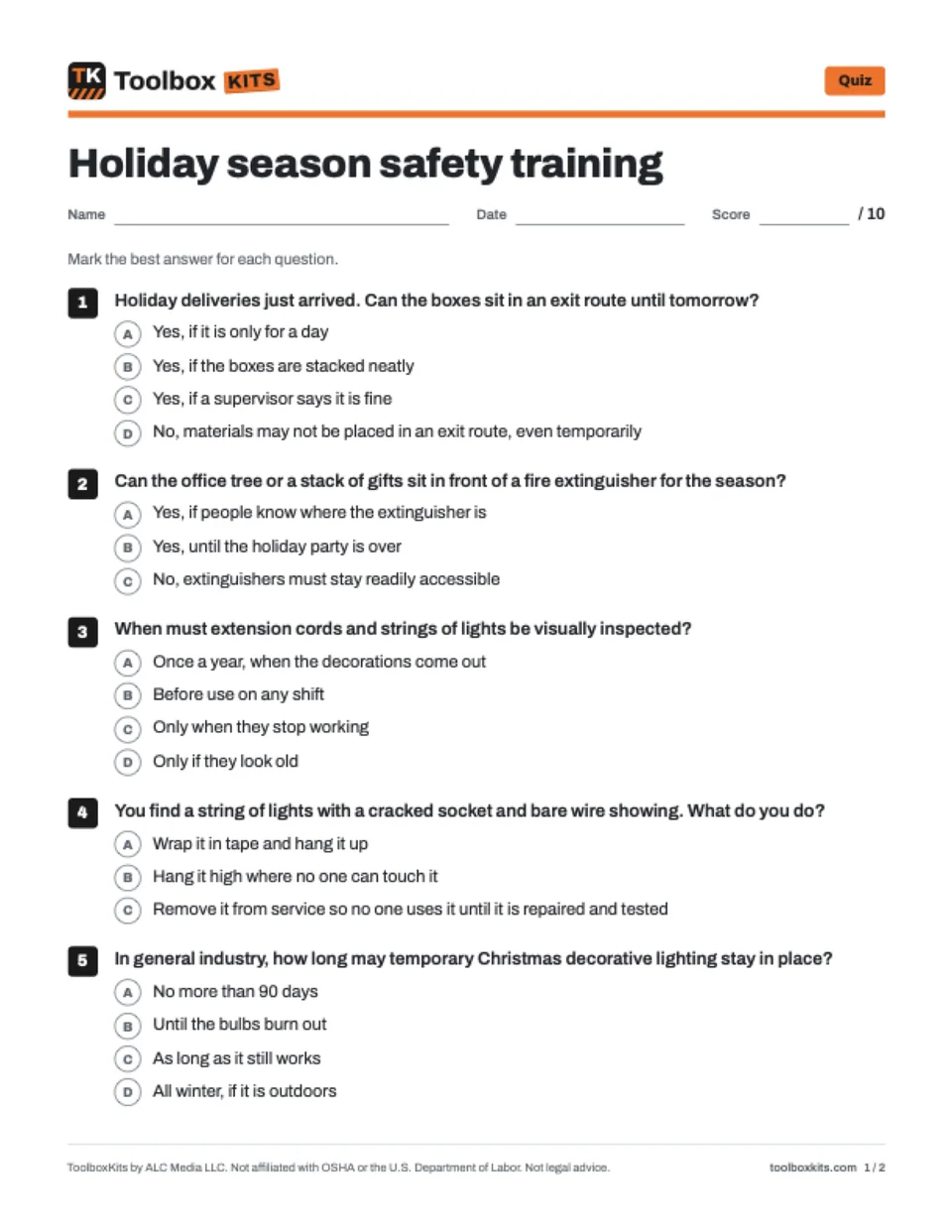 Quiz
- Answer key
 Sign-in sheet
 Certificate
- Crew handout
Try it
Try the quiz
Three questions from this topic. Pick an answer to see the right one and the OSHA paragraph.
Question 1 of 3
Can boxes or a holiday tree sit in an exit route for a few days?
The rule
What OSHA requires
Plain-language summary. Each line links to the exact paragraph of the regulation.
In construction, the employer must instruct each employee in recognizing and avoiding unsafe conditions and the rules that apply to their work. There is no specific OSHA standard for holiday safety; this general duty to train still applies.
“The employer shall instruct each employee in the recognition and avoidance of unsafe conditions and the regulations applicable to his work environment”
Exit routes must be kept free of explosive or highly flammable furnishings or other decorations.
“Exit routes must be kept free of explosive or highly flammable furnishings or other decorations.”
Exit routes must be free and unobstructed. No materials or equipment may be placed in an exit route, even temporarily.
“No materials or equipment may be placed, either permanently or temporarily, within the exit route.”
Portable fire extinguishers must be mounted, located and identified so they are readily accessible, so keep decorations and deliveries from blocking them.
“mount, locate and identify them so that they are readily accessible to employees without subjecting the employees to possible injury”
In general industry, temporary power and lighting installations used for Christmas decorative lighting may stay in place no more than 90 days.
“For a period not to exceed 90 days for Christmas decorative lighting, carnivals, and similar purposes”
Extension cords and other cord-and-plug equipment must be visually inspected before use on any shift for external defects and signs of internal damage. Cords and equipment that stay connected in place and are not exposed to damage need not be inspected until they are moved.
“shall be visually inspected before use on any shift for external defects”
Flexible cords may not be fastened with staples or hung in a way that could damage the outer jacket or insulation.
“Flexible cords may not be fastened with staples or otherwise hung in such a fashion as could damage the outer jacket or insulation.”
Ladders must be inspected before initial use in each work shift for visible defects.
“Ladders are inspected before initial use in each work shift”
Walking-working surfaces must be kept free of hazards such as leaks, spills, snow and ice.
“Walking-working surfaces are maintained free of hazards such as sharp or protruding objects, loose boards, corrosion, leaks, spills, snow, and ice.”
In construction, the safety program must provide for frequent and regular inspections of job sites, materials and equipment by competent persons. A restart after the holiday shutdown is a good time for one.
“frequent and regular inspections of the job sites, materials, and equipment to be made by competent persons designated by the employers”
Common questions
Questions people ask
Is there a printable holiday safety toolbox talk?
Yes. Download this holiday safety toolbox talk as a free PDF in English and Spanish, with a sign-in sheet for attendance. It takes about 5 minutes to read aloud, so it also works as an end of year toolbox talk at the last huddle before the break.
What is a good Christmas safety moment?
Pick one hazard and spend two minutes on it: decorating from a ladder, damaged cords and lights, a live tree near a heater, or a safe ride home from the party. If you have a live tree at work, keep it watered and away from heaters and exits. Exit routes must be kept free of explosive or highly flammable furnishings or other decorations.
What should a return to work after the holidays toolbox talk cover?
Walk the site together first, because conditions change while everyone is away. Recheck equipment that sat idle, look for weather damage, and go over new hazards and the plan for the week. In construction, the safety program must provide for frequent and regular inspections of job sites, materials and equipment by competent persons.
What are good holiday safety meeting topics?
Rotate through year-end rushing, stress and fatigue, decorations and exits, extension cords and lights, ladders, snow and ice, impaired driving, and coming back after the break. OSHA has no specific standard for holiday safety, but in construction the employer must still instruct each employee in recognizing and avoiding unsafe conditions. Keep each holiday safety moment short and tie it to your own site.
Is there a holiday safety presentation or PowerPoint?
This talk is made to be read aloud from a printout, so you can run it anywhere without a projector. If you want slides for a longer holiday safety presentation, use the training kit option on this page. Keep it short and practical, and end with how everyone is getting home safe.
Free to share
Use this talk for free
You can print, share and adapt this talk at no cost under the Creative Commons BY-NC-SA 4.0 license. Please credit ToolboxKits with a link.