

Free 5-minute toolbox talkSeasonal and holidaysEnglish and Spanish
Autumn safety moment: fall season toolbox talk
Fall brings shorter days, cold mornings, warm afternoons and wet, slippery ground. What OSHA requires: OSHA has no specific standard for fall season hazards; the general duty to train still applies. On construction jobs, the employer must instruct each employee in recognizing and avoiding unsafe conditions and the rules that apply to their work (29 CFR 1926.21(b)(2)).
A free fall season toolbox talk you can use as an autumn safety moment in September, October or November. Read it aloud in about five minutes in English or Spanish.
Updated October 29, 2026 · Based on 29 CFR 1926.21
Read it out loud
Free 5-minute toolbox talk
Read it out loud to your crew. It takes about 5 minutes.
Start with a question
What changes on your drive in and on the job once fall sets in?
Why it matters
Fall brings shorter days, cold mornings, warm afternoons and wet, slippery ground. The changes creep up on us, and we keep working like it is still summer. A few small adjustments keep the season's hazards from catching anyone off guard.
Key points
Shorter days need more light
Fall means more work at dawn and dusk. Construction areas, ramps, runways, corridors, offices, shops and storage areas must be lit to at least the minimum levels in OSHA's Table D-3 while any work is in progress.
More
Report burned-out lights, move lighting as the work moves, and wear high-visibility clothing near traffic and equipment.
Watch your step on leaves and frost
Wet leaves, mud and early frost make walkways, steps, ramps and ladder rungs slick. OSHA's general industry rule says walking-working surfaces must be kept free of hazards such as leaks, spills, snow and ice.
More
Clear leaves early, take shorter steps on frosty mornings, and wear eye and hearing protection when you run a leaf blower.
Adjust to the time change
When clocks fall back, the drive home can happen in the dark, and your sleep can be off for a few days. Tired workers react slower and miss hazards, so get enough rest and speak up if you are too tired to work or drive safely.
More
Watch for school buses, kids walking and deer near the road at dawn and dusk. On construction jobsites closed to public traffic, vehicles must have working headlights and taillights whenever visibility calls for more light.
Dress for temperature swings
A frosty morning can turn into a warm afternoon. Wear layers you can take off and put back on, and keep a dry layer in the truck in case you get wet. You can still get dehydrated in cool weather, and an adequate supply of drinking water must be provided at every workplace.
Run heaters safely
Temporary heaters come out as nights get colder. On construction sites, fresh air must be supplied in sufficient quantities to keep workers healthy and safe, with mechanical ventilation where natural fresh air is not enough.
More
Never run fuel-burning heaters or engines in a closed space without ventilation, because carbon monoxide has no smell.
Plan for storms and new faces
Depending on where you work, fall can bring hurricanes, high winds, heavy rain or early snow. Know how to report an emergency, where to go, and who takes the head count.
More
Where an OSHA standard requires an emergency action plan, the employer must review with each employee, when first assigned, the parts they need to know. Walk new and seasonal workers through it.
Scenario
Picture this: It is the first week after the clocks fall back. A crew is loading tools onto a trailer as the sun goes down. The work lights have not been moved since summer, the ramp to the trailer is covered in wet leaves, and one worker in a dark hoodie is standing near the truck as it backs up. What would you fix first, and who should fix it?
Ask the crew
- Where on our site does it get dark first, and is the lighting there good enough?
- Which walkways, steps or ramps collect leaves or frost, and who clears them?
- How has the time change affected your drive or your sleep, and what helps?
- Do you know our plan if a storm or high winds hit during a shift?
Takeaway
Fall changes the light, the ground and the weather, so change your habits with it.
Trainer: ______________________ Date: ____________
Credit: ToolboxKits, https://toolboxkits.com/topics/fall-season-safety/ (CC BY-NC-SA 4.0)
The poster is also inside the paid kits.
Audit-ready records in 60 seconds
Fill in your crew and download a filled sign-in sheet for this talk. Everything is made in your browser. Names are never uploaded or stored.
Start a sign-off
Crew scan a QR code on their own phones, type their name and sign with a finger. You see the names arrive and download the signed sheet. Free, no account.
Kits
Get the kit
No subscription needed. Buy only the kit you need.
Toolbox talk kit
$4.99
- 5-minute talk, English PDF
- 5-minute talk, Spanish PDF
- Editable mini-deck (English and Spanish)
- One-page crew handout (English and Spanish)
- Bilingual sign-in sheet
- 3-question quiz with answer key (English and Spanish)
- One-page bilingual poster
- Audit-ready records in 60 seconds: fill in your crew and get a sign-in sheet and a certificate for every worker
Training kit
$9
Editable PowerPoint, 34 slides
- Editable PowerPoint with trainer notes on every slide
- Trainer guide PDF with timing and discussion tips
- 10-question quiz and answer key
- Sign-in sheet and certificate of completion with fillable fields
- One-page crew handout
- Full Spanish version of everything
- One-page bilingual poster
- Audit-ready records in 60 seconds: fill in your crew and get a sign-in sheet and a certificate for every worker
- Instant download
- Secure checkout by Stripe
- 30-day refund, no questions
Need many topics? All Access gives you every kit for $99 a year.
Inside the kit
See what is in the kit
What is in the kit
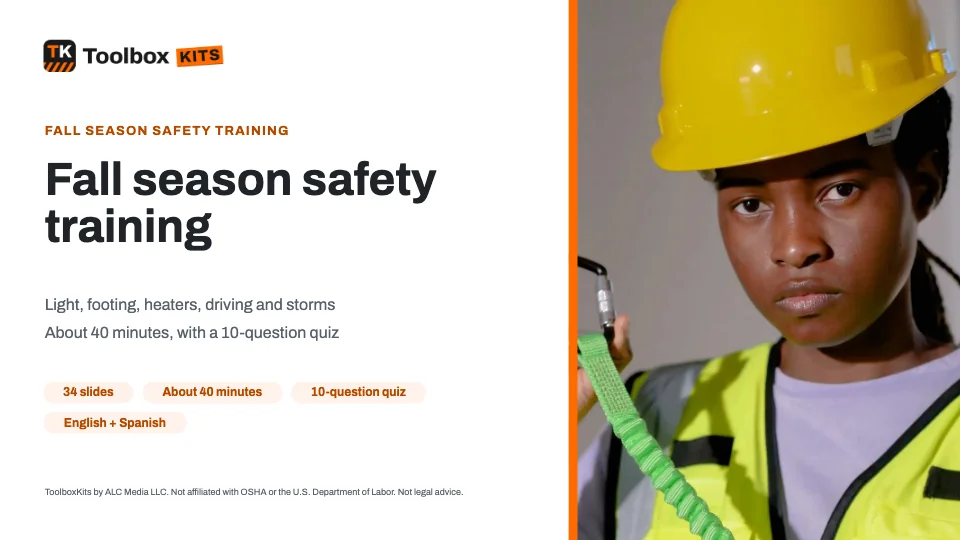 Editable PowerPoint
- Trainer guide
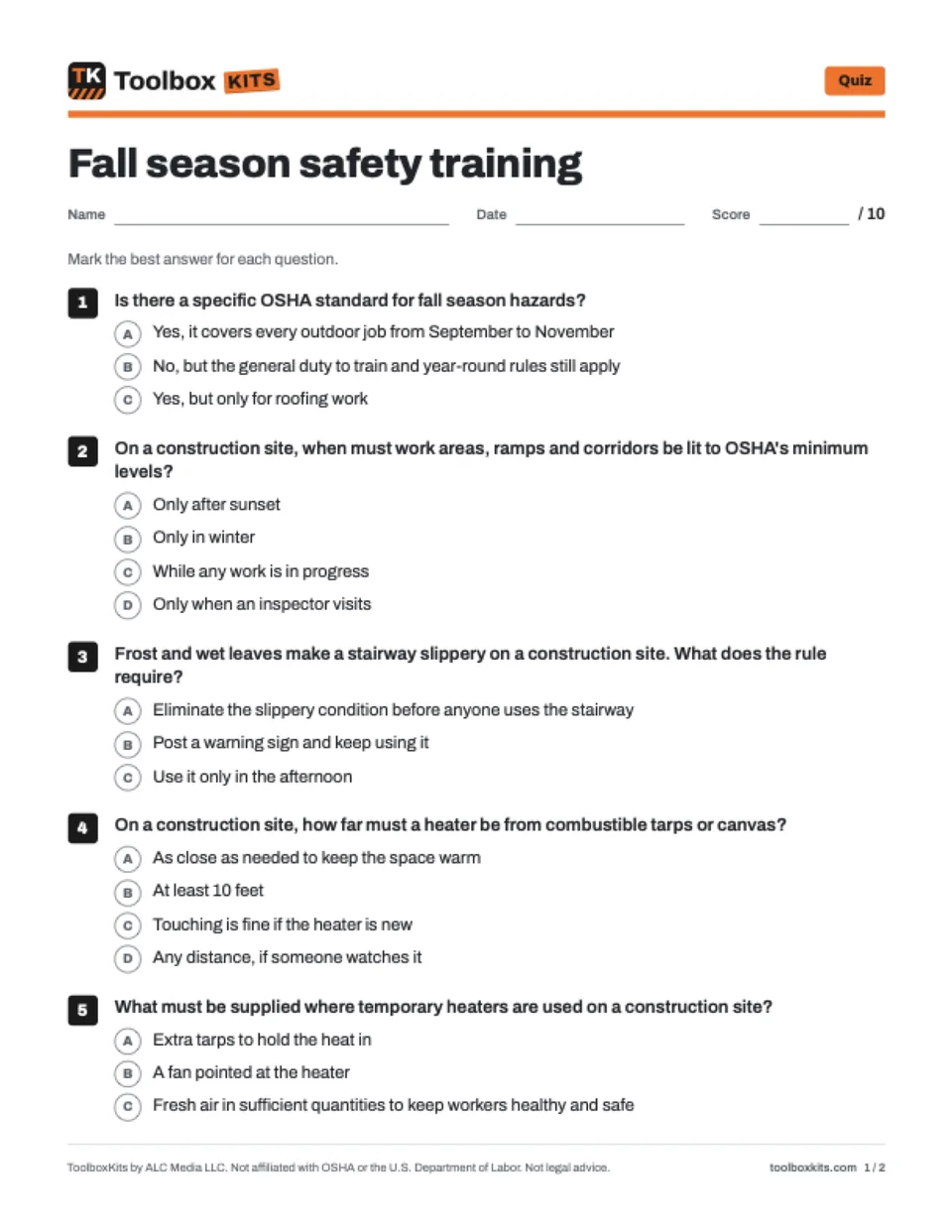 Quiz
- Answer key
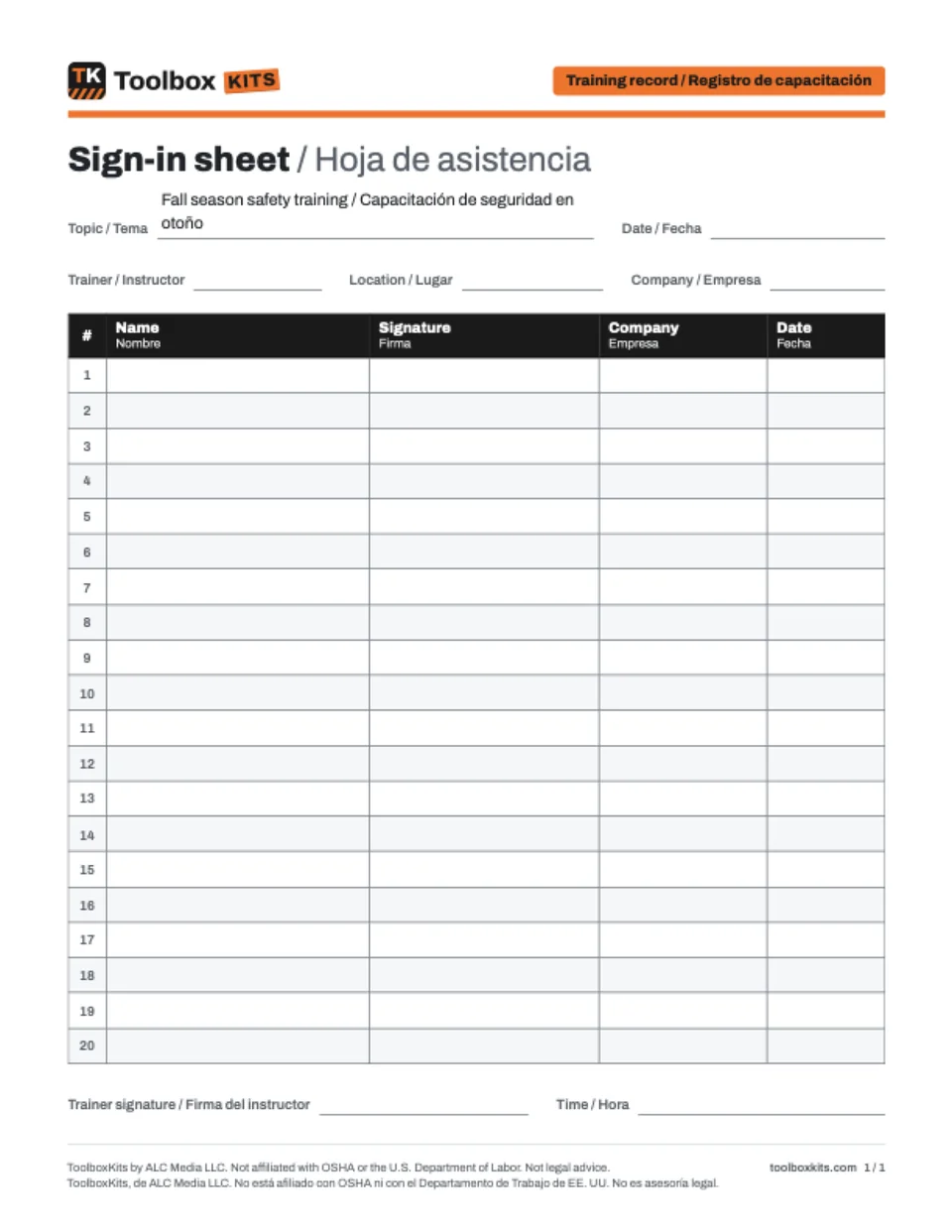 Sign-in sheet
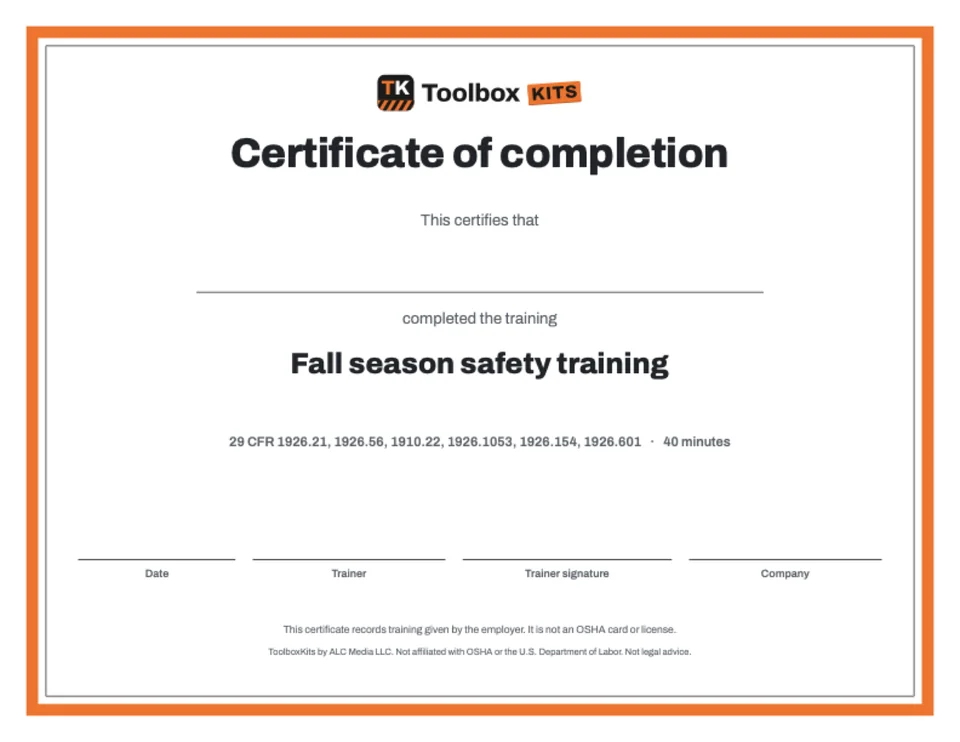 Certificate
- Crew handout
Try it
Try the quiz
Three questions from this topic. Pick an answer to see the right one and the OSHA paragraph.
Question 1 of 3
When must construction work areas be lit to OSHA's minimum levels?
The rule
What OSHA requires
Plain-language summary. Each line links to the exact paragraph of the regulation.
OSHA has no specific standard for fall season hazards; the general duty to train still applies. On construction jobs, the employer must instruct each employee in recognizing and avoiding unsafe conditions and the rules that apply to their work.
“The employer shall instruct each employee in the recognition and avoidance of unsafe conditions and the regulations applicable to his work environment”
Construction areas, ramps, runways, corridors, offices, shops and storage areas must be lit to at least the minimum levels in Table D-3 while any work is in progress.
“shall be lighted to not less than the minimum illumination intensities listed in Table D-3 while any work is in progress”
In general industry, walking-working surfaces must be kept free of hazards such as leaks, spills, snow and ice.
“Walking-working surfaces are maintained free of hazards such as sharp or protruding objects, loose boards, corrosion, leaks, spills, snow, and ice.”
On construction jobsites closed to public traffic, whenever visibility calls for more light, vehicles in use must have at least two headlights and two taillights in operable condition.
“all vehicles, or combinations of vehicles, in use shall be equipped with at least two headlights and two taillights in operable condition”
Construction jobsite vehicles working in conditions that fog or frost the windshield must have operable defogging or defrosting devices.
“Vehicles operating in areas or under conditions that cause fogging or frosting of the windshields shall be equipped with operable defogging or defrosting devices.”
On construction sites where temporary heaters are used, fresh air must be supplied in sufficient quantities to keep workers healthy and safe, with mechanical ventilation where natural fresh air is inadequate.
“Fresh air shall be supplied in sufficient quantities to maintain the health and safety of workmen.”
On construction sites, heaters used near combustible tarps, canvas or similar coverings must be at least 10 feet from them, and the coverings must be securely fastened so wind cannot cause a fire or upset the heater.
“Heaters used in the vicinity of combustible tarpaulins, canvas, or similar coverings shall be located at least 10 feet from the coverings.”
An adequate supply of drinking water must be provided in all places of employment.
“An adequate supply of potable water shall be provided in all places of employment.”
An emergency action plan required by an OSHA standard must include, among other elements, emergency escape procedures and route assignments, a way to account for all employees after evacuation, rescue and medical duties, the preferred way to report fires and other emergencies, and who to contact for more information.
The employer must review with each employee, when first assigned, the parts of the emergency action plan they need to know to protect themselves.
“The employer shall review with each employee upon initial assignment those parts of the plan which the employee must know to protect the employee in the event of an emergency.”
Common questions
Questions people ask
What are good safety meeting topics for September?
Early fall topics include school bus and school zone awareness on the drive in, heat that can linger into early fall, and storm readiness. If you are bringing on new or seasonal workers, walk them through the emergency plan and site rules. This autumn safety moment also works as a September safety talk.
What is a good safety moment for October?
October is a good month to talk about shorter days and site lighting, wet leaves on walkways and ramps, and checking heaters before cold weather. Construction work areas must be lit to at least OSHA's minimum levels while any work is in progress (29 CFR 1926.56(a)). Use this talk's discussion questions to make it about your own site.
What are good safety talk topics for November?
November brings the time change, darker commutes, frost on windshields and walkways, and more temporary heaters. Talk about driving in the dark, clearing frost and leaves, and keeping fresh air flowing where heaters run (29 CFR 1926.154(a)(1)). It is also a good time to plan for holiday travel and winter weather.
What should a daylight saving time safety moment cover?
In most of the United States, clocks fall back in early November, so the evening commute gets dark sooner and sleep can be off for a few days. Remind the crew to slow down, use headlights, watch for pedestrians and deer, and get enough rest. Check that site lighting and vehicle lights work before the early sunsets start.
Is there a fall season safety presentation we can use?
Yes. You can print this autumn safety moment free as a PDF in English and Spanish, with a sign-in sheet, and share it under a Creative Commons BY-NC-SA license with a credit link back to this page. The ToolboxKits fall season training kit adds a PowerPoint deck with trainer notes, a quiz and a handout for a longer autumn safety meeting.
Free to share
Use this talk for free
You can print, share and adapt this talk at no cost under the Creative Commons BY-NC-SA 4.0 license. Please credit ToolboxKits with a link.