

Free 5-minute toolbox talkSeasonal and holidaysEnglish and Spanish
Halloween safety moment: a free toolbox talk
A small cut from carving a pumpkin at the break table still counts. What OSHA requires: OSHA has no specific standard for Halloween safety; the general duty to train still applies. In construction, the employer must instruct each employee in recognizing and avoiding unsafe conditions and the rules that apply to their work environment (29 CFR 1926.21(b)(2)).
A free Halloween safety moment for the shift before the holiday. Read it aloud in about five minutes as a Halloween safety talk, in English or Spanish.
Updated October 29, 2026 · Based on 29 CFR 1926.21
Read it out loud
Free 5-minute toolbox talk
Read it out loud to your crew. It takes about 5 minutes.
Start with a question
What is the scariest thing you could run into at work this Halloween that has nothing to do with ghosts?
Why it matters
Halloween brings costumes, decorations, treats and longer nights. None of that is dangerous on its own. The trouble starts when it mixes with machines, vehicles and busy walkways. A few minutes of thought now keeps the holiday fun and the crew whole.
Key points
Costumes stay off the job unless they are safe
A mask can block your view. A long cape or loose fabric can catch on a machine or a door. Face paint, wigs and props can get in the way of safety glasses, hard hats and gloves.
More
If your crew has a dress-up day, keep the costume simple and never let it replace or interfere with required protective equipment.
Decorations cannot block the way out
Fake cobwebs, hay bales, inflatables and boxes of candy have a way of ending up in hallways and doorways. Keep every exit route clear, even for a short time. Keep decorations away from heaters, lights and hot equipment, and keep fire extinguishers easy to reach.
Watch the road and the dark
Many people are out on foot after dark, and many of them are children in dark costumes. If your drive home or your route for deliveries goes through neighborhoods, slow down and keep your eyes up. Put the phone away. In work zones, make sure signs, lights and reflective vests are working.
No pranks around equipment
A jump scare near a forklift, a ladder or a saw is not a joke. Startled people drop loads, lose their footing and move into the path of machines. Save the scares for after the shift and away from the work area.
Treats and parties have rules too
Check labels before sharing food, because allergies are real and serious. Keep food and drink out of areas where chemicals or dust are present. If any celebration includes alcohol after work, plan a safe ride home before the first drink.
Report it if something goes wrong
A small cut from carving a pumpkin at the break table still counts. Tell your supervisor about injuries and close calls, big or small. You should know how to report them.
Scenario
Picture this: It is the last shift before Halloween. A worker comes in wearing a long, loose costume with a big mask. He climbs onto the loading dock to help move boxes. The mask cuts off his side view, and the cape catches on a pallet jack handle. Nearby, a pile of decorations has been stacked in front of the side door. What should have been done differently, and who could have stopped it?
Ask the crew
- What costume or decoration would be a problem in our area, and why?
- Where are our exits and extinguishers, and is anything in front of them today?
- How do we make sure nobody gets startled around moving equipment?
- What is your plan for getting home safely on Halloween night?
Takeaway
Enjoy Halloween, but keep exits clear, protective equipment on and jokes away from the work.
Trainer: ______________________ Date: ____________
Credit: ToolboxKits, https://toolboxkits.com/topics/halloween-safety/ (CC BY-NC-SA 4.0)
The poster is also inside the paid kits.
Audit-ready records in 60 seconds
Fill in your crew and download a filled sign-in sheet for this talk. Everything is made in your browser. Names are never uploaded or stored.
Start a sign-off
Crew scan a QR code on their own phones, type their name and sign with a finger. You see the names arrive and download the signed sheet. Free, no account.
Kits
Get the kit
No subscription needed. Buy only the kit you need.
Toolbox talk kit
$4.99
- 5-minute talk, English PDF
- 5-minute talk, Spanish PDF
- Editable mini-deck (English and Spanish)
- One-page crew handout (English and Spanish)
- Bilingual sign-in sheet
- 3-question quiz with answer key (English and Spanish)
- One-page bilingual poster
- Audit-ready records in 60 seconds: fill in your crew and get a sign-in sheet and a certificate for every worker
Training kit
$9
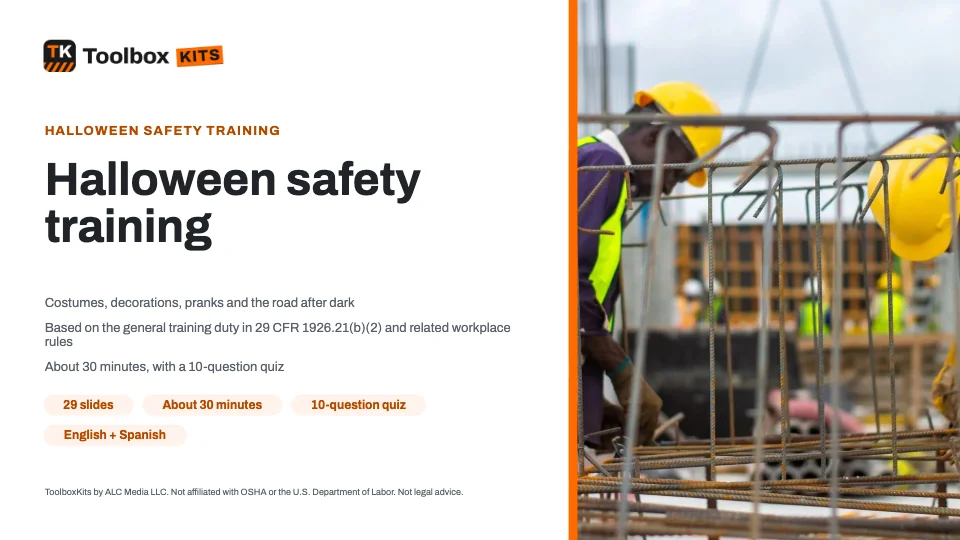
Editable PowerPoint, 29 slides
- Editable PowerPoint with trainer notes on every slide
- Trainer guide PDF with timing and discussion tips
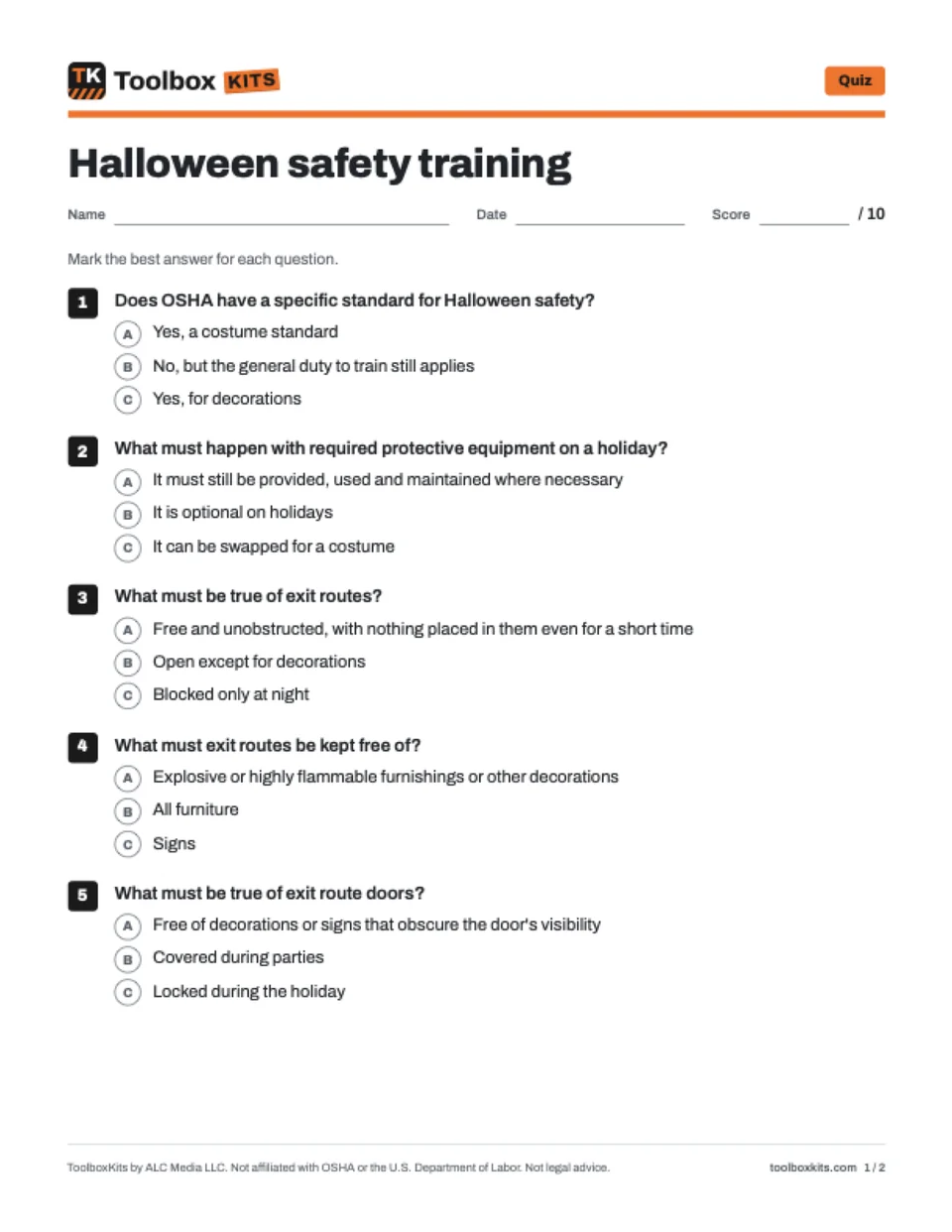
- 10-question quiz and answer key
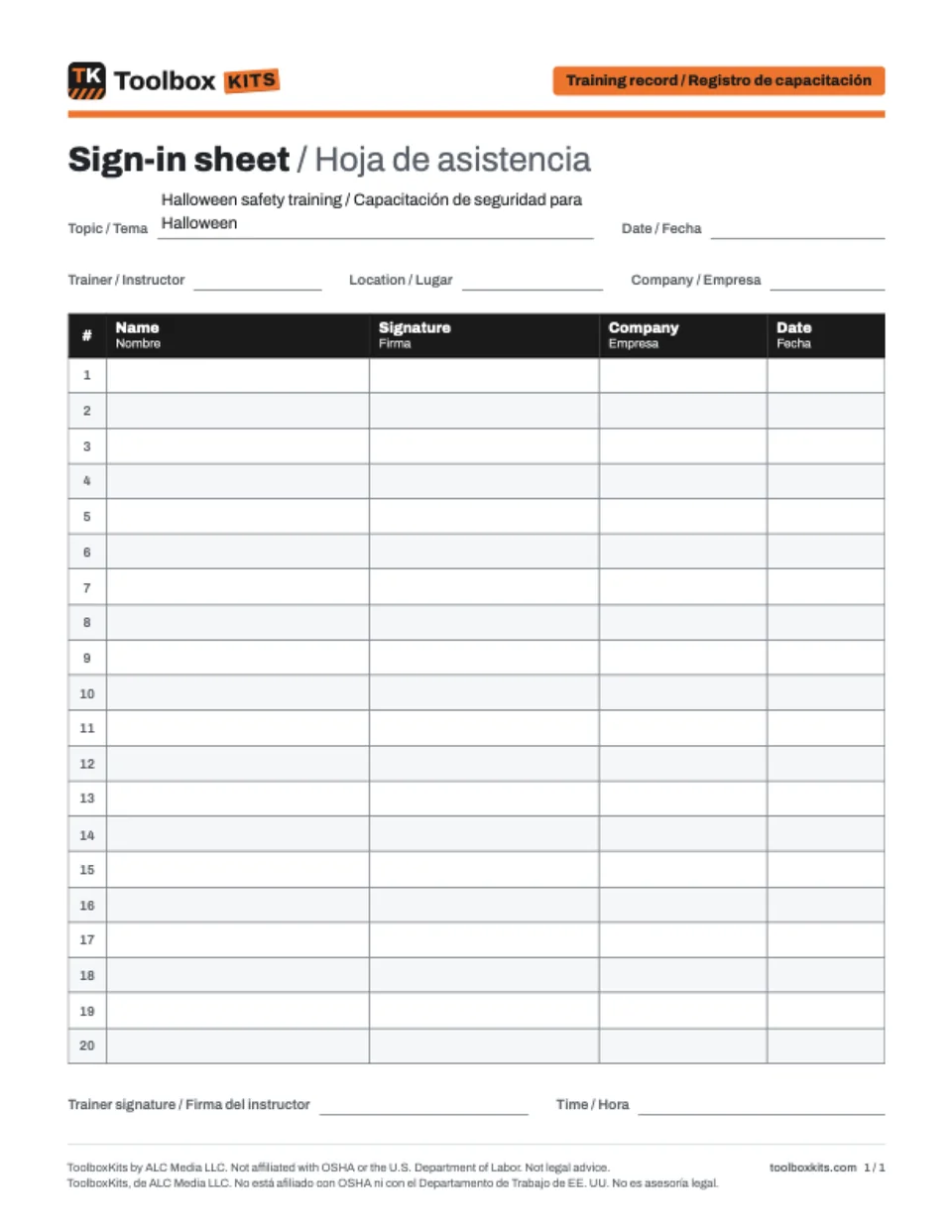
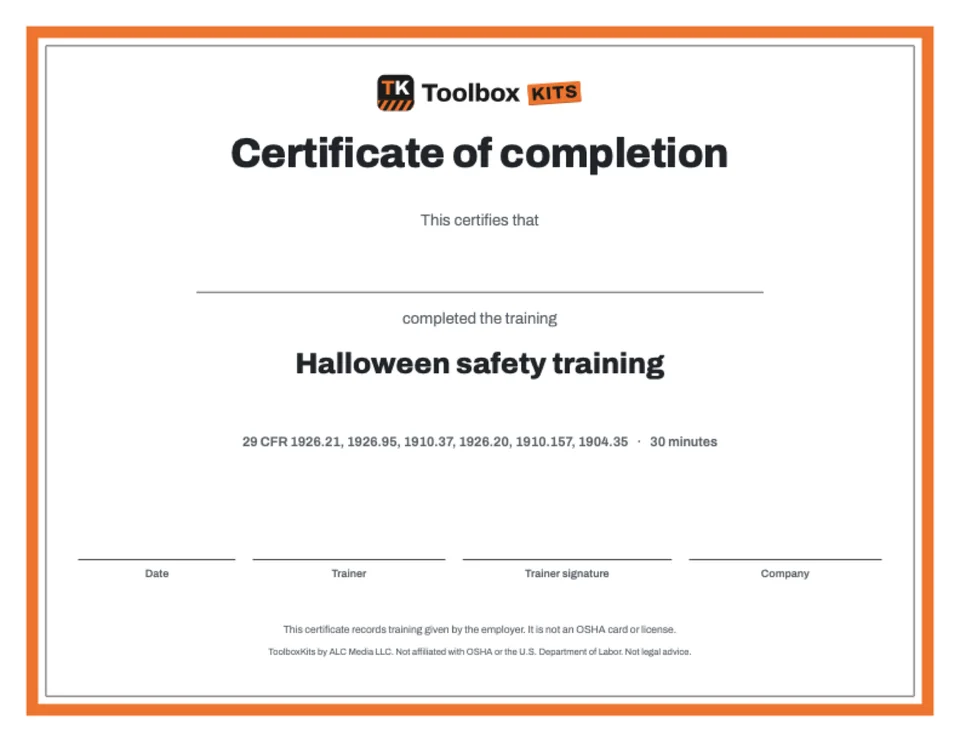
- Sign-in sheet and certificate of completion with fillable fields
- One-page crew handout
- Full Spanish version of everything
- One-page bilingual poster
- Audit-ready records in 60 seconds: fill in your crew and get a sign-in sheet and a certificate for every worker
- Instant download
- Secure checkout by Stripe
- 30-day refund, no questions
Need many topics? All Access gives you every kit for $99 a year.
Inside the kit
See what is in the kit
What is in the kit
 Editable PowerPoint
- Trainer guide
 Quiz
- Answer key
 Sign-in sheet
 Certificate
- Crew handout
Try it
Try the quiz
Three questions from this topic. Pick an answer to see the right one and the OSHA paragraph.
Question 1 of 3
What should you do with a costume that blocks your side vision?
The rule
What OSHA requires
Plain-language summary. Each line links to the exact paragraph of the regulation.
OSHA has no specific standard for Halloween safety; the general duty to train still applies. In construction, the employer must instruct each employee in recognizing and avoiding unsafe conditions and the rules that apply to their work environment.
“The employer shall instruct each employee in the recognition and avoidance of unsafe conditions and the regulations applicable to his work environment to control or eliminate any hazards or other exposure to illness or injury.”
In construction, protective equipment must be provided, used and maintained in reliable condition wherever it is necessary because of the hazards of the job or the environment. Nothing you wear or carry for a holiday replaces required protective equipment.
“Protective equipment, including personal protective equipment for eyes, face, head, and extremities, protective clothing, respiratory devices, and protective shields and barriers, shall be provided, used, and maintained in a sanitary and reliable condition wherever it is necessary”
In general industry, exit routes must be free and unobstructed. Nothing may be placed in an exit route, even for a short time, so keep decorations, tables, coolers and deliveries out of hallways and doorways that lead out.
“No materials or equipment may be placed, either permanently or temporarily, within the exit route.”
In general industry, portable fire extinguishers must be mounted, located and identified so employees can reach them easily. Do not let decorations, stacked boxes or party supplies block them.
“mount, locate and identify them so that they are readily accessible to employees without subjecting the employees to possible injury.”
In construction, the safety program must provide for frequent and regular inspections of job sites, materials and equipment by competent persons the employer designates. A walk of the site after a holiday or a change in routine is a good use of that duty.
“Such programs shall provide for frequent and regular inspections of the job sites, materials, and equipment to be made by competent persons designated by the employers.”
Employers must tell each employee how to report work-related injuries and illnesses. Know that procedure, and use it for small injuries and close calls too.
“You must inform each employee of your procedure for reporting work-related injuries and illnesses;”
Common questions
Questions people ask
What is a good Halloween safety moment for work?
Pick one or two hazards that fit your crew: costumes that block vision or catch on equipment, decorations that block exits, or driving near trick-or-treaters after dark. Keep it to about five minutes and end with a question for the group. This free talk is ready to read aloud.
Is there a Halloween safety talk I can use for a meeting?
Yes. This page is a free Halloween safety talk with an opening question, key points, a scenario and discussion questions. You can print it or read it from a phone, in English or Spanish.
What topics belong in a Halloween safety meeting?
Good topics are safe costumes, clear exits and extinguishers, fire risk from decorations, driving after dark, no pranks near equipment, food allergies and a safe ride home. Choose the ones that match your worksite.
Is there a Halloween safety presentation I can use?
The free talk on this page works as a short spoken presentation. For slides, a trainer guide, a quiz and a sign-in sheet, order the training kit or request a custom one.
Does OSHA have a rule about Halloween or costumes at work?
OSHA has no specific standard for Halloween. The general duty to train still applies, and protective equipment must still be used wherever it is needed, so a costume can never replace it.
Free to share
Use this talk for free
You can print, share and adapt this talk at no cost under the Creative Commons BY-NC-SA 4.0 license. Please credit ToolboxKits with a link.