

Free 5-minute toolbox talkCranes and riggingEnglish and Spanish
Rigging toolbox talk: slings, hitches and safe lifts
If the rigging fails or the load shifts, it can drop or swing without warning, and the riggers and signal people closest to it can be hit or crushed. What OSHA requires: Rigging equipment for material handling must be inspected before use on each shift and as necessary during use to make sure it is safe (29 CFR 1926.251(a)(1)).
A free rigging toolbox talk on inspecting slings, rigging the load right and staying clear of it. Read it aloud in about five minutes as a rigging safety talk before your next lift.
Updated October 29, 2026 · Based on 29 CFR 1926.251, 29 CFR 1910.184, 29 CFR 1926.1404
Read it out loud
Free 5-minute toolbox talk
Read it out loud to your crew. It takes about 5 minutes.
Start with a question
When did you last read the tag on a sling before you hooked it up?
Why it matters
Rigging is the gear and the work that connect a load to a crane or hoist: slings, shackles, hooks and the hitches you make with them. If the rigging fails or the load shifts, it can drop or swing without warning, and the riggers and signal people closest to it can be hit or crushed. Many rigging problems can be spotted on the ground, before the lift starts.
Key points
Inspect every piece before you use it
Rigging equipment must be inspected before use on each shift and as needed during use, and defective gear must be removed from service. On web slings, look for cuts, snags, burns, melted or charred spots, and broken or worn stitches.
More
On wire rope, look for broken wires, kinks, crushing and corrosion. If you are not sure a piece is safe, take it out of service and tell your supervisor.
Read the tag and know the weight
Rigging must carry legible markings showing its safe working load, and it must not be loaded beyond that load or used without the markings. Find out what the load weighs before you rig it.
More
The hitch and the sling angle change what a sling can hold: the flatter the angle, the more tension each leg carries.
Rig it right
Pad or protect slings from the sharp edges of the load. Balance loads in a basket hitch so they cannot slip, never shorten a sling with knots, bolts or other makeshift devices, and do not let sling legs kink.
More
Use hooks with latches that close, and check that the load is secure before it leaves the ground.
29 CFR 1926.251(c)(9) · 29 CFR 1926.251(c)(9) and 1910.184(c)(7) · 29 CFR 1926.251(c)(6) to (c)(8)
Keep your hands out of the pinch
Never put your hands or fingers between the sling and the load while the sling is being tightened. Guide loads with a tag line instead of your hands. Do not pull a sling out from under a load that is resting on it, and take up slack smoothly, because shock loading is prohibited.
29 CFR 1926.251(c)(10) · 29 CFR 1926.251(c)(12) · 29 CFR 1926.251(c)(11)
Stay out from under the load
Never stand or walk under a suspended load, and keep your eyes on it the whole time it moves. In general industry, all employees must be kept clear of loads about to be lifted and of suspended loads.
More
On construction crane jobs, when workers hooking, unhooking or guiding a load are in the fall zone, the materials must be rigged by a qualified rigger.
29 CFR 1910.184(c)(9) · 29 CFR 1926.1425(c)(3)
One signal person, and anyone can call stop
Agree on the signals before the lift starts. On construction jobs, only one person may give signals to a crane at a time, but anyone who sees a safety problem must give the stop or emergency stop signal. The operator must obey a stop signal no matter who gives it.
29 CFR 1926.1419(j) · 29 CFR 1926.1419(h) · 29 CFR 1926.1417(y)
Scenario
Picture this: A crew is lifting a bundle of steel pipe with a nylon web sling in a basket hitch. Nobody padded the sharp ends of the pipe, the sling tag is worn and hard to read, and a laborer reaches in to straighten the sling just as the operator takes up the slack. Two people are giving the operator hand signals at the same time. What should the crew have done before this lift started?
Ask the crew
- Who inspects our slings and shackles, and where does gear go when it fails?
- How do we find out what a load weighs before we rig it?
- Where are the sharp edges and pinch points on the loads we lift most?
- Who gives signals on our lifts, and how does anyone call a stop?
Takeaway
Inspect the gear, know the weight, rig it right, and keep your hands and body out of the load's path.
Trainer: ______________________ Date: ____________
Credit: ToolboxKits, https://toolboxkits.com/topics/rigging/ (CC BY-NC-SA 4.0)
The poster is also inside the paid kits.
Audit-ready records in 60 seconds
Fill in your crew and download a filled sign-in sheet for this talk. Everything is made in your browser. Names are never uploaded or stored.
Start a sign-off
Crew scan a QR code on their own phones, type their name and sign with a finger. You see the names arrive and download the signed sheet. Free, no account.
Kits
Get the kit
No subscription needed. Buy only the kit you need.
Toolbox talk kit
$4.99
- 5-minute talk, English PDF
- 5-minute talk, Spanish PDF
- Editable mini-deck (English and Spanish)
- One-page crew handout (English and Spanish)
- Bilingual sign-in sheet
- 3-question quiz with answer key (English and Spanish)
- One-page bilingual poster
- Audit-ready records in 60 seconds: fill in your crew and get a sign-in sheet and a certificate for every worker
Training kit
$9
Editable PowerPoint, 31 slides
- Editable PowerPoint with trainer notes on every slide
- Trainer guide PDF with timing and discussion tips
- 10-question quiz and answer key
- Sign-in sheet and certificate of completion with fillable fields
- One-page crew handout
- Full Spanish version of everything
- One-page bilingual poster
- Audit-ready records in 60 seconds: fill in your crew and get a sign-in sheet and a certificate for every worker
- Instant download
- Secure checkout by Stripe
- 30-day refund, no questions
Need many topics? All Access gives you every kit for $99 a year.
Inside the kit
See what is in the kit
What is in the kit
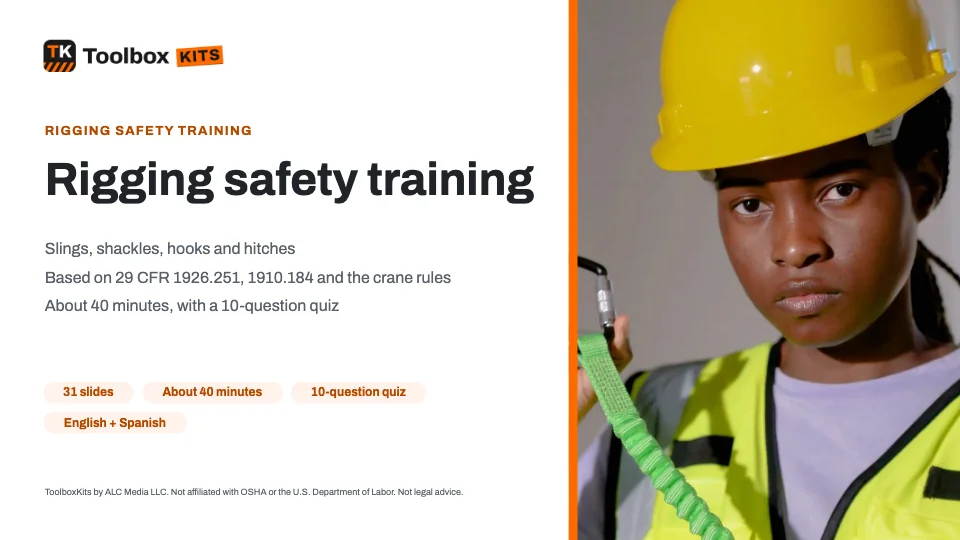 Editable PowerPoint
- Trainer guide
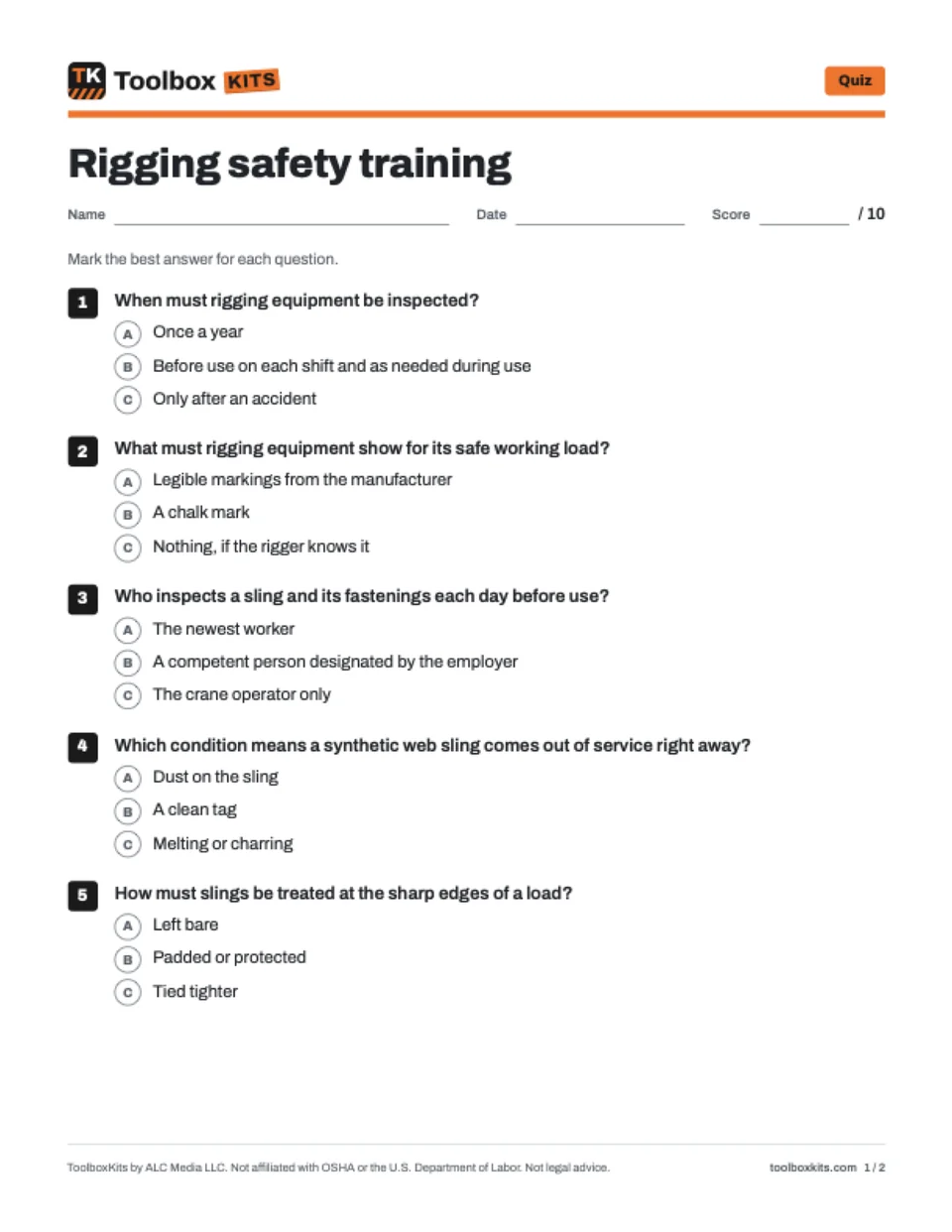 Quiz
- Answer key
 Sign-in sheet
 Certificate
- Crew handout
Try it
Try the quiz
Three questions from this topic. Pick an answer to see the right one and the OSHA paragraph.
Question 1 of 3
When must rigging equipment be inspected?
The rule
What OSHA requires
Plain-language summary. Each line links to the exact paragraph of the regulation.
Rigging equipment for material handling must be inspected before use on each shift and as necessary during use to make sure it is safe. Defective rigging equipment must be removed from service.
“Rigging equipment for material handling shall be inspected prior to use on each shift and as necessary during its use to ensure that it is safe.”
Rigging equipment must have permanently affixed, legible identification markings as prescribed by the manufacturer that show the recommended safe working load. It must not be loaded beyond that load, and it must not be used without those markings.
Each day before use, a competent person designated by the employer must inspect the sling and all fastenings and attachments for damage or defects. More inspections are needed during use where service conditions warrant, and damaged or defective slings must be removed from service right away.
“Each day before being used, the sling and all fastenings and attachments shall be inspected for damage or defects by a competent person designated by the employer.”
Synthetic web slings must be removed from service right away if they show acid or caustic burns, melting or charring, snags, punctures, tears or cuts, broken or worn stitches, or distorted fittings.
“Synthetic web slings shall be immediately removed from service if any of the following conditions are present”
Slings must be padded or protected from the sharp edges of their loads.
“Slings shall be padded or protected from the sharp edges of their loads.”
Hands or fingers must not be placed between the sling and its load while the sling is being tightened around the load.
“Hands or fingers shall not be placed between the sling and its load while the sling is being tightened around the load.”
In general industry, whenever a sling is used, it must not be damaged or defective, shortened with knots or bolts, kinked, or loaded beyond its rated capacity. It must be securely attached to its load and padded or protected from the load's sharp edges, and a load in a basket hitch must be balanced to prevent slippage.
“Whenever any sling is used, the following practices shall be observed”
In general industry, all employees must be kept clear of loads about to be lifted and of suspended loads.
“All employees shall be kept clear of loads about to be lifted and of suspended loads.”
On construction crane work, when employees hooking, unhooking or guiding a load, or making its initial connection, are within the fall zone, the materials must be rigged to prevent unintentional displacement, hooks with self-closing latches or their equivalent must be used (J hooks are allowed for setting wooden trusses), and the materials must be rigged by a qualified rigger.
When rigging is used for crane assembly or disassembly, the employer must ensure the rigging work is done by a qualified rigger. Under OSHA's crane rules, a qualified rigger is a rigger who meets the criteria for a qualified person (29 CFR 1926.1401).
“The rigging work is done by a qualified rigger.”
Common questions
Questions people ask
Is there a printable rigging toolbox talk PDF?
Yes. This rigging safety toolbox talk is free to print as a PDF in English and Spanish, with a sign-in table for your crew. It also works as a lifting and rigging safety toolbox talk before crane picks, hoisting jobs or steel deliveries.
What OSHA rules should a rigging toolbox talk cover?
Start with inspection and rated loads. In construction, rigging equipment must be inspected before use on each shift, and defective gear must be removed from service (29 CFR 1926.251(a)(1)). Rigging must also carry legible markings that show its safe working load, and it must not be loaded beyond that load (29 CFR 1926.251(a)(2)). The general industry rules for slings are in 29 CFR 1910.184.
What should a sling safety toolbox talk cover?
Cover how to read sling tags, what damage takes a sling out of service, how to protect slings from sharp edges, and how the hitch and angle change what a sling can hold. In general industry, whenever a sling is used, it must not be shortened with knots or bolts, kinked, or loaded beyond its rated capacity (29 CFR 1910.184(c)). Finish by inspecting a few of your own slings together.
What rigging training does OSHA require?
In construction, the employer must instruct each employee in recognizing and avoiding unsafe conditions and the rules that apply to their work (29 CFR 1926.21(b)(2)). On crane work, rigging for assembly and disassembly, and loads that workers hook, unhook or guide while inside the fall zone, must be rigged by a qualified rigger (29 CFR 1926.1404(r)(1) and 1926.1425(c)(3)). A qualified rigger is a rigger who meets the criteria for a qualified person (29 CFR 1926.1401).
Is there a lifting and rigging safety training PPT?
This free talk is written to be read aloud, so you do not need slides. For a longer lifting and rigging safety presentation, the paid training kit for this topic is an editable PowerPoint in English and Spanish with trainer notes, a quiz and a sign-in sheet. If the kit is not ready to buy yet, you can request it from this page.
Free to share
Use this talk for free
You can print, share and adapt this talk at no cost under the Creative Commons BY-NC-SA 4.0 license. Please credit ToolboxKits with a link.