

Free 5-minute toolbox talkCranes and riggingEnglish and Spanish
Overhead crane safety toolbox talk
An overhead crane moves heavy loads right over our heads. A dropped load, a swinging load, a failed brake or a bad rope can hurt or kill someone below. What OSHA requires: Only designated personnel may operate an overhead or gantry crane (29 CFR 1910.179(b)(8)).
A free overhead crane safety talk for shops, warehouses and plants that use bridge cranes and hoists. Read it aloud in about five minutes before the first lift of the shift.
Updated October 29, 2026 · Based on 29 CFR 1910.179
Read it out loud
Free 5-minute toolbox talk
Read it out loud to your crew. It takes about 5 minutes.
Start with a question
When you last used the overhead crane, did you check the hook, the limit switch and the path below the load?
Why it matters
An overhead crane moves heavy loads right over our heads. A dropped load, a swinging load, a failed brake or a bad rope can hurt or kill someone below. Much of your protection comes from checks and habits that take a few minutes: knowing the rated load, rigging well, testing before you lift and keeping people out from under the load.
Key points
Only designated operators run the crane
Only designated personnel may operate an overhead or gantry crane. Learn the controls, the warning signals and the rated load for the exact crane you use. If you are not designated, you do not run it. Ask your supervisor if you are not sure.
Inspect and test before you lift
Look at the hook for deformation and cracks, at the chain and rope for wear, kinks and broken wires, and at the operating mechanisms and air or hydraulic lines for leaks. Hooks need a visual inspection daily and a monthly inspection with a certification record.
More
At the beginning of each operator's shift, the upper limit switch of each hoist must be tried out under no load. If anything is wrong, stop and tell your supervisor.
29 CFR 1910.179(b)(4)(i) · 29 CFR 1910.179(j)(2)(iii) · 29 CFR 1910.179(n)(4)(i)
Know the rated load and never exceed it
The rated load is marked on the crane and must be clearly legible from the floor. The crane must not be loaded past its rated load except for test purposes. Know the weight of the load before you pick it up, and count the weight of the hook, the sling and any attachments.
29 CFR 1910.179(n)(1) · 29 CFR 1910.179(b)(5)
Rig it right before it leaves the floor
Attach the load to the hook with slings or other approved devices. The hoist rope or chain must be free of kinks or twists and must not be wrapped around the load. The load must be well secured and properly balanced before it is lifted more than a few inches.
More
Lift a few inches, check it and test the brakes before you go further.
29 CFR 1910.179(n)(3)(i) · 29 CFR 1910.179(n)(2)(ii) · 29 CFR 1910.179(n)(2)(i)
Keep people out from under the load
The employer must require the operator to avoid carrying loads over people. No one may ride on the load or hook while hoisting, lowering or traveling. Use the warning signal when the crane travels, plan the path ahead and clear it before the lift.
29 CFR 1910.179(b)(vi) · 29 CFR 1910.179(n)(3)(vi) · 29 CFR 1910.179(n)(3)(v)
Move smoothly and plan for swing
Avoid sudden starts and stops, which make the load swing. Bring the hook directly over the load before you lift, and keep the load clear of obstructions. Never use the upper limit switch as an operating control. If two cranes lift one load, one qualified, responsible person must be in charge.
29 CFR 1910.179(n)(4)(ii) · 29 CFR 1910.179(n)(3)(ix)
Scenario
Picture this: An operator is moving a steel part across the shop. The load is a little off center, the sling is twisted around the hook and a coworker is walking along the aisle the load will pass over. The operator starts and stops quickly, and the load swings. What should he have done differently?
Ask the crew
- Who on this site is designated to operate the crane?
- What do you check on the crane at the start of the shift?
- How do we keep people out from under the load?
- What would we do if a load got stuck or the crane stopped mid-lift?
Takeaway
Check the crane, know the load, rig it right and keep everyone out from under it.
Trainer: ______________________ Date: ____________
Credit: ToolboxKits, https://toolboxkits.com/topics/overhead-cranes/ (CC BY-NC-SA 4.0)
The poster is also inside the paid kits.
Audit-ready records in 60 seconds
Fill in your crew and download a filled sign-in sheet for this talk. Everything is made in your browser. Names are never uploaded or stored.
Start a sign-off
Crew scan a QR code on their own phones, type their name and sign with a finger. You see the names arrive and download the signed sheet. Free, no account.
Kits
Get the kit
No subscription needed. Buy only the kit you need.
Toolbox talk kit
$4.99
- 5-minute talk, English PDF
- 5-minute talk, Spanish PDF
- Editable mini-deck (English and Spanish)
- One-page crew handout (English and Spanish)
- Bilingual sign-in sheet
- 3-question quiz with answer key (English and Spanish)
- One-page bilingual poster
- Audit-ready records in 60 seconds: fill in your crew and get a sign-in sheet and a certificate for every worker
Training kit
$9
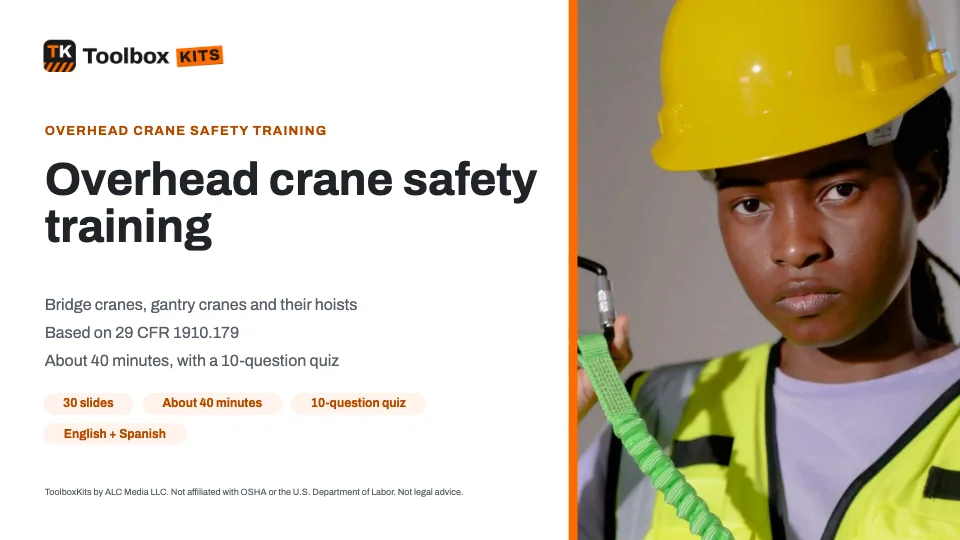
Editable PowerPoint, 30 slides
- Editable PowerPoint with trainer notes on every slide
- Trainer guide PDF with timing and discussion tips
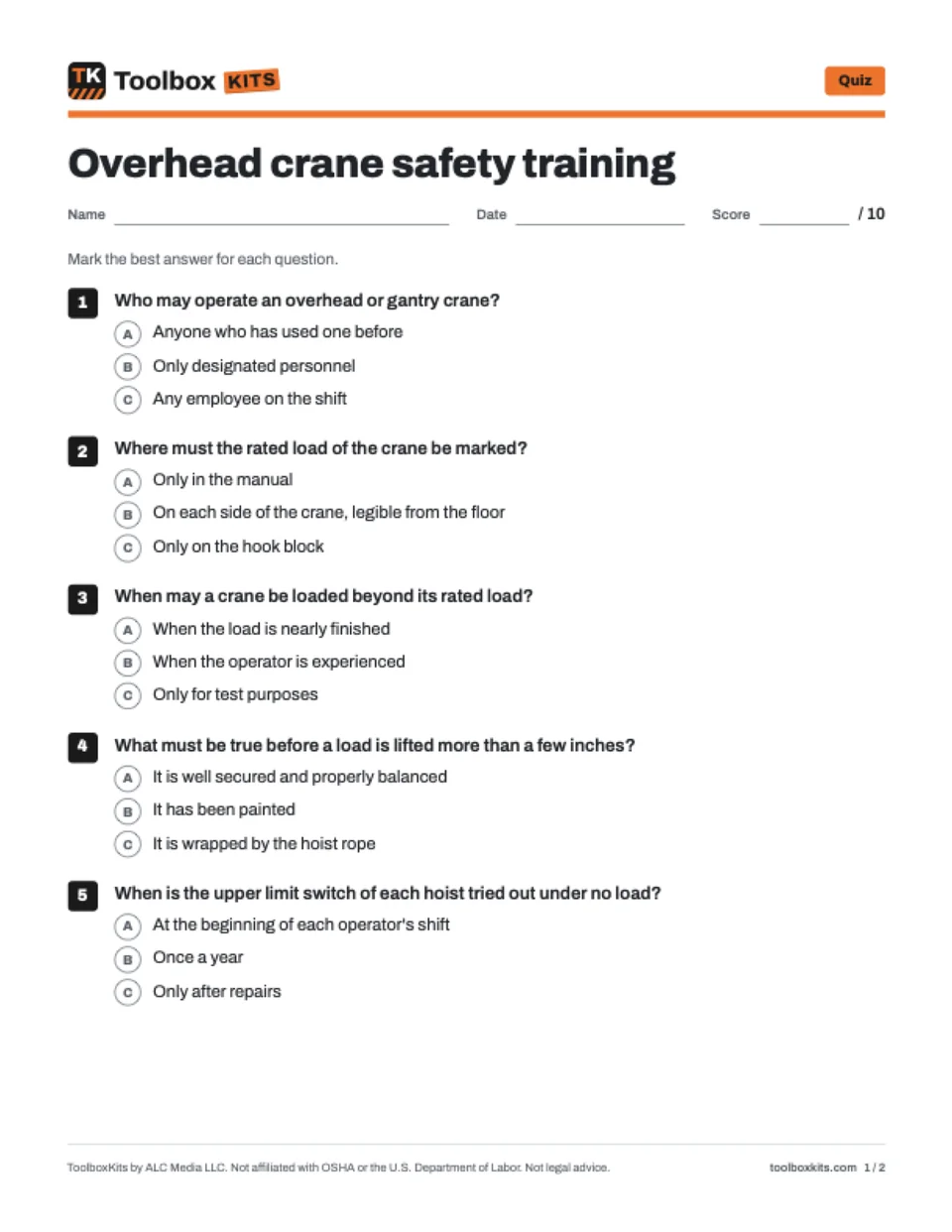
- 10-question quiz and answer key
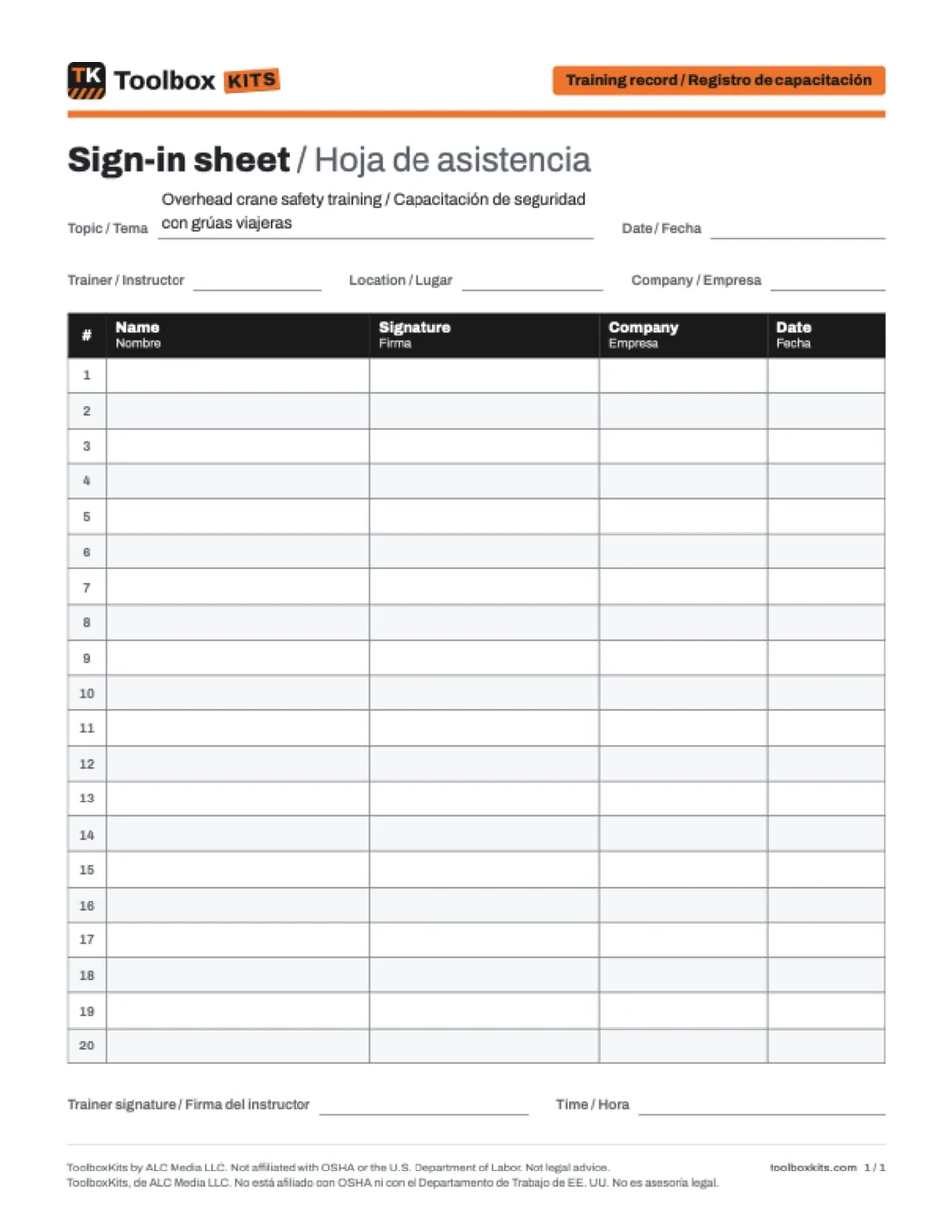
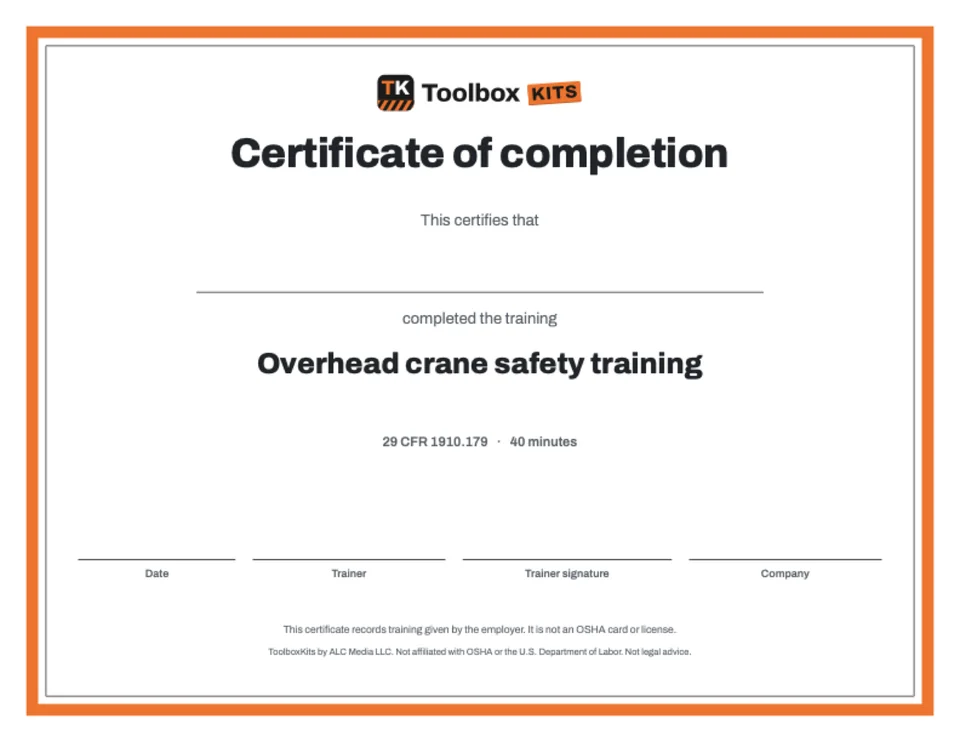
- Sign-in sheet and certificate of completion with fillable fields
- One-page crew handout
- Full Spanish version of everything
- One-page bilingual poster
- Audit-ready records in 60 seconds: fill in your crew and get a sign-in sheet and a certificate for every worker
- Instant download
- Secure checkout by Stripe
- 30-day refund, no questions
Need many topics? All Access gives you every kit for $99 a year.
Inside the kit
See what is in the kit
What is in the kit
 Editable PowerPoint
- Trainer guide
 Quiz
- Answer key
 Sign-in sheet
 Certificate
- Crew handout
Try it
Try the quiz
Three questions from this topic. Pick an answer to see the right one and the OSHA paragraph.
Question 1 of 3
Who may operate an overhead crane?
The rule
What OSHA requires
Plain-language summary. Each line links to the exact paragraph of the regulation.
Only designated personnel may operate an overhead or gantry crane.
“Only designated personnel shall be permitted to operate a crane covered by this section.”
The rated load of the crane must be plainly marked on each side of the crane, and the marking must be clearly legible from the ground or floor.
“The rated load of the crane shall be plainly marked on each side of the crane”
The crane must not be loaded past its rated load, except for test purposes.
“The crane shall not be loaded beyond its rated load except for test purposes as provided in paragraph (k) of this section.”
The load must be well secured and properly balanced in the sling or lifting device before it is lifted more than a few inches.
“The load shall be well secured and properly balanced in the sling or lifting device before it is lifted more than a few inches.”
At the beginning of each operator's shift, the upper limit switch of each hoist must be tried out under no load.
“At the beginning of each operator's shift, the upper limit switch of each hoist shall be tried out under no load.”
The employer must require the operator to avoid carrying loads over people.
“The employer shall require that the operator avoid carrying loads over people.”
While any employee is on the load or hook, there must be no hoisting, lowering or traveling.
“While any employee is on the load or hook, there shall be no hoisting, lowering, or traveling.”
The operator must test the brakes each time a load approaching the rated load is handled, by raising the load a few inches and applying the brakes.
“The operator shall test the brakes each time a load approaching the rated load is handled.”
All hoisting ropes must be thoroughly inspected at least once a month, with a certification record kept on file.
“A thorough inspection of all ropes shall be made at least once a month”
Who must be trained
Only designated personnel may operate an overhead or gantry crane (29 CFR 1910.179(b)(8)). OSHA's general industry rules do not say more about operator training in the cited text, so follow the crane manufacturer's instructions and your employer's program.

Common questions
Questions people ask
Is there a printable overhead crane safety toolbox talk PDF?
Yes. This overhead crane safety toolbox talk is free to print as a PDF in English and Spanish, with a sign-in table for your crew. Read it aloud in about five minutes before the first lift, and keep the signed sheet with your safety records.
Who is allowed to operate an overhead crane?
Only designated personnel may operate an overhead or gantry crane (29 CFR 1910.179(b)(8)). The employer decides who is designated. Designated operators should be trained on the crane, its controls and its warning signals before they run it.
What should be inspected on an overhead crane?
Frequent inspections (29 CFR 1910.179(j)(2)) include daily checks of operating mechanisms, air or hydraulic lines and hooks, and the hoist upper limit switch is tried at the start of each operator's shift. Ropes need a thorough inspection at least monthly with a certification record (29 CFR 1910.179(m)(1)). Complete periodic inspections follow the schedule in 29 CFR 1910.179(j)(3).
Is there overhead crane or hoist safety training PowerPoint?
This free talk is written to be read aloud, so you do not need slides. For a longer overhead crane or hoist safety session, the paid training kit for this topic is an editable PowerPoint in English and Spanish with trainer notes, a quiz and a sign-in sheet. If the kit is not ready to buy yet, you can request it from this page. Slides do not replace hands-on training on your crane.
Can a crane carry a load over people?
The employer must require the operator to avoid carrying loads over people, and no hoisting, lowering or traveling is allowed while anyone is on the load or hook (29 CFR 1910.179(n)(3)(v) and (vi)). Plan the path, use the warning signal and clear people from the area before the lift.
Free to share
Use this talk for free
You can print, share and adapt this talk at no cost under the Creative Commons BY-NC-SA 4.0 license. Please credit ToolboxKits with a link.