

Free 5-minute toolbox talkCranes and riggingEnglish and Spanish
Crane safety toolbox talk
The operator is not the only one at risk: riggers, signal persons, laborers and anyone walking by can be struck, crushed or caught under a load. What OSHA requires: The construction crane rules cover power-operated equipment that can hoist, lower and horizontally move a suspended load when used in construction (29 CFR 1926.1400(a)).
A free 5-minute crane safety talk for crews who work on or around cranes. It covers the swing radius, the fall zone, signals, power lines, inspections and who may operate, with the OSHA rule behind each point.
Updated October 29, 2026 · Based on 29 CFR 1926.1400, 29 CFR 1926.1427, 29 CFR 1910.179
Read it out loud
Free 5-minute toolbox talk
Read it out loud to your crew. It takes about 5 minutes.
Start with a question
If our crane swung all the way around right now, could it hit or pin anyone?
Why it matters
Cranes lift and swing heavy loads near workers and power lines, often on ground that can shift. When something goes wrong, it happens fast. The operator is not the only one at risk: riggers, signal persons, laborers and anyone walking by can be struck, crushed or caught under a load.
Key points
Stay out of the swing radius
The turning upper part of a crane can strike you or pin you against another object. In construction, the employer must mark this hazard area with control lines, warning lines, railings or similar barriers. Do not cross the barrier unless your job requires it.
More
Before you enter a spot in that area the operator cannot see, make sure the operator knows.
29 CFR 1926.1424(a)(2)(ii) · 29 CFR 1926.1424(a)(3)(i)
Never stand under a load
The fall zone is wherever a load could fall if something fails, not just the spot below it. In construction, while a suspended load is not being moved, only workers hooking, unhooking or guiding it, making its first connection, or working a concrete hopper or bucket may be in the fall zone.
More
When a load is being landed, only the workers needed to receive it may be there. Everyone else walks around, never under.
29 CFR 1926.1425(b) · 29 CFR 1926.1425(d)
One signal person, but anyone can call stop
In construction, a signal person must be provided when the operator cannot fully see the load's path or landing spot. Only one person may give signals at a time, so leave signaling to the person assigned.
More
The exception is stop: anyone who sees a safety problem must give the stop or emergency stop signal, and the operator must obey it no matter who gives it.
29 CFR 1926.1419(j) · 29 CFR 1926.1419(a)(1) · 29 CFR 1926.1419(h) · 29 CFR 1926.1417(y)
Treat every power line as live
In construction, power lines must be treated as energized unless the utility confirms they are deenergized and visibly grounded at the site.
More
If the crane, load line or load could get closer than 20 feet to a power line, the employer must have the line deenergized and grounded or keep a set clearance, using measures such as a warning line and a dedicated spotter. If a crane ever touches a line, stay away from the machine and the load, and keep others back.
29 CFR 1926.1408(a)(2) · 29 CFR 1926.1408(e) · 29 CFR 1926.1408(b)
Check the crane every shift
In construction, a competent person must begin a visual inspection before each shift the crane will be used. It covers items such as controls, hooks and latches, wire rope, hydraulic lines, the ground under the outriggers and the safety devices.
More
If the competent person finds a problem is a safety hazard, the crane must come out of service until it is fixed. If you spot a damaged latch, a frayed rope or soft ground near an outrigger, tell the operator.
29 CFR 1926.1412(d)(1) · 29 CFR 1926.1412(d)(2)
Only qualified people run the crane
In construction, with a few exceptions, each operator must be trained, certified or licensed, and evaluated before running a crane. Until then, a worker may only operate as an operator-in-training, continuously monitored by a trainer.
More
In general industry, only designated personnel may operate an overhead or gantry crane. Never take the controls just because you have seen it done.
29 CFR 1926.1427(a) · 29 CFR 1926.1427(b)(2) · 29 CFR 1910.179(b)(8)
Scenario
Picture this: A mobile crane is setting roof trusses. The barricade behind the crane was moved for a delivery and never put back. A laborer cuts behind the crane to grab a tool, out of the operator's view, just as the operator starts to swing. Meanwhile, two workers are both waving signals at the operator. What should have happened, and who could have stopped it?
Ask the crew
- Where is the swing radius on our crane today, and is it barricaded?
- Who is our signal person, and what does the emergency stop signal look like?
- How close could our boom or load get to a power line today?
- What would you do if you saw a frayed rope or soft ground near an outrigger?
Takeaway
Stay out of the swing radius and the fall zone, follow one signal person, and call stop the moment something looks wrong.
Trainer: ______________________ Date: ____________
Credit: ToolboxKits, https://toolboxkits.com/topics/cranes/ (CC BY-NC-SA 4.0)
The poster is also inside the paid kits.
Audit-ready records in 60 seconds
Fill in your crew and download a filled sign-in sheet for this talk. Everything is made in your browser. Names are never uploaded or stored.
Start a sign-off
Crew scan a QR code on their own phones, type their name and sign with a finger. You see the names arrive and download the signed sheet. Free, no account.
Kits
Get the kit
No subscription needed. Buy only the kit you need.
Toolbox talk kit
$4.99
- 5-minute talk, English PDF
- 5-minute talk, Spanish PDF
- Editable mini-deck (English and Spanish)
- One-page crew handout (English and Spanish)
- Bilingual sign-in sheet
- 3-question quiz with answer key (English and Spanish)
- One-page bilingual poster
- Audit-ready records in 60 seconds: fill in your crew and get a sign-in sheet and a certificate for every worker
Training kit
$9
Editable PowerPoint, 35 slides
- Editable PowerPoint with trainer notes on every slide
- Trainer guide PDF with timing and discussion tips
- 10-question quiz and answer key
- Sign-in sheet and certificate of completion with fillable fields
- One-page crew handout
- Full Spanish version of everything
- One-page bilingual poster
- Audit-ready records in 60 seconds: fill in your crew and get a sign-in sheet and a certificate for every worker
- Instant download
- Secure checkout by Stripe
- 30-day refund, no questions
Need many topics? All Access gives you every kit for $99 a year.
Inside the kit
See what is in the kit
What is in the kit
 Editable PowerPoint
- Trainer guide
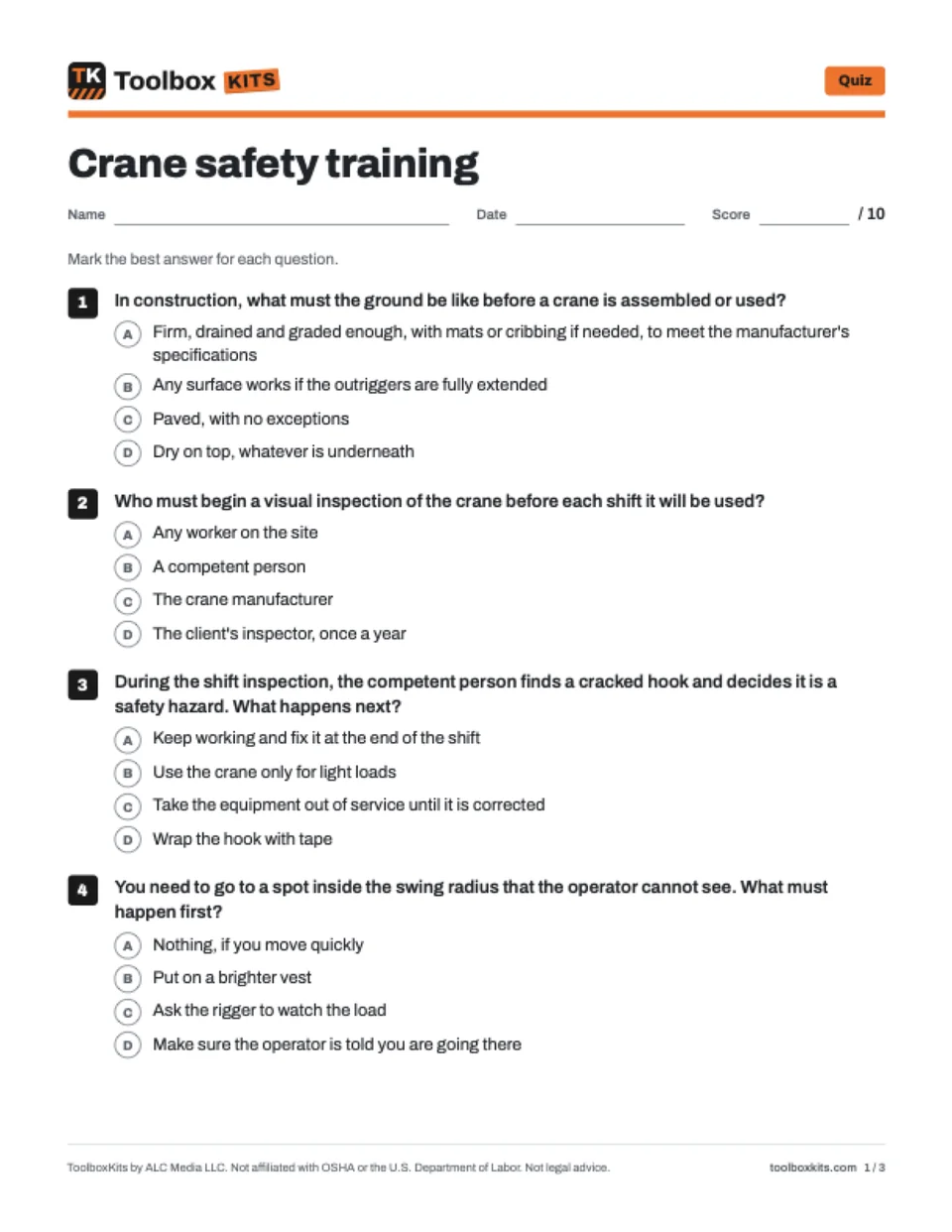 Quiz
- Answer key
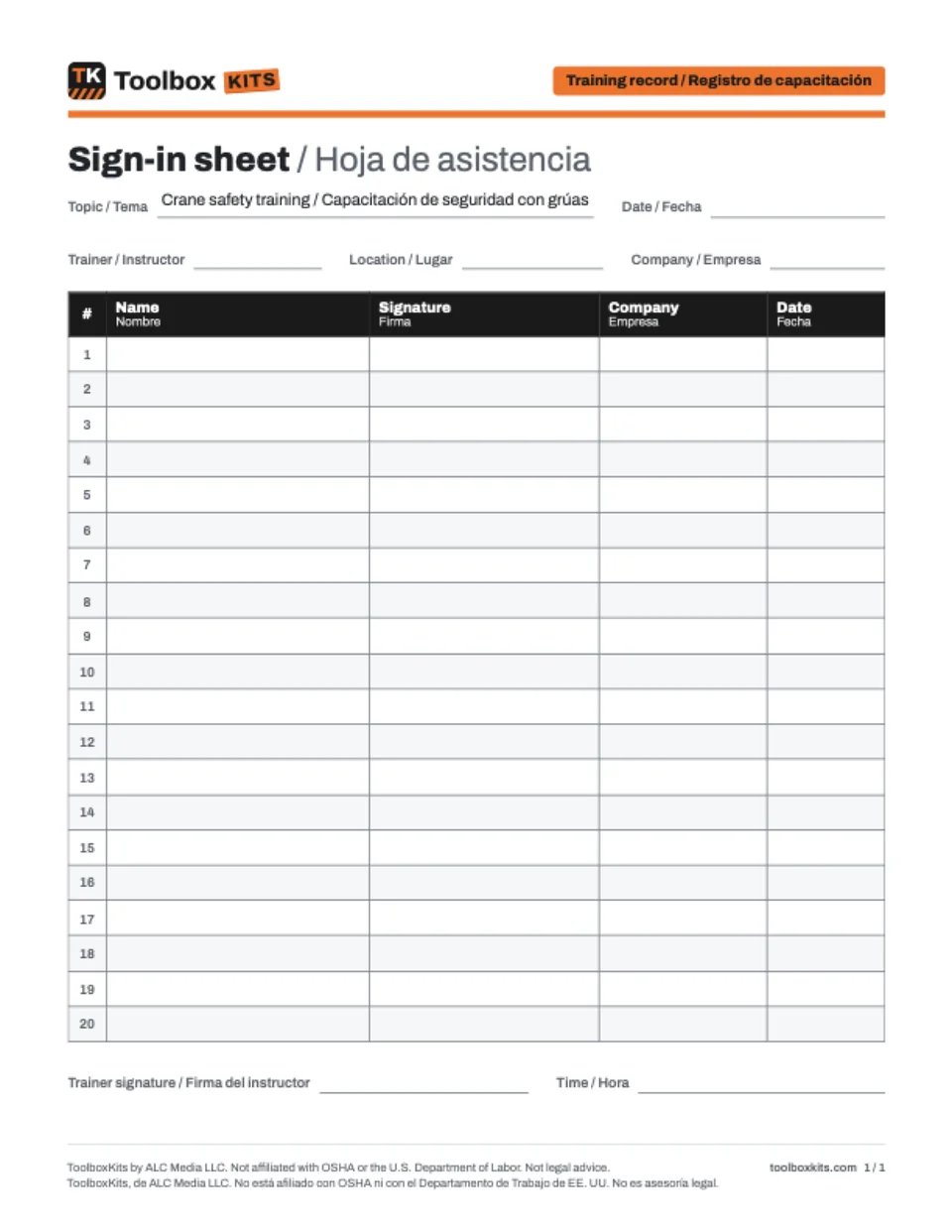 Sign-in sheet
 Certificate
- Crew handout
Try it
Try the quiz
Three questions from this topic. Pick an answer to see the right one and the OSHA paragraph.
Question 1 of 3
In construction, who may be in the fall zone while a suspended load is not being moved?
The rule
What OSHA requires
Plain-language summary. Each line links to the exact paragraph of the regulation.
The construction crane rules cover power-operated equipment that can hoist, lower and horizontally move a suspended load when used in construction. That includes mobile, crawler, tower, overhead and gantry cranes, boom truck cranes and similar equipment, with listed exclusions.
“This standard applies to power-operated equipment, when used in construction, that can hoist, lower and horizontally move a suspended load.”
Erect and maintain control lines, warning lines, railings or similar barriers to mark the swing and crush hazard areas around the crane's rotating superstructure. If barriers are not feasible on the ground or on the equipment, mark the areas with warning signs and high-visibility markings instead.
“Erect and maintain control lines, warning lines, railings or similar barriers to mark the boundaries of the hazard areas.”
Before a worker goes to a spot in the hazard area that is out of the operator's view, the worker, or someone the worker asks, must make sure the operator is told.
“the employee (or someone instructed by the employee) must ensure that the operator is informed that he/she is going to that location”
While a suspended load is not being moved, no one may be in the fall zone except workers hooking, unhooking or guiding the load, making its initial attachment to a component or structure, or operating a concrete hopper or bucket.
“While the operator is not moving a suspended load, no employee must be within the fall zone”
Anyone who becomes aware of a safety problem must alert the operator or signal person by giving the stop or emergency stop signal, and the operator must obey it.
“Anyone who becomes aware of a safety problem must alert the operator or signal person by giving the stop or emergency stop signal.”
Assume every power line is energized unless the utility owner or operator confirms it has been and continues to be deenergized and visibly grounded at the worksite.
“The employer must assume that all power lines are energized unless the utility owner/operator confirms that the power line has been and continues to be deenergized and visibly grounded at the worksite.”
Before equipment operations begin, determine whether any part of the equipment, load line or load could get closer than 20 feet to a power line when operated up to its maximum working radius. If it could, the line must be deenergized and grounded, or a set clearance must be kept using the required precautions.
“could get closer than 20 feet to a power line”
A competent person must begin a visual inspection before each shift the equipment will be used and complete it before or during that shift. It includes items such as controls, hydraulic lines, hooks and latches, wire rope, tires, ground conditions, level and safety devices.
“A competent person must begin a visual inspection prior to each shift the equipment will be used, which must be completed before or during that shift.”
Each operator must be trained, certified or licensed, and evaluated before operating equipment covered by the construction crane rules. Operators of derricks, sideboom cranes and equipment rated at 2,000 pounds or less follow training rules in other sections instead (29 CFR 1926.1427(a)(2)).
“The employer must ensure that each operator is trained, certified/licensed, and evaluated in accordance with this section before operating any equipment covered under subpart CC”
In general industry, only designated personnel may operate an overhead or gantry crane.
“Only designated personnel shall be permitted to operate a crane covered by this section.”
Who must be trained
In construction, each employee assigned to work on or near a crane must be trained to recognize the struck-by and pinch/crush hazard areas of the rotating superstructure (29 CFR 1926.1424(a)(2)(i)), and each employee who works with the equipment must be trained to keep clear of holes and crush/pinch points (29 CFR 1926.1430(e)). Each operator and crew member assigned to work with the equipment must be trained on power line safety topics (29 CFR 1926.1408(g)(1)). Operators must be trained, certified or licensed, and evaluated (29 CFR 1926.1427(a)), and each signal person must meet the qualification requirements before giving any signals (29 CFR 1926.1428(a)). Training required by the crane rules must be provided at no cost to the employee (29 CFR 1926.1430(g)(3)).
When to retrain
Operators must be retrained in relevant topics when their performance or an evaluation of their knowledge indicates retraining is necessary, and then re-evaluated on the subject of the retraining (29 CFR 1926.1427(b)(5) and (f)(7)). Any employee trained under the crane rules must get refresher training in relevant topics when their conduct or an evaluation of their knowledge indicates retraining is necessary (29 CFR 1926.1430(g)(2)).

Common questions
Questions people ask
Is there a printable crane safety toolbox talk PDF?
Yes. This crane safety talk is free, and you can print it as a PDF in English or Spanish with a sign-in table. Read it aloud in about five minutes before crane work starts, and keep the signed sheet with your safety records.
What should a working around cranes toolbox talk cover?
Cover the swing radius and its barriers, staying out of the fall zone, who gives signals and how anyone can call stop, power line clearance, and what the shift inspection looks for. In construction, the employer must train each employee assigned to work on or near a crane to recognize the struck-by and pinch/crush hazard areas created by its rotating superstructure.
Is there a crane safety PowerPoint presentation for training?
The free talk on this page is made to be read aloud from a printout, so you do not need a projector. If you want slides for a longer crane safety presentation, use the training kit option on this page. For a series of short crane safety meetings, good topics are the swing radius, the fall zone, signals, power lines, ground conditions and shift inspections.
What training does OSHA require for mobile crane operators?
In construction, the employer must make sure each crane operator, including mobile crane operators, is trained, certified or licensed, and evaluated before operating, with a few exceptions (29 CFR 1926.1427(a)(2)). Until then, a worker may only operate as an operator-in-training, continuously monitored by a trainer (29 CFR 1926.1427(b)(2)). Certification or licensing, and any required training, must be provided at no cost to the employee (29 CFR 1926.1427(c)(3) and 1926.1430(g)(3)).
Who can operate a gantry or overhead crane?
In general industry, only designated personnel may operate an overhead or gantry crane covered by 29 CFR 1910.179. Designated means selected or assigned by the employer or the employer's representative as being qualified to perform specific duties (29 CFR 1910.179(a)(35)). The rated load must be plainly marked on each side of the crane, and the crane must not be loaded beyond it except for test purposes (29 CFR 1910.179(b)(5) and (n)(1)).
Free to share
Use this talk for free
You can print, share and adapt this talk at no cost under the Creative Commons BY-NC-SA 4.0 license. Please credit ToolboxKits with a link.