

Free 5-minute toolbox talkErgonomics and liftingEnglish and Spanish
Lifting safety toolbox talk: safe lifting and manual handling
One bad lift can strain your back, and a dropped load can crush fingers or toes. What OSHA requires: OSHA has no specific standard for manual lifting. In construction, the general duty to instruct each worker in recognizing and avoiding unsafe conditions still applies (29 CFR 1926.21(b)(2)).
A five-minute lifting and manual handling talk for your crew. It covers planning the lift, using equipment or a partner, safe lifting technique, protecting hands and feet, and stacking materials so they stay put.
Updated October 29, 2026 · Based on 29 CFR 1926.21
Read it out loud
Free 5-minute toolbox talk
Read it out loud to your crew. It takes about 5 minutes.
Start with a question
What is the heaviest or most awkward thing you will move today, and how are you going to move it?
Why it matters
We lift, carry, push and pull materials by hand all day. One bad lift can strain your back, and a dropped load can crush fingers or toes. Even light loads add up when you move them all shift with poor technique. Planning the move takes a moment and can save you a lot of pain.
Key points
Size up the load and the path
Before you lift, check the weight, the shape and where you can get a good grip. Look for sharp edges, splinters and nails, and tip one corner to test the weight. Clear your path of debris and tripping hazards before you pick anything up.
More
In construction, aisles and passageways must be kept clear for the safe movement of workers and material handling equipment.
Get help from equipment or a partner
Use carts, dollies, hand trucks, pallet jacks or hoists whenever you can, and let the equipment take the weight. Run powered equipment such as a forklift only if you are trained and authorized. If a load is too heavy or awkward for one person, get a partner.
More
For a team lift, pick one leader who calls the lift so everyone lifts and sets down together.
Lift with your legs and keep it close
Stand close to the load with your feet about shoulder width apart. Bend at your hips and knees, keep your back straight and get a firm grip. Tighten your stomach muscles and lift smoothly with your legs, keeping the load close to your body. Do not jerk the load.
Do not twist, and set it down with care
Turn by moving your feet, not by twisting your back. If the load blocks your view, get help or use equipment. Set the load down the way you picked it up, bending your knees and keeping your fingers clear. If you feel a pull or pain, stop and tell your supervisor.
Protect your hands and feet
Wear gloves that fit and suit the load, and safety-toe boots where loads can drop or roll.
More
In general industry, employers must select and require hand protection when hands are exposed to hazards such as severe cuts, abrasions or punctures, and must make sure protective footwear is used where falling or rolling objects can injure feet. In construction, the employer must require appropriate PPE wherever workers are exposed to hazardous conditions, and used lumber must have all nails withdrawn before stacking.
29 CFR 1910.138(a) · 29 CFR 1910.136(a) · 29 CFR 1926.28(a) · 29 CFR 1926.250(b)(8)(i)
Stack materials so they stay put
Materials stored in tiers must be stacked and secured so they will not slide or collapse, in construction and in general industry.
More
In construction, bagged materials must be stacked by stepping back the layers and cross-keying the bags at least every 10 bags high, and lumber that will be handled manually must not be stacked more than 16 feet high. Store heavy items at about waist height when you can, so the next person does not have to lift from the floor.
29 CFR 1926.250(a)(1) · 29 CFR 1910.176(b) · 29 CFR 1926.250(b)(4) · 29 CFR 1926.250(b)(8)(iv)
Scenario
Picture this: a pallet of bagged mortar arrives late in the day. To save time, a worker grabs two bags at once, bends at the waist and twists to toss them onto a pile by the mixer. The pile is getting tall and starting to lean, and a hand truck sits unused by the gate. What could go wrong here, and how should the crew move and stack the rest?
Ask the crew
- Which loads on this job are too heavy or awkward for one person?
- Where are the carts, dollies and hoists, and what keeps us from using them?
- How will we call a team lift so everyone lifts and sets down together?
- Which stacks or storage areas here need fixing before someone pulls from them?
Takeaway
Plan every lift, let equipment or a partner take heavy loads, and keep the load close without twisting.
Trainer: ______________________ Date: ____________
Credit: ToolboxKits, https://toolboxkits.com/topics/manual-material-handling/ (CC BY-NC-SA 4.0)
The poster is also inside the paid kits.
Audit-ready records in 60 seconds
Fill in your crew and download a filled sign-in sheet for this talk. Everything is made in your browser. Names are never uploaded or stored.
Start a sign-off
Crew scan a QR code on their own phones, type their name and sign with a finger. You see the names arrive and download the signed sheet. Free, no account.
Kits
Get the kit
No subscription needed. Buy only the kit you need.
Toolbox talk kit
$4.99
- 5-minute talk, English PDF
- 5-minute talk, Spanish PDF
- Editable mini-deck (English and Spanish)
- One-page crew handout (English and Spanish)
- Bilingual sign-in sheet
- 3-question quiz with answer key (English and Spanish)
- One-page bilingual poster
- Audit-ready records in 60 seconds: fill in your crew and get a sign-in sheet and a certificate for every worker
Training kit
$9
Editable PowerPoint, 38 slides
- Editable PowerPoint with trainer notes on every slide
- Trainer guide PDF with timing and discussion tips
- 10-question quiz and answer key
- Sign-in sheet and certificate of completion with fillable fields
- One-page crew handout
- Full Spanish version of everything
- One-page bilingual poster
- Audit-ready records in 60 seconds: fill in your crew and get a sign-in sheet and a certificate for every worker
- Instant download
- Secure checkout by Stripe
- 30-day refund, no questions
Need many topics? All Access gives you every kit for $99 a year.
Inside the kit
See what is in the kit
What is in the kit
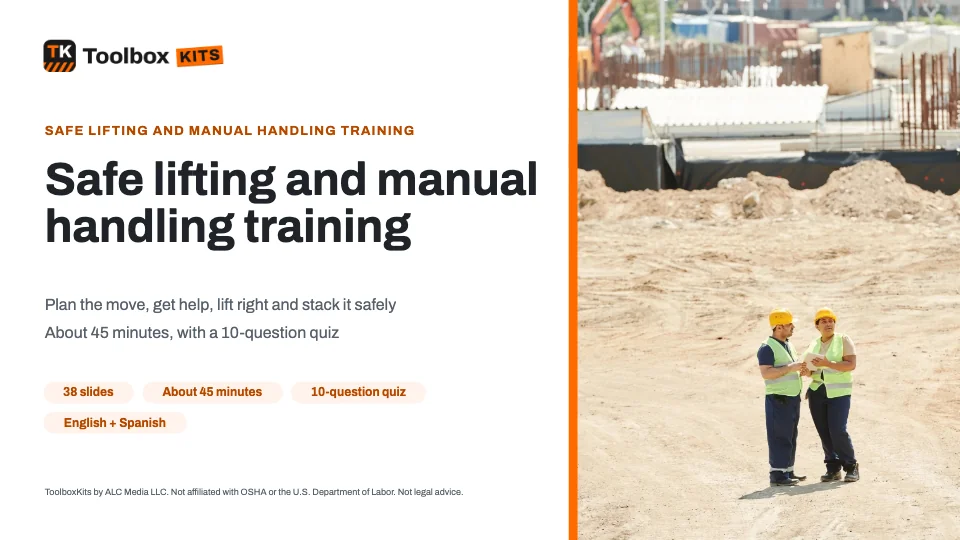 Editable PowerPoint
- Trainer guide
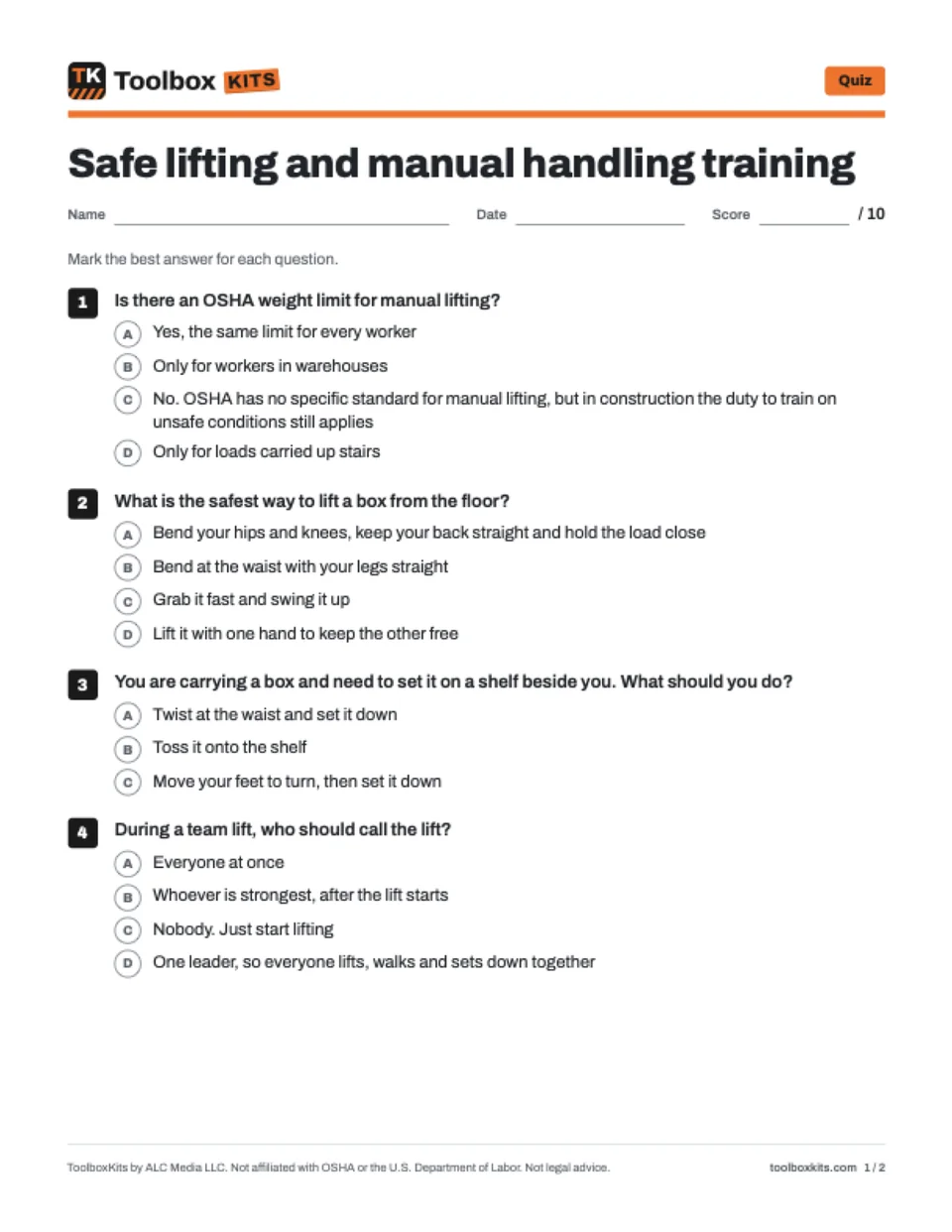 Quiz
- Answer key
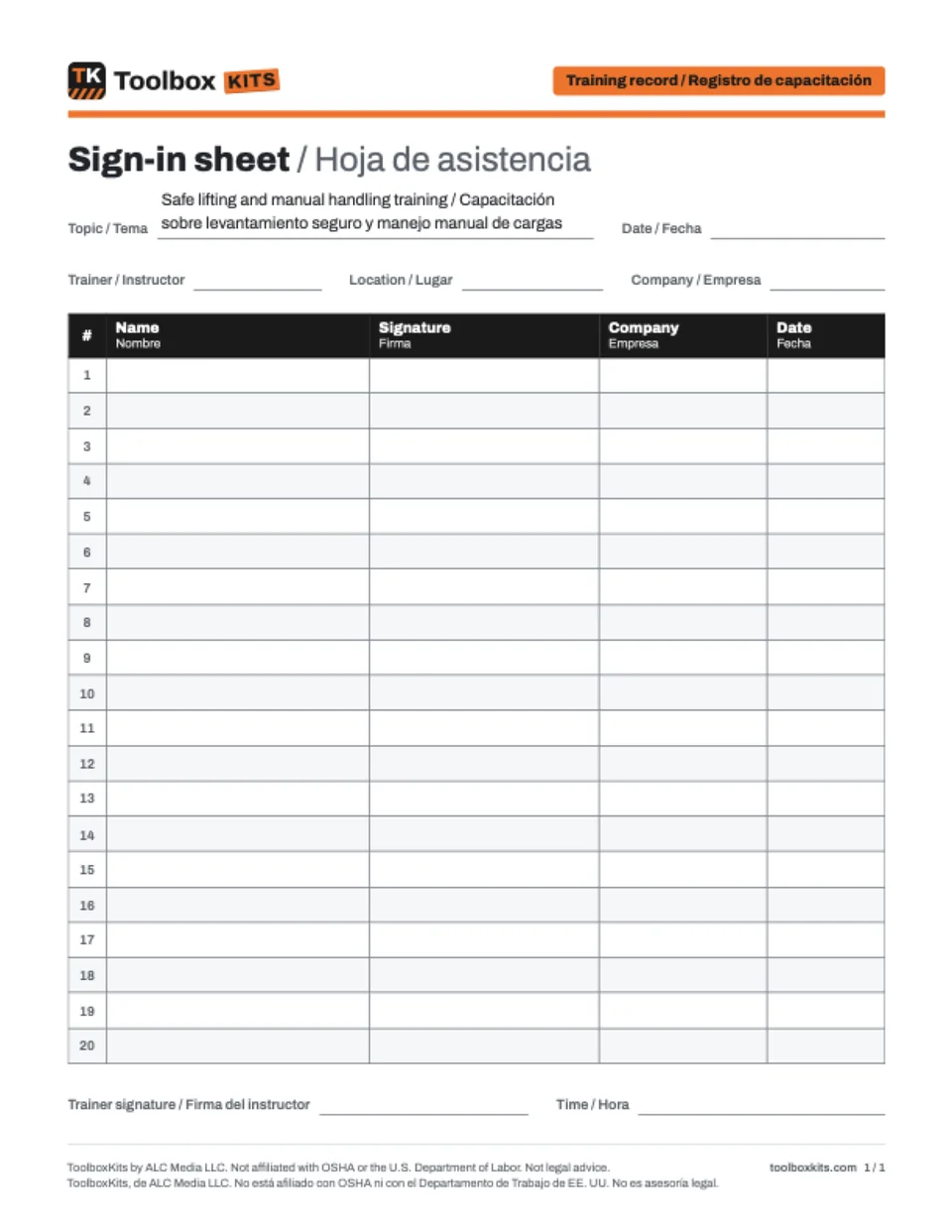 Sign-in sheet
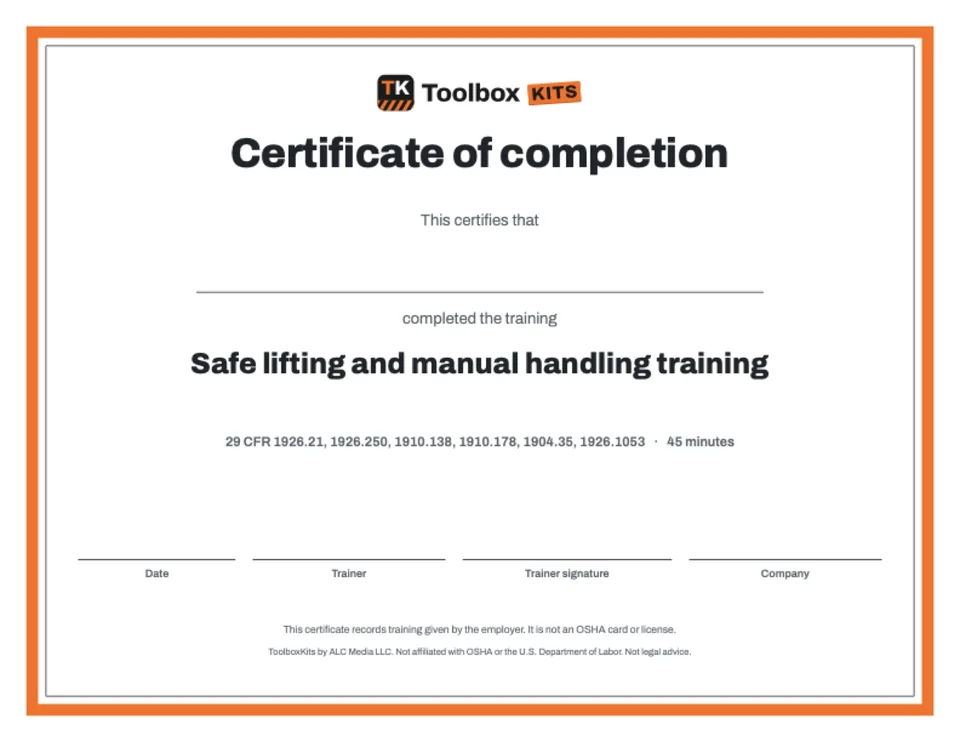 Certificate
- Crew handout
Try it
Try the quiz
Three questions from this topic. Pick an answer to see the right one and the OSHA paragraph.
Question 1 of 3
What is the safest way to lift a box from the floor?
The rule
What OSHA requires
Plain-language summary. Each line links to the exact paragraph of the regulation.
OSHA has no specific standard for manual lifting. In construction, the general duty to instruct each worker in recognizing and avoiding unsafe conditions still applies.
“The employer shall instruct each employee in the recognition and avoidance of unsafe conditions and the regulations applicable to his work environment”
Construction: all materials stored in tiers must be stacked, racked, blocked, interlocked or otherwise secured to prevent sliding, falling or collapse.
“All materials stored in tiers shall be stacked, racked, blocked, interlocked, or otherwise secured to prevent sliding, falling or collapse.”
General industry: storage must not create a hazard, and bags, containers and bundles stored in tiers must be stacked, blocked, interlocked and limited in height so they are stable and secure against sliding or collapse.
“Bags, containers, bundles, etc., stored in tiers shall be stacked, blocked, interlocked and limited in height so that they are stable and secure against sliding or collapse.”
Construction: bagged materials must be stacked by stepping back the layers and cross-keying the bags at least every 10 bags high.
“Bagged materials shall be stacked by stepping back the layers and cross-keying the bags at least every 10 bags high.”
Construction: lumber piles must not be more than 20 feet high, and lumber that will be handled manually must not be stacked more than 16 feet high.
“Lumber piles shall not exceed 20 feet in height provided that lumber to be handled manually shall not be stacked more than 16 feet high.”
Construction: aisles and passageways must be kept clear for the free and safe movement of material handling equipment or workers, and kept in good repair.
“Aisles and passageways shall be kept clear to provide for the free and safe movement of material handling equipment or employees.”
General industry: employers must select and require appropriate hand protection when hands are exposed to hazards such as severe cuts or lacerations, severe abrasions or punctures.
“Employers shall select and require employees to use appropriate hand protection when employees' hands are exposed to hazards”
General industry: the employer must make sure each affected worker uses protective footwear in areas where there is a danger of foot injuries from falling or rolling objects or objects piercing the sole.
“The employer shall ensure that each affected employee uses protective footwear when working in areas where there is a danger of foot injuries due to falling or rolling objects”
Construction: the employer must require workers to wear appropriate personal protective equipment wherever they are exposed to hazardous conditions.
“The employer is responsible for requiring the wearing of appropriate personal protective equipment in all operations where there is an exposure to hazardous conditions”
Under OSHA's injury and illness recordkeeping rule, the employer must set up a reasonable procedure for workers to report work-related injuries and illnesses promptly and accurately, and may not fire or discriminate against a worker for reporting (29 CFR 1904.35(b)(1)(iv)).
“You must establish a reasonable procedure for employees to report work-related injuries and illnesses promptly and accurately.”
Common questions
Questions people ask
Is there a printable lifting safety toolbox talk PDF?
Yes. This lifting and manual handling talk is free to print as a PDF in English and Spanish, with a sign-in table for your crew. For a quick lifting safety moment, read the scenario and ask one discussion question before the crew starts moving material.
What is a safe manual lifting technique?
Stand close with your feet about shoulder width apart, bend at the hips and knees, and keep your back straight. Get a firm grip, tighten your stomach muscles and lift smoothly with your legs, keeping the load close. Turn with your feet instead of twisting, and set the load down the same way you picked it up. If the load is too heavy or awkward, use equipment or get a partner.
Is there an OSHA weight limit for heavy lifting?
No. OSHA has no specific standard that sets a weight limit for manual lifting. In construction, the general duty to instruct each employee in recognizing and avoiding unsafe conditions still applies. Plan heavy lifts around equipment or a partner instead of a number.
What is the difference between manual and mechanical material handling?
Manual handling means moving a load with your body: lifting, carrying, pushing or pulling it by hand. Mechanical handling uses equipment such as carts, dollies, hand trucks, hoists or forklifts to take the weight. Use mechanical help whenever it is available, and only run powered equipment you are trained and authorized to use.
Is there a lifting safety training PowerPoint?
This talk is written to be read aloud, so you do not need slides. For a longer back and lifting safety session, the paid training kit for this topic is an editable PowerPoint in English and Spanish with trainer notes, a quiz and a sign-in sheet. If the kit is not ready to buy yet, you can request it from this page.
Free to share
Use this talk for free
You can print, share and adapt this talk at no cost under the Creative Commons BY-NC-SA 4.0 license. Please credit ToolboxKits with a link.