

Free 5-minute toolbox talkErgonomics and liftingEnglish and Spanish
Back safety toolbox talk: lifting and back injury prevention
A back injury can follow you home. It can make it hard to work, drive, sleep and play with your kids. A back injury does not always come from one big lift. What OSHA requires: OSHA has no specific standard for manual lifting or back injuries (29 CFR 1926.21(b)(2)).
A free back injury prevention toolbox talk for crews that lift, carry, bend and reach. Read it aloud in about five minutes as a back safety talk before the shift starts.
Updated October 29, 2026 · Based on 29 CFR 1926.21
Read it out loud
Free 5-minute toolbox talk
Read it out loud to your crew. It takes about 5 minutes.
Start with a question
When did you last lift something and feel your back complain the next morning?
Why it matters
A back injury can follow you home. It can make it hard to work, drive, sleep and play with your kids. A back injury does not always come from one big lift. It can build up from small habits repeated all day, like twisting, reaching and lifting from the floor. OSHA has no specific standard for manual lifting or back injuries, so this talk is about good habits and about your employer's duty to train you on the hazards of your job.
Key points
Plan the lift before you touch it
Look at the load and the path. Is the way clear? Is there a spot ready to set it down? Check for handles, slippery floors and doorways. If you cannot see a clear path from start to finish, fix that first.
More
Where mechanical handling equipment is used, aisles and passageways must be kept clear, with nothing across them that could create a hazard.
Test the weight and get help
Push the load with your foot or hands before you lift. If it feels too heavy or too awkward, do not be a hero. Ask a coworker or use a cart, hand truck, dolly or hoist. Long, wide or shifting loads usually need two people.
Lift with your legs, load close to your body
Stand close, feet apart, one foot slightly forward. Bend your knees, keep your back in its natural curve and grip firmly. Hold the load close to your belt. Lift smoothly with your legs. Jerking and fast moves put extra strain on your back.
Do not twist
Turn your whole body by moving your feet. Do not twist at the waist while you hold a load. Lift, then step, then set down. Keep your nose and toes pointing the same way.
Store things where they are safe to reach
Heavy items belong between your knees and your shoulders, not on the floor or on the top shelf. Storage must not create a hazard, and materials stored in tiers must be stacked, racked, blocked or interlocked so they cannot slide or fall. A stack that is easy to reach is also easy on your back.
29 CFR 1910.176(b) · 29 CFR 1910.176(b) and 29 CFR 1926.250(a)(1)
Report pain early
Aches that do not go away are a warning. Tell your supervisor before a small problem becomes a big one. Stretch before work, take short breaks from repeat tasks and switch jobs when you can. No one gets in trouble for speaking up early.
Scenario
Picture this: A worker is unloading boxes from a pickup. The last box is at the back of the bed, so she bends over the tailgate and reaches. She grabs it with both hands, twists to set it on a cart and feels a sharp pull in her lower back. A coworker was ten steps away with a hand truck. What should she have done differently?
Ask the crew
- What is the heaviest or most awkward thing we lift on this job?
- Where do we have to twist, bend or reach to do our work?
- What equipment could we use so nobody has to lift by hand?
- How do you ask for help here, and does it feel easy or hard?
Takeaway
Plan the lift, get help or equipment, keep the load close and never twist while you carry.
Trainer: ______________________ Date: ____________
Credit: ToolboxKits, https://toolboxkits.com/topics/back-injury-prevention/ (CC BY-NC-SA 4.0)
The poster is also inside the paid kits.
Audit-ready records in 60 seconds
Fill in your crew and download a filled sign-in sheet for this talk. Everything is made in your browser. Names are never uploaded or stored.
Start a sign-off
Crew scan a QR code on their own phones, type their name and sign with a finger. You see the names arrive and download the signed sheet. Free, no account.
Kits
Get the kit
No subscription needed. Buy only the kit you need.
Toolbox talk kit
$4.99
- 5-minute talk, English PDF
- 5-minute talk, Spanish PDF
- Editable mini-deck (English and Spanish)
- One-page crew handout (English and Spanish)
- Bilingual sign-in sheet
- 3-question quiz with answer key (English and Spanish)
- One-page bilingual poster
- Audit-ready records in 60 seconds: fill in your crew and get a sign-in sheet and a certificate for every worker
Training kit
$9
Editable PowerPoint, 30 slides
- Editable PowerPoint with trainer notes on every slide
- Trainer guide PDF with timing and discussion tips
- 10-question quiz and answer key
- Sign-in sheet and certificate of completion with fillable fields
- One-page crew handout
- Full Spanish version of everything
- One-page bilingual poster
- Audit-ready records in 60 seconds: fill in your crew and get a sign-in sheet and a certificate for every worker
- Instant download
- Secure checkout by Stripe
- 30-day refund, no questions
Need many topics? All Access gives you every kit for $99 a year.
Inside the kit
See what is in the kit
What is in the kit
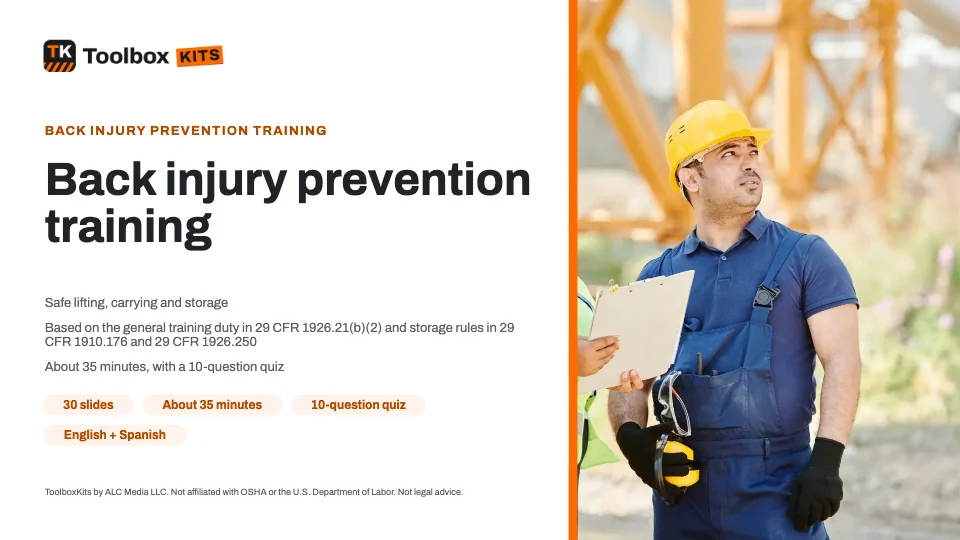 Editable PowerPoint
- Trainer guide
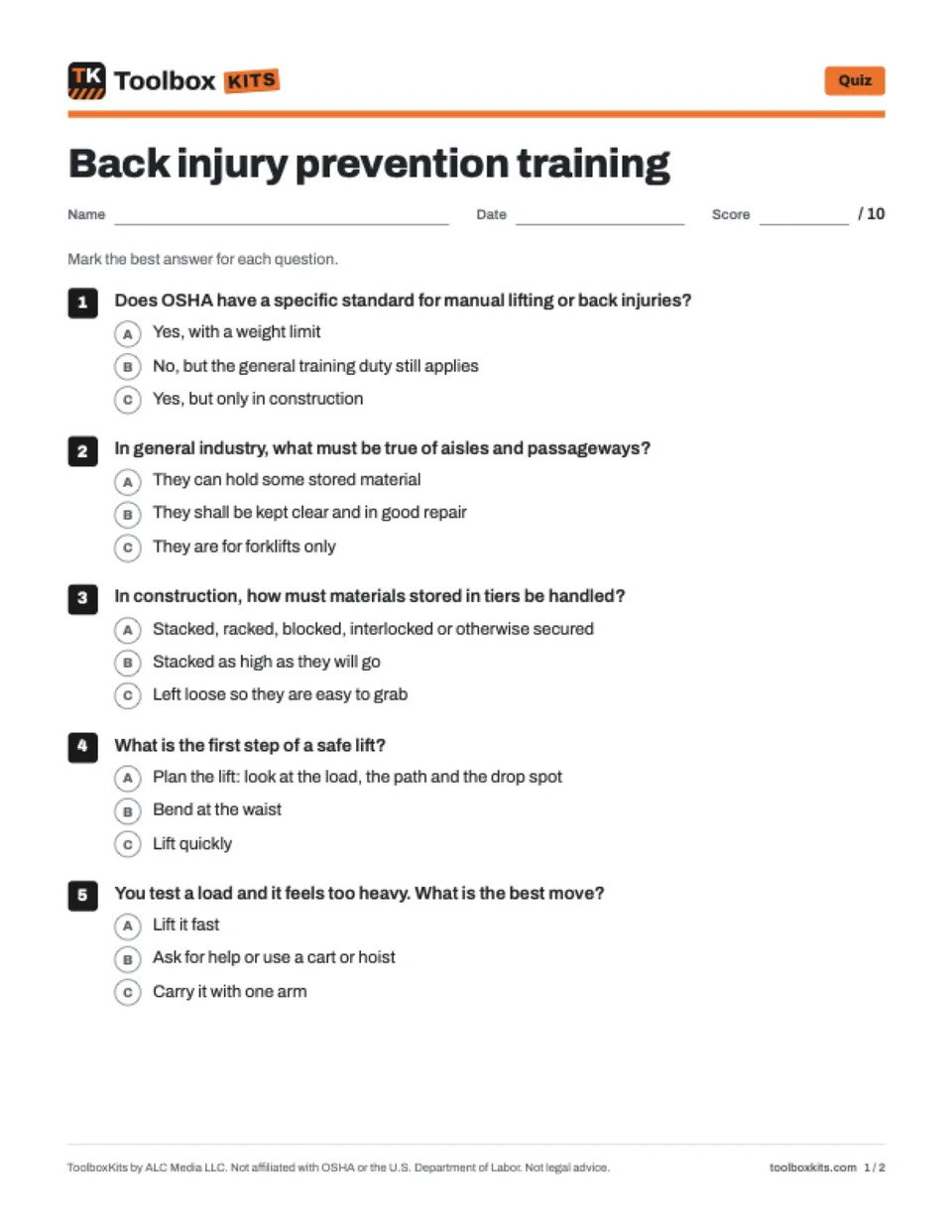 Quiz
- Answer key
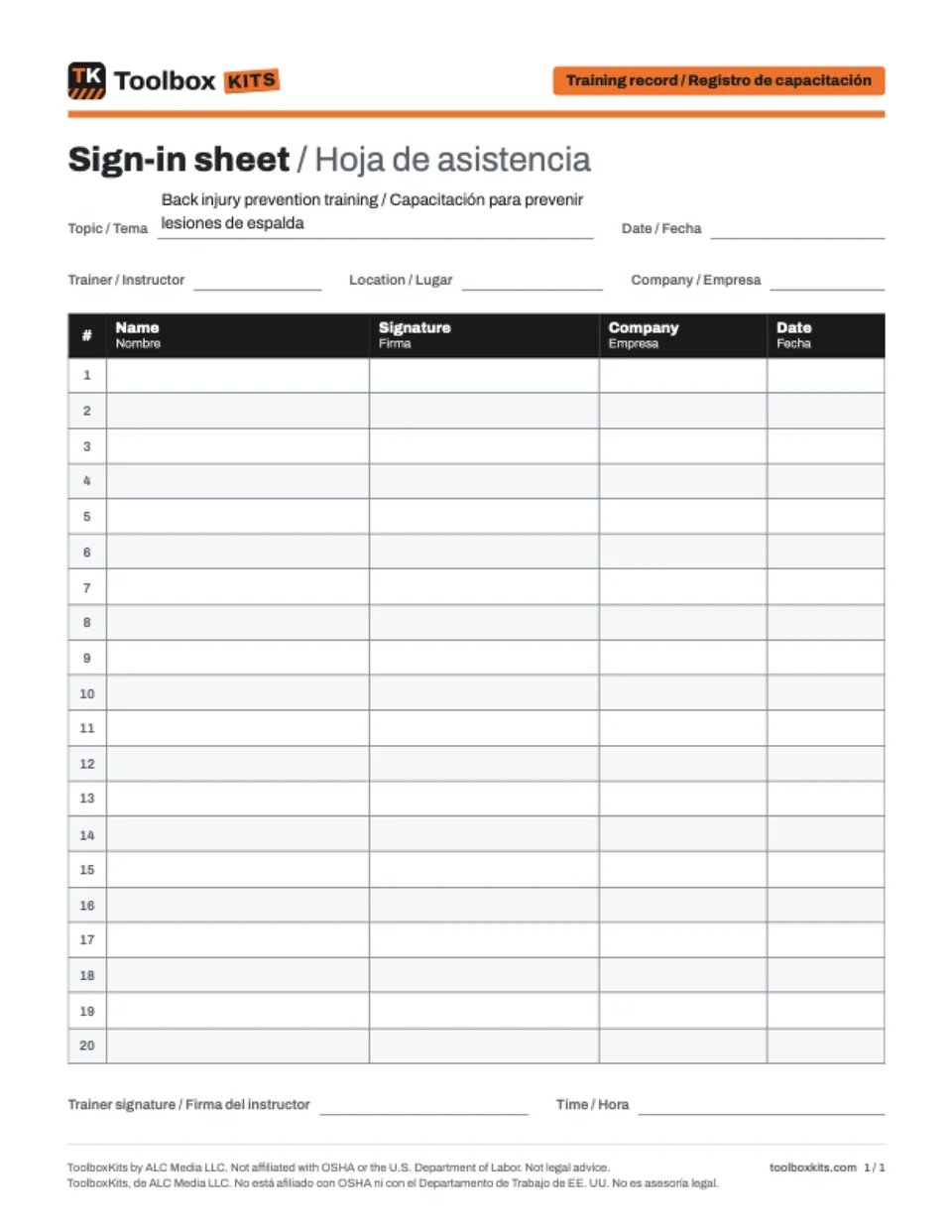 Sign-in sheet
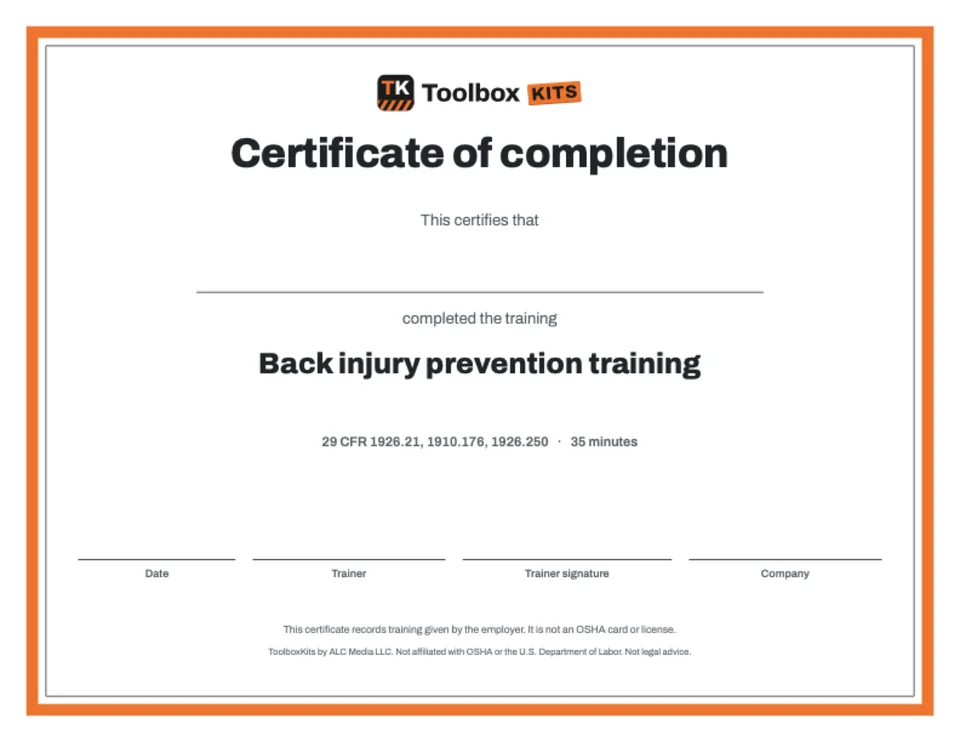 Certificate
- Crew handout
Try it
Try the quiz
Three questions from this topic. Pick an answer to see the right one and the OSHA paragraph.
Question 1 of 3
You need to turn with a heavy box in your hands. What should you do?
The rule
What OSHA requires
Plain-language summary. Each line links to the exact paragraph of the regulation.
OSHA has no specific standard for manual lifting or back injuries. In construction, the general training duty applies: the employer must instruct each employee in recognizing and avoiding unsafe conditions and the rules that apply to the work, to control or eliminate hazards or other exposure to illness or injury.
“The employer shall instruct each employee in the recognition and avoidance of unsafe conditions and the regulations applicable to his work environment to control or eliminate any hazards or other exposure to illness or injury.”
The employer should use the safety and health training programs the Secretary of Labor provides.
“The employer should avail himself of the safety and health training programs the Secretary provides.”
Where mechanical handling equipment is used, aisles and passageways must be kept clear and in good repair, with nothing across them that could create a hazard.
“Aisles and passageways shall be kept clear and in good repair, with no obstruction across or in aisles that could create a hazard.”
In general industry, storage of material must not create a hazard. Items stored in tiers must be stable and secure against sliding or collapse.
“Storage of material shall not create a hazard.”
In construction, all materials stored in tiers must be stacked, racked, blocked, interlocked or otherwise secured to prevent sliding, falling or collapse.
“All materials stored in tiers shall be stacked, racked, blocked, interlocked, or otherwise secured to prevent sliding, falling or collapse.”
Who must be trained
In construction, the employer must instruct each employee in the recognition and avoidance of unsafe conditions and the regulations that apply to the work (29 CFR 1926.21(b)(2)). OSHA has no specific lifting or back injury training rule.

Common questions
Questions people ask
Is there a printable back safety toolbox talk PDF?
Yes. This back safety toolbox talk is free to print as a PDF in English and Spanish, with a sign-in table for your crew. Read it aloud in about five minutes and keep the signed sheet with your safety records.
Does OSHA have a standard for lifting or back injury prevention?
OSHA has no specific standard for manual lifting or back injuries. The general duty to train still applies: in construction, the employer must instruct each employee in recognizing and avoiding unsafe conditions (29 CFR 1926.21(b)(2)). Good lifting habits, equipment and help from coworkers are how crews prevent back injuries.
What are the best ways to prevent back injuries at work?
Plan the lift, test the weight, keep the load close and lift with your legs. Do not twist, and use a cart, hand truck or hoist when a load is heavy or awkward. Stretch, take breaks from repeat tasks and report pain early.
Is this a back to work safety talk?
This talk is about protecting your back on the job. If you mean a talk for people returning to work after time off or an injury, use it as a refresher on lifting habits and add a review of anything that changed on the site. The employer's duty to instruct employees on the hazards of their work still applies (29 CFR 1926.21(b)(2)).
Is there a back safety training PowerPoint or presentation?
This free talk is written to be read aloud, so you do not need slides. For a longer back safety session, the paid training kit for this topic is an editable PowerPoint in English and Spanish with trainer notes, a quiz and a sign-in sheet. If the kit is not ready to buy yet, you can request it from this page.
Free to share
Use this talk for free
You can print, share and adapt this talk at no cost under the Creative Commons BY-NC-SA 4.0 license. Please credit ToolboxKits with a link.