

Free 5-minute toolbox talkErgonomics and liftingEnglish and Spanish
Ergonomics toolbox talk
Strain injuries often build up over time instead of coming from one big accident. What OSHA requires: OSHA has no specific ergonomics standard. In construction, the general duty to instruct each worker in recognizing and avoiding unsafe conditions still applies (29 CFR 1926.21(b)(2)).
A five-minute ergonomics talk for your crew. It covers what causes strain injuries, how to set up the work to fit your body, and why to report aches early.
Updated October 29, 2026 · Based on 29 CFR 1926.21
Read it out loud
Free 5-minute toolbox talk
Read it out loud to your crew. It takes about 5 minutes.
Start with a question
What part of your body hurts at the end of a long shift, and which task do you think causes it?
Why it matters
Strain injuries often build up over time instead of coming from one big accident. The same awkward reach, heavy lift or vibrating tool, day after day, wears on muscles, tendons and joints. Early signs are easy to ignore, but working through them can turn soreness into an injury that keeps you off the job. Ergonomics means fitting the work to the worker so your body lasts a full career.
Key points
Know what wears your body down
Watch for the risk factors: heavy force, awkward positions, the same motion over and over, vibration, pressure from hard edges, and holding one position too long. The more of these a task has, and the longer you do it, the higher the risk. Look at your own work today and pick out the worst task.
Work in the power zone
Keep work between your shoulders and knees, close to your body. Raise low work on a bench or sawhorses, and use a platform or lift so you are not reaching overhead or bending your neck back for long stretches. Turn with your feet instead of twisting your back.
More
For heavy or awkward loads, use a cart, a hoist or a second person.
Go easy on your hands, wrists and arms
Use tools that fit your hand and let you keep your wrist straight. Dull blades and worn bits make you push harder, so replace them. With vibrating tools, use anti-vibration models or handles when they are available, grip no tighter than you need, keep your hands warm and take breaks.
More
Let the tool do the work.
Change it up and slow down
Rotate tasks when you can, switch hands or sides, and take short breaks to stretch and change position. Use knee pads or a kneeling mat on hard surfaces. When people rush, they tend to lift alone, skip the cart or twist instead of stepping, so plan a realistic pace with the crew.
Report aches early
Pain, tingling, numbness, swelling or stiffness that keeps coming back is an early warning. Tell your supervisor early, while the fix may be as simple as a new setup or a better tool.
More
OSHA's recordkeeping rule requires employers to have a reasonable way for workers to report work-related injuries and illnesses, and employers may not fire or discriminate against a worker for reporting.
29 CFR 1904.35(b)(1) · 29 CFR 1904.35(b)(1)(iv)
Scenario
Picture this: a worker spends most of the day fastening ceiling board overhead. He holds the screw gun with a bent wrist, keeps his arms above his head for hours, and skips breaks to finish the floor. By the end of the week his shoulder aches and two fingers feel numb, but he figures it will pass. What could he and the crew change about the job, and what should he do about the numbness?
Ask the crew
- Which task on this job leaves you the most sore at the end of the day?
- What could we change about that task: the height, the tool, the weight, or how long one person does it?
- What early signs would make you report a problem?
- How do we report aches and pains here, and who do you tell?
Takeaway
Fit the work to your body, change positions often, and report aches early before they turn into injuries.
Trainer: ______________________ Date: ____________
Credit: ToolboxKits, https://toolboxkits.com/topics/ergonomics/ (CC BY-NC-SA 4.0)
The poster is also inside the paid kits.
Audit-ready records in 60 seconds
Fill in your crew and download a filled sign-in sheet for this talk. Everything is made in your browser. Names are never uploaded or stored.
Start a sign-off
Crew scan a QR code on their own phones, type their name and sign with a finger. You see the names arrive and download the signed sheet. Free, no account.
Kits
Get the kit
No subscription needed. Buy only the kit you need.
Toolbox talk kit
$4.99
- 5-minute talk, English PDF
- 5-minute talk, Spanish PDF
- Editable mini-deck (English and Spanish)
- One-page crew handout (English and Spanish)
- Bilingual sign-in sheet
- 3-question quiz with answer key (English and Spanish)
- One-page bilingual poster
- Audit-ready records in 60 seconds: fill in your crew and get a sign-in sheet and a certificate for every worker
Training kit
$9
Editable PowerPoint, 38 slides
- Editable PowerPoint with trainer notes on every slide
- Trainer guide PDF with timing and discussion tips
- 10-question quiz and answer key
- Sign-in sheet and certificate of completion with fillable fields
- One-page crew handout
- Full Spanish version of everything
- One-page bilingual poster
- Audit-ready records in 60 seconds: fill in your crew and get a sign-in sheet and a certificate for every worker
- Instant download
- Secure checkout by Stripe
- 30-day refund, no questions
Need many topics? All Access gives you every kit for $99 a year.
Inside the kit
See what is in the kit
What is in the kit
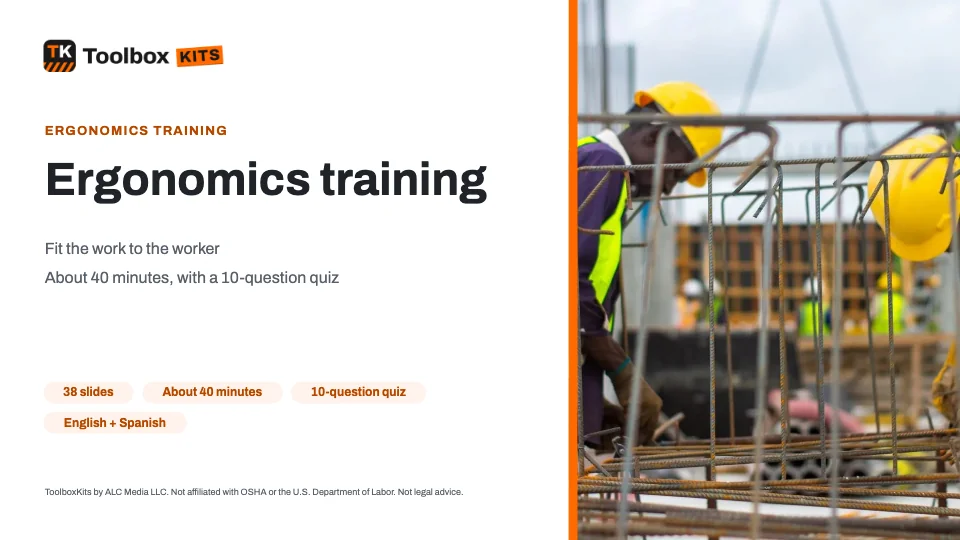 Editable PowerPoint
- Trainer guide
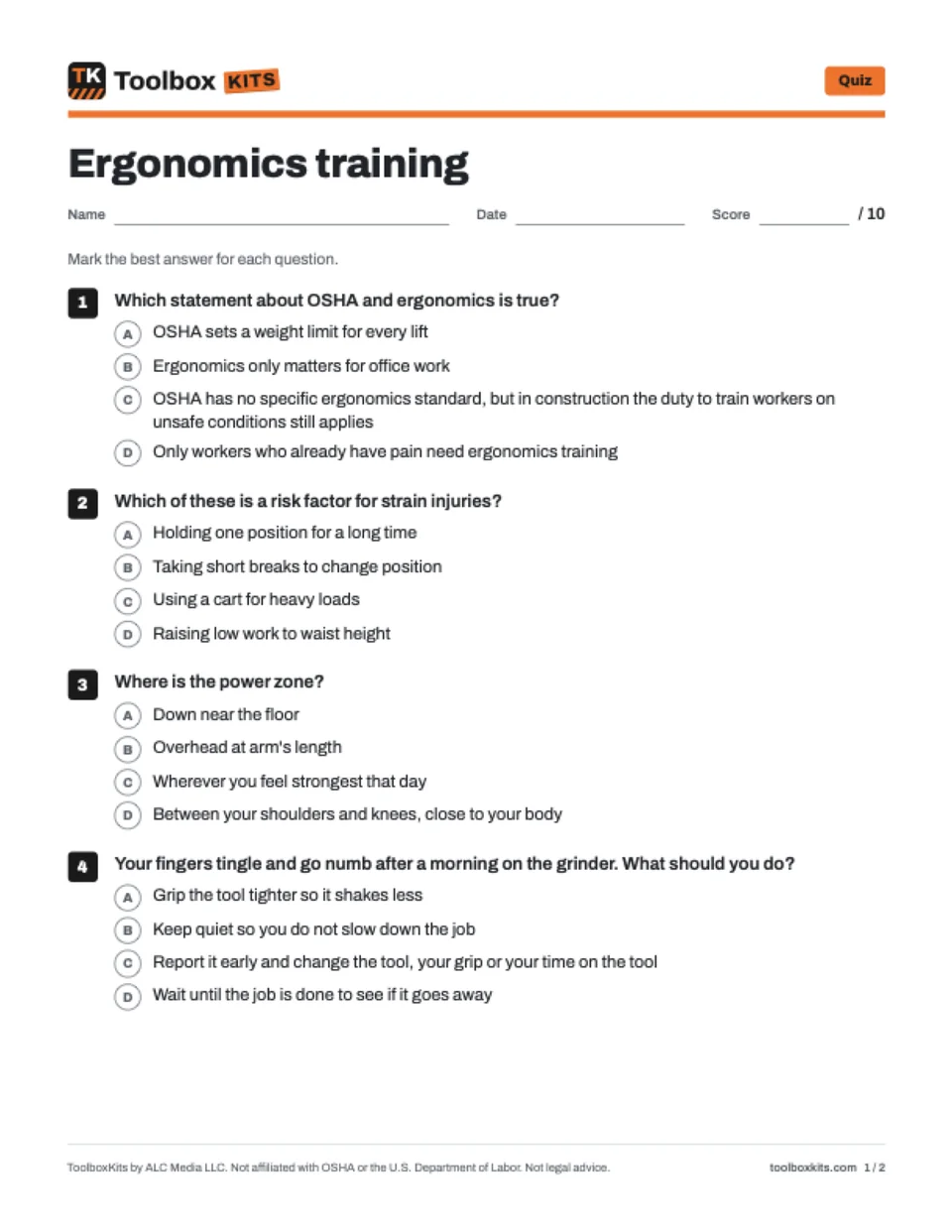 Quiz
- Answer key
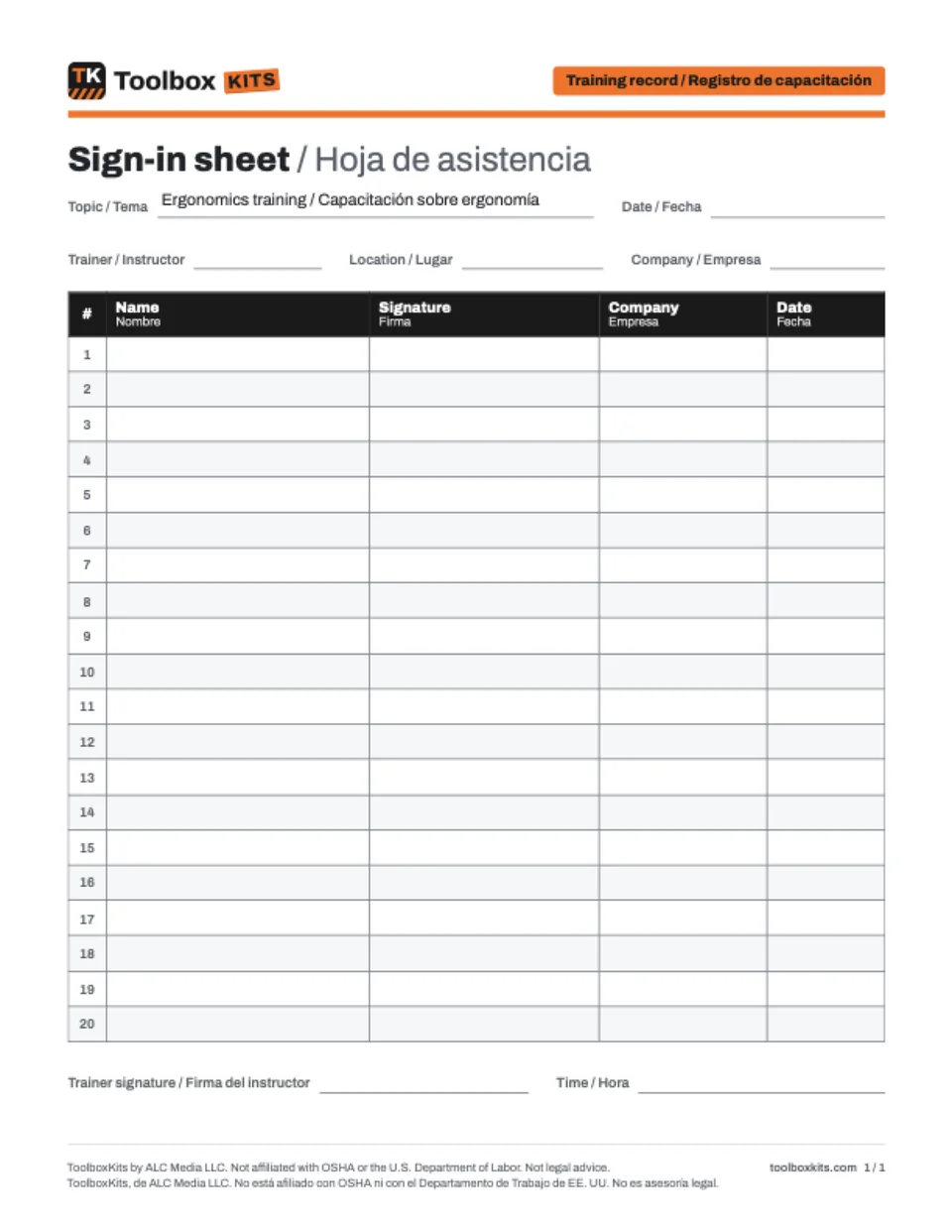 Sign-in sheet
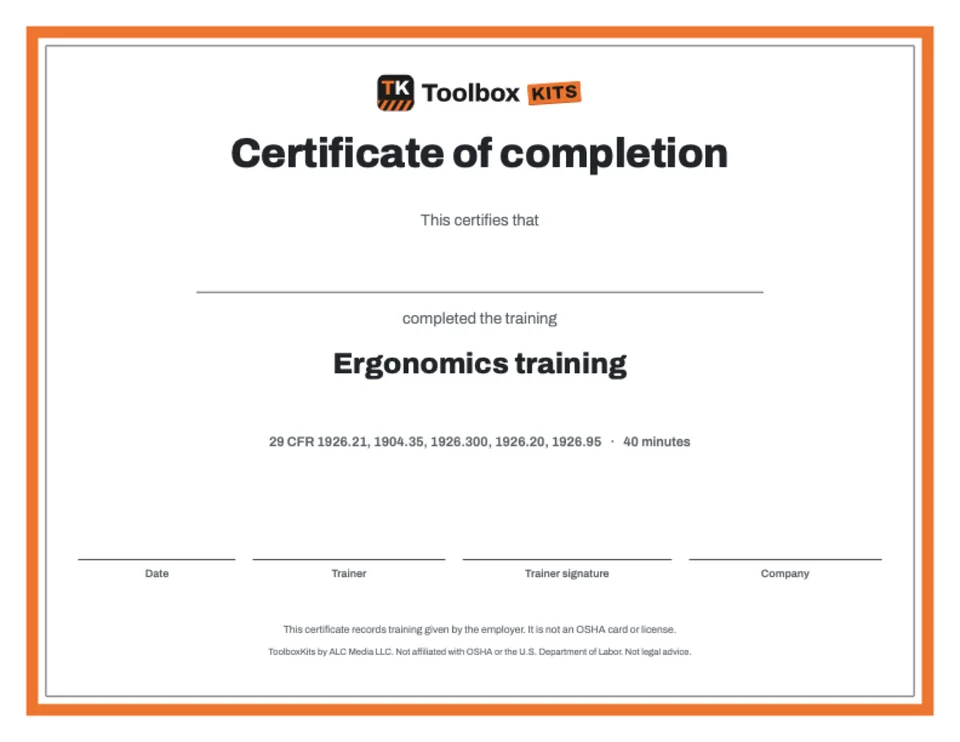 Certificate
- Crew handout
Try it
Try the quiz
Three questions from this topic. Pick an answer to see the right one and the OSHA paragraph.
Question 1 of 3
Where should you try to keep your work to reduce strain?
The rule
What OSHA requires
Plain-language summary. Each line links to the exact paragraph of the regulation.
OSHA has no specific ergonomics standard. In construction, the general duty to instruct each worker in recognizing and avoiding unsafe conditions still applies.
“The employer shall instruct each employee in the recognition and avoidance of unsafe conditions and the regulations applicable to his work environment”
Under OSHA's injury and illness recordkeeping rule, the employer must set up a reasonable procedure for workers to report work-related injuries and illnesses promptly and accurately. A procedure that would discourage a reasonable worker from reporting is not reasonable.
“You must establish a reasonable procedure for employees to report work-related injuries and illnesses promptly and accurately.”
The employer must tell each worker how the reporting procedure works.
“You must inform each employee of your procedure for reporting work-related injuries and illnesses”
The employer must tell each worker that employees have the right to report work-related injuries and illnesses.
“Employees have the right to report work-related injuries and illnesses”
The employer may not fire or in any way discriminate against a worker for reporting a work-related injury or illness.
“You must not discharge or in any manner discriminate against any employee for reporting a work-related injury or illness.”
Common questions
Questions people ask
Is there a printable ergonomics toolbox talk PDF?
Yes. This ergonomics talk is free to print as a PDF in English and Spanish, with a sign-in table for your crew. Read it aloud in about five minutes and keep the signed sheet with your safety records.
What does OSHA require for ergonomics in the workplace?
OSHA has no specific ergonomics standard. In construction, the general duty to instruct each employee in recognizing and avoiding unsafe conditions still applies. OSHA's recordkeeping rule also requires employers to have a reasonable way for workers to report work-related injuries and illnesses promptly and accurately (29 CFR 1904.35(b)(1)).
How do I give a 5-minute safety talk or safety moment on ergonomics?
Read the talk on this page aloud; it takes about five minutes. For a shorter safety moment, read the scenario and ask the crew which task on today's job is hardest on their bodies and how to fix it. End by reminding everyone how to report aches early.
What does ergonomics have to do with workplace stress?
When people are rushed or stressed, they tend to lift alone, skip the cart and work through pain. Awkward, tiring work can also add to fatigue and stress. A good setup and a realistic pace help with both.
Is there an ergonomics safety presentation or PowerPoint?
This talk is written to be read aloud, so you do not need slides. For a longer session, the paid training kit for this topic is an editable PowerPoint in English and Spanish with trainer notes, a quiz and a sign-in sheet. If the kit is not ready to buy yet, you can request it from this page.
Free to share
Use this talk for free
You can print, share and adapt this talk at no cost under the Creative Commons BY-NC-SA 4.0 license. Please credit ToolboxKits with a link.