

Free 5-minute toolbox talkHealthcareEnglish and Spanish
Laboratory safety presentation and 5-minute talk
A splash, a vapor you breathe in or a mislabeled bottle can cause burns, poisoning or a fire. What OSHA requires: The chemical hygiene plan must require that fume hoods and other protective equipment are working properly, and set out specific measures to keep them performing (29 CFR 1910.1450(e)(3)(iii)).
A free lab safety talk you can present in about five minutes at a safety meeting or before lab work starts. It covers the chemical hygiene plan, labels and safety data sheets, fume hoods, PPE, food and drink, and spills, with the OSHA rule behind each point.
Updated October 29, 2026 · Based on 29 CFR 1910.1450
Read it out loud
Free 5-minute toolbox talk
Read it out loud to your crew. It takes about 5 minutes.
Start with a question
If the bottle in front of you spilled right now, would you know what is in it, how it could hurt you and what to do first?
Why it matters
Labs use many different chemicals, often in small amounts, and that makes it easy to get comfortable. A splash, a vapor you breathe in or a mislabeled bottle can cause burns, poisoning or a fire. Good habits and working equipment are what keep a small mistake from turning into an injury.
Key points
Know your chemical hygiene plan
Where hazardous chemicals are used in a lab, the employer must have a written chemical hygiene plan and carry it out. The plan sets the procedures, controls, PPE and hygiene practices for your lab, and it must be readily available to employees.
More
Know where to find it and who your chemical hygiene officer is.
29 CFR 1910.1450(e)(1) · 29 CFR 1910.1450(e)(2)
Read the label and the SDS first
Labels on incoming chemical containers must not be removed or defaced, and safety data sheets that arrive with shipments must be kept and made readily accessible to lab employees. Before you use a chemical, check its label and SDS for the hazards, the PPE to wear and first aid.
More
If a container's label is missing or unreadable, do not use it, and tell your supervisor.
Use the fume hood the right way
The chemical hygiene plan must require that fume hoods and other protective equipment work properly, with specific steps to make sure they do. Work with volatile or toxic chemicals inside the hood, keep the sash as low as you can, and do not block the airflow with clutter.
More
If a hood alarm sounds or the hood does not seem to pull air, stop and report it.
Wear eye and hand protection
In general industry, employees exposed to liquid chemicals, acids or caustic liquids, or chemical gases or vapors must use appropriate eye or face protection.
More
Employers must also select and require appropriate hand protection, such as gloves, when hands are exposed to hazards like skin absorption of harmful substances or chemical burns. Check the SDS for the right glove type, and take gloves off before touching doorknobs, phones or keyboards.
29 CFR 1910.133(a)(1) · 29 CFR 1910.138(a)
Keep food and drinks out
In general industry, no employee may eat or drink in any area exposed to a toxic material, and food and drinks may not be stored there. Never keep food in a refrigerator used for chemicals or samples. Wash your hands before you leave the lab, even if you wore gloves.
29 CFR 1910.141(g)(2) · 29 CFR 1910.141(g)(4)
Know what to do in a spill or splash
Where the eyes or body may be exposed to injurious corrosive materials, facilities for quick drenching or flushing must be provided in the work area for immediate emergency use. Know where the eyewash, safety shower and spill kit are, and report every spill, even a small one.
More
After a spill, leak or other event likely to cause a hazardous exposure, the affected employee must be given an opportunity for a medical consultation.
29 CFR 1910.151(c) · 29 CFR 1910.1450(g)(1)(iii)
Scenario
Picture this: At the end of a long day, a lab tech pours a solvent into an unlabeled beaker on the open bench instead of in the fume hood, planning to label it later. A coworker sets a cup of coffee down right next to it. The beaker tips, splashing the tech's bare wrist and the coffee cup. What went wrong, and what should both of them do right now?
Ask the crew
- Where is our chemical hygiene plan kept, and who is our chemical hygiene officer?
- Where are the nearest eyewash, safety shower and spill kit, and is anything blocking them?
- Which of our chemicals need the fume hood, and how do we know it is working?
- What would you do first if a chemical splashed in your eyes or on your skin?
Takeaway
Know what you are working with, use the hood and the right PPE, keep food out of the lab, and report every spill or exposure.
Trainer: ______________________ Date: ____________
Credit: ToolboxKits, https://toolboxkits.com/topics/laboratory-safety/ (CC BY-NC-SA 4.0)
The poster is also inside the paid kits.
Audit-ready records in 60 seconds
Fill in your crew and download a filled sign-in sheet for this talk. Everything is made in your browser. Names are never uploaded or stored.
Start a sign-off
Crew scan a QR code on their own phones, type their name and sign with a finger. You see the names arrive and download the signed sheet. Free, no account.
Kits
Get the kit
No subscription needed. Buy only the kit you need.
Toolbox talk kit
$4.99
- 5-minute talk, English PDF
- 5-minute talk, Spanish PDF
- Editable mini-deck (English and Spanish)
- One-page crew handout (English and Spanish)
- Bilingual sign-in sheet
- 3-question quiz with answer key (English and Spanish)
- One-page bilingual poster
- Audit-ready records in 60 seconds: fill in your crew and get a sign-in sheet and a certificate for every worker
Training kit
$9
Editable PowerPoint, 35 slides
- Editable PowerPoint with trainer notes on every slide
- Trainer guide PDF with timing and discussion tips
- 10-question quiz and answer key
- Sign-in sheet and certificate of completion with fillable fields
- One-page crew handout
- Full Spanish version of everything
- One-page bilingual poster
- Audit-ready records in 60 seconds: fill in your crew and get a sign-in sheet and a certificate for every worker
- Instant download
- Secure checkout by Stripe
- 30-day refund, no questions
Need many topics? All Access gives you every kit for $99 a year.
Inside the kit
See what is in the kit
What is in the kit
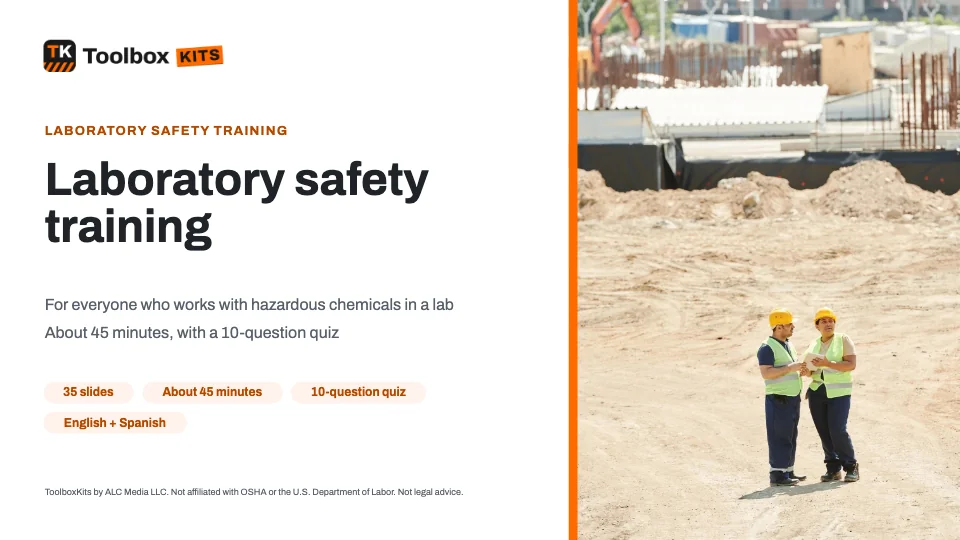 Editable PowerPoint
- Trainer guide
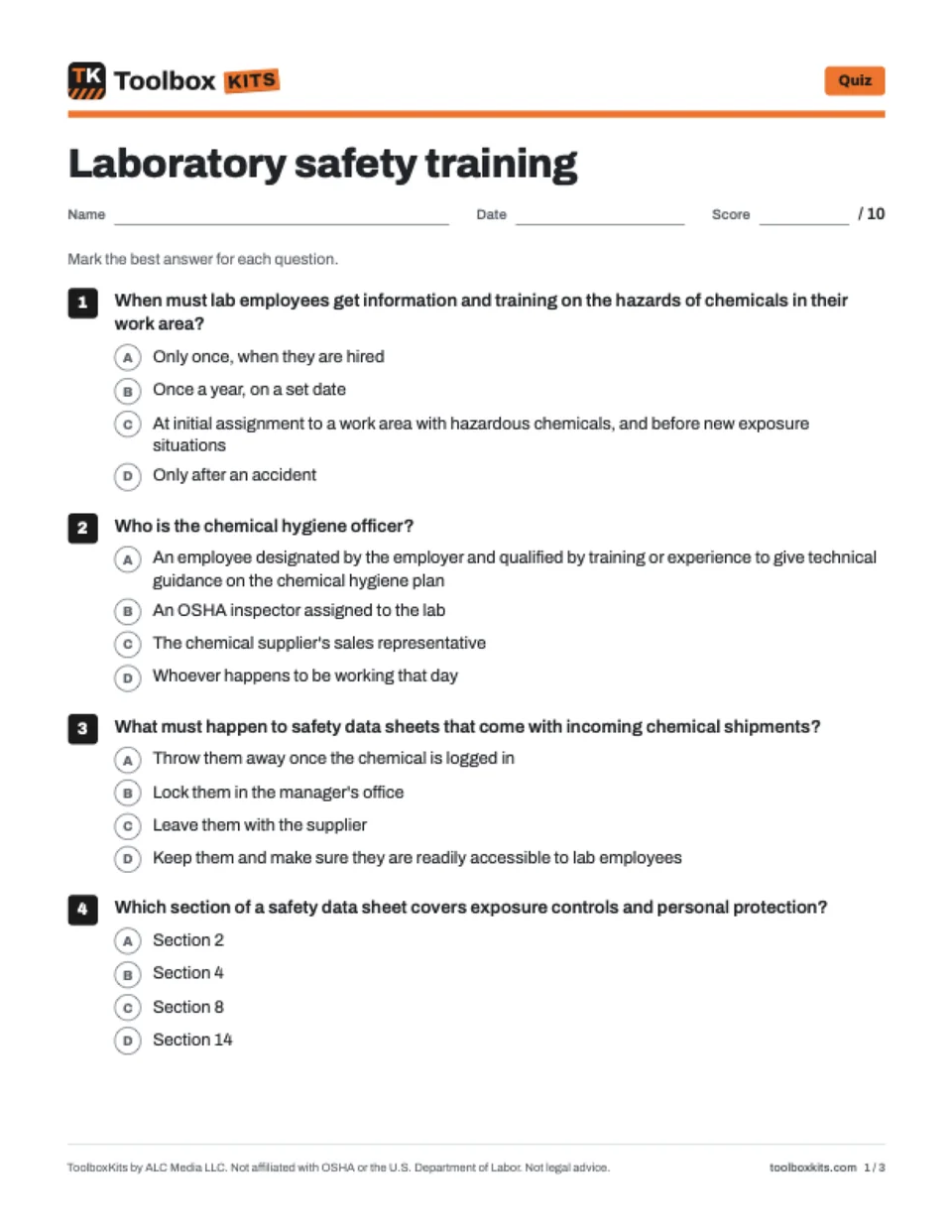 Quiz
- Answer key
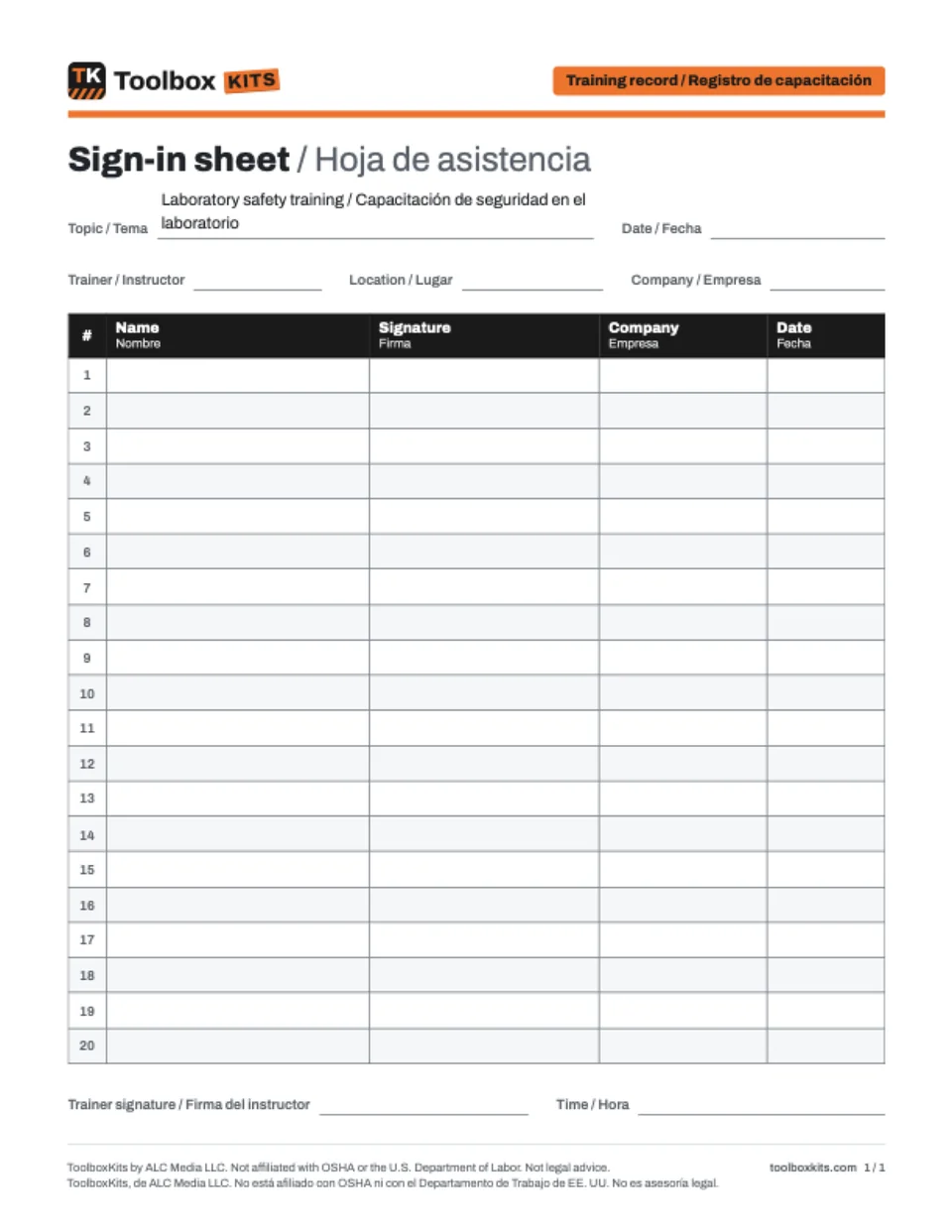 Sign-in sheet
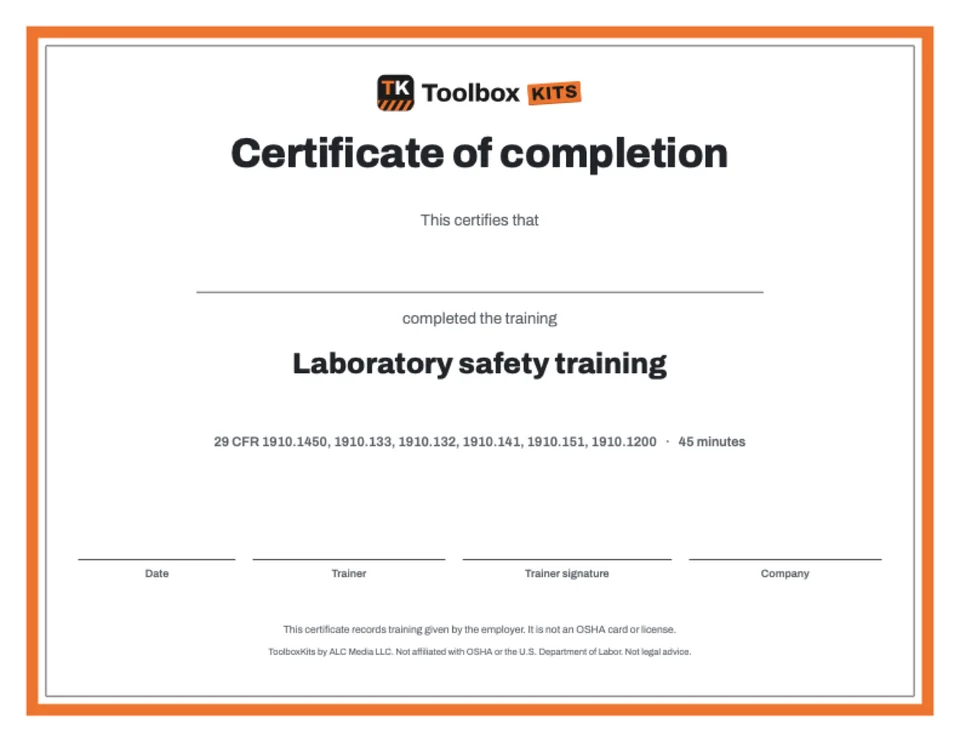 Certificate
- Crew handout
Try it
Try the quiz
Three questions from this topic. Pick an answer to see the right one and the OSHA paragraph.
Question 1 of 3
Under OSHA's lab standard, what written plan must an employer have where hazardous chemicals are used in a lab?
The rule
What OSHA requires
Plain-language summary. Each line links to the exact paragraph of the regulation.
Where hazardous chemicals are used in a laboratory, the employer must develop and carry out a written chemical hygiene plan that can protect employees from the health hazards of those chemicals and keep exposures below the permissible limits.
“the employer shall develop and carry out the provisions of a written Chemical Hygiene Plan”
The chemical hygiene plan must require that fume hoods and other protective equipment are working properly, and set out specific measures to keep them performing.
“A requirement that fume hoods and other protective equipment are functioning properly”
Employers must give employees information and training so they know the hazards of the chemicals present in their work area.
“The employer shall provide employees with information and training to ensure that they are apprised of the hazards of chemicals present in their work area.”
Information and training must be provided when an employee is first assigned to a work area where hazardous chemicals are present and before assignments involving new exposure situations. The employer decides how often refresher training happens.
“The frequency of refresher information and training shall be determined by the employer.”
Training must include the measures employees can take to protect themselves, including the employer's specific procedures such as work practices, emergency procedures and the PPE to be used.
“such as appropriate work practices, emergency procedures, and personal protective equipment to be used”
Labels on incoming containers of hazardous chemicals must not be removed or defaced.
“Employers shall ensure that labels on incoming containers of hazardous chemicals are not removed or defaced.”
Safety data sheets received with incoming shipments of hazardous chemicals must be kept and readily accessible to laboratory employees.
“ensure that they are readily accessible to laboratory employees”
After a spill, leak, explosion or other event likely to cause a hazardous exposure, the affected employee must be given an opportunity for a medical consultation.
“the affected employee shall be provided an opportunity for a medical consultation”
In general industry, employees must use appropriate eye or face protection when exposed to hazards from liquid chemicals, acids or caustic liquids, or chemical gases or vapors.
“appropriate eye or face protection when exposed to eye or face hazards from flying particles, molten metal, liquid chemicals, acids or caustic liquids, chemical gases or vapors”
Where the eyes or body may be exposed to injurious corrosive materials, suitable facilities for quick drenching or flushing of the eyes and body must be provided in the work area for immediate emergency use.
“suitable facilities for quick drenching or flushing of the eyes and body shall be provided within the work area for immediate emergency use”
Who must be trained
Under the lab standard, the employer must provide employees with information and training on the hazards of chemicals present in their work area (29 CFR 1910.1450(f)(1)). In this standard, an employee is an individual employed in a laboratory workplace who may be exposed to hazardous chemicals in the course of his or her assignments (29 CFR 1910.1450(b)). Employees must also be trained on the applicable details of the employer's written chemical hygiene plan (29 CFR 1910.1450(f)(4)(ii)).
When to retrain
The employer decides how often refresher information and training is given. Information and training must also be provided before assignments involving new exposure situations (29 CFR 1910.1450(f)(2)).

Common questions
Questions people ask
Is there a lab safety PowerPoint presentation?
The free talk on this page is made to be read aloud from a printout, so you can present it without a projector. If you want slides for a longer laboratory safety presentation, use the training kit option on this page. Either way, finish by walking the lab and pointing out the eyewash, safety shower, spill kit and fume hoods.
Is there a printable laboratory safety training PDF I can download?
Yes. This lab safety talk is free, and you can download and print it as a PDF in English or Spanish with a sign-in table. Keep the signed sheet with your training records.
What are good lab safety meeting topics?
Good topics include your chemical hygiene plan, reading labels and safety data sheets, fume hood use, eye and hand protection, keeping food out of the lab, chemical storage, waste handling, and what to do in a spill or splash. Cover one topic per meeting and tie it to work the lab is doing that week.
What lab safety rules should a presentation cover?
Start with the rules in your own chemical hygiene plan, because OSHA's lab standard requires the plan to include standard operating procedures for lab work that involves hazardous chemicals. Then cover the basics: read the label and SDS first, use a working fume hood for hazardous vapors, wear the eye and hand protection the task calls for, keep food and drinks out, and report every spill.
What does OSHA require for laboratory safety training?
Under 29 CFR 1910.1450, employers must give lab employees information and training on the hazards of chemicals in their work area. It must be provided when an employee is first assigned to a work area where hazardous chemicals are present and before assignments involving new exposure situations, and the employer decides how often refresher training happens. Training must also cover the applicable details of the employer's written chemical hygiene plan (29 CFR 1910.1450(f)(4)(ii)).
Free to share
Use this talk for free
You can print, share and adapt this talk at no cost under the Creative Commons BY-NC-SA 4.0 license. Please credit ToolboxKits with a link.