

Free 5-minute toolbox talkLandscapingEnglish and Spanish
Interesting safety meeting topics: insects, ticks and stings
Ticks and mosquitoes can spread diseases such as Lyme disease and West Nile virus, and a sting can set off a severe allergic reaction that needs emergency care right away. What OSHA requires: In construction, the employer must instruct each employee in recognizing and avoiding unsafe conditions and the regulations that apply to their work environment (29 CFR 1926.21(b)(2)).
Looking for interesting safety meeting topics for outdoor crews? This free 5-minute bug and insect protection talk covers ticks, mosquitoes, bees, wasps and fire ants: how to avoid bites and stings, check for ticks and spot a severe allergic reaction.
Updated October 29, 2026 · Based on 29 CFR 1926.21
Read it out loud
Free 5-minute toolbox talk
Read it out loud to your crew. It takes about 5 minutes.
Start with a question
Who here has pulled a tick off after work or been stung on the job, and what did you do about it?
Why it matters
Outdoor crews work where ticks, mosquitoes and stinging insects live: tall grass, brush, wood piles, eaves and equipment that has sat for a while. Ticks and mosquitoes can spread diseases such as Lyme disease and West Nile virus, and a sting can set off a severe allergic reaction that needs emergency care right away.
Key points
Know what bites and stings on this site
OSHA has no standard written just for insects and ticks, but in construction the general duty to train still applies. On construction sites where harmful plants or animals are present, workers who may be exposed must be told about the hazards, how to avoid injury and the first aid to use.
More
Learn where ticks, nests and ant mounds show up on this job, and tell your foreman about new ones.
29 CFR 1926.21(b)(4) · 29 CFR 1926.21(b)(2)
Cover up and use repellent
Wear long sleeves and long pants, and tuck your pants into your socks or boots in grass and brush. Light colors make ticks easier to spot. Use an EPA-registered insect repellent on exposed skin and follow the label.
More
Clothing treated with permethrin helps against ticks, but permethrin goes on clothing and gear, never on skin.
Check for ticks every day
After work, check your whole body, especially your scalp, ears, armpits, waist, the backs of your knees and your groin. If you find a tick, grab it close to the skin with fine-tipped tweezers and pull straight up with steady, even pressure.
More
Do not twist it, burn it or smother it with nail polish or petroleum jelly. Clean the bite, report it, and see a doctor if you get a rash, fever or body aches in the weeks after.
Stay calm around bees, wasps and fire ants
Look before you reach into equipment, boxes, eaves or holes in the ground, and watch for ant mounds. If a single bee or wasp flies near you, stay calm and still, because swatting can make it sting; if several attack, get away fast and get indoors or into a vehicle.
More
If you are stung, scrape out any stinger instead of squeezing it, wash the spot and use a cold pack. Have someone stay with the person in case an allergic reaction starts.
Cut down on mosquitoes
Mosquitoes breed in standing water, so dump water from buckets, tires, tarps and other containers on site. Be extra careful at dawn and dusk, when many mosquitoes are most active. Use repellent and long sleeves, and tell your supervisor if you get a fever, headache or body aches after being bitten.
Know the signs of a severe allergic reaction
Call 911 right away if someone has trouble breathing, swelling of the face, lips, tongue or throat, spreading hives, or dizziness after a sting or bite. Help them use their own epinephrine auto-injector if they have one, and stay with them.
More
If you have a serious sting allergy, carry your auto-injector and tell a coworker where it is. On construction sites where 911 service is not available, the phone numbers of physicians, hospitals or ambulances must be conspicuously posted.
Scenario
Picture this: A landscaping crew is clearing brush along a fence line. One worker lifts an old pallet, disturbs a wasp nest and gets stung several times. A few minutes later, the worker says their throat feels tight and their lips are swelling. The truck is far away, and nobody knows if the worker carries an auto-injector. What should the crew do right now, and what should have been planned first?
Ask the crew
- Where on this site have we seen ticks, nests or ant mounds?
- What repellent and long-sleeve gear do we have on the truck?
- How do you check for ticks after work, and what do you do if you find one?
- If someone has a severe reaction, who calls 911 and how do we tell them where we are?
Takeaway
Cover up, use repellent, check for ticks every day, stay calm around stinging insects, and call 911 at the first sign of a severe allergic reaction.
Trainer: ______________________ Date: ____________
Credit: ToolboxKits, https://toolboxkits.com/topics/insects-and-ticks/ (CC BY-NC-SA 4.0)
The poster is also inside the paid kits.
Audit-ready records in 60 seconds
Fill in your crew and download a filled sign-in sheet for this talk. Everything is made in your browser. Names are never uploaded or stored.
Start a sign-off
Crew scan a QR code on their own phones, type their name and sign with a finger. You see the names arrive and download the signed sheet. Free, no account.
Kits
Get the kit
No subscription needed. Buy only the kit you need.
Toolbox talk kit
$4.99
- 5-minute talk, English PDF
- 5-minute talk, Spanish PDF
- Editable mini-deck (English and Spanish)
- One-page crew handout (English and Spanish)
- Bilingual sign-in sheet
- 3-question quiz with answer key (English and Spanish)
- One-page bilingual poster
- Audit-ready records in 60 seconds: fill in your crew and get a sign-in sheet and a certificate for every worker
Training kit
$9
Editable PowerPoint, 38 slides
- Editable PowerPoint with trainer notes on every slide
- Trainer guide PDF with timing and discussion tips
- 10-question quiz and answer key
- Sign-in sheet and certificate of completion with fillable fields
- One-page crew handout
- Full Spanish version of everything
- One-page bilingual poster
- Audit-ready records in 60 seconds: fill in your crew and get a sign-in sheet and a certificate for every worker
- Instant download
- Secure checkout by Stripe
- 30-day refund, no questions
Need many topics? All Access gives you every kit for $99 a year.
Inside the kit
See what is in the kit
What is in the kit
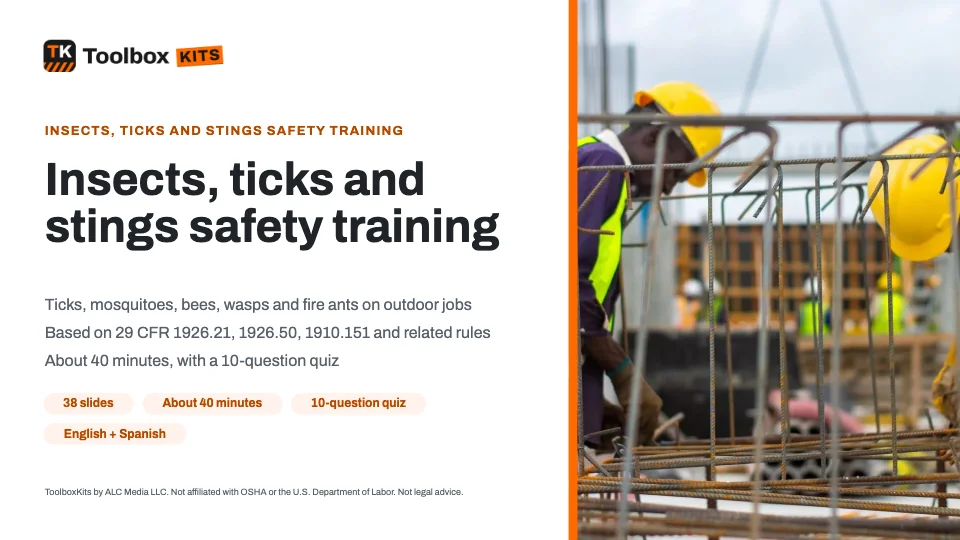 Editable PowerPoint
- Trainer guide
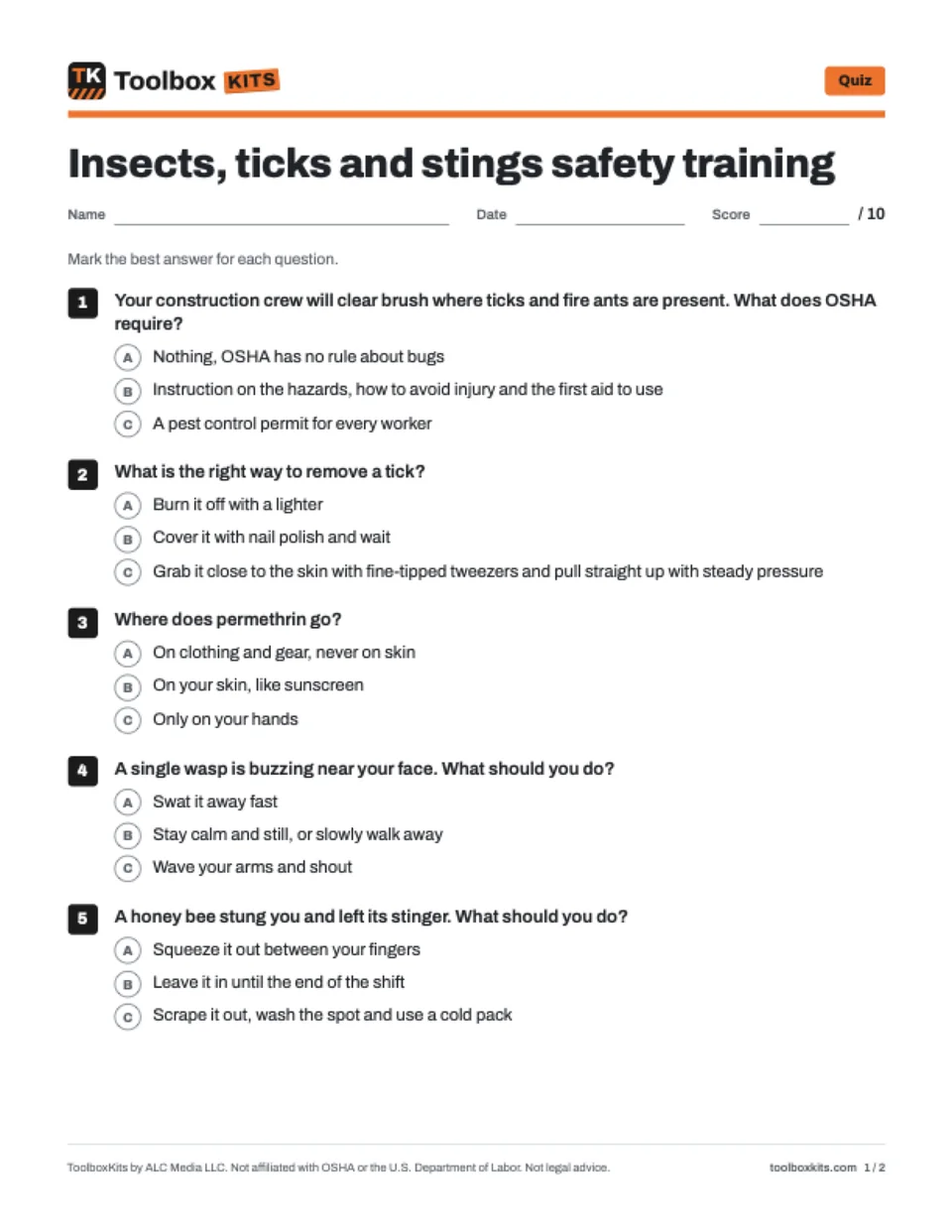 Quiz
- Answer key
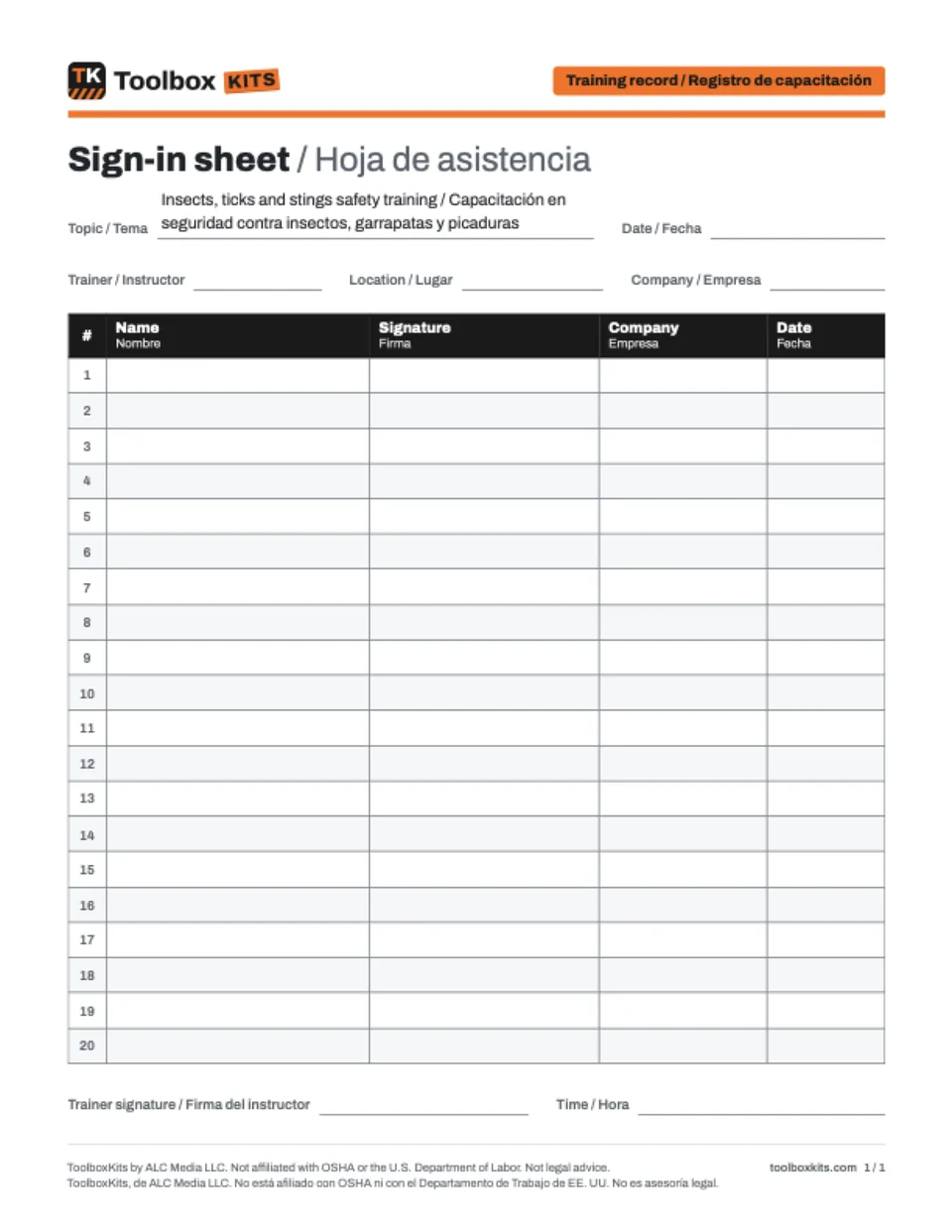 Sign-in sheet
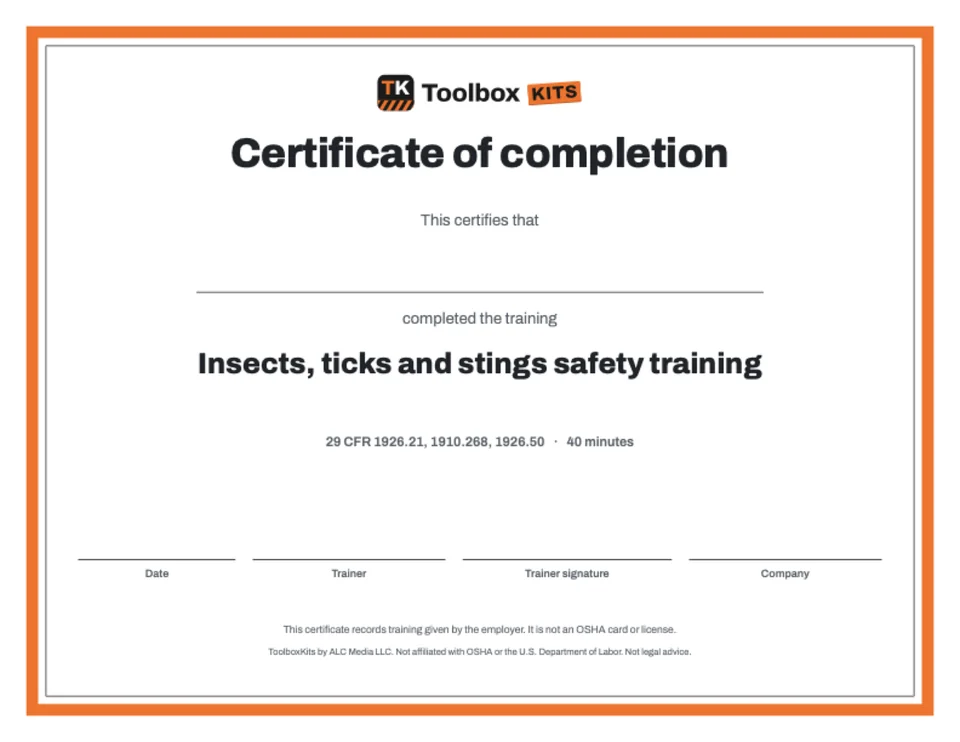 Certificate
- Crew handout
Try it
Try the quiz
Three questions from this topic. Pick an answer to see the right one and the OSHA paragraph.
Question 1 of 3
What is the right way to remove a tick?
The rule
What OSHA requires
Plain-language summary. Each line links to the exact paragraph of the regulation.
On construction sites where harmful plants or animals are present, employees who may be exposed must be instructed on the potential hazards, how to avoid injury and the first aid procedures to use if they are injured.
“employees who may be exposed shall be instructed regarding the potential hazards, and how to avoid injury, and the first aid procedures to be used in the event of injury”
In construction, the employer must instruct each employee in recognizing and avoiding unsafe conditions and the regulations that apply to their work environment. OSHA has no standard written just for insects and ticks; this general duty to train still applies.
“The employer shall instruct each employee in the recognition and avoidance of unsafe conditions”
For telecommunications center and field work, required training must, where appropriate, include recognizing and avoiding dangers from encounters with harmful substances and animal, insect or plant life.
“Recognition and avoidance of dangers relating to encounters with harmful substances and animal, insect, or plant life”
In general industry permanent places of employment, every enclosed workplace must be built, equipped and maintained, as far as reasonably practicable, to keep rodents, insects and other vermin from getting in or nesting, with a continuing and effective extermination program where they are found. Construction has the same rule (29 CFR 1926.51(h)).
“A continuing and effective extermination program shall be instituted where their presence is detected.”
In general industry, if there is no infirmary, clinic or hospital in near proximity to the workplace that is used to treat all injured employees, a person or persons must be adequately trained to render first aid. Adequate first aid supplies must be readily available.
“a person or persons shall be adequately trained to render first aid. Adequate first aid supplies shall be readily available.”
On construction projects, provisions for prompt medical attention in case of serious injury must be made before the project starts.
“Provisions shall be made prior to commencement of the project for prompt medical attention in case of serious injury.”
In construction, if no infirmary, clinic, hospital or physician that is reasonably accessible in terms of time and distance is available to treat injured employees, a person with a valid first aid training certificate from the U.S. Bureau of Mines or the American Red Cross, or equivalent training that can be verified by documentary evidence, must be available at the worksite to render first aid.
“shall be available at the worksite to render first aid”
In construction, first aid supplies must be easily accessible when required.
“First aid supplies shall be easily accessible when required.”
In construction, proper equipment for prompt transportation of an injured person to a physician or hospital, or a communication system for contacting ambulance service, must be provided.
“a communication system for contacting necessary ambulance service, shall be provided”
Who must be trained
On construction sites where harmful plants or animals are present, employees who may be exposed must be instructed on the potential hazards, how to avoid injury and the first aid procedures to use (29 CFR 1926.21(b)(4)). For telecommunications work, training must, where appropriate, include recognizing and avoiding dangers from animal, insect or plant life (29 CFR 1910.268(c)(1)). In general industry, if there is no infirmary, clinic or hospital in near proximity that is used to treat all injured employees, a person or persons must be adequately trained to render first aid (29 CFR 1910.151(b)).

Common questions
Questions people ask
What are some interesting safety meeting topics for outdoor crews?
Pick hazards your crew will face this week: ticks and stinging insects in warm months, heat and water in summer, lightning and storms, poison plants, and cold stress in winter. Seasonal topics like these feel fresh because the crew can see them on site. To keep any talk interesting, ask questions, show a photo or a real example from your area, and end with one thing everyone will do today.
What should a tick safety talk or tick safety moment cover?
Cover where ticks live on your sites, long sleeves and pants tucked into socks, EPA-registered repellent, and permethrin-treated clothing (never on skin). Then teach a daily tick check and the right way to remove a tick: fine-tipped tweezers close to the skin, pulling straight up with steady pressure. Tell workers to report bites and to see a doctor if a rash or fever follows. The talk on this page also works as a short tick or insect safety presentation.
What should a bee and wasp safety talk cover?
Cover where nests hide (eaves, equipment, wall voids and holes in the ground), staying calm and still instead of swatting, and getting away fast if several insects attack. Teach bee sting first aid: scrape out the stinger, wash the spot, use a cold pack and watch the person for an allergic reaction. Make sure everyone knows to call 911 for trouble breathing or swelling of the face or throat, and where workers with a serious sting allergy keep their auto-injector. For a quick wasp safety moment, walk the site and point out nests before work starts.
What should a mosquito safety talk or safety moment cover?
Cover repellent, long sleeves and pants, extra care at dawn and dusk, and dumping standing water from buckets, tires and tarps on site. Mosquitoes can spread diseases such as West Nile virus, so workers should report a fever, headache or body aches after bites. The mosquito section of this talk works as a quick mosquito safety moment or presentation at the start of a summer shift.
Does OSHA have a rule about insects and ticks at work?
OSHA has no standard written just for insects and ticks. In construction, where harmful plants or animals are present, employees who may be exposed must be instructed on the hazards, how to avoid injury and the first aid to use. First aid rules also apply, such as 29 CFR 1910.151(b) in general industry and 29 CFR 1926.50(c) in construction, and telecommunications training must cover animal, insect and plant life hazards where appropriate (29 CFR 1910.268(c)(1)).
Free to share
Use this talk for free
You can print, share and adapt this talk at no cost under the Creative Commons BY-NC-SA 4.0 license. Please credit ToolboxKits with a link.