

Free 5-minute toolbox talkBehavior and attitudeEnglish and Spanish
Falling objects toolbox talk: dropped objects and overhead hazards
A tool, bolt or piece of scrap dropped from height can seriously hurt someone below, often with no warning. What OSHA requires: In construction, each employee on a walking/working surface must be protected from objects falling through holes, including skylights, by covers (29 CFR 1926.501(b)(4)(iii)).
This free falling objects toolbox talk takes about five minutes to read aloud. It covers dropped objects and overhead hazards: keeping tools and materials from falling, protecting the people below, and the OSHA rules behind each point.
Updated October 29, 2026 · Based on 29 CFR 1926.501, 29 CFR 1926.502, 29 CFR 1926.451
Read it out loud
Free 5-minute toolbox talk
Read it out loud to your crew. It takes about 5 minutes.
Start with a question
Look up. What is above you right now that could fall, and what would stop it if it did?
Why it matters
A tool, bolt or piece of scrap dropped from height can seriously hurt someone below, often with no warning. A drop can start with something small: a loose tool, material near an edge, or debris kicked off a platform. Hard hats help, but the real goal is to keep things from falling and keep people out from under the work.
Key points
A hard hat alone is not enough
In construction, workers exposed to falling objects must wear hard hats, and the employer must also use one of three measures: toeboards, screens or guardrail systems; a canopy, with objects kept back from the edge; or a barricaded area that people stay out of, with objects kept back from the edge.
More
General industry has a similar rule that requires head protection plus one or more of those measures.
29 CFR 1926.501(c) · 29 CFR 1910.28(c)
Keep tools and materials back from the edge
Toeboards along an overhead edge help stop tools and small parts from being kicked off. Where tools, equipment or materials are piled higher than the toeboard, paneling or screening must be put up to protect the people below.
More
During roofing work, materials and equipment must not be stored within 6 feet of a roof edge unless guardrails are erected at the edge.
29 CFR 1926.502(j)(7)(i) · 29 CFR 1926.502(j)(4)
Secure your tools when you work at height
Use tool lanyards rated for the tool, tool bags or buckets that close, and hand lines to raise and lower gear. Never toss tools or materials up or down. In steel erection, all materials, equipment and tools that are not in use while aloft must be secured against accidental displacement.
More
Check your pockets and your platform before you move so nothing loose rides along.
Scaffolds need falling object protection too
Besides wearing hard hats, workers on a scaffold must be protected from falling hand tools, debris and other small objects by toeboards, screens, guardrail systems, debris nets, catch platforms or canopy structures.
More
When tools or materials could fall from a scaffold onto people below, one option is to barricade the area below and keep everyone out. Do not let debris build up on platforms.
29 CFR 1926.451(h)(1) · 29 CFR 1926.451(h)(2)(i) · 29 CFR 1926.451(f)(13)
Stay out from under the work
Respect barricades, warning lines and signs below overhead work. Never walk or stand under a suspended load.
More
On crane work, while the operator is not moving a suspended load, no one may be in the fall zone except workers hooking, unhooking or guiding the load, making the initial attachment, or operating a concrete hopper or bucket. If you must pass near overhead work, get the crew's attention first.
Stack materials so they cannot fall
On construction sites, materials stored in tiers must be stacked, racked, blocked, interlocked or otherwise secured to prevent sliding, falling or collapse.
More
In warehouses and other general industry workplaces, bags, containers and bundles stored in tiers must be stacked, blocked, interlocked and limited in height so they are stable and secure against sliding or collapse. Check racks and stacks before you pull from them, and report anything leaning or damaged.
29 CFR 1926.250(a)(1) · 29 CFR 1910.176(b)
Scenario
Picture this: A crew is setting decking two floors up. A worker sets a box of screws and a cordless drill near the edge of the deck while he adjusts his harness. Below, a laborer cuts through the area under the work, past a barricade that someone moved earlier. What could go wrong in the next minute, and what should each person do differently?
Ask the crew
- What tools or materials are up high on this job today, and how are they secured?
- Where are the barricaded areas below overhead work, and does everyone know to stay out?
- What would you do if you saw a tool sitting near an open edge?
- How do we warn people below before overhead work starts?
Takeaway
Secure what is up high, keep people out from under the work, and wear your hard hat every time.
Trainer: ______________________ Date: ____________
Credit: ToolboxKits, https://toolboxkits.com/topics/falling-objects/ (CC BY-NC-SA 4.0)
The poster is also inside the paid kits.
Audit-ready records in 60 seconds
Fill in your crew and download a filled sign-in sheet for this talk. Everything is made in your browser. Names are never uploaded or stored.
Start a sign-off
Crew scan a QR code on their own phones, type their name and sign with a finger. You see the names arrive and download the signed sheet. Free, no account.
Kits
Get the kit
No subscription needed. Buy only the kit you need.
Toolbox talk kit
$4.99
- 5-minute talk, English PDF
- 5-minute talk, Spanish PDF
- Editable mini-deck (English and Spanish)
- One-page crew handout (English and Spanish)
- Bilingual sign-in sheet
- 3-question quiz with answer key (English and Spanish)
- One-page bilingual poster
- Audit-ready records in 60 seconds: fill in your crew and get a sign-in sheet and a certificate for every worker
Training kit
$9
Editable PowerPoint, 38 slides
- Editable PowerPoint with trainer notes on every slide
- Trainer guide PDF with timing and discussion tips
- 10-question quiz and answer key
- Sign-in sheet and certificate of completion with fillable fields
- One-page crew handout
- Full Spanish version of everything
- One-page bilingual poster
- Audit-ready records in 60 seconds: fill in your crew and get a sign-in sheet and a certificate for every worker
- Instant download
- Secure checkout by Stripe
- 30-day refund, no questions
Need many topics? All Access gives you every kit for $99 a year.
Inside the kit
See what is in the kit
What is in the kit
 Editable PowerPoint
- Trainer guide
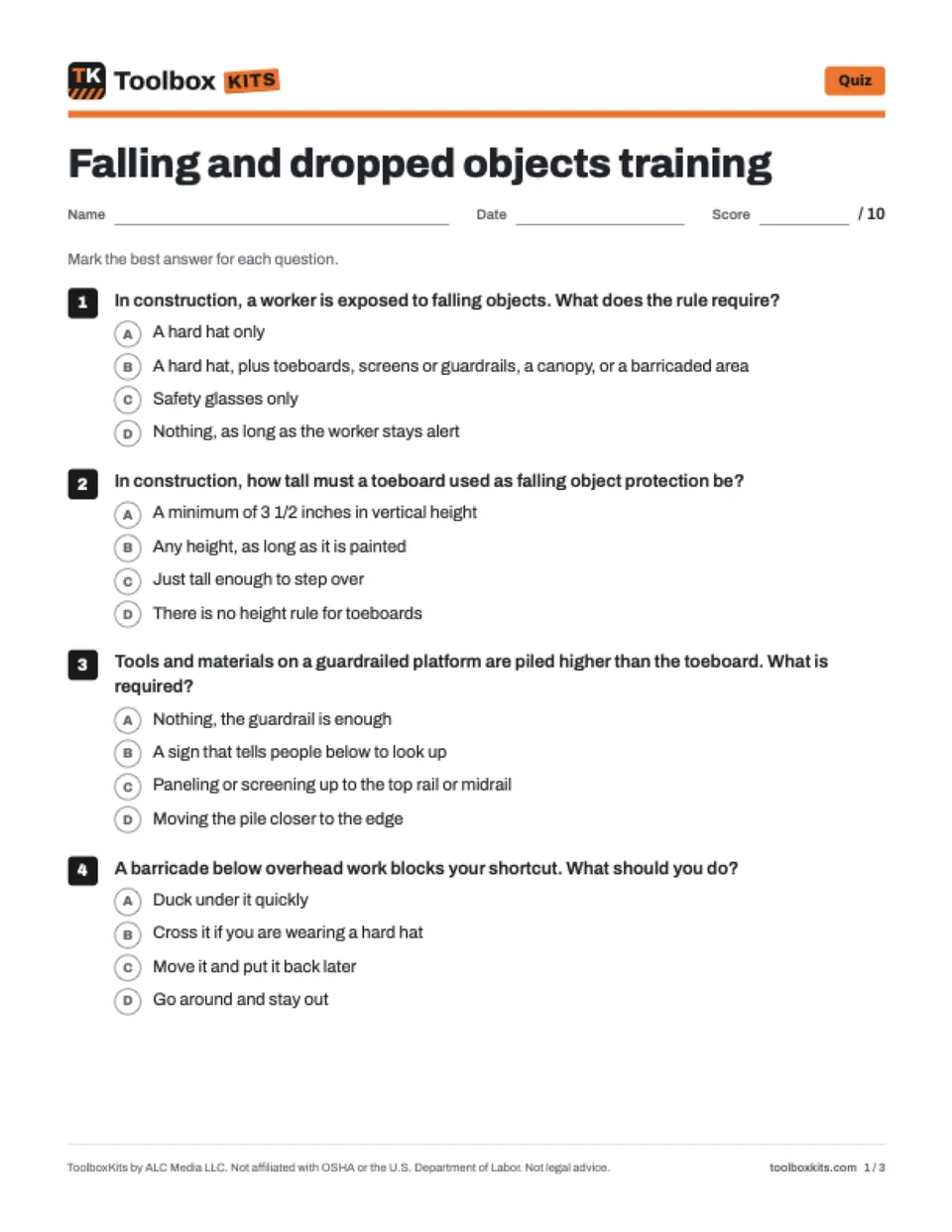 Quiz
- Answer key
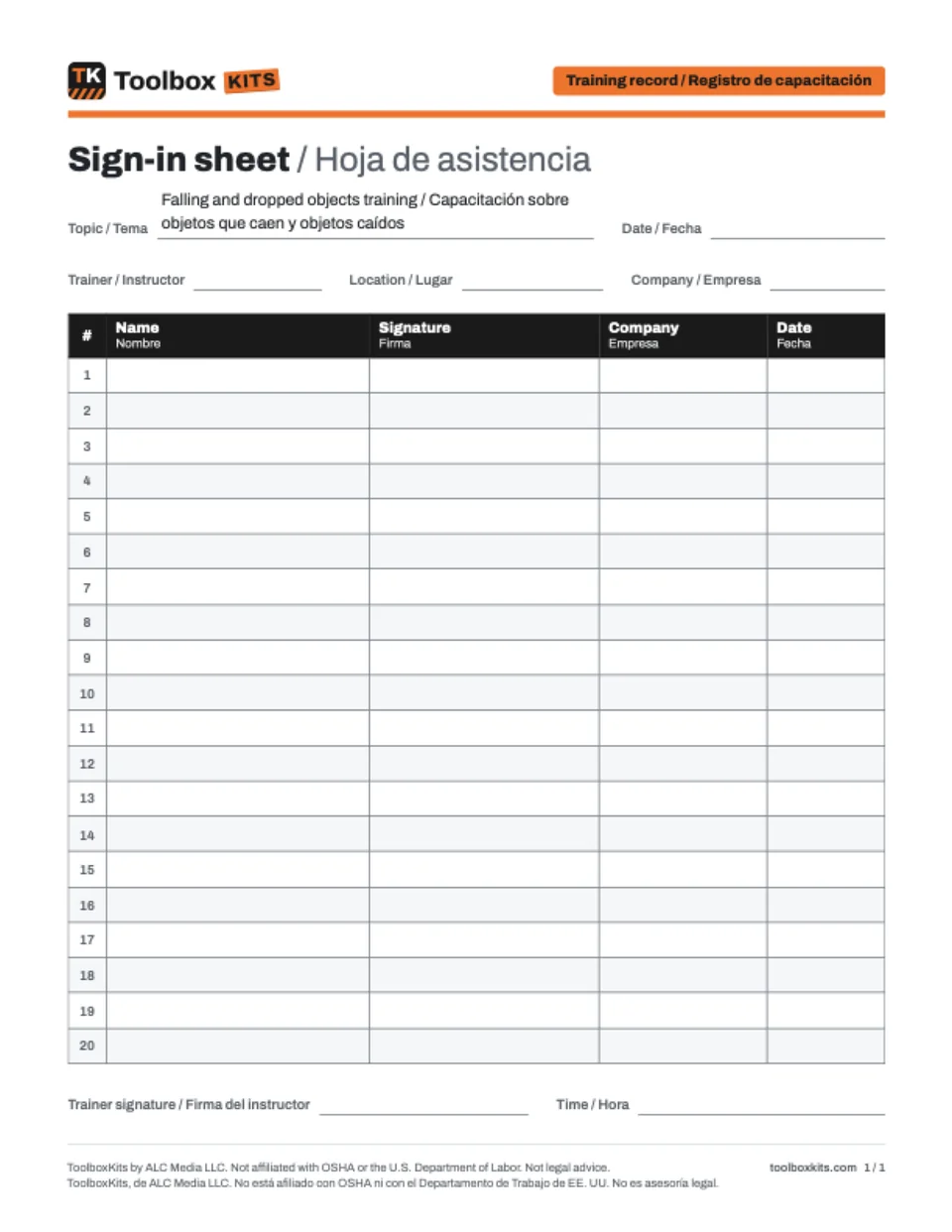 Sign-in sheet
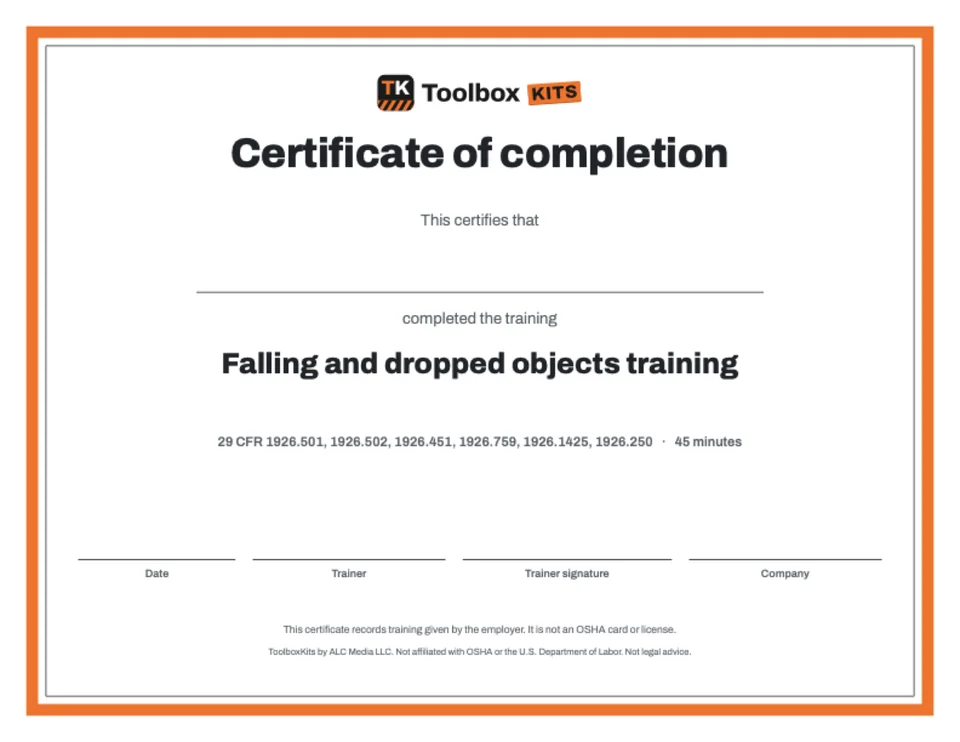 Certificate
- Crew handout
Try it
Try the quiz
Three questions from this topic. Pick an answer to see the right one and the OSHA paragraph.
Question 1 of 3
During roofing work with no guardrails at the edge, how close to the roof edge may materials and equipment be stored?
The rule
What OSHA requires
Plain-language summary. Each line links to the exact paragraph of the regulation.
In construction, when an employee is exposed to falling objects, the employer must have each employee wear a hard hat and must also use one of three measures: toeboards, screens or guardrail systems; a canopy structure with objects kept back from the edge; or a barricaded area that employees are kept out of, with objects kept back from the edge.
“When an employee is exposed to falling objects, the employer shall have each employee wear a hard hat and shall implement one of the following measures:”
In general industry, when an employee is exposed to falling objects, the employer must make sure each employee wears head protection and must also use one or more of these: toeboards, screens or guardrail systems; canopy structures with potential falling objects kept far enough from an edge, hole or opening; or a barricaded area that employees are kept out of, with objects kept back from the edge or opening.
“When an employee is exposed to falling objects, the employer must ensure that each employee wears head protection that meets the requirements of subpart I of this part.”
In construction, each employee on a walking/working surface must be protected from objects falling through holes, including skylights, by covers.
“Each employee on a walking/working surface shall be protected from objects falling through holes (including skylights) by covers.”
Where tools, equipment or materials are piled higher than the top edge of a toeboard, paneling or screening must be erected up to the top rail or midrail of the guardrail system, for a distance sufficient to protect employees below.
“Where tools, equipment, or materials are piled higher than the top edge of a toeboard, paneling or screening shall be erected”
During roofing work, materials and equipment must not be stored within 6 feet of a roof edge unless guardrails are erected at the edge. Materials piled, grouped or stacked near a roof edge must be stable and self-supporting (29 CFR 1926.502(j)(7)(ii)).
“Materials and equipment shall not be stored within 6 feet (1.8 m) of a roof edge unless guardrails are erected at the edge.”
Besides wearing hard hats, each employee on a scaffold must be protected from falling hand tools, debris and other small objects by toeboards, screens or guardrail systems, or by debris nets, catch platforms or canopy structures. Objects too large or heavy for those measures must be placed away from the edge and secured as necessary to keep them from falling.
“In addition to wearing hardhats each employee on a scaffold shall be provided with additional protection from falling hand tools, debris, and other small objects”
In steel erection, all materials, equipment and tools that are not in use while aloft must be secured against accidental displacement.
“All materials, equipment, and tools, which are not in use while aloft, shall be secured against accidental displacement.”
On crane work, while the operator is not moving a suspended load, no employee may be within the fall zone except employees hooking, unhooking or guiding the load, making the initial attachment of the load to a component or structure, or operating a concrete hopper or concrete bucket.
“While the operator is not moving a suspended load, no employee must be within the fall zone, except for employees:”
In construction, all materials stored in tiers must be stacked, racked, blocked, interlocked or otherwise secured to prevent sliding, falling or collapse.
“All materials stored in tiers shall be stacked, racked, blocked, interlocked, or otherwise secured to prevent sliding, falling or collapse.”
In construction, whenever materials are dropped more than 20 feet to any point outside the exterior walls of the building, an enclosed chute of wood or equivalent material must be used.
“Whenever materials are dropped more than 20 feet to any point lying outside the exterior walls of the building, an enclosed chute of wood, or equivalent material, shall be used.”
Who must be trained
Each employee who works on a scaffold must be trained by a person qualified in the subject matter, and the training must include, as applicable, the nature of any falling object hazards in the work area and the correct procedures for erecting, maintaining and disassembling the falling object protection systems being used (29 CFR 1926.454(a)(1) and (a)(2)). In construction, each employee who might be exposed to fall hazards must be trained, as necessary, by a competent person in areas that include the correct procedures for handling and storing equipment and materials and erecting overhead protection (29 CFR 1926.503(a)(1) and (a)(2)(vi)).
When to retrain
On scaffold work, the employer must retrain an employee when there is reason to believe the employee lacks the skill or understanding needed, including when changes in the types of scaffolds, fall protection, falling object protection or other equipment present a hazard the employee has not been trained on (29 CFR 1926.454(c) and (c)(2)).

Common questions
Questions people ask
What is the difference between falling objects and dropped objects?
People often use the two terms for the same thing: anything that falls from height and could hit someone below. Some crews say dropped objects for items that slip from a hand, belt or platform, and falling objects for anything that comes loose, like stacked material or debris. Either way, in construction the protection required when workers are exposed to falling objects is the same: a hard hat plus toeboards, screens or guardrails, or a canopy or barricaded area with objects kept back from the edge (29 CFR 1926.501(c)).
What should an overhead hazards safety talk cover?
Cover what could fall from above, how tools and materials are secured, edge protection like toeboards and screens, barricaded areas below the work, staying out from under suspended loads and wearing hard hats. Walk the site and look up together before the talk ends. On crane work, no one may be in the fall zone while the operator is not moving a suspended load, except workers hooking, unhooking or guiding the load, making its initial attachment, or operating a concrete hopper or bucket (29 CFR 1926.1425(b)).
Does OSHA require tool tethering?
OSHA's falling object rules for construction do not mention tool tethers by name. Instead, they require protection when workers are exposed to falling objects: a hard hat plus toeboards, screens or guardrails, or a canopy or barricaded area with objects kept back from the edge (29 CFR 1926.501(c)). In steel erection, materials, equipment and tools not in use while aloft must be secured against accidental displacement (29 CFR 1926.759(a)). Tethers rated for the tool are a practical way to keep tools from falling, and this free printable talk is a good way to start that conversation with your crew.
How do you run a quick dropped object safety moment?
Have everyone look up and name one thing above them that could fall. Pick one fix to make before work starts, like moving material back from an edge or bagging loose tools. It takes a few minutes and works well before any overhead work begins.
Is there a falling objects safety presentation for longer training?
This free talk is written to be read aloud, so you can run it without slides. If you want a falling or dropped objects safety presentation with slides, use the training kit option on this page. Workers on scaffolds must also be trained by a qualified person, and that training includes, as applicable, the falling object hazards in the work area and the correct procedures for erecting, maintaining and disassembling the falling object protection systems being used (29 CFR 1926.454(a)(1) and (a)(2)).
Free to share
Use this talk for free
You can print, share and adapt this talk at no cost under the Creative Commons BY-NC-SA 4.0 license. Please credit ToolboxKits with a link.