

Free 5-minute toolbox talkHealth and wellnessEnglish and Spanish
Dust toolbox talk: dust control on the job
When we cut, grind, drill, sand or sweep, dust gets into the air. The finest particles are too small to see and can travel deep into your lungs. What OSHA requires: To meet those limits in construction, administrative or engineering controls must be implemented first whenever feasible (29 CFR 1926.55(b)).
A free 5-minute talk on controlling dust from cutting, grinding, drilling, sanding and sweeping. It covers silica and wood dust, controls at the tool, safe cleanup and respirators, with citations to the OSHA rules.
Updated October 29, 2026 · Based on 29 CFR 1926.1153, 29 CFR 1926.55
Read it out loud
Free 5-minute toolbox talk
Read it out loud to your crew. It takes about 5 minutes.
Start with a question
What is making dust on this site today, and how much of it ends up in the air you breathe?
Why it matters
When we cut, grind, drill, sand or sweep, dust gets into the air. The finest particles are too small to see and can travel deep into your lungs. Over time, some dusts can cause lung disease, asthma or cancer, and some of that damage cannot be undone.
Key points
Know what is in your dust
Concrete, block, brick, mortar, many types of stone and engineered stone contain crystalline silica, and breathing silica dust can cause silicosis, lung cancer and kidney disease. Wood dust can irritate your eyes, nose, throat and skin and cause asthma, and some wood dusts can cause cancer.
More
OSHA's hazard communication standard does not exempt wood that may be sawed or cut, generating dust. Check the safety data sheet (SDS) for what you cut, grind or sand.
Pick a method that makes less dust
The best dust is the dust you never make. Under OSHA's air contaminant rules for construction, engineering or administrative controls must be used first whenever feasible, with protective equipment used when those controls cannot fully meet the exposure limits.
More
Choose methods that make less dust, like splitting pavers instead of sawing them or scoring and snapping drywall.
Control dust at the tool
Use tools with a water feed or a shroud hooked to a vacuum or dust collector, and keep the water or vacuum running the whole time.
More
For construction tasks listed in Table 1 of OSHA's silica standard, the employer must fully and properly put the listed engineering controls, work practices and respiratory protection in place, unless it assesses and limits exposure another way. When Table 1 calls for wet methods, water must flow fast enough to minimize the release of visible dust. If you see a dust cloud, stop and fix the control.
29 CFR 1926.1153(c)(1) · 29 CFR 1926.1153(c)(2)(ii)
Clean up without making more dust
The employer must not allow dry sweeping or dry brushing that could add to silica exposure unless wet sweeping, HEPA-filtered vacuuming or other methods that minimize the likelihood of exposure are not feasible. The same standards restrict cleaning clothes or surfaces with compressed air.
More
Use a HEPA vacuum or wet the dust down, and empty dust bags and collectors carefully.
29 CFR 1926.1153(f)(1) · 29 CFR 1926.1153(f)(1) and 29 CFR 1910.1053(h)(1) · 29 CFR 1926.1153(f)(2) and 29 CFR 1910.1053(h)(2)
Use respirators as backup, not the first fix
A respirator backs up dust controls; it does not replace them. OSHA's respiratory protection standard, which construction also follows, calls for engineering controls first, as far as feasible, and appropriate respirators when those controls are not feasible or while they are being put in place.
More
A tight-fitting respirator must be fit tested before first use, whenever you switch facepieces and at least annually, and your employer may not let you wear one with facial hair that comes between the seal and your face.
29 CFR 1910.134(a)(1) · 29 CFR 1926.103 · 29 CFR 1910.134(f)(2) and (g)(1)(i)(A)
Leave the dust at work
Bag or cover dusty waste before you move it; in construction, containers for hazardous wastes such as harmful dusts must have covers. Wash your hands and face before you eat, drink or smoke. HEPA vacuum your clothes or change them before you get in your vehicle, so you do not carry dust home.
Scenario
Picture this: Two workers are sanding drywall and cutting hardwood trim in a closed room. The saw's dust bag is full, so they pull it off and keep cutting. At lunch, one dry sweeps the floor, the other blows off his shirt with an air hose, and they eat right there. What went wrong, and what should they have done differently?
Ask the crew
- Which tasks on our job make the most dust, and what control does each one use?
- How do we check that the water feed or vacuum works before we cut?
- What will we clean up with instead of a broom or an air hose?
Takeaway
Know what is in your dust, control it at the tool, clean up wet or with a HEPA vacuum, and use a respirator when controls are not enough.
Trainer: ______________________ Date: ____________
Credit: ToolboxKits, https://toolboxkits.com/topics/dust-control/ (CC BY-NC-SA 4.0)
The poster is also inside the paid kits.
Audit-ready records in 60 seconds
Fill in your crew and download a filled sign-in sheet for this talk. Everything is made in your browser. Names are never uploaded or stored.
Start a sign-off
Crew scan a QR code on their own phones, type their name and sign with a finger. You see the names arrive and download the signed sheet. Free, no account.
Kits
Get the kit
No subscription needed. Buy only the kit you need.
Toolbox talk kit
$4.99
- 5-minute talk, English PDF
- 5-minute talk, Spanish PDF
- Editable mini-deck (English and Spanish)
- One-page crew handout (English and Spanish)
- Bilingual sign-in sheet
- 3-question quiz with answer key (English and Spanish)
- One-page bilingual poster
- Audit-ready records in 60 seconds: fill in your crew and get a sign-in sheet and a certificate for every worker
Training kit
$9
Editable PowerPoint, 30 slides
- Editable PowerPoint with trainer notes on every slide
- Trainer guide PDF with timing and discussion tips
- 10-question quiz and answer key
- Sign-in sheet and certificate of completion with fillable fields
- One-page crew handout
- Full Spanish version of everything
- One-page bilingual poster
- Audit-ready records in 60 seconds: fill in your crew and get a sign-in sheet and a certificate for every worker
- Instant download
- Secure checkout by Stripe
- 30-day refund, no questions
Need many topics? All Access gives you every kit for $99 a year.
Inside the kit
See what is in the kit
What is in the kit
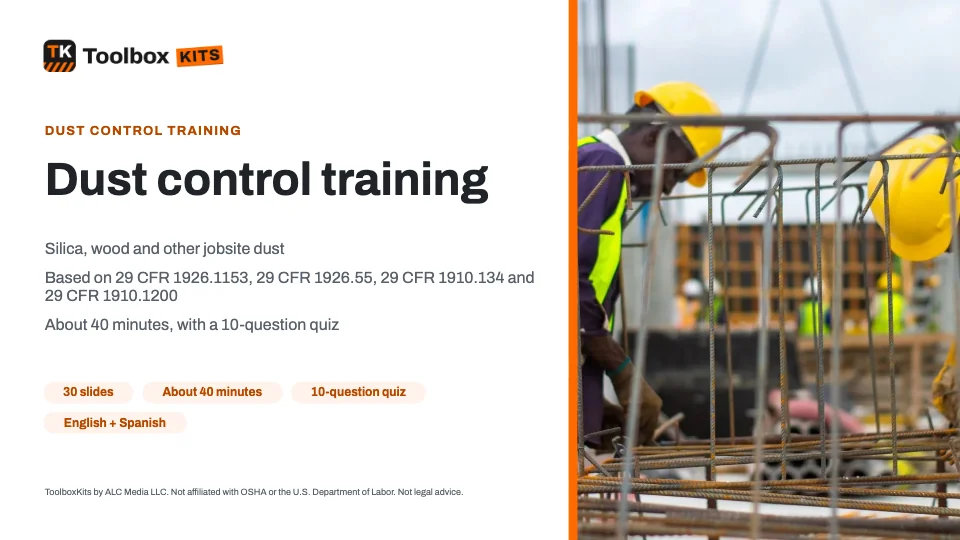 Editable PowerPoint
- Trainer guide
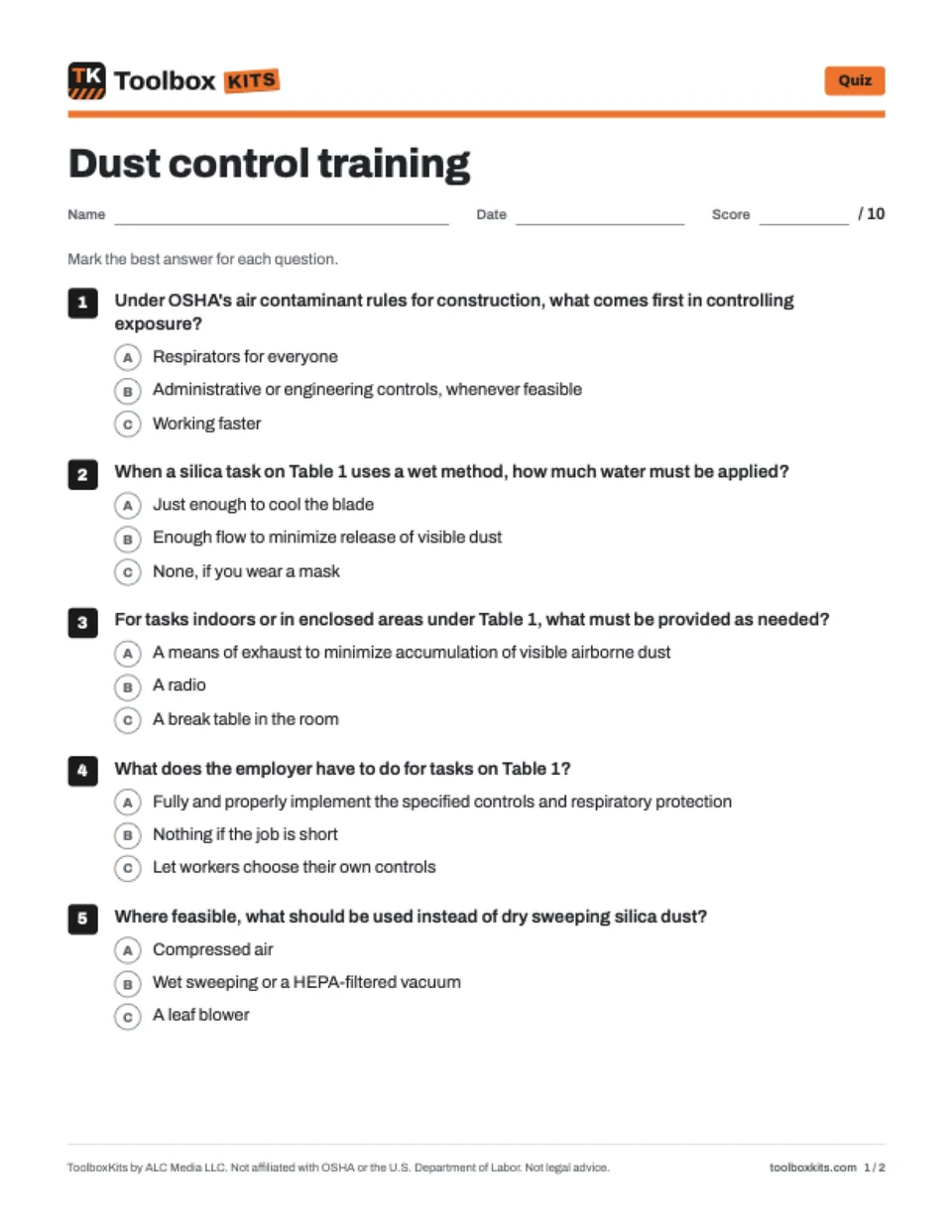 Quiz
- Answer key
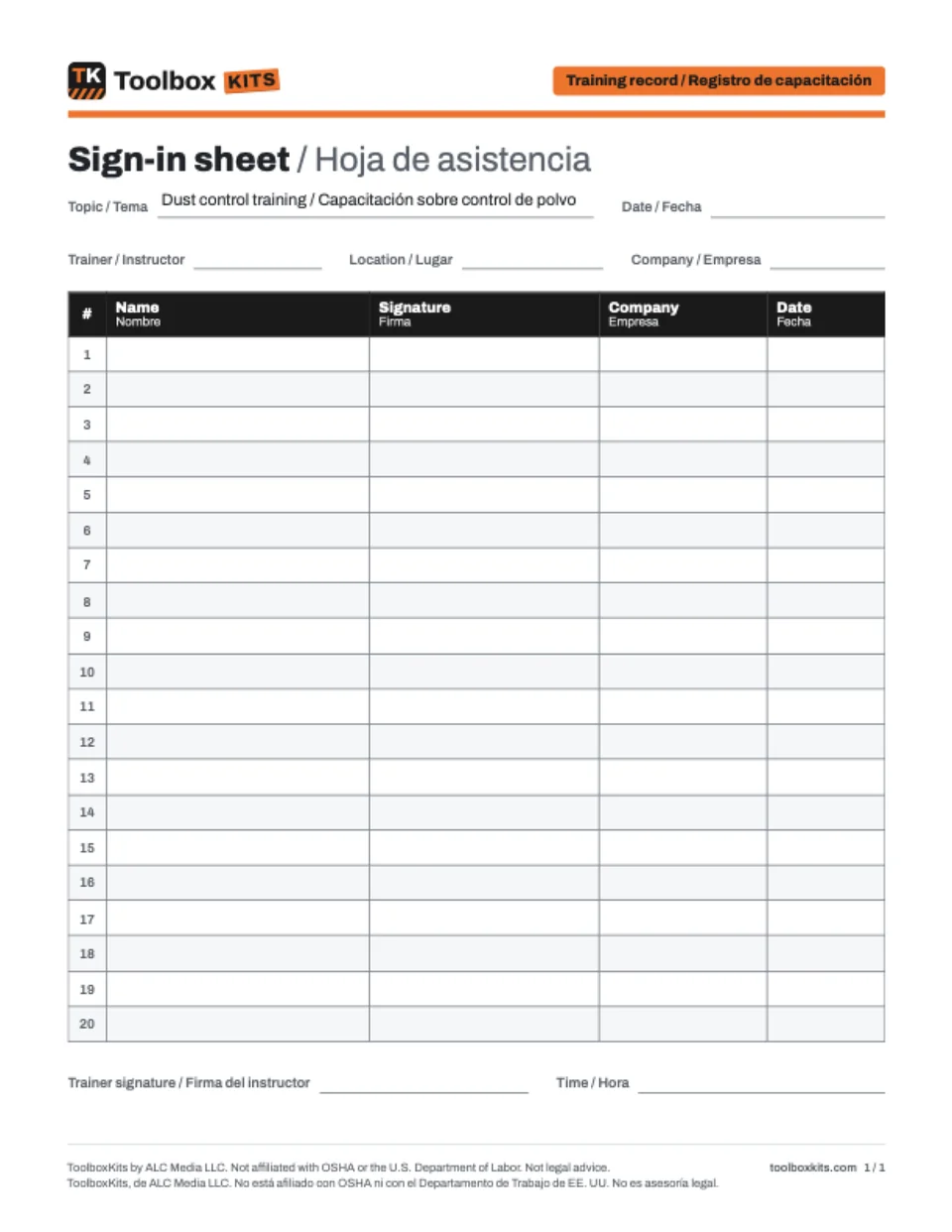 Sign-in sheet
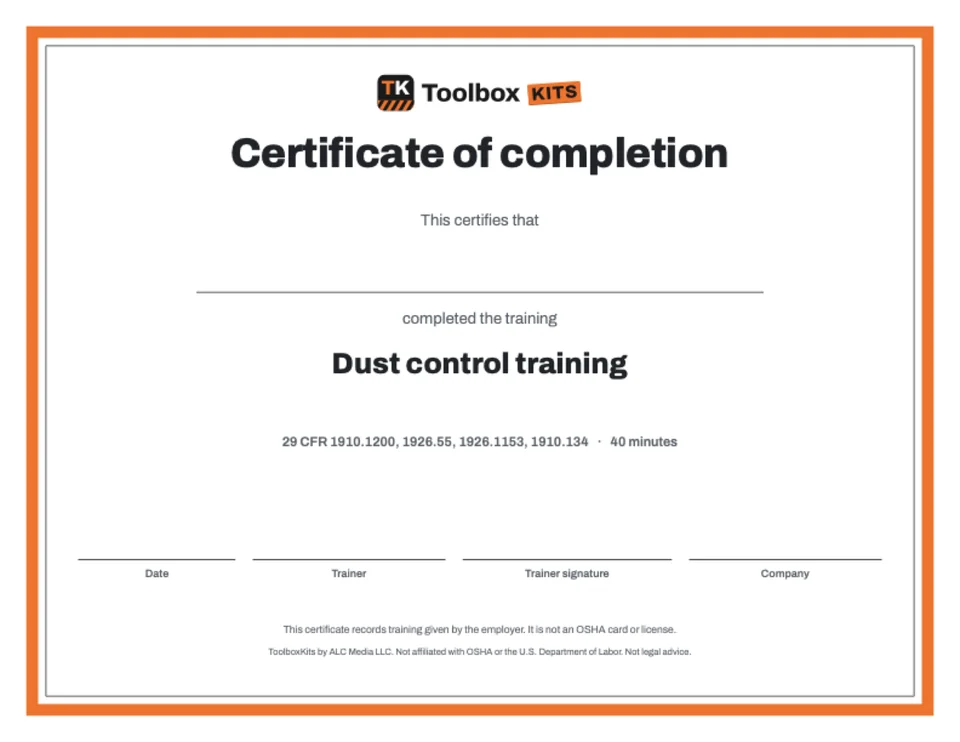 Certificate
- Crew handout
Try it
Try the quiz
Three questions from this topic. Pick an answer to see the right one and the OSHA paragraph.
Question 1 of 3
When a silica task on Table 1 uses a wet method, how much water must be applied?
The rule
What OSHA requires
Plain-language summary. Each line links to the exact paragraph of the regulation.
In construction, employers must limit each employee's exposure to any substance listed in Table 1 or Table 2 of 29 CFR 1926.55. For limits not marked as ceiling values, exposure measured from breathing-zone air samples must not exceed the limit as an 8-hour time-weighted average in any work shift (29 CFR 1926.55(a)(2)). General industry has its own air contaminant limits in Tables Z-1, Z-2 and Z-3 of 29 CFR 1910.1000.
“Employers must limit an employee's exposure to any substance listed in Table 1 or 2 of this section in accordance with the following”
To meet those limits in construction, administrative or engineering controls must be implemented first whenever feasible. When they are not feasible to achieve full compliance, protective equipment or other protective measures must be used to keep exposure within the limits, and any respirator use must comply with 29 CFR 1926.103. General industry has the same order of controls (29 CFR 1910.1000(e)).
“administrative or engineering controls must first be implemented whenever feasible”
In construction, for each employee doing a task listed on Table 1 of the silica standard, the employer must fully and properly implement the engineering controls, work practices and respiratory protection Table 1 specifies for that task, unless it assesses and limits the employee's exposure under paragraph (d) instead. When implementing Table 1, the employer must provide a means of exhaust as needed for tasks indoors or in enclosed areas to minimize the buildup of visible airborne dust, and must apply water at flow rates sufficient to minimize the release of visible dust when wet methods are used (29 CFR 1926.1153(c)(2)(i) and (ii)).
“the employer shall fully and properly implement the engineering controls, work practices, and respiratory protection specified for the task on Table 1”
In construction, for tasks not listed on Table 1, or where the Table 1 controls are not fully and properly implemented, no employee may be exposed to respirable crystalline silica above 50 micrograms per cubic meter of air, calculated as an 8-hour time-weighted average (the permissible exposure limit, or PEL). General industry has the same PEL (29 CFR 1910.1053(c)).
In construction, where dry sweeping or dry brushing could contribute to silica exposure, the employer must not allow it unless wet sweeping, HEPA-filtered vacuuming or other methods that minimize the likelihood of exposure are not feasible. Compressed air must not be used to clean clothing or surfaces where it could contribute to exposure, unless it is used with a ventilation system that effectively captures the dust cloud or no alternative method is feasible (29 CFR 1926.1153(f)(2)). General industry has the same rules (29 CFR 1910.1053(h)(1) and (h)(2)).
“The employer shall not allow dry sweeping or dry brushing where such activity could contribute to employee exposure to respirable crystalline silica”
In construction, the employer must establish and implement a written exposure control plan that describes the tasks involving silica exposure, the engineering controls, work practices and respiratory protection used for each task, the housekeeping measures used to limit exposure and the procedures used to restrict access to work areas when necessary. The employer must also designate a competent person to make frequent and regular inspections of job sites, materials and equipment to implement the plan (29 CFR 1926.1153(g)(4)).
“The employer shall establish and implement a written exposure control plan that contains at least the following elements”
In construction, each employee covered by the silica standard must be able to demonstrate knowledge and understanding of the health hazards of silica, the tasks that could expose them, the protective measures in use, the contents of the standard, the identity of the competent person and the purpose and a description of the medical surveillance program. General industry has a similar list, without the competent person item (29 CFR 1910.1053(j)(3)(i)).
“The employer shall ensure that each employee covered by this section can demonstrate knowledge and understanding of at least the following”
Under OSHA's respiratory protection standard, which construction also follows (29 CFR 1926.103), the primary objective in controlling diseases caused by breathing air contaminated with harmful dusts and other contaminants is to prevent atmospheric contamination, as far as feasible by accepted engineering controls such as enclosure or confinement of the operation, general and local ventilation, and substitution of less toxic materials. When effective engineering controls are not feasible, or while they are being put in place, appropriate respirators must be used.
“the primary objective shall be to prevent atmospheric contamination”
Where respirator use is not required, an employer may provide respirators at employees' request or let employees use their own, if it determines that the use will not in itself create a hazard. If voluntary use is allowed, the employer must give users the information in Appendix D of the standard. Employees whose only respirator use is the voluntary use of filtering facepieces (dust masks) do not have to be included in a written respiratory protection program (29 CFR 1910.134(c)(2)(ii)).
“An employer may provide respirators at the request of employees or permit employees to use their own respirators, if the employer determines that such respirator use will not in itself create a hazard.”
OSHA's hazard communication standard exempts some wood and wood products, such as lumber that will not be processed where the manufacturer or importer can show the only hazard is flammability or combustibility, but not wood treated with a hazardous chemical covered by the standard or wood that may later be sawed or cut, generating dust. Employers must give employees effective information and training on hazardous chemicals in their work area at their initial assignment and whenever a new chemical hazard they have not been trained about is introduced (29 CFR 1910.1200(h)(1)). Construction follows the same rules (29 CFR 1926.59).
“wood which may be subsequently sawed or cut, generating dust, are not exempted”
Who must be trained
In construction, the employer must make sure each employee covered by the silica standard can demonstrate knowledge and understanding of the health hazards, the tasks that could expose them, the protective measures in use, the contents of the standard, the identity of the competent person and the medical surveillance program (29 CFR 1926.1153(i)(2)(i)). The silica standard covers all occupational exposure to respirable crystalline silica in construction work, except where exposure will remain below 25 micrograms per cubic meter of air as an 8-hour time-weighted average under any foreseeable conditions (29 CFR 1926.1153(a)). Under the hazard communication standard, which construction also follows (29 CFR 1926.59), employers must train employees on the hazardous chemicals in their work area at their initial assignment (29 CFR 1910.1200(h)(1)).

Common questions
Questions people ask
Is there a printable dust toolbox talk?
Yes. This dust control talk is free, and you can print it as a PDF in English or Spanish with a sign-in table. Use it before any job that involves cutting, grinding, drilling, sanding or demolition.
What should a construction dust toolbox talk cover?
Cover what is in the dust on your job, how it affects health, the controls at the tool, safe cleanup and when respirators are needed. If your crew works with concrete, masonry or stone, include the silica rules: the Table 1 controls for each task (29 CFR 1926.1153(c)(1)), the limits on dry sweeping and compressed air (29 CFR 1926.1153(f)(1) and (f)(2)), and the written plan and competent person (29 CFR 1926.1153(g)(1) and (g)(4)).
What should a wood dust safety talk cover?
Explain that wood dust can irritate the eyes, nose, throat and skin and cause asthma, and that some wood dusts can cause cancer. Cover dust collection on saws and sanders, emptying bags and collectors before they overflow, cleaning up with a vacuum instead of a broom or air hose, and when to wear a respirator. OSHA's hazard communication standard does not exempt wood that may be sawed or cut, generating dust (29 CFR 1910.1200(b)(6)(iv)).
What are the main dust control methods on a job site?
Start with a work method that makes less dust, then control it at the tool with water or a shroud connected to a vacuum or dust collector. Use exhaust ventilation indoors, clean up with wet methods or a HEPA vacuum, and use respirators as backup. OSHA's air contaminant rules for construction require engineering or administrative controls first whenever feasible, with protective equipment used when those controls cannot fully meet the exposure limits (29 CFR 1926.55(b)).
Is a dust mask enough protection from dust?
Not on its own. A dust mask (filtering facepiece) is a type of respirator under OSHA's respiratory protection standard (29 CFR 1910.134(b)), and respirators are meant to back up engineering controls, not replace them (29 CFR 1910.134(a)(1)). When a respirator is required, the employer must provide one that is suitable for the purpose and run a respiratory protection program, including fit testing for tight-fitting respirators (29 CFR 1910.134(a)(2) and (f)(2)). If your employer lets you wear a dust mask voluntarily, it must give you the information in Appendix D of the standard (29 CFR 1910.134(c)(2)(i)).
Free to share
Use this talk for free
You can print, share and adapt this talk at no cost under the Creative Commons BY-NC-SA 4.0 license. Please credit ToolboxKits with a link.