

Free 5-minute toolbox talkHealth and wellnessEnglish and Spanish
Silica dust toolbox talk
Cutting, grinding and drilling concrete, brick, block, stone and mortar throws silica dust into the air. What OSHA requires: Under the alternative exposure control methods, the employer must use engineering and work practice controls to keep exposure at or below the PEL unless it can show they are not feasible (29 CFR 1926.1153(d)(3)(i)).
A free 5-minute talk for crews who cut, grind, drill or crush concrete, stone, brick and other materials that contain crystalline silica. It covers the health risks, dust controls, cleanup and respirators, with citations to the OSHA silica standards.
Updated October 29, 2026 · Based on 29 CFR 1926.1153, 29 CFR 1910.1053
Read it out loud
Free 5-minute toolbox talk
Read it out loud to your crew. It takes about 5 minutes.
Start with a question
Who here cut, ground or drilled concrete, block, brick or stone this week, and where did the dust go?
Why it matters
Cutting, grinding and drilling concrete, brick, block, stone and mortar throws silica dust into the air. Breathing it over time can cause silicosis, lung cancer and kidney disease. Silicosis has no cure, so the real protection is keeping the dust out of the air you breathe.
Key points
Know where silica dust comes from
Crystalline silica is a natural mineral in sand, stone, concrete, brick, block, mortar and engineered stone. Cutting, grinding, drilling or crushing these materials releases dust fine enough to reach deep into your lungs, and much of it is too fine to see.
More
Where you can, pick a method that makes less dust, like splitting pavers instead of sawing them.
Know what it does to your body
Breathing silica dust can scar your lungs over time. Shortness of breath and a cough may not show up until years after the damage starts, and by then it cannot be undone.
More
OSHA's silica standard requires the employer's hazard communication program to address at least cancer, lung effects, immune system effects and kidney effects.
Use the dust controls listed for your task
In construction, Table 1 of the silica standard lists tasks and the engineering controls, work practices and respiratory protection for each. For a Table 1 task, the employer must fully and properly put those in place, unless it assesses and limits exposure under the standard's alternative methods.
More
With wet methods, the water flow must be enough to minimize the release of visible dust. Check the water or vacuum before you start, and stop if you see a dust cloud.
29 CFR 1926.1153(c)(1) · 29 CFR 1926.1153(c)(2)(ii)
Clean up with water or a HEPA vacuum
The employer must not allow dry sweeping or dry brushing where it could add to silica exposure, unless wet sweeping, HEPA-filtered vacuuming or other methods that minimize the likelihood of exposure are not feasible.
More
Compressed air may not be used to clean clothing or surfaces where it could add to exposure, unless it is used with a ventilation system that effectively captures the dust cloud or no other method is feasible. General industry has the same rules.
29 CFR 1926.1153(f)(1) · 29 CFR 1926.1153(f)(2) · 29 CFR 1910.1053(h)(1) and (h)(2)
Wear the respirator your task calls for
A respirator backs up dust controls; it does not replace them. 134. If you use a tight-fitting respirator, you must be fit tested before first use, whenever you switch to a different facepiece and at least annually. You cannot wear one with facial hair that comes between the seal and your face.
29 CFR 1926.1153(e)(1) · 29 CFR 1910.134(f)(2) · 29 CFR 1910.134(g)(1)(i)(A)
Know the plan and the competent person
In construction, the employer must set up and follow a written exposure control plan that lists the silica tasks, the controls for each, the housekeeping measures and how access is restricted when needed.
More
The employer must designate a competent person to make frequent and regular inspections of job sites, materials and equipment to carry out the plan. Workers who must wear a respirator 30 or more days a year under the standard can get medical exams at no cost.
29 CFR 1926.1153(g)(4) · 29 CFR 1926.1153(g)(1) · 29 CFR 1926.1153(h)(1)(i)
Scenario
Picture this: Two workers are cutting concrete pavers with a handheld saw. The water line keeps clogging, so one of them pulls it off to finish faster. A gray cloud drifts over a nearby crew with no respirators. At the end of the day, someone blows the dust off his jeans with the air hose. What went wrong, and what should each person have done?
Ask the crew
- Which tasks on our job make silica dust, and what control does each one use?
- How do we check that the water or vacuum is working before we cut?
- Who is our competent person for silica, and where is the written plan?
- What will we use instead of a broom or air hose to clean up today?
Takeaway
Control the dust at the tool every time, clean up with water or a HEPA vacuum, and wear the respirator your task calls for.
Trainer: ______________________ Date: ____________
Credit: ToolboxKits, https://toolboxkits.com/topics/silica/ (CC BY-NC-SA 4.0)
The poster is also inside the paid kits.
Audit-ready records in 60 seconds
Fill in your crew and download a filled sign-in sheet for this talk. Everything is made in your browser. Names are never uploaded or stored.
Start a sign-off
Crew scan a QR code on their own phones, type their name and sign with a finger. You see the names arrive and download the signed sheet. Free, no account.
Kits
Get the kit
No subscription needed. Buy only the kit you need.
Toolbox talk kit
$4.99
- 5-minute talk, English PDF
- 5-minute talk, Spanish PDF
- Editable mini-deck (English and Spanish)
- One-page crew handout (English and Spanish)
- Bilingual sign-in sheet
- 3-question quiz with answer key (English and Spanish)
- One-page bilingual poster
- Audit-ready records in 60 seconds: fill in your crew and get a sign-in sheet and a certificate for every worker
Training kit
$9
Editable PowerPoint, 40 slides
- Editable PowerPoint with trainer notes on every slide
- Trainer guide PDF with timing and discussion tips
- 10-question quiz and answer key
- Sign-in sheet and certificate of completion with fillable fields
- One-page crew handout
- Full Spanish version of everything
- One-page bilingual poster
- Audit-ready records in 60 seconds: fill in your crew and get a sign-in sheet and a certificate for every worker
- Instant download
- Secure checkout by Stripe
- 30-day refund, no questions
Need many topics? All Access gives you every kit for $99 a year.
Inside the kit
See what is in the kit
What is in the kit
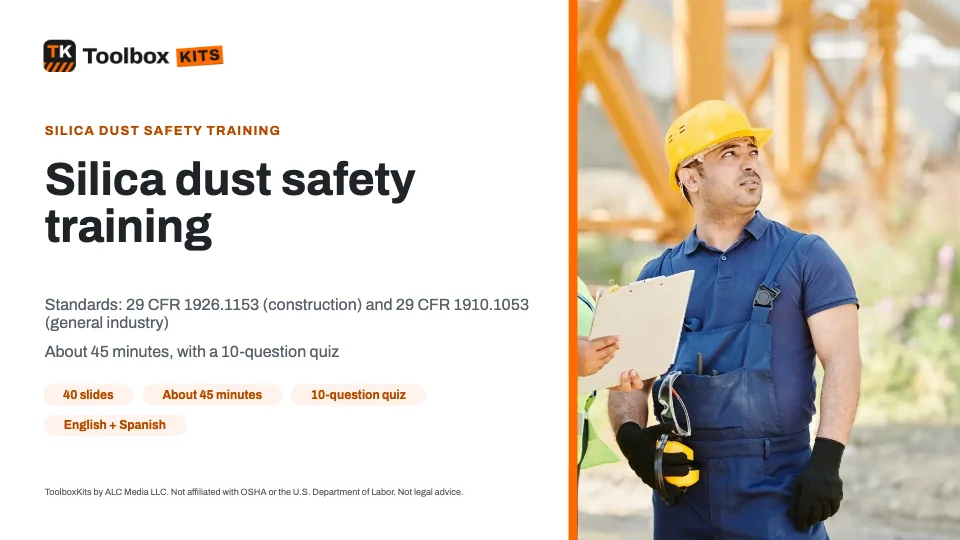 Editable PowerPoint
- Trainer guide
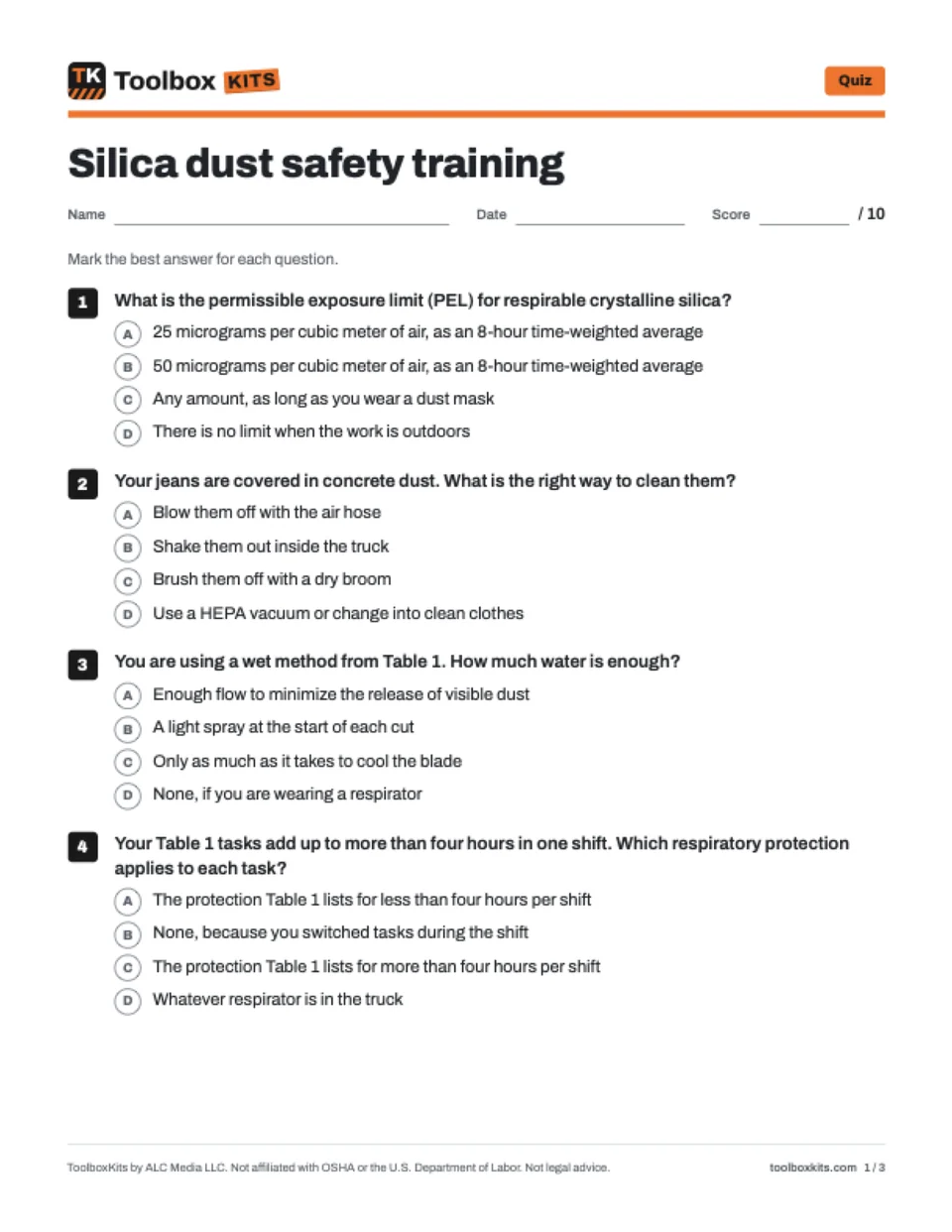 Quiz
- Answer key
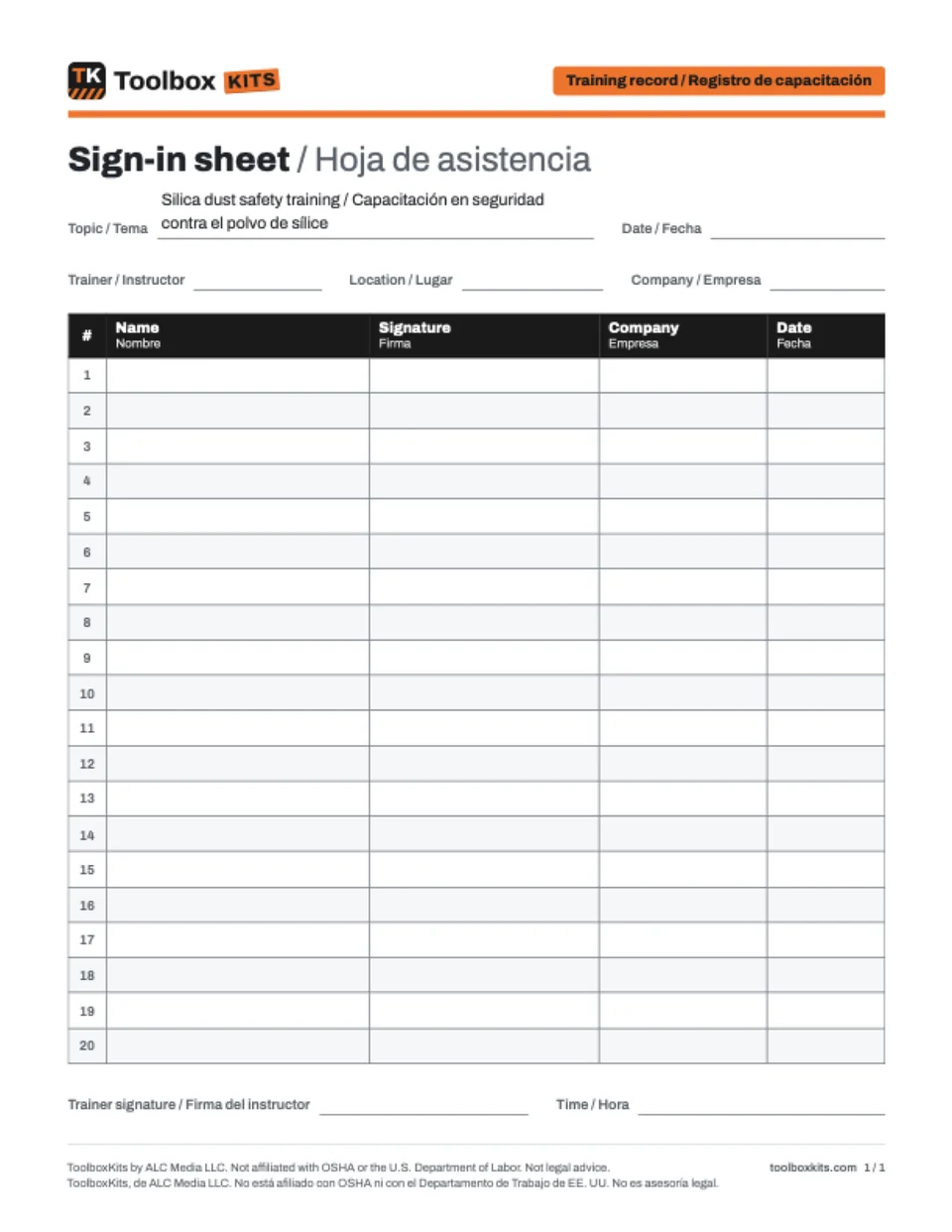 Sign-in sheet
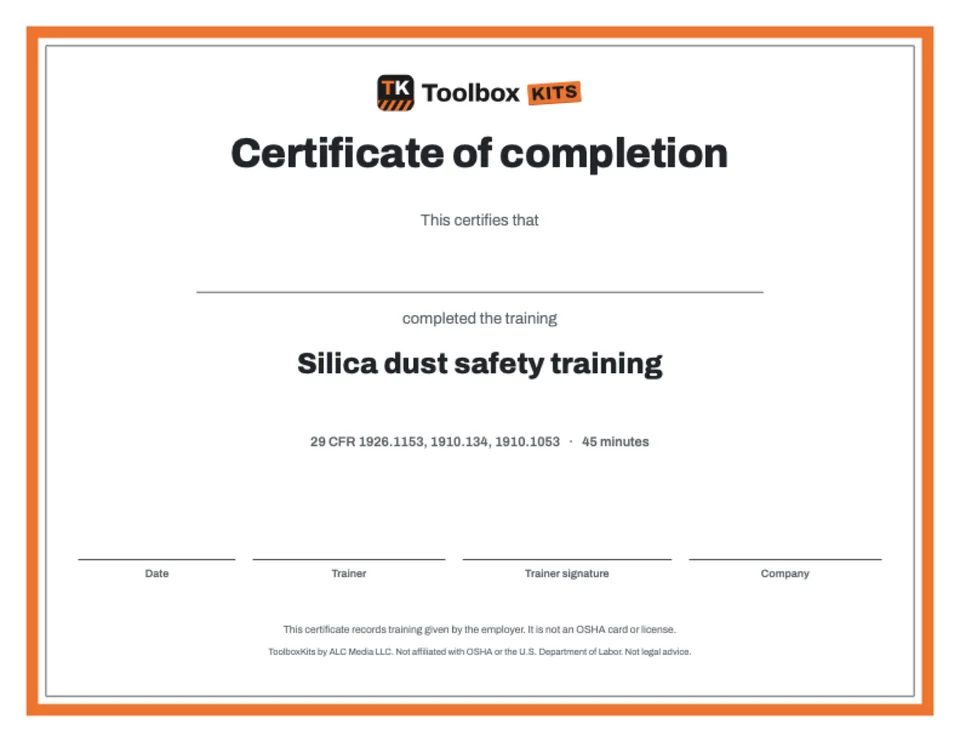 Certificate
- Crew handout
Try it
Try the quiz
Three questions from this topic. Pick an answer to see the right one and the OSHA paragraph.
Question 1 of 3
On a construction task listed on Table 1 of the silica standard, what must the employer do?
The rule
What OSHA requires
Plain-language summary. Each line links to the exact paragraph of the regulation.
In construction, for each employee doing a task listed on Table 1 of the silica standard, the employer must fully and properly implement the engineering controls, work practices and respiratory protection that Table 1 specifies for that task, unless it assesses and limits the employee's exposure under paragraph (d) instead.
“the employer shall fully and properly implement the engineering controls, work practices, and respiratory protection specified for the task on Table 1”
For tasks not listed on Table 1, or where the Table 1 controls are not fully and properly implemented, no employee may be exposed to respirable crystalline silica above 50 micrograms per cubic meter of air, calculated as an 8-hour time-weighted average (the permissible exposure limit, or PEL). The employer must assess the exposure of each employee who is or may reasonably be expected to be exposed at or above the action level (29 CFR 1926.1153(d)(2)(i)). General industry has the same PEL (29 CFR 1910.1053(c)).
Under the alternative exposure control methods, the employer must use engineering and work practice controls to keep exposure at or below the PEL unless it can show they are not feasible. Where those controls are not enough, the employer must still use them to reduce exposure to the lowest feasible level and add respiratory protection.
“The employer shall use engineering and work practice controls to reduce and maintain employee exposure to respirable crystalline silica to or below the PEL, unless the employer can demonstrate that such controls are not feasible.”
Where the silica standard requires respiratory protection, the employer must provide each employee an appropriate respirator that complies with 29 CFR 1910.134, and must set up a respiratory protection program under that standard (29 CFR 1926.1153(e)(2)).
“the employer must provide each employee an appropriate respirator that complies with the requirements of this paragraph and 29 CFR 1910.134”
Dry sweeping or dry brushing must not be allowed where it could contribute to silica exposure, unless wet sweeping, HEPA-filtered vacuuming or other methods that minimize the likelihood of exposure are not feasible. Compressed air must not be used to clean clothing or surfaces where it could contribute to exposure, unless it is used with a ventilation system that effectively captures the dust cloud or no alternative method is feasible (29 CFR 1926.1153(f)(2)). General industry has the same rules (29 CFR 1910.1053(h)(1) and (h)(2)).
“The employer shall not allow dry sweeping or dry brushing where such activity could contribute to employee exposure to respirable crystalline silica”
In construction, the employer must establish and implement a written exposure control plan that describes the tasks involving silica exposure, the controls used for each task, the housekeeping measures and the procedures used to restrict access to work areas when necessary. The plan must be reviewed at least annually and updated as necessary (29 CFR 1926.1153(g)(2)).
“The employer shall establish and implement a written exposure control plan that contains at least the following elements”
In construction, the employer must designate a competent person to make frequent and regular inspections of job sites, materials and equipment to implement the written exposure control plan.
“The employer shall designate a competent person to make frequent and regular inspections of job sites, materials, and equipment to implement the written exposure control plan.”
In construction, medical surveillance must be made available at no cost, at a reasonable time and place, to each employee who will be required by the standard to use a respirator for 30 or more days per year. In general industry, it must be made available to each employee who will be exposed at or above the action level for 30 or more days per year (29 CFR 1910.1053(i)(1)(i)).
“for each employee who will be required under this section to use a respirator for 30 or more days per year”
In construction, the employer must make sure each employee covered by the standard can demonstrate knowledge and understanding of the health hazards of silica, the tasks that could expose them, the protective measures in use, the contents of the standard, the identity of the competent person and the medical surveillance program. A copy of the standard must be readily available to them at no cost (29 CFR 1926.1153(i)(2)(ii)). General industry has the same list, without the competent person item (29 CFR 1910.1053(j)(3)(i)).
“The employer shall ensure that each employee covered by this section can demonstrate knowledge and understanding of at least the following”
In general industry, the employer must establish a regulated area wherever an employee's exposure is, or can reasonably be expected to be, above the PEL. Signs must be posted at all entrances (29 CFR 1910.1053(e)(2)(ii)), access is limited to people authorized by the employer whose work requires them to be there, employee representatives observing exposure monitoring, and people authorized under the OSH Act or its regulations (29 CFR 1910.1053(e)(3)), and each employee entering must be given an appropriate respirator and required to use it (29 CFR 1910.1053(e)(4)).
“The employer shall establish a regulated area wherever an employee's exposure to airborne concentrations of respirable crystalline silica is, or can reasonably be expected to be, in excess of the PEL.”
Who must be trained
In construction, the employer must make sure each employee covered by the silica standard can demonstrate the required knowledge (29 CFR 1926.1153(i)(2)(i)). The standard covers all occupational exposure to respirable crystalline silica in construction work, except where exposure will remain below 25 micrograms per cubic meter of air as an 8-hour time-weighted average under any foreseeable conditions (29 CFR 1926.1153(a)). In general industry, the employer has the same duty for each employee covered by 29 CFR 1910.1053 (29 CFR 1910.1053(j)(3)(i)).

Common questions
Questions people ask
Is there a printable silica toolbox talk PDF?
Yes. This silica dust talk is free, and you can print it as a PDF in English or Spanish with a sign-in table. Use it before any job that involves cutting, grinding, drilling or crushing concrete, masonry or stone.
What should a silica dust toolbox talk cover?
Cover the tasks on your job that make silica dust, the health effects, the controls for each task, cleanup without dry sweeping or compressed air, and when respirators are required. Under OSHA's construction silica standard, the employer must also make sure each covered worker can demonstrate knowledge of the contents of the standard, the identity of the competent person and the purpose of the medical surveillance program (29 CFR 1926.1153(i)(2)(i)).
Why is silica dust dangerous?
The finest particles go deep into your lungs, and breathing them over time can cause silicosis, lung cancer and kidney disease. Silicosis has no cure. OSHA's silica standards require the hazard communication program to address at least cancer, lung effects, immune system effects and kidney effects (29 CFR 1926.1153(i)(1) and 29 CFR 1910.1053(j)(1)).
Does a silica safety talk count as OSHA silica training?
Only as one part of it. The silica standards require the employer to make sure each covered employee can demonstrate knowledge and understanding of a specific list of topics, including the contents of the standard, and to train employees on silica under the hazard communication standard (29 CFR 1926.1153(i)(1) and (i)(2)(i), and 29 CFR 1910.1053(j)(1) and (j)(3)(i)). A short talk will not cover all of that, but it is a good way to refresh the training and review this week's controls.
What does OSHA require for silica dust in construction?
Employers must either follow the controls listed in Table 1 for each listed task (29 CFR 1926.1153(c)(1)) or assess exposure and keep it at or below 50 micrograms per cubic meter of air as an 8-hour time-weighted average (29 CFR 1926.1153(d)(1) and (d)(2)(i)). They also need a written exposure control plan and a competent person, must restrict dry sweeping and compressed air, and must provide respirators, medical surveillance and training where the standard requires them. General industry has its own silica standard, 29 CFR 1910.1053.
Free to share
Use this talk for free
You can print, share and adapt this talk at no cost under the Creative Commons BY-NC-SA 4.0 license. Please credit ToolboxKits with a link.