

Free 5-minute toolbox talkPeople and the crewEnglish and Spanish
Drugs and alcohol toolbox talk
Around heights, traffic, power tools or heavy equipment, that can get you or the people around you badly hurt. What OSHA requires: OSHA has no general standard on drugs and alcohol at work. In construction, the employer must still instruct each employee in recognizing and avoiding unsafe conditions and the regulations that apply to their work environment (29 CFR 1926.21(b)(2)).
A free 5-minute talk on drugs and alcohol at work. It covers impairment, prescription and over-the-counter medicines, hangovers, your company's policy and what to do when a coworker is not fit for duty, plus where OSHA rules apply.
Updated October 29, 2026 · Based on 29 CFR 1926.21
Read it out loud
Free 5-minute toolbox talk
Read it out loud to your crew. It takes about 5 minutes.
Start with a question
Would you want someone who is high, or still drunk from last night, running the machine next to you?
Why it matters
Alcohol and drugs slow your reactions, cloud your judgment and make you take chances you normally would not. Around heights, traffic, power tools or heavy equipment, that can get you or the people around you badly hurt. Impairment does not only come from illegal drugs: alcohol, some prescription medicines and even some over-the-counter medicines can do it too.
Key points
What OSHA says about drugs and alcohol
OSHA has no general standard on drugs and alcohol at work, but a few rules name them directly. In construction, no one may handle or use explosives while under the influence of intoxicating liquors, narcotics or other dangerous drugs.
More
The general duty to train still applies: in construction, the employer must instruct each employee in recognizing and avoiding unsafe conditions. Treat being impaired on the job as one of those unsafe conditions.
29 CFR 1926.21(b)(2) · 29 CFR 1926.900(c)
Know your company's policy
Many companies have a written drug and alcohol policy, often called a drug-free workplace policy. It may cover testing, what counts as being under the influence, rules for prescription medicines and what happens if someone breaks the rules. Read it before you need it.
More
If you have not seen it, ask your supervisor for a copy.
Check your medicines
Some prescription and over-the-counter medicines cause drowsiness, dizziness or slow reactions. Read the label, and ask your doctor or pharmacist whether it is safe to drive, climb or run equipment while you take it.
More
If a medicine could affect your work, follow your company's policy and tell your supervisor before you start a hazardous task. Never take someone else's prescription.
Alcohol, hangovers and the morning after
Alcohol keeps affecting you until your body clears it, and that can take hours. Coffee, a cold shower or an energy drink will not sober you up; only time does. A hangover can also slow you down and break your focus, and being high at work is not safe even where marijuana is legal.
More
Plan ahead the night before a workday, and do not drive to work if you could still be impaired.
Look out for each other
Warning signs can include the smell of alcohol, slurred speech, poor balance, glassy or red eyes, mood swings and careless mistakes. These signs can have other causes, like a medical problem, so do not try to diagnose or confront the person.
More
If you safely can, keep them off equipment, ladders and the road, and tell your supervisor right away. If someone seems to be in a medical emergency or may have overdosed, call 911.
Get help early
If you or someone you know is struggling with alcohol or drugs, getting help early is a sign of strength, not weakness. Ask whether your company has an employee assistance program (EAP), which can offer confidential counseling.
More
SAMHSA's National Helpline at 1-800-662-4357 is free and confidential, and it offers help in English and Spanish.
Scenario
Picture this: A worker shows up Monday morning after a late night. He says he feels fine, but he smells of alcohol and is slow to answer questions. The foreman has not noticed and assigns him to run the skid steer near a crew setting forms. Two coworkers notice but do not want to get him in trouble. What could happen next, and what should each person do?
Ask the crew
- What does our company's drug and alcohol policy say, and where can you get a copy?
- Which medicines could make it unsafe to drive, climb or run equipment, and who should you tell?
- How would you tell a supervisor that a coworker seems impaired?
- Where can someone on this crew get confidential help with alcohol or drugs?
Takeaway
Show up clear-headed, know how your medicines affect you, and speak up when you or a coworker is not fit for duty.
Trainer: ______________________ Date: ____________
Credit: ToolboxKits, https://toolboxkits.com/topics/drugs-and-alcohol/ (CC BY-NC-SA 4.0)
The poster is also inside the paid kits.
Audit-ready records in 60 seconds
Fill in your crew and download a filled sign-in sheet for this talk. Everything is made in your browser. Names are never uploaded or stored.
Start a sign-off
Crew scan a QR code on their own phones, type their name and sign with a finger. You see the names arrive and download the signed sheet. Free, no account.
Kits
Get the kit
No subscription needed. Buy only the kit you need.
Toolbox talk kit
$4.99
- 5-minute talk, English PDF
- 5-minute talk, Spanish PDF
- Editable mini-deck (English and Spanish)
- One-page crew handout (English and Spanish)
- Bilingual sign-in sheet
- 3-question quiz with answer key (English and Spanish)
- One-page bilingual poster
- Audit-ready records in 60 seconds: fill in your crew and get a sign-in sheet and a certificate for every worker
Training kit
$9
Editable PowerPoint, 38 slides
- Editable PowerPoint with trainer notes on every slide
- Trainer guide PDF with timing and discussion tips
- 10-question quiz and answer key
- Sign-in sheet and certificate of completion with fillable fields
- One-page crew handout
- Full Spanish version of everything
- One-page bilingual poster
- Audit-ready records in 60 seconds: fill in your crew and get a sign-in sheet and a certificate for every worker
- Instant download
- Secure checkout by Stripe
- 30-day refund, no questions
Need many topics? All Access gives you every kit for $99 a year.
Inside the kit
See what is in the kit
What is in the kit
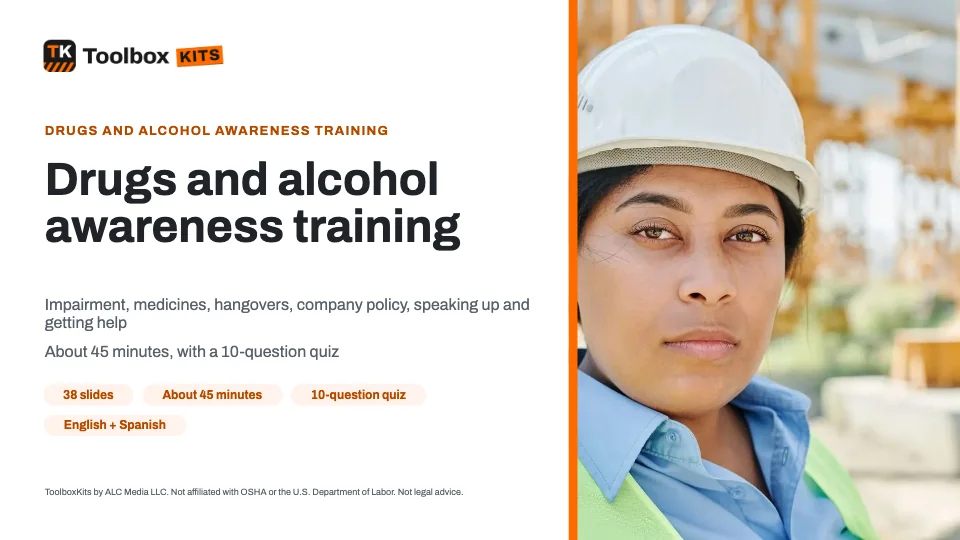 Editable PowerPoint
- Trainer guide
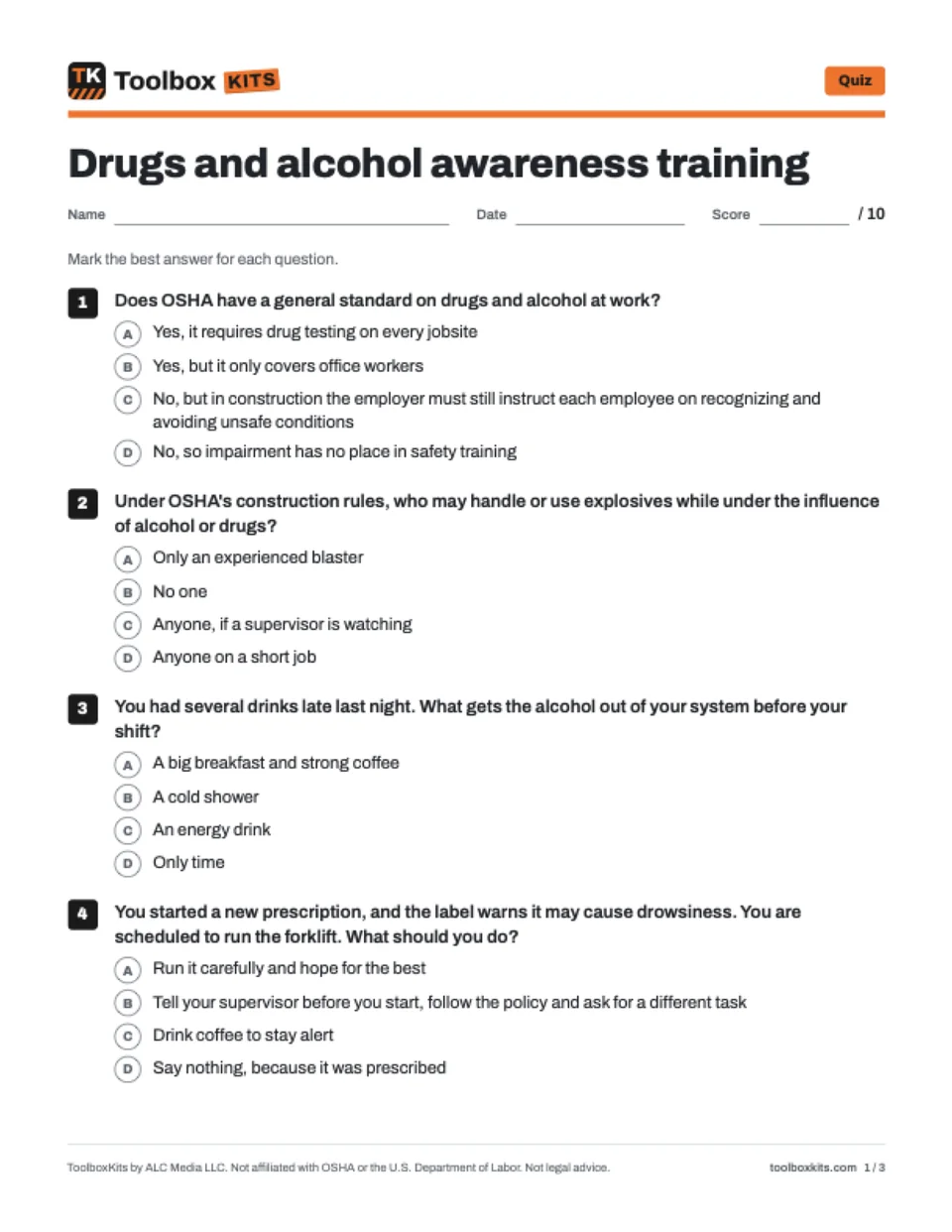 Quiz
- Answer key
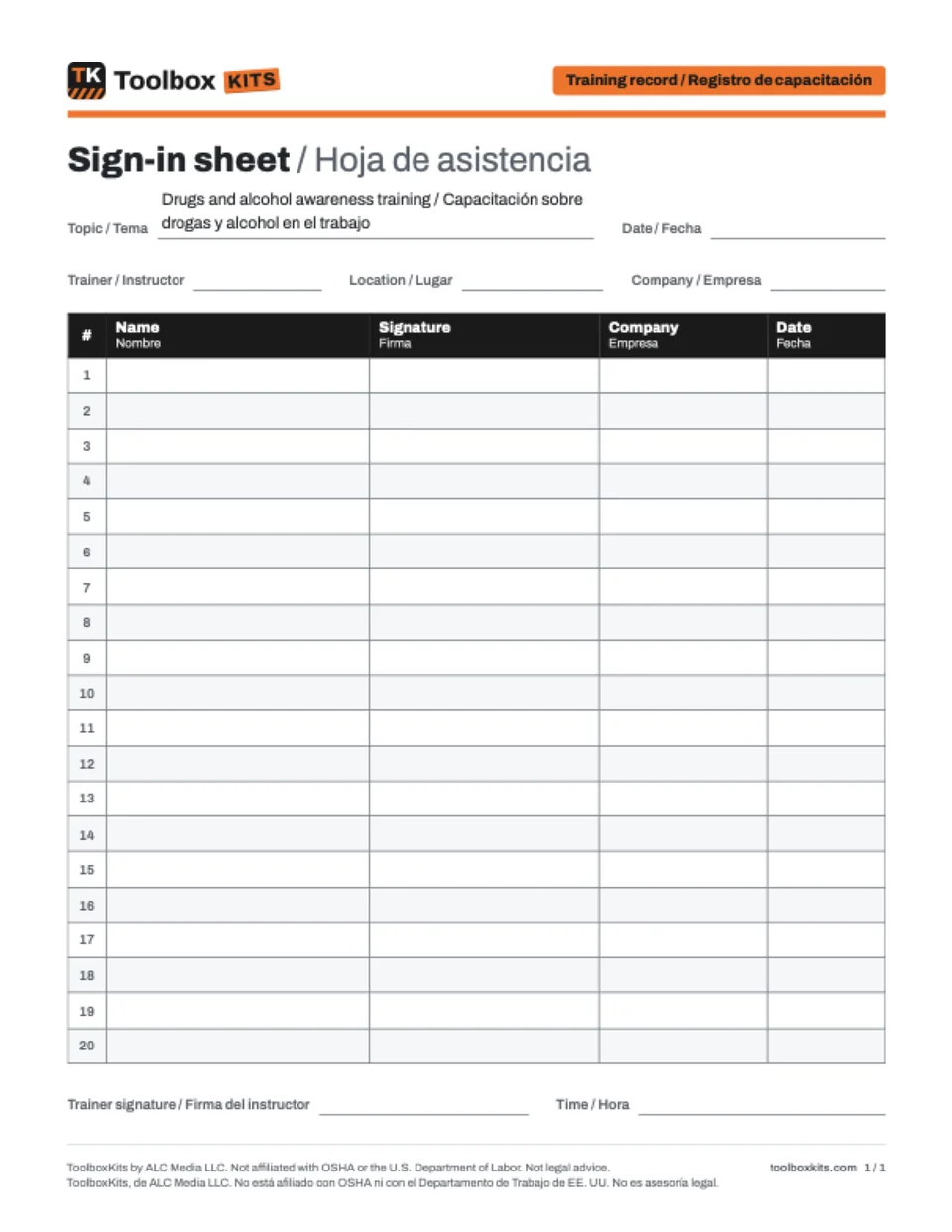 Sign-in sheet
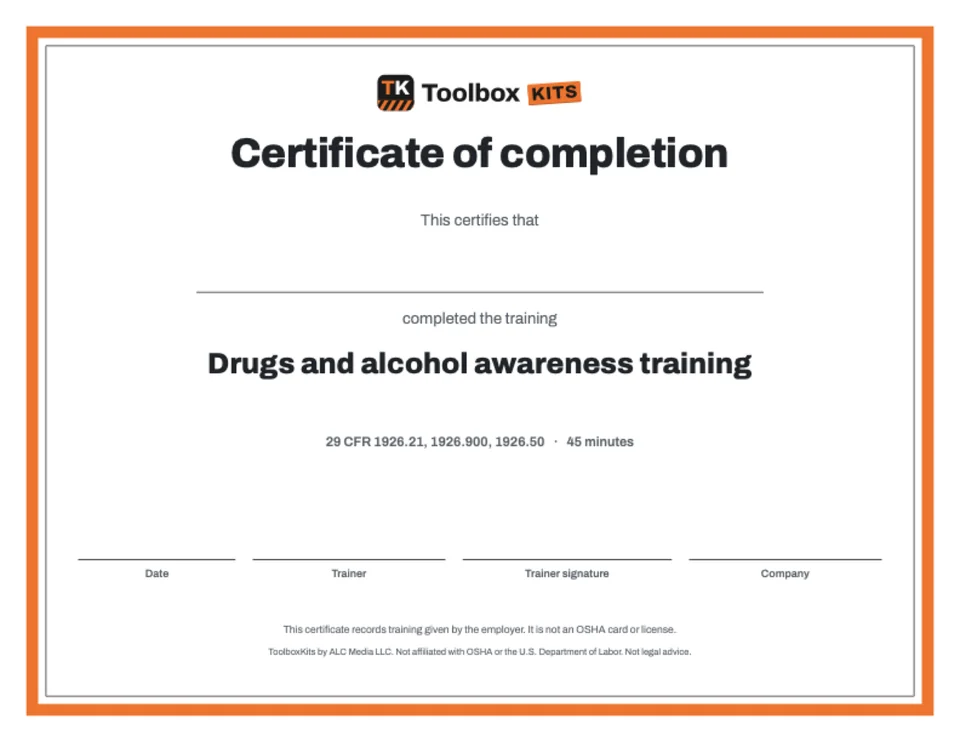 Certificate
- Crew handout
Try it
Try the quiz
Three questions from this topic. Pick an answer to see the right one and the OSHA paragraph.
Question 1 of 3
Under OSHA's construction rules, who may handle or use explosives while under the influence of alcohol or drugs?
The rule
What OSHA requires
Plain-language summary. Each line links to the exact paragraph of the regulation.
OSHA has no general standard on drugs and alcohol at work. In construction, the employer must still instruct each employee in recognizing and avoiding unsafe conditions and the regulations that apply to their work environment.
“The employer shall instruct each employee in the recognition and avoidance of unsafe conditions and the regulations applicable to his work environment to control or eliminate any hazards or other exposure to illness or injury.”
In construction, no person may handle or use explosives while under the influence of intoxicating liquors, narcotics or other dangerous drugs.
“No person shall be allowed to handle or use explosives while under the influence of intoxicating liquors, narcotics, or other dangerous drugs.”
In construction, a blaster must be in good physical condition and must not be addicted to narcotics, intoxicants or similar types of drugs.
“A blaster shall be in good physical condition and not be addicted to narcotics, intoxicants, or similar types of drugs.”
In general industry, no person may handle explosives while under the influence of intoxicating liquors, narcotics or other dangerous drugs.
“No person shall be allowed to handle explosives while under the influence of intoxicating liquors, narcotics, or other dangerous drugs.”
Who must be trained
OSHA has no training rule specific to drugs and alcohol. In construction, the employer must instruct each employee in recognizing and avoiding unsafe conditions and the regulations that apply to their work environment (29 CFR 1926.21(b)(2)).

Common questions
Questions people ask
Is there a free printable drugs and alcohol toolbox talk?
Yes. This drugs and alcohol talk is free, and you can print it as a PDF in English or Spanish with a sign-in table. It takes about five minutes to read aloud and works for construction crews, shops, warehouses and other workplaces.
Does OSHA have a standard for drugs and alcohol in the workplace?
OSHA has no general standard on drugs and alcohol at work. A few rules name them directly, such as the ban on handling explosives while under the influence of intoxicating liquors, narcotics or other dangerous drugs (29 CFR 1910.109(e)(1)(i) in general industry, and 29 CFR 1926.900(c) in construction, which also bans using them). In construction, the employer must also instruct each employee in recognizing and avoiding unsafe conditions (29 CFR 1926.21(b)(2)).
What should a drug-free workplace toolbox talk cover?
Go over what your company's policy says, including any testing and the rules for prescription medicines. Talk about how alcohol, drugs and some medicines affect safety, the warning signs of impairment, how to report a concern and where to get confidential help, such as an employee assistance program. Keep the focus on safety, not on shaming anyone.
Why are drugs and alcohol such a risk in construction?
Construction work means heights, heavy equipment, power tools and traffic, where one slow reaction or bad call can hurt you or the people around you. Alcohol and drugs slow reactions and cloud judgment, and a hangover can do the same. Showing up clear-headed and speaking up when someone is not fit for duty protects the whole crew.
What should I do if a coworker seems drunk or high at work?
If you safely can, keep them away from equipment, ladders, heights and driving, and tell your supervisor right away. Do not try to diagnose or confront them yourself, because the same signs can come from a medical problem. If they seem to be in a medical emergency, call 911.
Free to share
Use this talk for free
You can print, share and adapt this talk at no cost under the Creative Commons BY-NC-SA 4.0 license. Please credit ToolboxKits with a link.