

Free 5-minute toolbox talkPeople and the crewEnglish and Spanish
Mental health toolbox talk
Stress, burnout, anxiety, depression and substance use are health problems, not weakness, and people do get better with help. What OSHA requires: OSHA has no specific standard for mental health at work. In construction, the general duty to instruct each worker in recognizing and avoiding unsafe conditions still applies (29 CFR 1926.21(b)(2)).
A five-minute mental health talk for your crew. It covers stress and the warning signs, how to ask a coworker if they are okay, where to get help, and what OSHA does and does not require.
Updated October 29, 2026 · Based on 29 CFR 1926.21
Read it out loud
Free 5-minute toolbox talk
Read it out loud to your crew. It takes about 5 minutes.
Start with a question
When was the last time someone on this crew asked how you were really doing, and waited for the answer?
Why it matters
Everyone brings their life to work: money worries, family problems, long hours, time away from home, grief or a layoff. Stress, burnout, anxiety, depression and substance use are health problems, not weakness, and people do get better with help. They also pull your focus off the task, and on a jobsite a lost focus can get someone hurt. Looking out for each other's minds is part of looking out for each other's safety.
Key points
Know the warning signs
Watch for changes in a coworker: pulling away from the crew, being unusually quiet or angry, more mistakes or near misses, coming in late or missing days, or drinking or using more. Talk about feeling hopeless, trapped or like a burden is a serious warning sign.
More
You do not need to diagnose anything. You just need to notice and care enough to ask.
Ask, then listen
" Then listen without judging, arguing or trying to fix everything. If you are worried they might hurt themselves, it is okay to ask directly if they are thinking about suicide. Stay with them and help them connect with support.
Know where to get help
If your company has an employee assistance program (EAP), find out how to reach it before you need it. Anyone can call or text 988 to reach the 988 Suicide and Crisis Lifeline, any time, day or night. If someone is in immediate danger, call 911 and stay with them.
More
In construction, where 911 service is not available, the phone numbers of doctors, hospitals or ambulances must be posted where everyone can see them.
Stress, fatigue and substances affect safety
Worry, lack of sleep, alcohol, drugs and some medications slow your reactions and cloud your judgment. On a jobsite, that can mean a missed step, a hand in a pinch point or a wrong move with equipment. If you are not fit to do a task safely today, say so.
More
Asking for a different task is better than getting hurt.
Keep it private and make it normal
Leaders set the tone: talk about stress openly, and never joke about someone getting help. If a coworker opens up to you, keep it between you, unless someone's safety is at risk.
More
OSHA's recordkeeping rule treats mental illnesses as privacy concern cases, so the employer may not enter the worker's name on the OSHA 300 Log.
29 CFR 1904.29(b)(7)(iii) · 29 CFR 1904.29(b)(6)
Take care of your own head too
Sleep, food, water and time off the job all help you handle stress. Stay connected with family and friends, and talk to someone you trust when things pile up. Go easy on alcohol, because it can make stress and sleep worse. Asking for help is a sign of strength.
Scenario
Picture this: a reliable crew member has been showing up late, snapping at people and making small mistakes for a couple of weeks. Yesterday he almost stepped off a deck edge without looking. At lunch he jokes that nobody would notice if he did not come back. What should his coworkers and the foreman do today?
Ask the crew
- What changes in a coworker would make you stop and ask if they are okay?
- Where can someone on this crew get help, and does everyone have 988 saved in their phone?
- What makes it hard to talk about stress on a jobsite, and what would make it easier?
- How can we check on each other without making it awkward?
Takeaway
Ask how people are really doing, listen without judging, and help them get to the right support.
Trainer: ______________________ Date: ____________
Credit: ToolboxKits, https://toolboxkits.com/topics/mental-health/ (CC BY-NC-SA 4.0)
The poster is also inside the paid kits.
Audit-ready records in 60 seconds
Fill in your crew and download a filled sign-in sheet for this talk. Everything is made in your browser. Names are never uploaded or stored.
Start a sign-off
Crew scan a QR code on their own phones, type their name and sign with a finger. You see the names arrive and download the signed sheet. Free, no account.
Kits
Get the kit
No subscription needed. Buy only the kit you need.
Toolbox talk kit
$4.99
- 5-minute talk, English PDF
- 5-minute talk, Spanish PDF
- Editable mini-deck (English and Spanish)
- One-page crew handout (English and Spanish)
- Bilingual sign-in sheet
- 3-question quiz with answer key (English and Spanish)
- One-page bilingual poster
- Audit-ready records in 60 seconds: fill in your crew and get a sign-in sheet and a certificate for every worker
Training kit
$9
Editable PowerPoint, 38 slides
- Editable PowerPoint with trainer notes on every slide
- Trainer guide PDF with timing and discussion tips
- 10-question quiz and answer key
- Sign-in sheet and certificate of completion with fillable fields
- One-page crew handout
- Full Spanish version of everything
- One-page bilingual poster
- Audit-ready records in 60 seconds: fill in your crew and get a sign-in sheet and a certificate for every worker
- Instant download
- Secure checkout by Stripe
- 30-day refund, no questions
Need many topics? All Access gives you every kit for $99 a year.
Inside the kit
See what is in the kit
What is in the kit
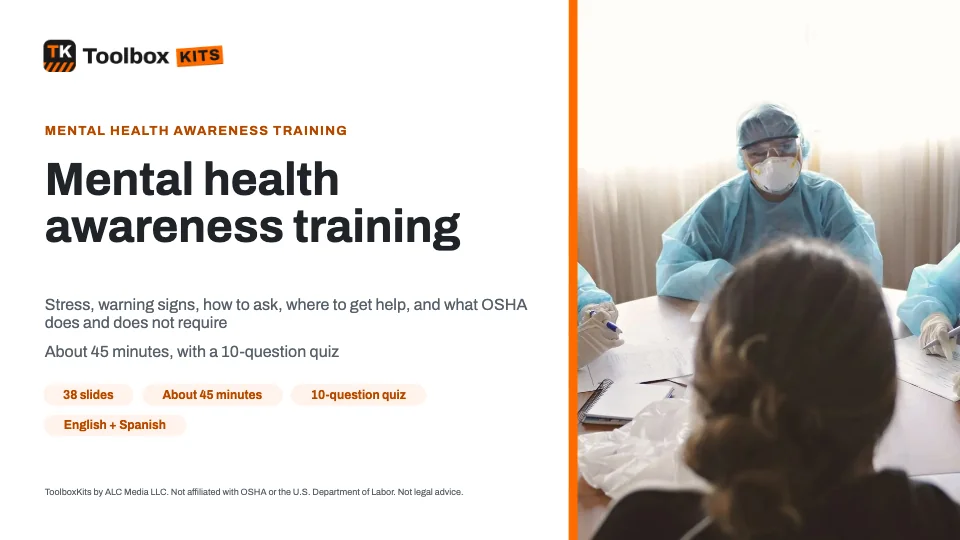 Editable PowerPoint
- Trainer guide
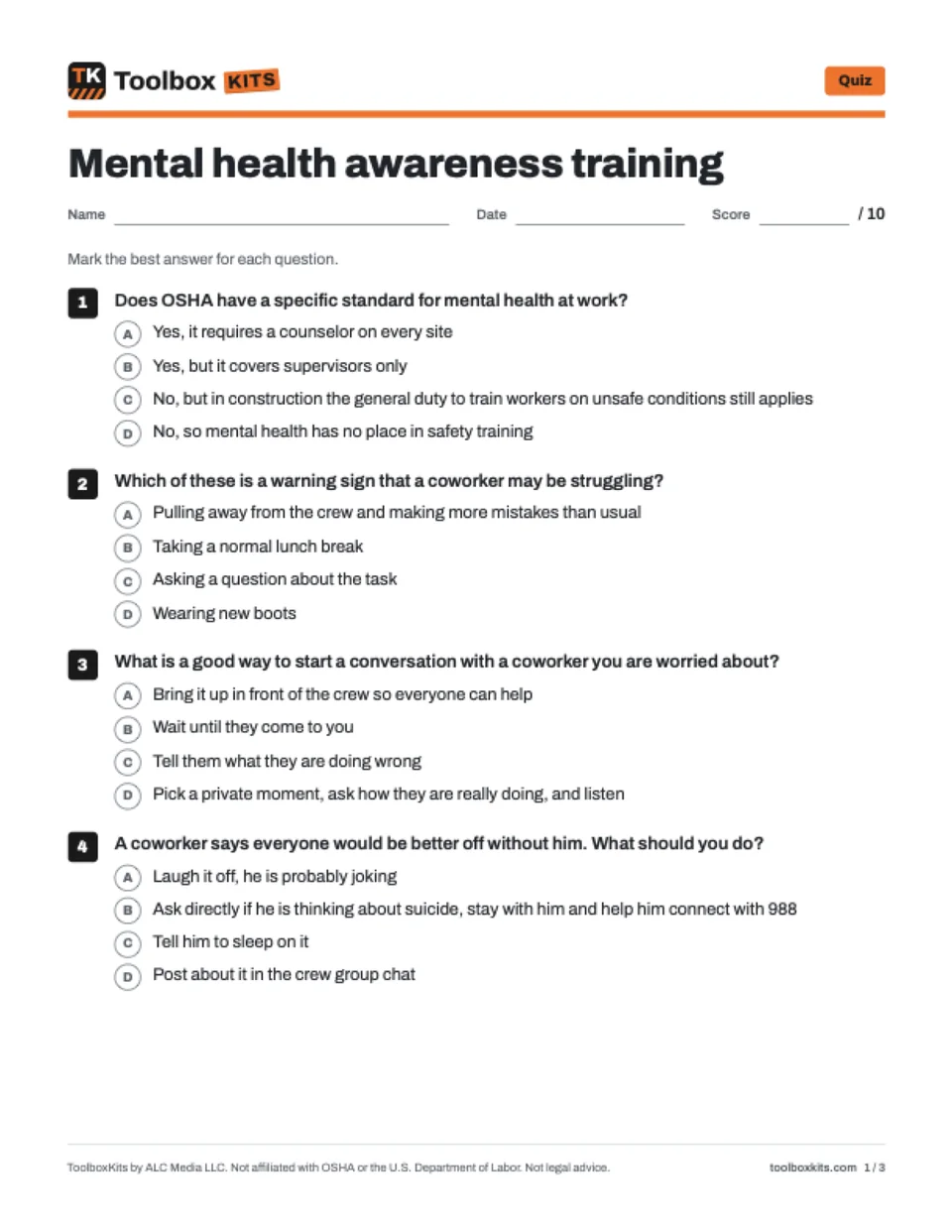 Quiz
- Answer key
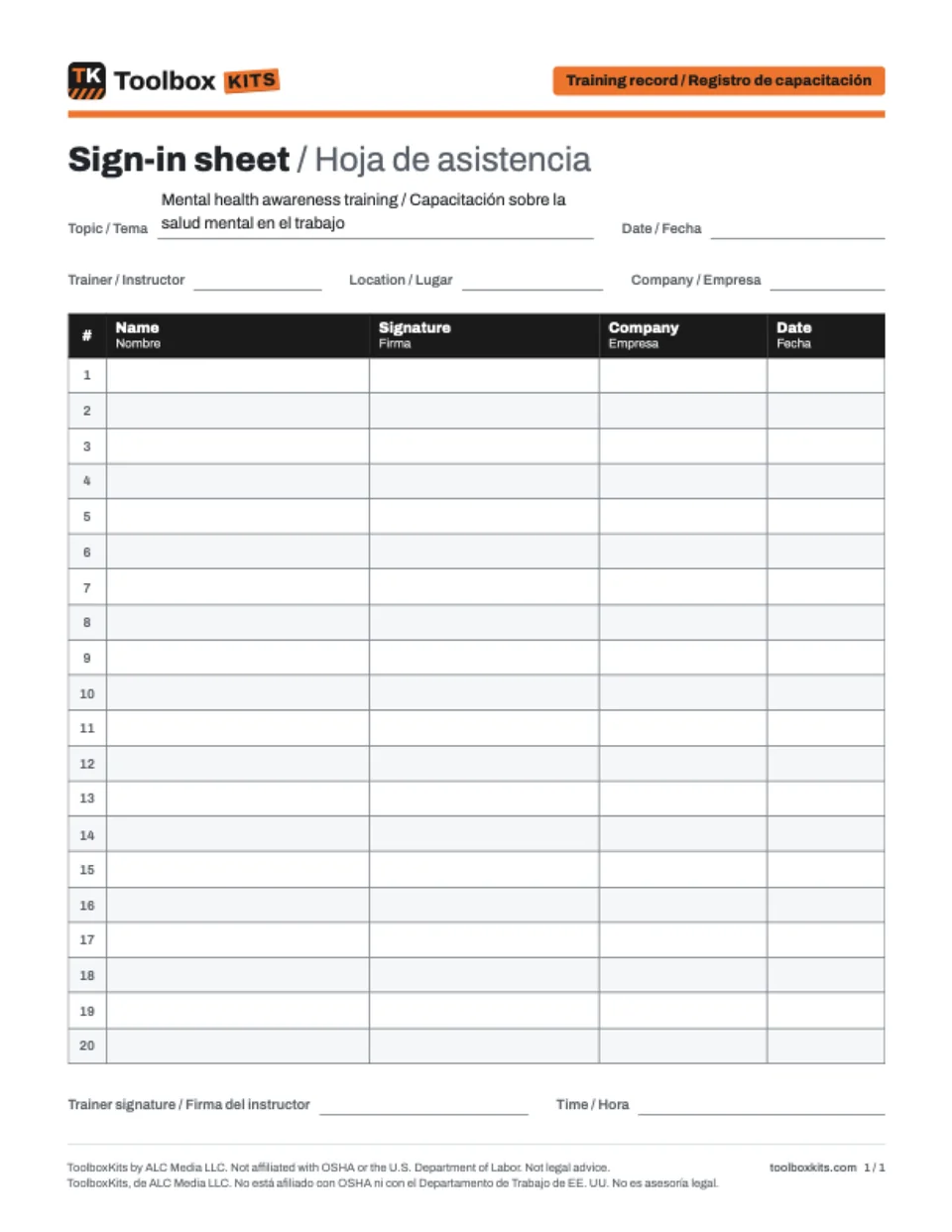 Sign-in sheet
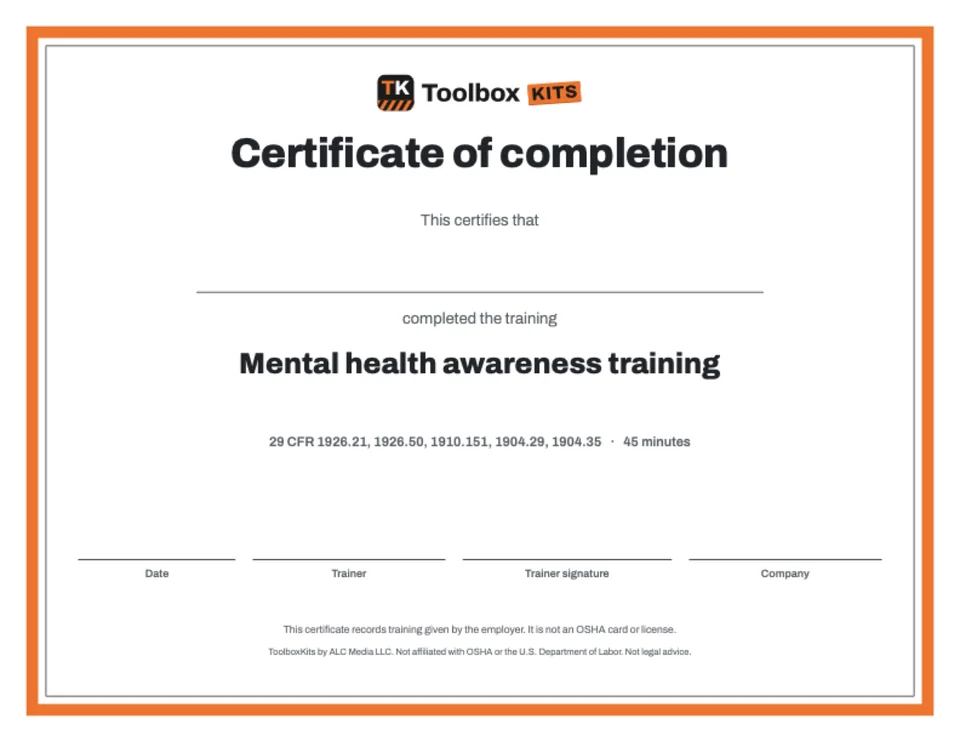 Certificate
- Crew handout
Try it
Try the quiz
Three questions from this topic. Pick an answer to see the right one and the OSHA paragraph.
Question 1 of 3
A coworker has been quiet, short-tempered and making mistakes for a few weeks. What is a good first step?
The rule
What OSHA requires
Plain-language summary. Each line links to the exact paragraph of the regulation.
OSHA has no specific standard for mental health at work. In construction, the general duty to instruct each worker in recognizing and avoiding unsafe conditions still applies.
“The employer shall instruct each employee in the recognition and avoidance of unsafe conditions and the regulations applicable to his work environment”
Construction: before a project starts, the employer must arrange for prompt medical attention in case of serious injury.
“Provisions shall be made prior to commencement of the project for prompt medical attention in case of serious injury.”
Construction: where 911 emergency service is not available, the phone numbers of physicians, hospitals or ambulances must be posted where they are easy to see.
“the telephone numbers of the physicians, hospitals, or ambulances shall be conspicuously posted”
Construction: where 911 service is available and the employer uses a communication system to contact emergency medical service, the employer must make sure that system is effective in reaching it.
“Ensure that the communication system is effective in contacting the emergency-medical service”
General industry: if there is no infirmary, clinic or hospital in near proximity that is used to treat all injured employees, a person or persons must be adequately trained to give first aid, and adequate first aid supplies must be readily available.
“a person or persons shall be adequately trained to render first aid. Adequate first aid supplies shall be readily available.”
Recordkeeping: OSHA's injury and illness recordkeeping rule lists mental illnesses as privacy concern cases (29 CFR 1904.29(b)(7)(iii)). For these cases the employer may not enter the worker's name on the OSHA 300 Log and writes "privacy case" instead.
“you may not enter the employee's name on the OSHA 300 Log”
Common questions
Questions people ask
Is there a printable mental health toolbox talk or template for construction?
Yes. This talk is free to print as a PDF in English and Spanish, with a sign-in table for your crew. It uses jobsite examples, so it fits construction crews, and it works in other workplaces too. Read it aloud in about five minutes and keep the signed sheet with your safety records.
How do you run a mental health safety moment?
Keep it short and calm. Read one key point or the scenario, ask one question, and remind everyone where to get help, including the 988 Suicide and Crisis Lifeline. Do not make it a once-a-year talk; come back to it often, especially during Mental Health Awareness Month in May, the holidays, long stretches of overtime, and after the crew goes through a serious incident or a loss.
Does OSHA have a rule on mental health in the workplace?
OSHA has no specific standard for mental health at work. In construction, the general duty to instruct each employee in recognizing and avoiding unsafe conditions still applies. OSHA's recordkeeping rule also lists mental illnesses as privacy concern cases, so the employer may not enter the worker's name on the OSHA 300 Log (29 CFR 1904.29(b)(6) and (b)(7)(iii)).
Is psychological safety the same as mental health?
Not quite. Psychological safety means people on a crew can speak up, ask questions, admit mistakes and report near misses without being mocked or punished. Mental health is about how a person thinks, feels and copes. The two are linked, because on a crew where it is safe to speak up, it is easier to say you are not okay.
Is there a mental health safety moment presentation or PowerPoint?
This talk is written to be read aloud, so you do not need slides. For a longer session, the paid training kit for this topic is an editable PowerPoint in English and Spanish with trainer notes, a quiz and a sign-in sheet. If the kit is not ready to buy yet, you can request it from this page.
Free to share
Use this talk for free
You can print, share and adapt this talk at no cost under the Creative Commons BY-NC-SA 4.0 license. Please credit ToolboxKits with a link.