

Free 5-minute toolbox talkPeople and the crewEnglish and Spanish
Fatigue management toolbox talk
Around equipment, heights or traffic, one slow reaction can be enough to get someone hurt. What OSHA requires: OSHA has no specific standard for worker fatigue. In construction, the employer must still instruct each employee in recognizing and avoiding unsafe conditions and the regulations that apply to their work environment (29 CFR 1926.21(b)(2)).
A free 5-minute talk on worker fatigue for the start of a shift. It covers the signs of fatigue, sleep, long shifts, stress and speaking up when someone is not fit for duty, and it explains where OSHA rules apply.
Updated October 29, 2026 · Based on 29 CFR 1926.21
Read it out loud
Free 5-minute toolbox talk
Read it out loud to your crew. It takes about 5 minutes.
Start with a question
How did you sleep last night, and how would you know if you were too tired to work safely today?
Why it matters
A tired worker reacts slower, misses hazards and makes more mistakes, often without noticing. Fatigue builds up from long shifts, night work, heat, hard physical work, stress and too many short nights in a row. Around equipment, heights or traffic, one slow reaction can be enough to get someone hurt.
Key points
What OSHA says about fatigue
OSHA has no specific standard for worker fatigue and no general limit on work hours. The general duty to train still applies: in construction, the employer must instruct each employee in recognizing and avoiding unsafe conditions and the regulations that apply to their work environment.
More
Treat working while overly tired as a hazard like any other, and know any fit-for-duty or scheduling rules your company has.
Know the signs
Watch for yawning, heavy eyelids, nodding off, slow reactions, trouble focusing, forgetting steps, irritability and headaches. In yourself, an early sign is missing something you would normally catch. In a coworker, it can look like zoning out, careless mistakes or a short temper.
Protect your sleep
Only sleep can make up for lost sleep, and the loss adds up over several short nights. Keep a regular sleep schedule, make your room dark, quiet and cool, and put the phone away before bed. If you work nights, block out daylight and protect your sleep time like an appointment.
More
Caffeine can hide tiredness for a while, but it does not replace sleep.
Plan long shifts and hard work
Schedule the hardest and most dangerous tasks for when people are most alert, not at the end of a long shift. Take your breaks, drink water and eat real food. Rotate heavy or repetitive tasks, and be extra careful after several long days or night shifts in a row.
More
In winter, short days and less daylight can leave some people feeling more tired, so watch for it in yourself and your crew.
Speak up when you are not fit for duty
If you are too tired to work safely, tell your supervisor before you start a hazardous task, not after something goes wrong. If a coworker seems unsafe, say something to them and let the supervisor know.
More
Stress and worry can also wear you down and cost you sleep, so talk to someone you trust or use your employee assistance program if your company has one.
Get home safely
Drowsy driving after a long shift is a serious danger. If you are fighting to stay awake, get a ride or rest before you drive. If it hits while you are on the road, pull over somewhere safe. Carpool when you can, and check on coworkers who have a long drive after a double shift.
Scenario
Picture this: A crew has worked long days all week to beat a deadline. On the last night, a worker who has been getting only a few hours of sleep is running a saw and feels his eyes closing. He does not want to look weak, so he keeps going and plans to drive straight home after. What are the warning signs here, and what should he, his coworkers and the foreman do?
Ask the crew
- What signs tell you that you are too tired to work safely?
- Which tasks on our job are the most dangerous to do tired?
- What should you do if you think a coworker is too tired to work or drive safely?
- What gets in the way of good sleep for you, and what helps?
Takeaway
Treat fatigue like any other hazard: get real sleep, plan the hardest work for when you are alert, and speak up when you or a coworker is not fit for duty.
Trainer: ______________________ Date: ____________
Credit: ToolboxKits, https://toolboxkits.com/topics/fatigue/ (CC BY-NC-SA 4.0)
The poster is also inside the paid kits.
Audit-ready records in 60 seconds
Fill in your crew and download a filled sign-in sheet for this talk. Everything is made in your browser. Names are never uploaded or stored.
Start a sign-off
Crew scan a QR code on their own phones, type their name and sign with a finger. You see the names arrive and download the signed sheet. Free, no account.
Kits
Get the kit
No subscription needed. Buy only the kit you need.
Toolbox talk kit
$4.99
- 5-minute talk, English PDF
- 5-minute talk, Spanish PDF
- Editable mini-deck (English and Spanish)
- One-page crew handout (English and Spanish)
- Bilingual sign-in sheet
- 3-question quiz with answer key (English and Spanish)
- One-page bilingual poster
- Audit-ready records in 60 seconds: fill in your crew and get a sign-in sheet and a certificate for every worker
Training kit
$9
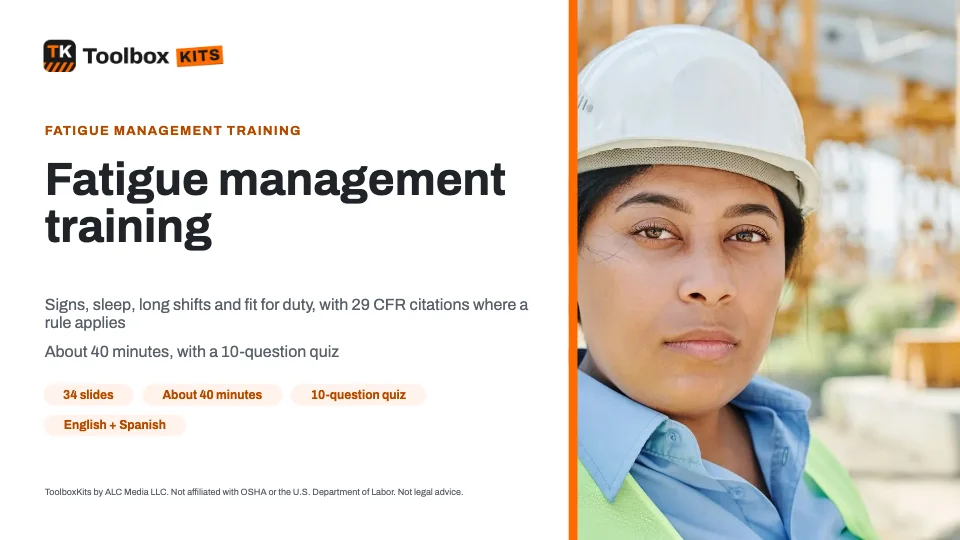
Editable PowerPoint, 34 slides
- Editable PowerPoint with trainer notes on every slide
- Trainer guide PDF with timing and discussion tips
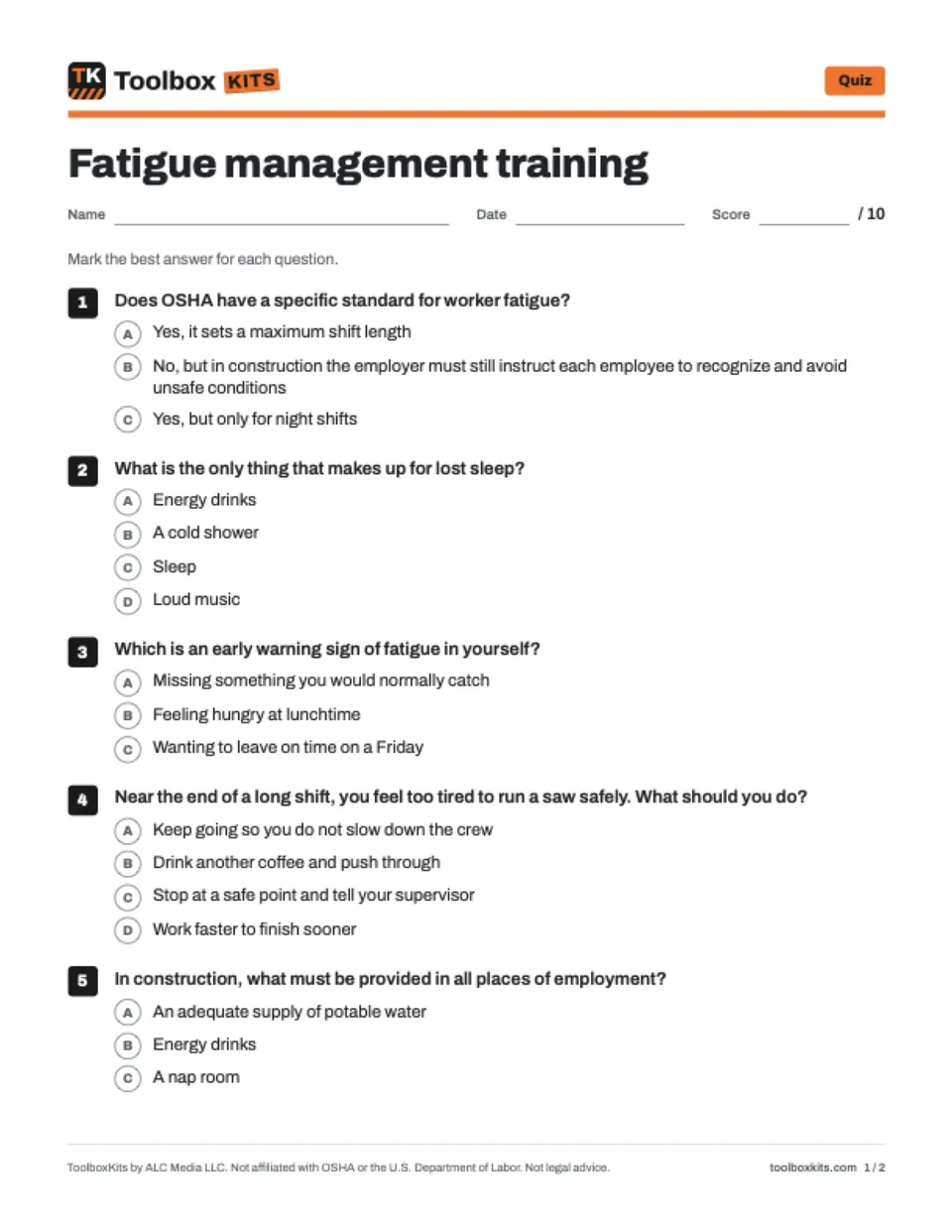
- 10-question quiz and answer key
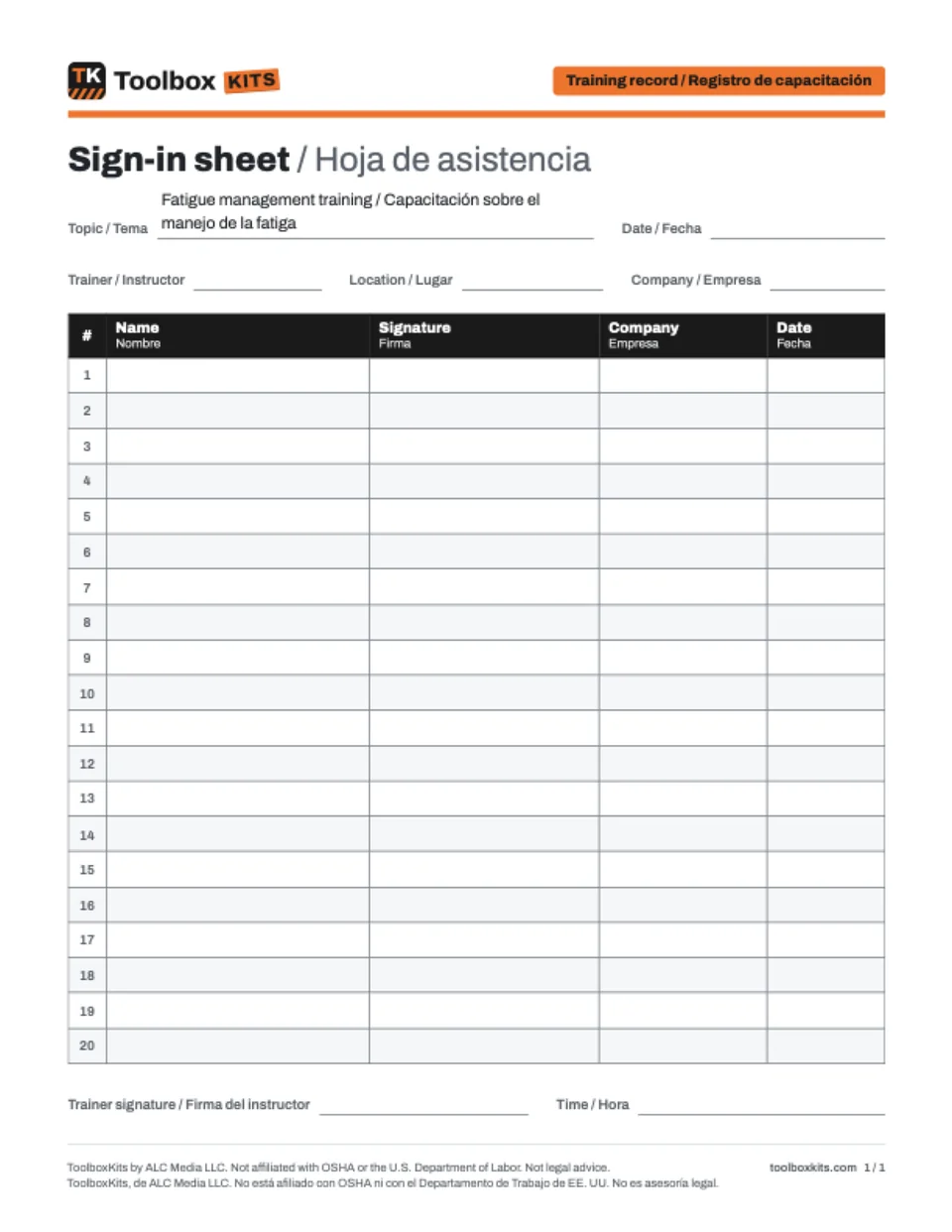
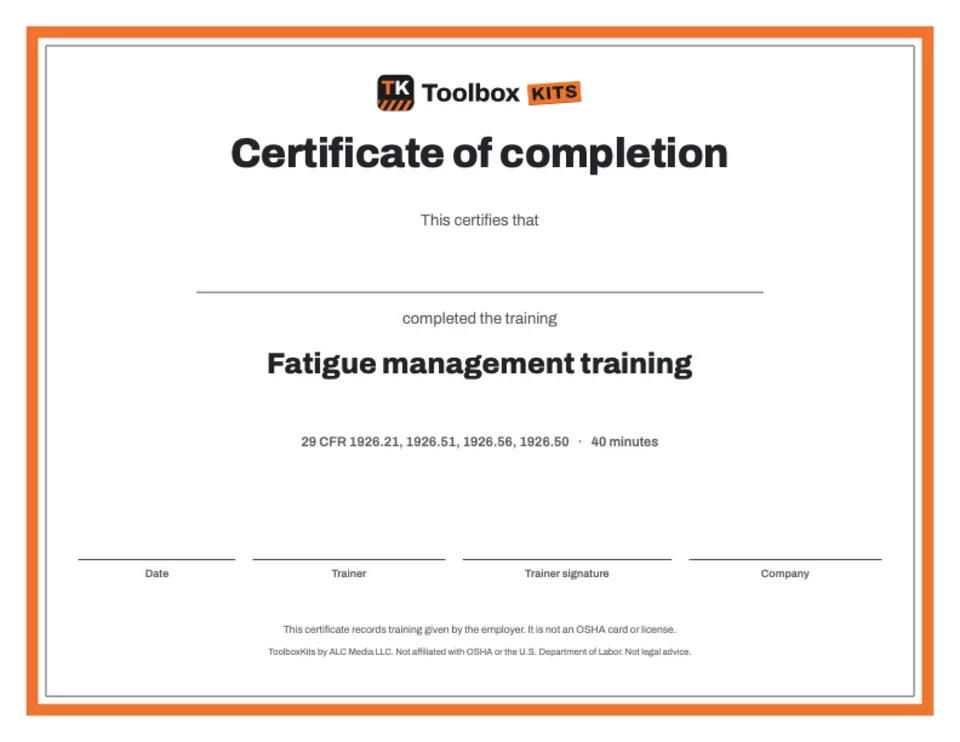
- Sign-in sheet and certificate of completion with fillable fields
- One-page crew handout
- Full Spanish version of everything
- One-page bilingual poster
- Audit-ready records in 60 seconds: fill in your crew and get a sign-in sheet and a certificate for every worker
- Instant download
- Secure checkout by Stripe
- 30-day refund, no questions
Need many topics? All Access gives you every kit for $99 a year.
Inside the kit
See what is in the kit
What is in the kit
 Editable PowerPoint
- Trainer guide
 Quiz
- Answer key
 Sign-in sheet
 Certificate
- Crew handout
Try it
Try the quiz
Three questions from this topic. Pick an answer to see the right one and the OSHA paragraph.
Question 1 of 3
Does OSHA have a specific standard for worker fatigue?
The rule
What OSHA requires
Plain-language summary. Each line links to the exact paragraph of the regulation.
OSHA has no specific standard for worker fatigue. In construction, the employer must still instruct each employee in recognizing and avoiding unsafe conditions and the regulations that apply to their work environment.
“The employer shall instruct each employee in the recognition and avoidance of unsafe conditions and the regulations applicable to his work environment to control or eliminate any hazards or other exposure to illness or injury.”
In construction, an adequate supply of potable (safe to drink) water must be provided at every workplace.
“An adequate supply of potable water shall be provided in all places of employment.”
In general industry (permanent workplaces), potable water must be provided for drinking and other personal uses.
“Potable water shall be provided in all places of employment, for drinking”
In construction, if no infirmary, clinic, hospital or physician is reasonably accessible to the worksite, a person with a valid first aid training certificate from the U.S. Bureau of Mines or the American Red Cross, or equivalent training that can be verified by documentation, must be available at the worksite to render first aid.
“shall be available at the worksite to render first aid”
In general industry, if there is no infirmary, clinic or hospital in near proximity to the workplace, one or more people must be adequately trained to render first aid, and adequate first aid supplies must be readily available.
“a person or persons shall be adequately trained to render first aid”
Who must be trained
OSHA has no fatigue-specific training rule. In construction, the employer must instruct each employee in recognizing and avoiding unsafe conditions and the regulations that apply to their work environment (29 CFR 1926.21(b)(2)).

Common questions
Questions people ask
Is there a printable fatigue management toolbox talk PDF?
Yes. This fatigue talk is free, and you can print it as a PDF in English or Spanish with a sign-in table. Read it aloud in about five minutes at the start of a shift, especially during long hours, night work or a big push to finish a job.
Does OSHA regulate fatigue in the workplace?
OSHA has no specific standard for worker fatigue and no general limit on work hours. The general duty to train still applies: in construction, the employer must instruct each employee in recognizing and avoiding unsafe conditions (29 CFR 1926.21(b)(2)). Your company may also have its own fit-for-duty and scheduling rules, so ask your supervisor what applies on your job.
What should a fit for duty safety talk cover?
Cover what fit for duty means: rested, sober, not impaired by medication, and able to focus on the work. Talk about the signs of fatigue, how to tell a supervisor you are not fit before a hazardous task, and what to do if a coworker seems impaired. Make it clear that speaking up is expected.
Why is proper rest important for safety?
Without enough sleep, your reactions slow down, your judgment suffers and you can nod off without warning. Lost sleep adds up over several short nights, and coffee or energy drinks only cover it up for a while. Proper rest is what keeps you sharp around equipment, heights and traffic.
What should a fatigue and stress management safety moment cover?
Explain how stress and fatigue feed each other: worry can ruin sleep, and poor sleep makes stress harder to handle. Share simple steps like a regular sleep routine, real breaks during the shift and talking to someone you trust. If your company has an employee assistance program, tell the crew how to reach it.
Free to share
Use this talk for free
You can print, share and adapt this talk at no cost under the Creative Commons BY-NC-SA 4.0 license. Please credit ToolboxKits with a link.