

Free 5-minute toolbox talkHeavy equipmentEnglish and Spanish
Scissor lift toolbox talk: safe use and pre-use checks
A fall over the rail, a tip-over, a crush against something overhead or an object dropped on someone below can happen quickly. Good checks and habits before you raise the platform do most of the work. What OSHA requires: None of the OSHA paragraphs cited here names scissor lifts (29 CFR 1926.21(b)(2)).
A free scissor lift safety toolbox talk for crews who work from scissor lifts. Read it aloud in about five minutes before anyone rides the platform up.
Updated October 29, 2026 · Based on 29 CFR 1926.451, 29 CFR 1926.452, 29 CFR 1926.454
Read it out loud
Free 5-minute toolbox talk
Read it out loud to your crew. It takes about 5 minutes.
Start with a question
Before you last rode a scissor lift up, did you check the ground, the guardrails and the path overhead?
Why it matters
A scissor lift looks stable, but it is a tall platform on small wheels. A fall over the rail, a tip-over, a crush against something overhead or an object dropped on someone below can happen quickly. Good checks and habits before you raise the platform do most of the work. The OSHA rules cited here do not name scissor lifts, so this talk follows the manufacturer's manual and the scaffold rules that your employer may apply to the lift.
Key points
Get trained on this lift
Read the operator's manual and learn the controls on the exact model you will use, including the lower controls and the emergency lowering.
More
Under OSHA's scaffold rules, employees who work on a scaffold must be trained by a qualified person to recognize the hazards of the type of scaffold and how to control them. Do not run a lift you have not been trained on.
Inspect before every shift
Walk around the lift. Look for leaks, damaged tires, loose parts, missing or bent guardrails, a gate that does not latch and a damaged scissor arm. Test the controls and the alarms. Under the scaffold rules, a competent person inspects a scaffold for visible defects before each work shift.
More
If something is wrong, tag the lift out of service and report it.
Stay inside the rails
Keep both feet on the platform floor with the guardrails and gate closed. Do not climb on the rails, stand on boxes or put a ladder on the platform to reach higher. If you cannot reach, lower the platform and move the lift.
More
Under the scaffold rules, an employee on a scaffold more than 10 feet above a lower level must be protected from falling. Follow the manufacturer's fall protection instructions.
Level ground, load limit, no storms
Drive and raise only on firm, level ground, and watch for holes, drop-offs, slopes and debris. Never load the platform past its rated capacity, and count people, tools and materials.
More
Scaffolds and components must not be loaded past their maximum intended loads or rated capacities, whichever is less. Work on or from scaffolds is prohibited during storms or high winds unless a competent person has determined that it is safe and the workers are protected.
29 CFR 1926.451(f)(1) · 29 CFR 1926.451(f)(12)
Look up and look around
Check overhead for beams, pipes, ductwork, ceilings and power lines before you raise the platform. Keep your body inside the rails so you cannot be pinched against something above you.
More
Under the scaffold rules, scaffolds and any conductive material handled on them must stay clear of energized power lines unless the utility has been notified and has acted. Watch the path behind you too when you drive.
Protect people below and plan the rescue
Barricade the area under the lift. In addition to wearing hard hats, employees on a scaffold must be protected from falling tools and debris. Know how to lower the platform from the ground and who will do it. Plan how you would get a worker down if the controls failed.
Scenario
Picture this: A crew is running conduit along a warehouse ceiling from a scissor lift. The floor has a small drain grate and some loose screws. To reach a bracket, a worker steps up on the mid-rail while a coworker below holds a ladder. The platform is above a spot where forklifts pass. Nobody looked at the pipe running just under the ceiling. What should they have done differently?
Ask the crew
- Which scissor lifts do we use, and who is trained on each one?
- What is on our pre-use checklist for a scissor lift?
- Where are the overhead hazards near lift work on this site?
- How would we rescue someone stuck in a raised lift?
Takeaway
Be trained, inspect first, stay inside the rails on level ground, and look up before the platform goes up.
Trainer: ______________________ Date: ____________
Credit: ToolboxKits, https://toolboxkits.com/topics/scissor-lifts/ (CC BY-NC-SA 4.0)
The poster is also inside the paid kits.
Audit-ready records in 60 seconds
Fill in your crew and download a filled sign-in sheet for this talk. Everything is made in your browser. Names are never uploaded or stored.
Start a sign-off
Crew scan a QR code on their own phones, type their name and sign with a finger. You see the names arrive and download the signed sheet. Free, no account.
Kits
Get the kit
No subscription needed. Buy only the kit you need.
Toolbox talk kit
$4.99
- 5-minute talk, English PDF
- 5-minute talk, Spanish PDF
- Editable mini-deck (English and Spanish)
- One-page crew handout (English and Spanish)
- Bilingual sign-in sheet
- 3-question quiz with answer key (English and Spanish)
- One-page bilingual poster
- Audit-ready records in 60 seconds: fill in your crew and get a sign-in sheet and a certificate for every worker
Training kit
$9
Editable PowerPoint, 30 slides
- Editable PowerPoint with trainer notes on every slide
- Trainer guide PDF with timing and discussion tips
- 10-question quiz and answer key
- Sign-in sheet and certificate of completion with fillable fields
- One-page crew handout
- Full Spanish version of everything
- One-page bilingual poster
- Audit-ready records in 60 seconds: fill in your crew and get a sign-in sheet and a certificate for every worker
- Instant download
- Secure checkout by Stripe
- 30-day refund, no questions
Need many topics? All Access gives you every kit for $99 a year.
Inside the kit
See what is in the kit
What is in the kit
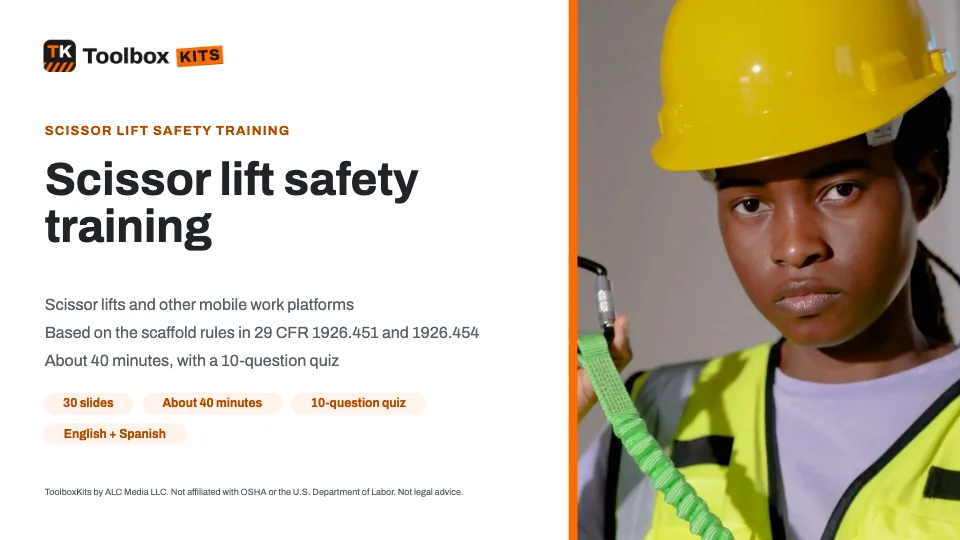 Editable PowerPoint
- Trainer guide
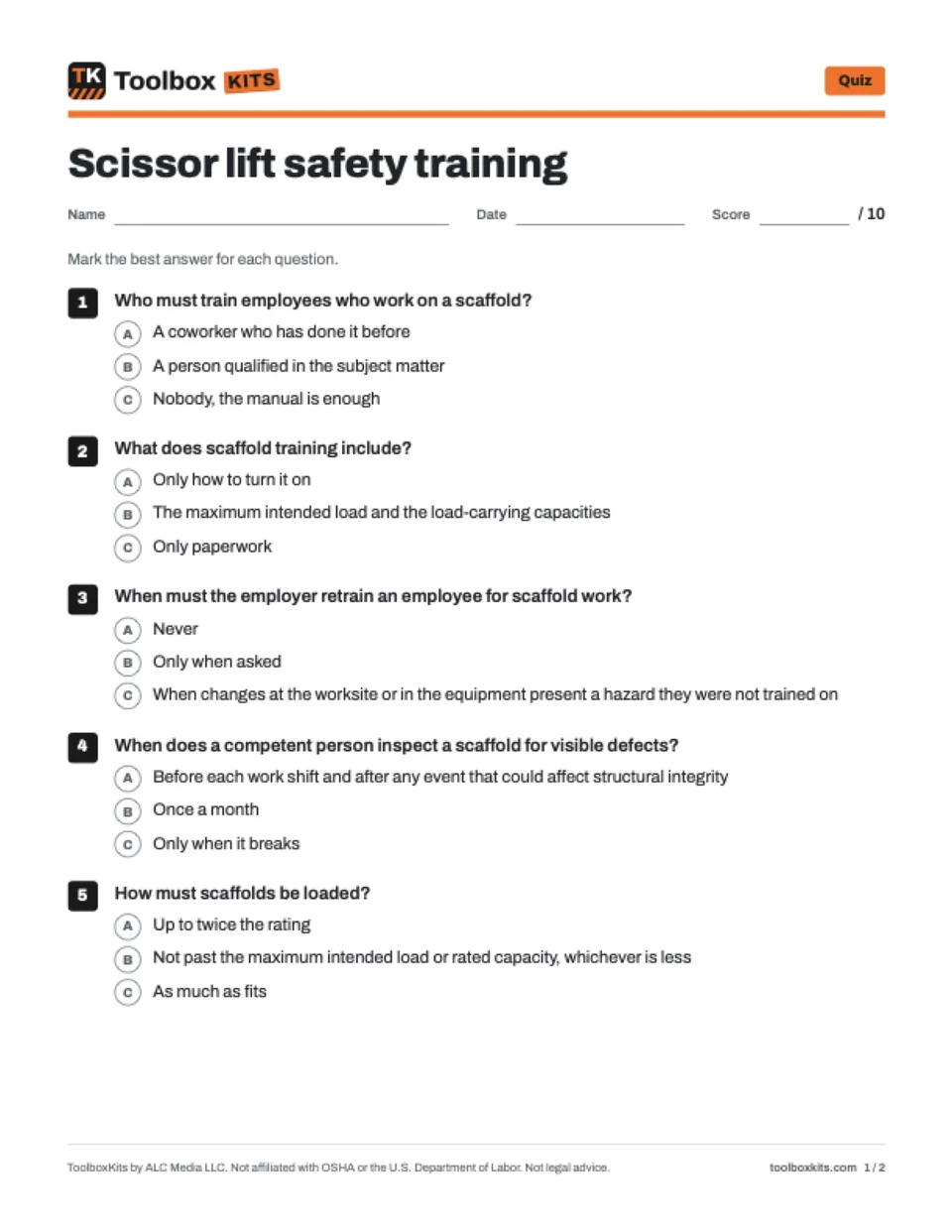 Quiz
- Answer key
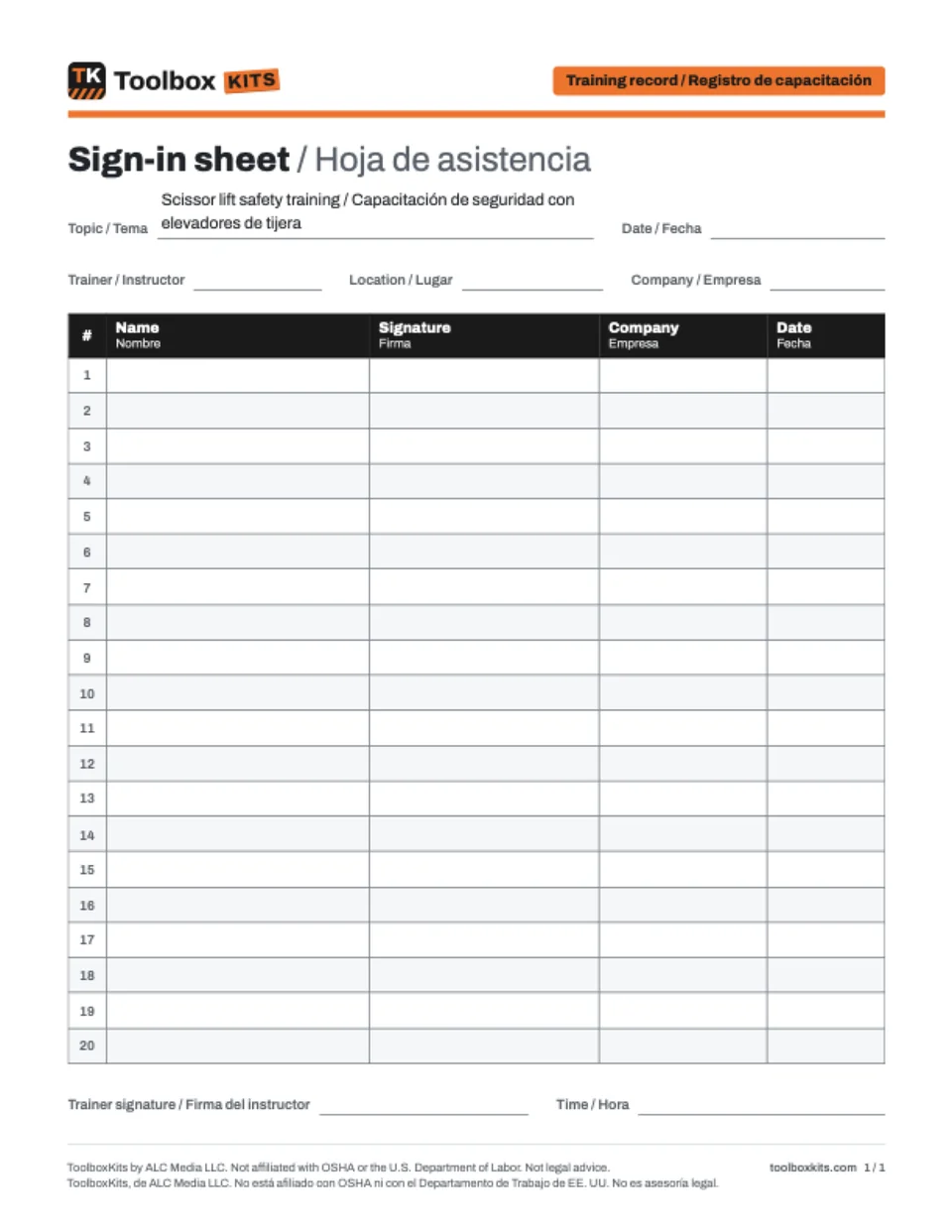 Sign-in sheet
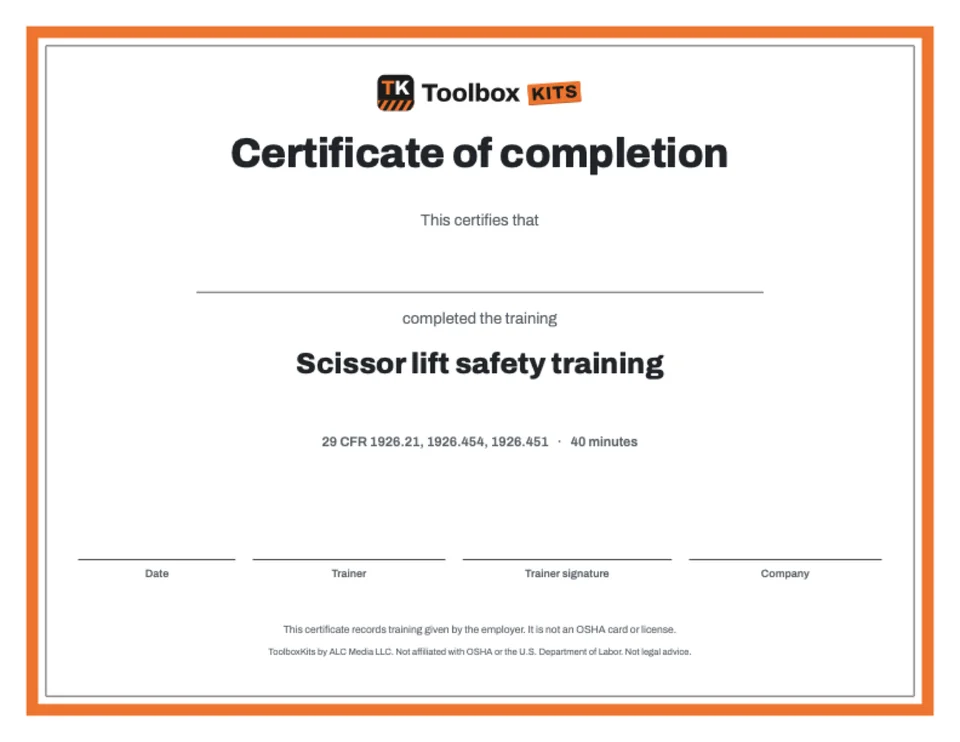 Certificate
- Crew handout
Try it
Try the quiz
Three questions from this topic. Pick an answer to see the right one and the OSHA paragraph.
Question 1 of 3
Under the scaffold rules, when must a scaffold be inspected for visible defects?
The rule
What OSHA requires
Plain-language summary. Each line links to the exact paragraph of the regulation.
None of the OSHA paragraphs cited here names scissor lifts. The scaffold rules below are the closest construction rules, so ask your supervisor which rules and which manufacturer instructions apply to the scissor lift you use. The general training duty also applies: the employer must instruct each employee in recognizing and avoiding unsafe conditions.
“The employer shall instruct each employee in the recognition and avoidance of unsafe conditions and the regulations applicable to his work environment to control or eliminate any hazards or other exposure to illness or injury.”
Under the scaffold training rule, the employer must have each employee who works while on a scaffold trained by a person qualified in the subject matter to recognize the hazards of the type of scaffold and understand how to control or minimize them.
“The employer shall have each employee who performs work while on a scaffold trained by a person qualified in the subject matter to recognize the hazards associated with the type of scaffold being used”
Scaffold training includes the maximum intended load and the load-carrying capacities of the scaffolds used.
“The maximum intended load and the load-carrying capacities of the scaffolds used; and”
When the employer has reason to believe an employee lacks the skill or understanding needed for safe scaffold work, the employer must retrain that employee so the needed proficiency is regained. Retraining is required at least when changes at the worksite or in the equipment present a hazard the employee was not trained on, or when the employee's work shows the proficiency was not kept.
A competent person must inspect scaffolds and their components for visible defects before each work shift and after any event that could affect structural integrity.
“Scaffolds and scaffold components shall be inspected for visible defects by a competent person before each work shift, and after any occurrence which could affect a scaffold's structural integrity.”
Scaffolds and components must not be loaded past their maximum intended loads or rated capacities, whichever is less.
“Scaffolds and scaffold components shall not be loaded in excess of their maximum intended loads or rated capacities, whichever is less.”
Each employee on a scaffold more than 10 feet above a lower level must be protected from falling to that lower level.
“Each employee on a scaffold more than 10 feet (3.1 m) above a lower level shall be protected from falling to that lower level.”
Work on or from scaffolds is prohibited during storms or high winds unless a competent person has determined that it is safe and the employees are protected by a personal fall arrest system or wind screens.
In addition to hard hats, employees on a scaffold must be protected from falling hand tools, debris and other small objects by toeboards, screens, guardrails, debris nets, catch platforms or canopies.
Who must be trained
Under the scaffold rules, the employer must have each employee who works on a scaffold trained by a person qualified in the subject matter (29 CFR 1926.454(a)), and employees involved in erecting, moving, operating, repairing, maintaining or inspecting a scaffold must be trained by a competent person (29 CFR 1926.454(b)).
When to retrain
The employer must retrain an employee when changes at the worksite or in the type of equipment present a hazard the employee has not been trained on, or when the employee's work shows the skill was not retained (29 CFR 1926.454(c)).

Common questions
Questions people ask
Is there a printable scissor lift toolbox talk PDF?
Yes. This scissor lift toolbox talk is free to print as a PDF in English and Spanish, with a sign-in table for your crew. Read it aloud in about five minutes before the platform goes up, and keep the signed sheet with your safety records.
Does OSHA have a specific rule for scissor lifts?
None of the OSHA paragraphs cited on this page names scissor lifts. The aerial lift rule (29 CFR 1926.453) covers vehicle-mounted devices, and the scaffold rules (29 CFR 1926.451 and 1926.454) cover scaffolds. Ask your supervisor which rules apply to your lift, and follow the manufacturer's manual. The general duty to train applies in every case (29 CFR 1926.21(b)(2)).
What should be on a scissor lift pre-use inspection?
Check for leaks, tires, loose or damaged parts, guardrails and the entry gate. Test the controls, the alarms and the emergency lowering, and look at the ground and the space overhead. Under the scaffold rules, inspection for visible defects happens before each work shift (29 CFR 1926.451(f)(3)).
Is there a scissor lift safety training PowerPoint or PDF?
This free talk is written to be read aloud, so you do not need slides. For a longer scissor lift session, the paid training kit for this topic is an editable PowerPoint in English and Spanish with trainer notes, a quiz and a sign-in sheet. If the kit is not ready to buy yet, you can request it from this page. Slides do not replace hands-on training on the lift you will use.
Can I work from a scissor lift in high wind or a storm?
Under the scaffold rules, work on or from scaffolds is prohibited during storms or high winds unless a competent person has determined it is safe and the workers are protected (29 CFR 1926.451(f)(12)). Also follow the wind limits in the manufacturer's manual. When in doubt, lower the platform and stop.
Free to share
Use this talk for free
You can print, share and adapt this talk at no cost under the Creative Commons BY-NC-SA 4.0 license. Please credit ToolboxKits with a link.