

Free 5-minute toolbox talkHeavy equipmentEnglish and Spanish
Aerial lift toolbox talk: boom lifts and bucket trucks
A fall, a tip-over, contact with a power line or getting crushed against a beam can happen fast. What OSHA requires: On extensible and articulating boom platforms, lift controls must be tested each day before use to make sure they are in safe working condition (29 CFR 1926.453(b)(2)(i)).
A free aerial lift safety toolbox talk for crews who work from boom lifts, bucket trucks and other aerial lifts. Read it aloud in about five minutes as an aerial lift safety talk before anyone goes up.
Updated October 29, 2026 · Based on 29 CFR 1926.453, 29 CFR 1926.454, 29 CFR 1910.67
Read it out loud
Free 5-minute toolbox talk
Read it out loud to your crew. It takes about 5 minutes.
Start with a question
Before you last went up in a lift, did you test the controls and look up for power lines?
Why it matters
Aerial lifts put you high above the ground in a small basket. A fall, a tip-over, contact with a power line or getting crushed against a beam can happen fast. Much of your protection comes from the checks and habits you use before the basket leaves the ground.
Key points
Inspect the lift and test the controls
Walk around the lift before you use it and look for leaks, damaged parts, bad tires, and missing guardrails or gates. Lift controls must be tested each day before use to make sure they are in safe working condition. If something is wrong, do not use the lift; tag it out of service and report it.
Only trained, authorized operators
In construction, only authorized persons may operate an aerial lift. In general industry, only trained persons may operate one. Learn the controls on the exact model you will use, including the lower controls, which can override the upper ones.
More
Lower controls must not be operated without permission from the worker in the lift, except in an emergency.
29 CFR 1926.453(b)(2)(ii) · 29 CFR 1910.67(c)(2)(ii) · 29 CFR 1926.453(b)(2)(ix)
Stand on the floor and stay tied off
Stand firmly on the floor of the basket. Do not sit or climb on the edge, and never use planks or ladders to reach higher. Attach your lanyard to the boom or basket as the rules require, never to a nearby pole, structure or other equipment.
29 CFR 1926.453(b)(2)(iv) · 29 CFR 1926.453(b)(2)(iii) and (b)(2)(v)
Prevent tip-overs
Never exceed the boom and basket load limits set by the manufacturer, and count people, tools and materials. Set the brakes, put outriggers on pads or a solid surface, and chock the wheels on an incline when that can be done safely.
More
Do not move a lift truck with the boom raised in a working position and workers in the basket unless it is specifically designed for that. Watch for holes, soft ground, slopes and drop-offs, and follow the manufacturer's wind limits.
29 CFR 1926.453(b)(2)(vi) · 29 CFR 1926.453(b)(2)(vii) · 29 CFR 1926.453(b)(2)(viii)
Look up for power lines
Check for overhead lines before you raise the boom, and keep the lift and anything you hold well away from them.
More
In construction, the employer must find out whether the work could bring anyone or anything into contact with an energized power circuit, post warning signs where one exists, and tell you where the lines are, the hazards and the protective measures. In general industry, equipment raised near energized overhead lines must keep a clearance of 10 feet, more for voltages over 50kV, unless an exception in the rule applies.
29 CFR 1926.416(a)(3) · 29 CFR 1910.333(c)(3)(iii)(A)
Protect the people below
Keep tools and materials secured in the basket so nothing falls. Barricade the area under the lift so nobody walks beneath you. Workers in areas where there is a possible danger of head injury from falling objects must be protected by protective helmets.
More
Up top, watch for beams and ceilings so you are not crushed between the basket and an overhead object.
Scenario
Picture this: A crew is hanging a sign from a bucket truck in a parking lot. The lot slopes a little, the outriggers sit on loose gravel instead of pads, and the basket holds two workers, the sign and a pile of tools. To reach the top bracket, one worker steps up onto the edge of the basket. Nobody checked for overhead lines, and one runs right past the light pole. What should they have done differently?
Ask the crew
- Which aerial lifts do we use, and who is authorized to operate each one?
- What do you check on a lift before you go up?
- Where are the power lines and other overhead hazards on this job?
- How would we get a worker down if the lift stopped working while they were up?
Takeaway
Test the controls, stay on the floor and tied off, respect the load limit and look up before the boom goes up.
Trainer: ______________________ Date: ____________
Credit: ToolboxKits, https://toolboxkits.com/topics/aerial-lifts/ (CC BY-NC-SA 4.0)
The poster is also inside the paid kits.
Audit-ready records in 60 seconds
Fill in your crew and download a filled sign-in sheet for this talk. Everything is made in your browser. Names are never uploaded or stored.
Start a sign-off
Crew scan a QR code on their own phones, type their name and sign with a finger. You see the names arrive and download the signed sheet. Free, no account.
Kits
Get the kit
No subscription needed. Buy only the kit you need.
Toolbox talk kit
$4.99
- 5-minute talk, English PDF
- 5-minute talk, Spanish PDF
- Editable mini-deck (English and Spanish)
- One-page crew handout (English and Spanish)
- Bilingual sign-in sheet
- 3-question quiz with answer key (English and Spanish)
- One-page bilingual poster
- Audit-ready records in 60 seconds: fill in your crew and get a sign-in sheet and a certificate for every worker
Training kit
$9
Editable PowerPoint, 30 slides
- Editable PowerPoint with trainer notes on every slide
- Trainer guide PDF with timing and discussion tips
- 10-question quiz and answer key
- Sign-in sheet and certificate of completion with fillable fields
- One-page crew handout
- Full Spanish version of everything
- One-page bilingual poster
- Audit-ready records in 60 seconds: fill in your crew and get a sign-in sheet and a certificate for every worker
- Instant download
- Secure checkout by Stripe
- 30-day refund, no questions
Need many topics? All Access gives you every kit for $99 a year.
Inside the kit
See what is in the kit
What is in the kit
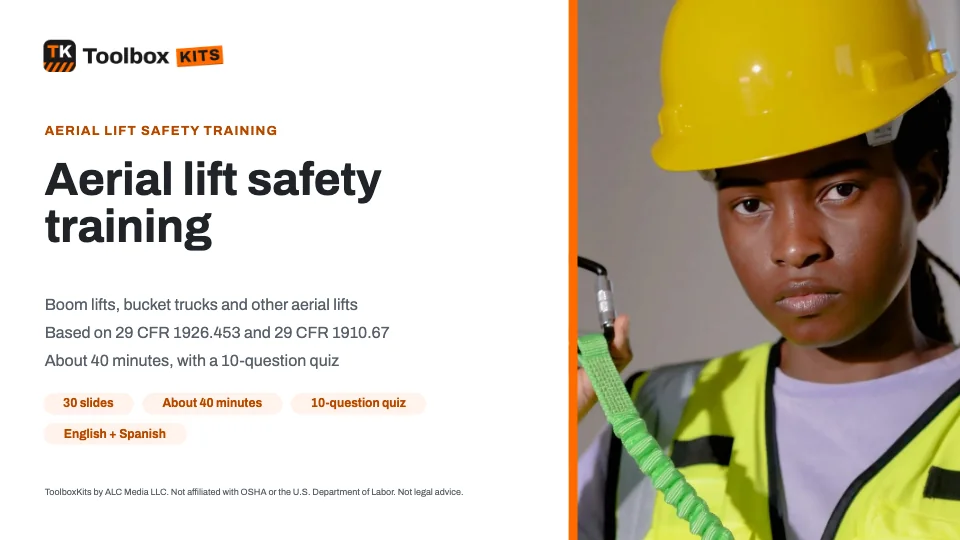 Editable PowerPoint
- Trainer guide
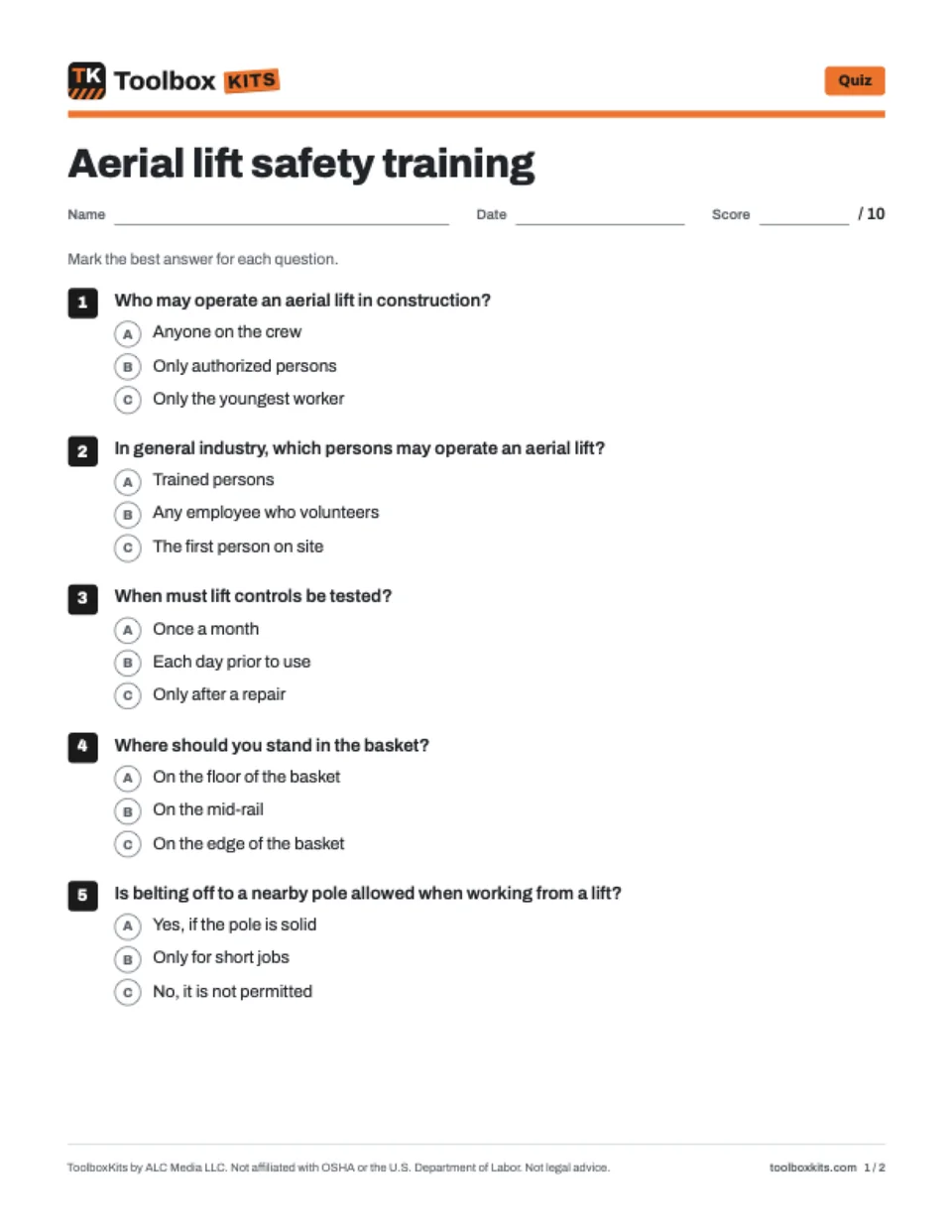 Quiz
- Answer key
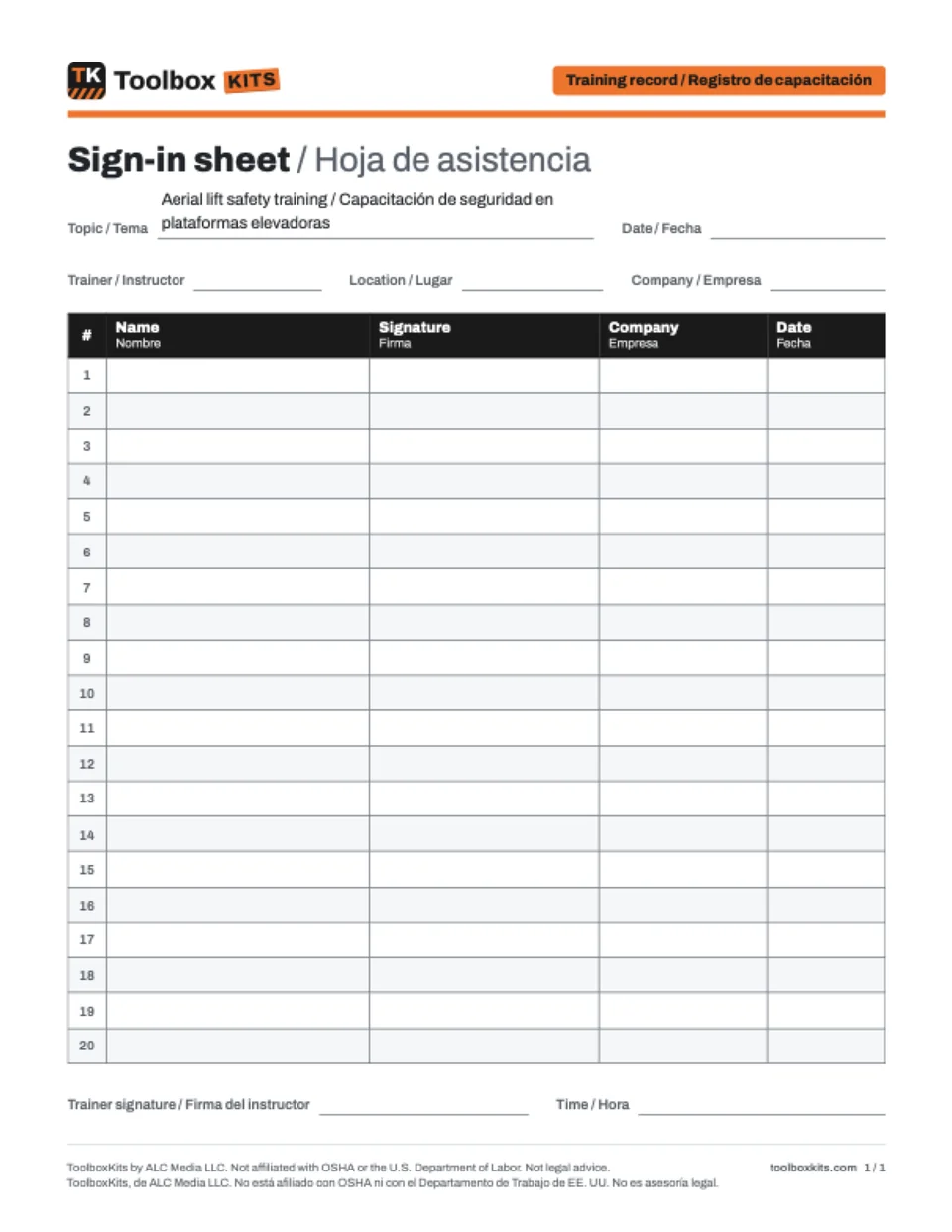 Sign-in sheet
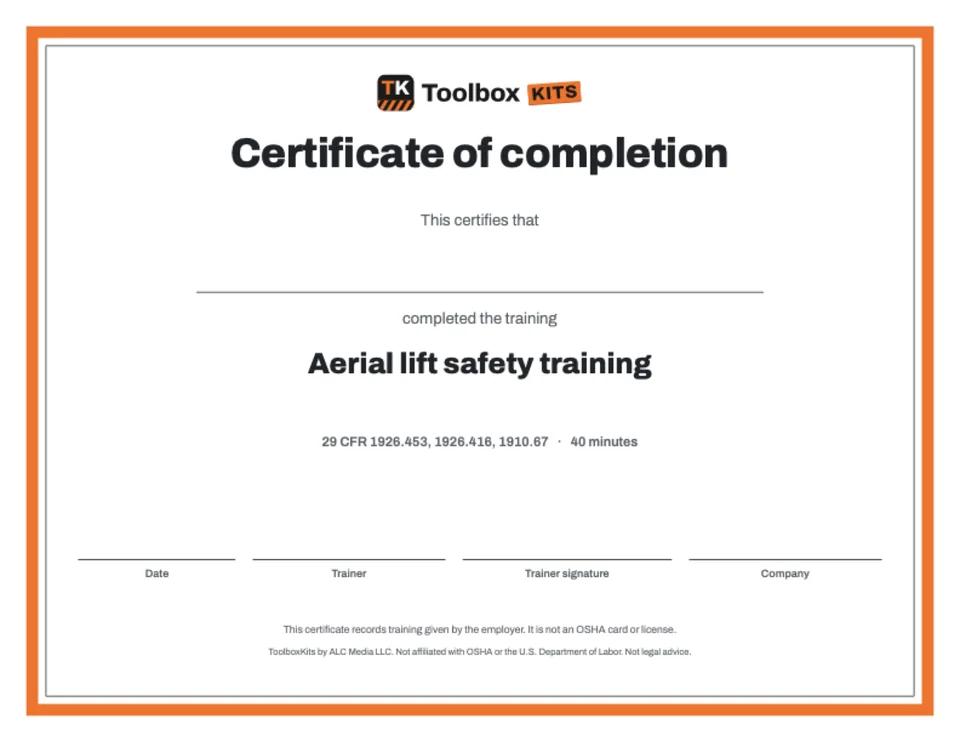 Certificate
- Crew handout
Try it
Try the quiz
Three questions from this topic. Pick an answer to see the right one and the OSHA paragraph.
Question 1 of 3
When must aerial lift controls be tested?
The rule
What OSHA requires
Plain-language summary. Each line links to the exact paragraph of the regulation.
OSHA's construction aerial lift rule covers vehicle-mounted aerial devices used to raise workers to job sites above ground: extensible boom platforms, aerial ladders, articulating boom platforms, vertical towers, and combinations of these.
“Aerial lifts include the following types of vehicle-mounted aerial devices used to elevate personnel to job-sites above ground:”
On extensible and articulating boom platforms, lift controls must be tested each day before use to make sure they are in safe working condition.
“Lift controls shall be tested each day prior to use to determine that such controls are in safe working condition.”
In construction, only authorized persons may operate an aerial lift.
“Only authorized persons shall operate an aerial lift.”
In general industry, only trained persons may operate an aerial lift.
“Only trained persons shall operate an aerial lift.”
Workers must stand firmly on the floor of the basket. They must not sit or climb on the edge of the basket or use planks, ladders or other devices for a work position.
“Employees shall always stand firmly on the floor of the basket, and shall not sit or climb on the edge of the basket or use planks, ladders, or other devices for a work position.”
Belting off to an adjacent pole, structure or equipment while working from an aerial lift is not permitted.
“Belting off to an adjacent pole, structure, or equipment while working from an aerial lift shall not be permitted.”
In construction, a body belt must be worn with a lanyard attached to the boom or basket when working from an aerial lift. Body belts are not acceptable as part of a personal fall arrest system, but a body belt may be used in a tethering or restraint system. In general industry, a personal fall arrest or travel restraint system must be worn and attached to the boom or basket (29 CFR 1910.67(c)(2)(v)).
“A body belt shall be worn and a lanyard attached to the boom or basket when working from an aerial lift.”
Boom and basket load limits specified by the manufacturer must not be exceeded.
“Boom and basket load limits specified by the manufacturer shall not be exceeded.”
The brakes must be set, and outriggers, when used, must be positioned on pads or a solid surface. Wheel chocks must be installed before using an aerial lift on an incline, provided they can be safely installed.
“Wheel chocks shall be installed before using an aerial lift on an incline, provided they can be safely installed.”
In general industry, vehicles and equipment that can be raised near energized overhead lines must be operated with a clearance of 10 feet, increased for voltages over 50kV. The clearance may be reduced only under the listed conditions, such as an aerial lift insulated for the voltage and used by a qualified person.
“shall be operated so that a clearance of 10 ft. (305 cm) is maintained”
Who must be trained
In general industry, only trained persons may operate an aerial lift (29 CFR 1910.67(c)(2)(ii)). In construction, only authorized persons may operate one (29 CFR 1926.453(b)(2)(ii)), the employer may permit only employees qualified by training or experience to operate equipment and machinery (29 CFR 1926.20(b)(4)), and each employee must be instructed in recognizing and avoiding unsafe conditions (29 CFR 1926.21(b)(2)).

Common questions
Questions people ask
Is there a printable aerial lift safety toolbox talk PDF?
Yes. This aerial lift safety toolbox talk is free to print as a PDF in English and Spanish, with a sign-in table for your crew. Read it aloud in about five minutes before the lift goes up, and keep the signed sheet with your safety records.
Does this work as a MEWP toolbox talk?
Yes, for boom-type lifts, so you can use it as a MEWP safety toolbox talk. MEWP stands for mobile elevating work platform, an industry term that covers boom lifts and scissor lifts. OSHA's aerial lift rule lists extensible and articulating boom platforms, aerial ladders, vertical towers and combinations of them (29 CFR 1926.453(a)(1)). Scissor lifts are not on that list, so ask your supervisor which OSHA rules and manufacturer instructions apply to the scissor lift you use.
Is a manlift the same as an aerial lift?
On many jobsites, people call a boom lift a manlift, and this manlift safety toolbox talk covers that kind of lift. In OSHA's general industry rules, though, a manlift is a different machine: platforms or brackets on an endless belt that moves vertically and is meant to carry people only (29 CFR 1910.68(b)(1)).
Do you need an aerial lift written program?
OSHA's aerial lift rules (29 CFR 1926.453 and 1910.67) do not require a written aerial lift program. A short written program can still help: it can name who is authorized to operate each lift, how lifts are inspected, what fall protection is used and how you would get a worker down in an emergency.
Is there an aerial lift safety training PPT?
This free talk is written to be read aloud, so you do not need slides. For a longer aerial lift, manlift or bucket truck safety training session, the paid training kit for this topic is an editable PowerPoint in English and Spanish with trainer notes, a quiz and a sign-in sheet. If the kit is not ready to buy yet, you can request it from this page. Slides do not replace hands-on training on the lift each operator will use.
Free to share
Use this talk for free
You can print, share and adapt this talk at no cost under the Creative Commons BY-NC-SA 4.0 license. Please credit ToolboxKits with a link.