

Free 5-minute toolbox talkHeavy equipmentEnglish and Spanish
Working around heavy equipment toolbox talk
When a machine is being repaired or is not in use, blades, buckets and dump bodies must be fully lowered or blocked. What OSHA requires: Only employees qualified by training or experience may operate equipment and machinery (29 CFR 1926.20(b)(4)).
A 5-minute talk for operators and everyone on foot near loaders, dozers, excavators and trucks. It covers blind spots, backing, swing zones, raised buckets and beds, power lines, and the OSHA rules that apply.
Updated October 29, 2026 · Based on 29 CFR 1926.600, 29 CFR 1926.602
Read it out loud
Free 5-minute toolbox talk
Read it out loud to your crew. It takes about 5 minutes.
Start with a question
Where are the blind spots on the machines working on this site today, and could you point to them right now?
Why it matters
Heavy equipment is big, loud and hard to see around. Operators deal with blind spots, mirrors, dust and noise, and a backing loader or a swinging excavator can hit someone who is busy with their own work nearby. Operators and people on foot share the same ground, so both sides have to follow the same simple rules to stay out of each other's way.
Key points
Make eye contact before you get close
If you cannot see the operator's eyes, assume the operator cannot see you. Before you walk near a machine, get the operator's attention, make eye contact and wait for a clear signal that they know where you are.
More
Never walk behind or beside a moving machine, and never stand in a spot you could not get out of if it moved.
Backing needs an alarm or a spotter
Loaders, dozers, rollers and other earthmoving or compacting machines often have an obstructed view to the rear. When they do, they may not be used in reverse unless a reverse signal alarm is working and stands out from the surrounding noise, or an employee signals that it is safe.
More
Treat every backup alarm as a warning meant for you. If you are the spotter, stay where the operator can see you, use the signals you agreed on, and never walk backward in the machine's path.
Stay out of the swing zone
Excavators and cranes rotate, and the back end can pin you against a wall, a truck or another machine. Stay outside the swing radius unless the operator knows you are there and has stopped.
More
On excavation work, no employee may be underneath loads handled by lifting or digging equipment, and workers must stand away from any vehicle being loaded or unloaded.
Lower it or block it
When a machine is being repaired or is not in use, blades, buckets and dump bodies must be fully lowered or blocked. The controls go in neutral, with the motor stopped and the brakes set, unless the work requires otherwise.
More
Never work under or between machinery or parts held up by slings, hoists or jacks until they are substantially blocked or cribbed. A raised bucket or bed is never a safe roof.
Look up for power lines
Booms, buckets and raised dump beds can reach overhead lines. Treat every overhead wire as energized unless the line owner or the electric utility says it is not and it has been visibly grounded.
More
Find the lines before work starts, and use a spotter whenever the operator cannot easily judge the clearance.
Only qualified operators, and check before you start
The employer may permit only employees qualified by training or experience to operate equipment and machinery. If you have not been trained on a machine, do not start it, even just to move it.
More
Operators should walk around the machine before starting, check that the horn and backup alarm work, and buckle the seat belt.
Scenario
Picture this: A loader is backing up to dump a bucket of gravel. Its backup alarm quit yesterday, but the job is almost done, so nobody reported it. A laborer is setting grade stakes behind the loader with his back to it, and a compactor running nearby drowns out other sounds. The operator checks one mirror, sees only dust, and keeps backing. What should the operator, the laborer and the foreman have done differently?
Ask the crew
- Which machines on this site have the biggest blind spots, and where are they?
- What hand signals do we use with operators, and who is the spotter today?
- What do you do if a backup alarm or horn is not working?
- Where are the overhead power lines on this site?
Takeaway
Make eye contact before you get close, stay out of blind spots and swing zones, and never work under anything raised that is not blocked.
Trainer: ______________________ Date: ____________
Credit: ToolboxKits, https://toolboxkits.com/topics/heavy-equipment/ (CC BY-NC-SA 4.0)
The poster is also inside the paid kits.
Audit-ready records in 60 seconds
Fill in your crew and download a filled sign-in sheet for this talk. Everything is made in your browser. Names are never uploaded or stored.
Start a sign-off
Crew scan a QR code on their own phones, type their name and sign with a finger. You see the names arrive and download the signed sheet. Free, no account.
Kits
Get the kit
No subscription needed. Buy only the kit you need.
Toolbox talk kit
$4.99
- 5-minute talk, English PDF
- 5-minute talk, Spanish PDF
- Editable mini-deck (English and Spanish)
- One-page crew handout (English and Spanish)
- Bilingual sign-in sheet
- 3-question quiz with answer key (English and Spanish)
- One-page bilingual poster
- Audit-ready records in 60 seconds: fill in your crew and get a sign-in sheet and a certificate for every worker
Training kit
$9
Editable PowerPoint, 35 slides
- Editable PowerPoint with trainer notes on every slide
- Trainer guide PDF with timing and discussion tips
- 10-question quiz and answer key
- Sign-in sheet and certificate of completion with fillable fields
- One-page crew handout
- Full Spanish version of everything
- One-page bilingual poster
- Audit-ready records in 60 seconds: fill in your crew and get a sign-in sheet and a certificate for every worker
- Instant download
- Secure checkout by Stripe
- 30-day refund, no questions
Need many topics? All Access gives you every kit for $99 a year.
Inside the kit
See what is in the kit
What is in the kit
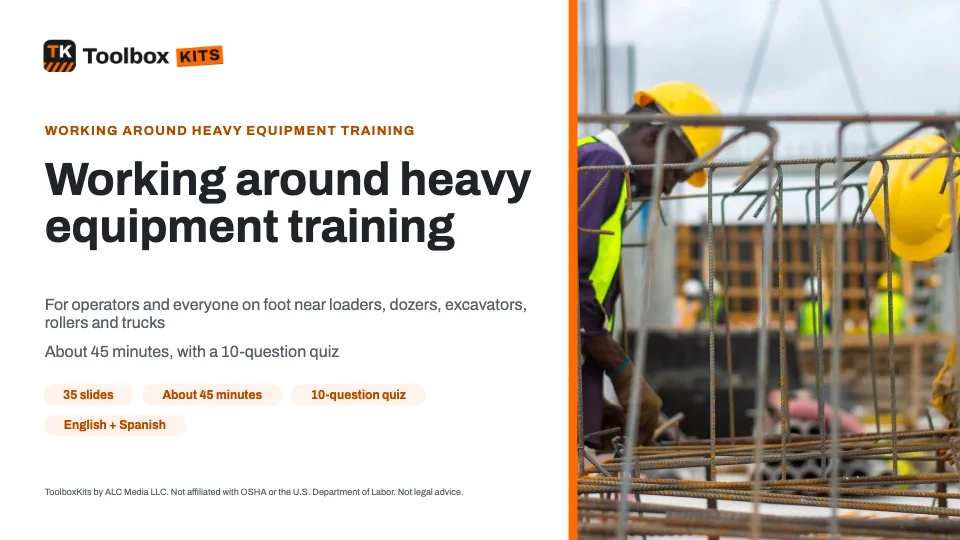 Editable PowerPoint
- Trainer guide
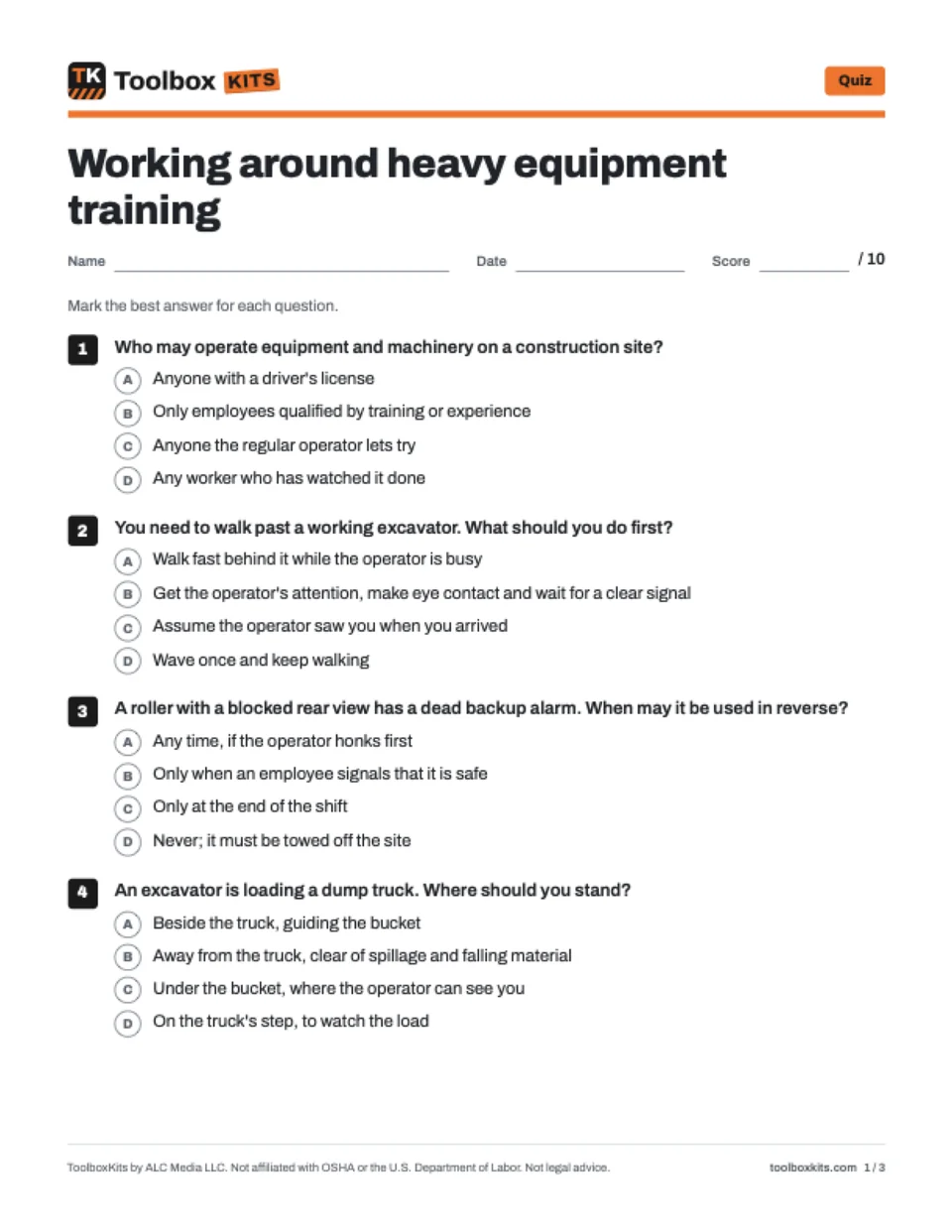 Quiz
- Answer key
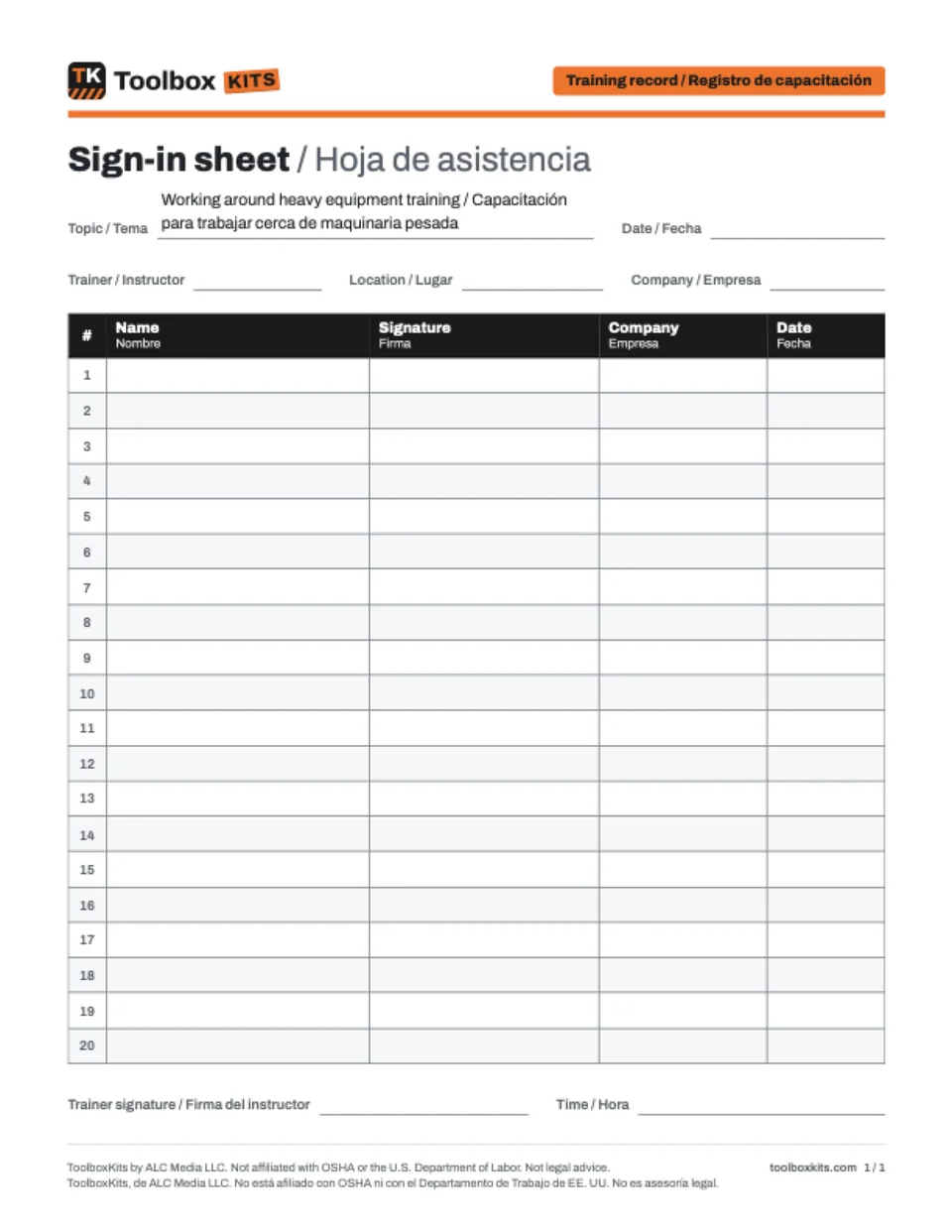 Sign-in sheet
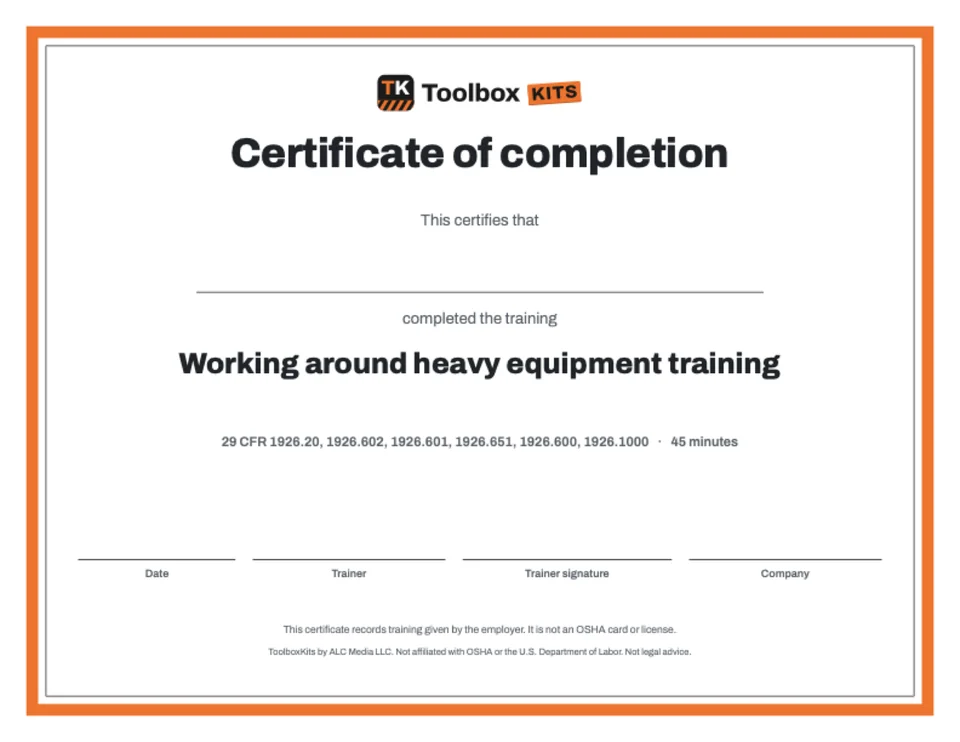 Certificate
- Crew handout
Try it
Try the quiz
Three questions from this topic. Pick an answer to see the right one and the OSHA paragraph.
Question 1 of 3
A loader with a blocked rear view needs to back up, and its backup alarm is broken. What does the standard require?
The rule
What OSHA requires
Plain-language summary. Each line links to the exact paragraph of the regulation.
Only employees qualified by training or experience may operate equipment and machinery.
“The employer shall permit only those employees qualified by training or experience to operate equipment and machinery.”
Earthmoving or compacting equipment with an obstructed view to the rear may not be used in reverse unless it has a reverse signal alarm distinguishable from the surrounding noise level, or an employee signals that it is safe.
“unless the equipment has in operation a reverse signal alarm distinguishable from the surrounding noise level or an employee signals that it is safe to do so”
On off-highway jobsites, motor vehicles such as dump trucks with an obstructed view to the rear may not be used unless they have a reverse signal alarm audible above the surrounding noise level, or are backed up only when an observer signals that it is safe.
“No employer shall use any motor vehicle equipment having an obstructed view to the rear unless:”
Bidirectional machines such as rollers, compactors, front-end loaders and bulldozers must have a horn, distinguishable from the surrounding noise level, that is used as needed when the machine moves in either direction and is kept in working order.
“shall be equipped with a horn, distinguishable from the surrounding noise level, which shall be operated as needed when the machine is moving in either direction”
On excavation work, no employee may be underneath loads handled by lifting or digging equipment, and employees must stand away from any vehicle being loaded or unloaded to avoid being struck by spillage or falling material.
“No employee shall be permitted underneath loads handled by lifting or digging equipment.”
Heavy machinery or parts held up by slings, hoists or jacks must be substantially blocked or cribbed before anyone works under or between them. Blades, buckets, dump bodies and similar equipment must be fully lowered or blocked when being repaired or not in use, with controls in neutral, motors stopped and brakes set unless the work requires otherwise.
“Bulldozer and scraper blades, end-loader buckets, dump bodies, and similar equipment, shall be either fully lowered or blocked when being repaired or when not in use.”
Whenever equipment is parked, the parking brake must be set. Equipment parked on inclines must also have the wheels chocked.
“Equipment parked on inclines shall have the wheels chocked and the parking brake set.”
Any overhead wire must be treated as an energized line unless and until the line owner or the electric utility says it is not energized and it has been visibly grounded.
“Any overhead wire shall be considered to be an energized line”
When it is hard for the operator to keep the needed clearance from power lines by sight, a person must be designated to watch the clearance and give timely warning.
“A person shall be designated to observe clearance of the equipment and give timely warning”
When mobile equipment works next to an excavation, or must approach its edge, and the operator does not have a clear and direct view of the edge, a warning system such as barricades, hand or mechanical signals, or stop logs must be used.
“a warning system shall be utilized such as barricades, hand or mechanical signals, or stop logs”
Who must be trained
In construction, the employer must instruct each employee in recognizing and avoiding unsafe conditions and the regulations that apply to their work environment (29 CFR 1926.21(b)(2)). Only employees qualified by training or experience may operate equipment and machinery (29 CFR 1926.20(b)(4)). Powered industrial truck (forklift) operators on construction sites must be trained under the same requirements as general industry (29 CFR 1926.602(d)).

Common questions
Questions people ask
What are good heavy equipment safety meeting topics?
Good topics include blind spots and eye contact, backup alarms and spotters, swing zones, staying clear of trucks being loaded, raised buckets and dump beds, overhead power lines and pre-start checks. Rollover protection and seat belts are good topics for operators. Cover one at a time so each gets a real conversation, and use the discussion questions in this talk to make it about your own site.
Is there a heavy equipment safety training PPT?
The free talk on this page is written to be read aloud from a printout, so no projector is needed. For a longer class, use the training kit option on this page, which adds a heavy equipment safety PowerPoint presentation with trainer notes, a quiz and a handout in English and Spanish. Slides do not replace hands-on training on the machine an operator will run.
Does OSHA require a mobile equipment written program?
The construction equipment rules in 29 CFR 1926.600 and 1926.602 do not spell out a written program. They do require specific controls, such as a backup alarm or a signaler for earthmoving or compacting equipment with an obstructed rear view (29 CFR 1926.602(a)(9)(ii)), and construction safety programs must provide for frequent and regular inspections of job sites, materials and equipment by competent persons (29 CFR 1926.20(b)(2)). Writing down your site's traffic plan, spotter signals and pre-start checks is a simple way to keep everyone on the same page.
Who is allowed to operate heavy equipment?
Only employees qualified by training or experience may operate equipment and machinery on a construction site (29 CFR 1926.20(b)(4)). Forklift and other powered industrial truck operators in construction must be trained under the same rules as general industry (29 CFR 1926.602(d)). If you have not been trained on a machine, do not start it, even just to move it.
What hazards should a mobile equipment safety talk cover?
For people on foot, the main hazards are being struck by a backing or turning machine, getting caught between a swinging machine and something solid, being hit by material falling from a load or a truck being loaded, and contact with overhead power lines. Operators also face rollovers and unstable ground. Treat every overhead wire as energized unless the owner or utility says it is not and it has been visibly grounded (29 CFR 1926.600(a)(6)(vi)).
Free to share
Use this talk for free
You can print, share and adapt this talk at no cost under the Creative Commons BY-NC-SA 4.0 license. Please credit ToolboxKits with a link.