

Free 5-minute toolbox talkOil and gasEnglish and Spanish
Process safety management toolbox talk
One release can hurt many people at once. It can start small: a skipped step, a change nobody reviewed or equipment nobody checked. What OSHA requires: The employer must develop and implement written operating procedures with clear instructions for safely conducting activities in each covered process (29 CFR 1910.119(f)(1)).
A five-minute process safety management (PSM) talk for operators, maintenance crews and contractors at facilities covered by OSHA's PSM standard. It covers operating procedures, management of change, permits and safe work practices, equipment integrity, incident reporting and training.
Updated October 29, 2026 · Based on 29 CFR 1910.119
Read it out loud
Free 5-minute toolbox talk
Read it out loud to your crew. It takes about 5 minutes.
Start with a question
If a pressure or temperature on your unit moved outside its normal range right now, would you know the steps to bring it back?
Why it matters
Process safety is about preventing catastrophic releases of toxic, reactive, flammable or explosive chemicals, which can cause toxic exposures, fires or explosions. One release can hurt many people at once. It can start small: a skipped step, a change nobody reviewed or equipment nobody checked.
Key points
Follow the procedure and stay within limits
Each covered process must have written operating procedures with clear steps for every phase, from initial startup to emergency shutdown.
More
They must spell out the operating limits, the consequences of deviation and the steps to correct or avoid it, and be readily accessible to employees who work in or maintain the process. If the procedure does not match the job, stop and ask.
29 CFR 1910.119(f)(1) · 29 CFR 1910.119(f)(1)(ii) · 29 CFR 1910.119(f)(2)
No change without management of change
A new chemical, a part that does not meet the design specification or a new way of doing a step can all be changes. Written procedures must manage changes to process chemicals, technology, equipment and procedures, and to facilities that affect a covered process, except replacements in kind.
More
Operators, and maintenance and contract employees whose tasks will be affected, must be informed and trained before start-up.
29 CFR 1910.119(l)(1) · 29 CFR 1910.119(l)(3)
Use the permits and safe work practices
The employer must have safe work practices for jobs like lockout/tagout, confined space entry, opening process equipment or piping, and controlling entry into the facility by maintenance, contractor, laboratory or other support personnel, and they apply to contractor employees too.
More
Hot work on or near a covered process needs a hot work permit. The permit documents that the welding standard's fire prevention and protection requirements are in place before the work begins.
29 CFR 1910.119(f)(4) · 29 CFR 1910.119(k)(1) · 29 CFR 1910.119(k)(2)
Keep equipment in good shape
Pressure vessels, storage tanks, piping, relief and vent systems, emergency shutdown systems, controls and pumps must be inspected and tested.
More
Deficiencies outside acceptable limits must be corrected before further use, or in a safe and timely manner when necessary means are taken to assure safe operation. If you see a leak, a stuck valve or an alarm that does not work, report it right away.
29 CFR 1910.119(j)(5) · 29 CFR 1910.119(j)(1) and (j)(4)(i)
Report close calls and know the emergency plan
The employer must investigate each incident that resulted in, or could reasonably have resulted in, a catastrophic release, starting as promptly as possible and no later than 48 hours after the incident. Report close calls, too.
More
The plant's emergency action plan must include procedures for handling small releases. Know your alarms, your shutdown duties, your escape route and your muster point.
29 CFR 1910.119(m)(1) · 29 CFR 1910.119(m)(2) · 29 CFR 1910.119(n)
Speak up, because you know the unit
Employers must consult with employees and their representatives on process hazard analyses and other parts of PSM, and give them access to that information. Each process hazard analysis team must include at least one employee with experience and knowledge specific to the process.
More
If you see a hazard nobody has talked about, speak up.
29 CFR 1910.119(c)(2) · 29 CFR 1910.119(c)(3) · 29 CFR 1910.119(e)(4)
Scenario
Picture this: on a night shift, a pump on a unit that handles a flammable liquid keeps tripping. A mechanic has a seal on hand that is close but not the same specification, and wants to put it in so the unit can run until morning. The procedure does not cover this. What should the crew do, and who needs to be involved first?
Ask the crew
- Where are our unit's operating procedures, and when did you last read the part you use most?
- What kinds of changes on our unit need management of change?
- Which readings or alarms tell you the process is heading outside its limits?
- How do we report a close call or equipment that is not working right?
Takeaway
Follow the procedure, stay within limits, never change anything without management of change, and report anything that could lead to a release.
Trainer: ______________________ Date: ____________
Credit: ToolboxKits, https://toolboxkits.com/topics/process-safety/ (CC BY-NC-SA 4.0)
The poster is also inside the paid kits.
Audit-ready records in 60 seconds
Fill in your crew and download a filled sign-in sheet for this talk. Everything is made in your browser. Names are never uploaded or stored.
Start a sign-off
Crew scan a QR code on their own phones, type their name and sign with a finger. You see the names arrive and download the signed sheet. Free, no account.
Kits
Get the kit
No subscription needed. Buy only the kit you need.
Toolbox talk kit
$4.99
- 5-minute talk, English PDF
- 5-minute talk, Spanish PDF
- Editable mini-deck (English and Spanish)
- One-page crew handout (English and Spanish)
- Bilingual sign-in sheet
- 3-question quiz with answer key (English and Spanish)
- One-page bilingual poster
- Audit-ready records in 60 seconds: fill in your crew and get a sign-in sheet and a certificate for every worker
Training kit
$9
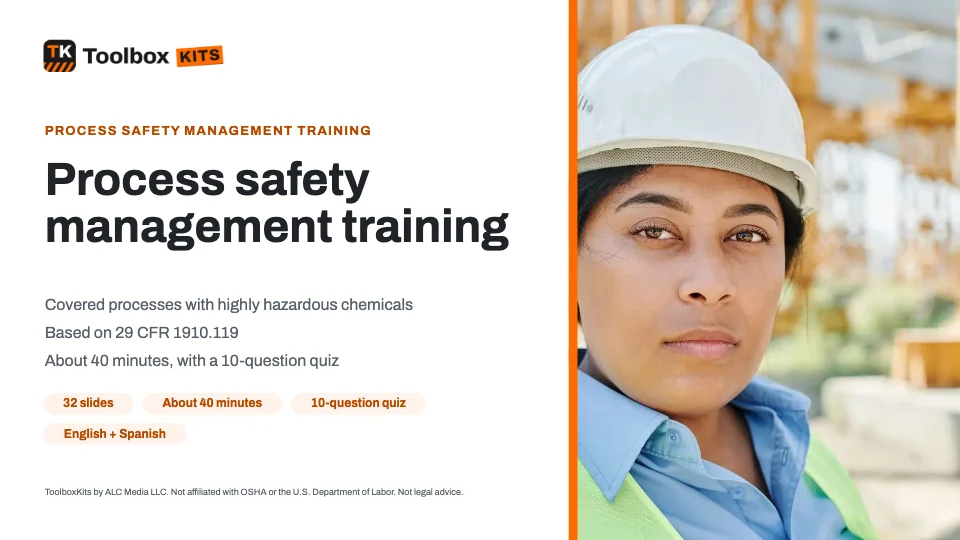
Editable PowerPoint, 32 slides
- Editable PowerPoint with trainer notes on every slide
- Trainer guide PDF with timing and discussion tips
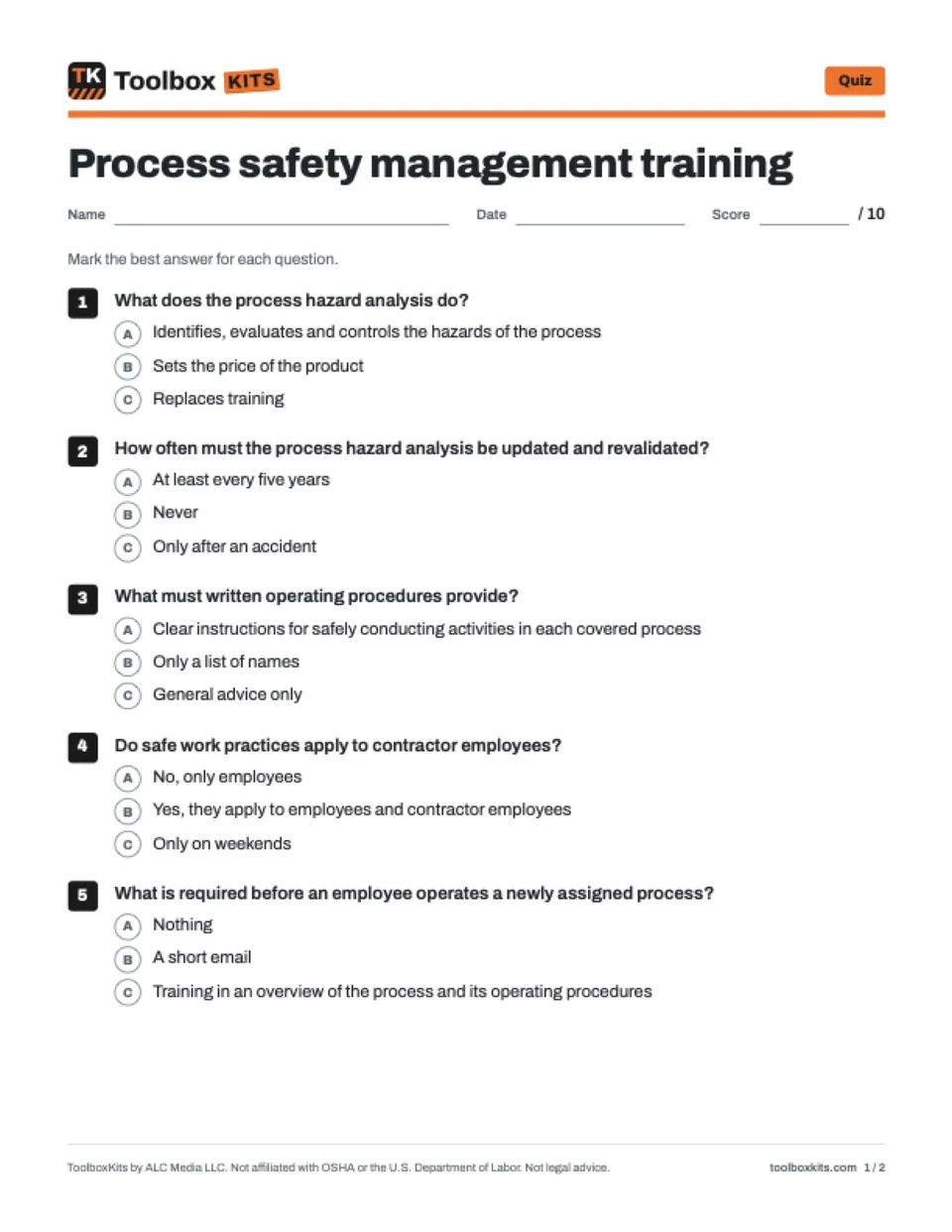
- 10-question quiz and answer key
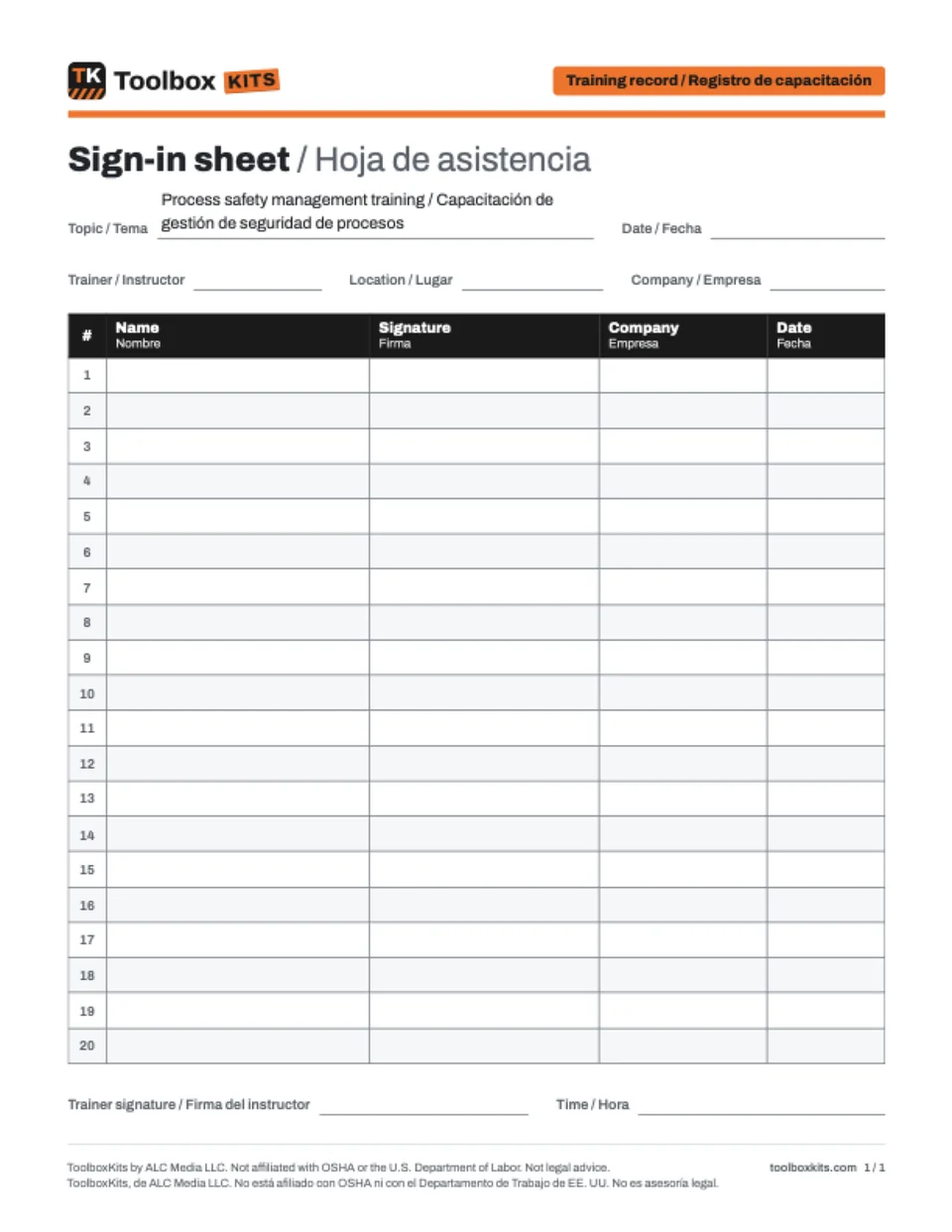
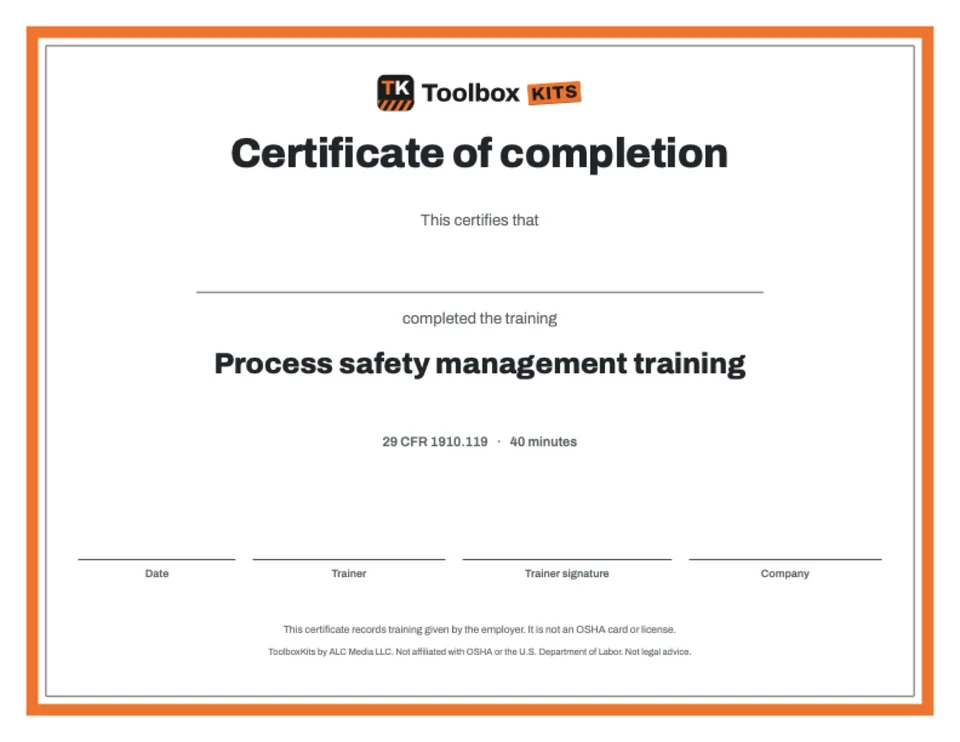
- Sign-in sheet and certificate of completion with fillable fields
- One-page crew handout
- Full Spanish version of everything
- One-page bilingual poster
- Audit-ready records in 60 seconds: fill in your crew and get a sign-in sheet and a certificate for every worker
- Instant download
- Secure checkout by Stripe
- 30-day refund, no questions
Need many topics? All Access gives you every kit for $99 a year.
Inside the kit
See what is in the kit
What is in the kit
 Editable PowerPoint
- Trainer guide
 Quiz
- Answer key
 Sign-in sheet
 Certificate
- Crew handout
Try it
Try the quiz
Three questions from this topic. Pick an answer to see the right one and the OSHA paragraph.
Question 1 of 3
How often must refresher training be given to employees who operate a covered process?
The rule
What OSHA requires
Plain-language summary. Each line links to the exact paragraph of the regulation.
PSM applies to a process involving a chemical at or above the threshold quantity listed in appendix A to the standard (29 CFR 1910.119(a)(1)(i)). It also applies to a process involving a Category 1 flammable gas or a flammable liquid with a flashpoint below 100 °F (37.8 °C) on site in one location in a quantity of 10,000 pounds (4535.9 kg) or more (29 CFR 1910.119(a)(1)(ii)), with some exceptions, such as hydrocarbon fuels used solely as fuel in the workplace when they are not part of a process containing another covered highly hazardous chemical. It does not apply to retail facilities, oil or gas well drilling or servicing operations, or normally unoccupied remote facilities (29 CFR 1910.119(a)(2)).
“a flammable liquid with a flashpoint below 100 °F (37.8 °C) on site in one location, in a quantity of 10,000 pounds (4535.9 kg) or more”
Before any process hazard analysis, the employer must compile written process safety information on the hazards of the chemicals, the technology of the process and the equipment (29 CFR 1910.119(d)). The employer must perform a process hazard analysis that identifies, evaluates and controls the hazards of the process, and it must be updated and revalidated at least every five years (29 CFR 1910.119(e)(6)).
“The process hazard analysis shall be appropriate to the complexity of the process and shall identify, evaluate, and control the hazards involved in the process.”
The employer must develop and implement written operating procedures with clear instructions for safely conducting activities in each covered process. They must cover the steps for each operating phase, operating limits, safety and health considerations and safety systems, and they must be readily accessible to employees who work in or maintain the process (29 CFR 1910.119(f)(2)). The employer must certify annually that they are current and accurate (29 CFR 1910.119(f)(3)).
“written operating procedures that provide clear instructions for safely conducting activities involved in each covered process”
The employer must develop and implement safe work practices to control hazards during operations such as lockout/tagout, confined space entry, opening process equipment or piping, and entry into the facility by maintenance, contractor, laboratory or other support personnel. These practices apply to employees and contractor employees.
“These safe work practices shall apply to employees and contractor employees.”
Each employee operating a process, and each employee before operating a newly assigned process, must be trained in an overview of the process and its operating procedures, with emphasis on the specific safety and health hazards, emergency operations including shutdown, and safe work practices for their job tasks. Refresher training is required at least every three years, and more often if necessary (29 CFR 1910.119(g)(2)).
“The training shall include emphasis on the specific safety and health hazards, emergency operations including shutdown, and safe work practices applicable to the employee's job tasks.”
A pre-startup safety review is required for new facilities, and for modified facilities when the modification is significant enough to require a change in the process safety information. Before highly hazardous chemicals are introduced, it must confirm, among other things, that safety, operating, maintenance and emergency procedures are in place and adequate, and that training of each employee involved in operating the process has been completed (29 CFR 1910.119(i)(2)).
“The employer shall perform a pre-startup safety review for new facilities and for modified facilities when the modification is significant enough to require a change in the process safety information.”
Process equipment such as pressure vessels, storage tanks, piping, relief and vent systems, emergency shutdown systems, controls and pumps must be inspected and tested (29 CFR 1910.119(j)(1) and (j)(4)(i)). Deficiencies outside acceptable limits must be corrected before further use, or in a safe and timely manner when necessary means are taken to assure safe operation.
“The employer shall correct deficiencies in equipment that are outside acceptable limits”
The employer must issue a hot work permit for hot work on or near a covered process. The permit must document that the fire prevention and protection requirements of the welding standard (29 CFR 1910.252) have been implemented before hot work begins, show the dates authorized for hot work and identify the object to be worked on (29 CFR 1910.119(k)(2)).
“The employer shall issue a hot work permit for hot work operations conducted on or near a covered process.”
Written management of change procedures must cover changes to process chemicals, technology, equipment and procedures, and changes to facilities that affect a covered process, except replacements in kind (29 CFR 1910.119(l)(1)). Operators, and maintenance and contract employees whose job tasks will be affected, must be informed of and trained in the change before start-up of the process or the affected part.
“shall be informed of, and trained in, the change prior to start-up of the process or affected part of the process”
The employer must investigate each incident that resulted in, or could reasonably have resulted in, a catastrophic release of a highly hazardous chemical in the workplace (29 CFR 1910.119(m)(1)). The investigation must start as promptly as possible, and no later than 48 hours after the incident.
“An incident investigation shall be initiated as promptly as possible, but not later than 48 hours following the incident.”
Who must be trained
Each employee presently involved in operating a process, and each employee before being involved in operating a newly assigned process, must be trained in an overview of the process and in its operating procedures (29 CFR 1910.119(g)(1)(i)). Each employee involved in maintaining the on-going integrity of process equipment must be trained in an overview of the process and its hazards and in the procedures that apply to their job tasks (29 CFR 1910.119(j)(3)). Contract employers must make sure each contract employee is trained in the work practices needed to do the job safely, and is instructed in the known potential fire, explosion or toxic release hazards of the job and the process and in the applicable parts of the emergency action plan (29 CFR 1910.119(h)(3)(i) and (h)(3)(ii)). Operators, and maintenance and contract employees whose job tasks will be affected by a change, must be informed of and trained in it before start-up (29 CFR 1910.119(l)(3)).
When to retrain
Refresher training must be provided at least every three years, and more often if necessary, to each employee involved in operating a process, so that the employee understands and follows the current operating procedures. The employer decides the right frequency in consultation with the employees who operate the process (29 CFR 1910.119(g)(2)). The employer must prepare a record of each employee's training that shows the employee's identity, the date of training and how understanding was verified (29 CFR 1910.119(g)(3)).

Common questions
Questions people ask
What should a process safety management toolbox talk cover?
Start with what PSM is about. In the standard, a process means any activity involving a highly hazardous chemical, including any use, storage, manufacturing, handling or on-site movement of it (29 CFR 1910.119(b)). Then cover the parts that touch daily work: operating procedures and limits, management of change, permits and safe work practices, equipment checks, reporting close calls and the emergency plan.
What is a good process safety moment?
A good process safety moment is short, covers one idea and ties it to the unit you work on. Strong choices are an operating limit and what to do when you get close to it, a recent change and how it was reviewed, a hot work permit, or a close call and what the crew learned from it. Rotate topics so the message stays fresh.
What should a management of change safety moment cover?
Explain what counts as a change: changes to process chemicals, technology, equipment and procedures, and to facilities that affect a covered process, but not replacements in kind that satisfy the design specification (29 CFR 1910.119(l)(1) and (b)). Before any change, the procedures must address its technical basis, its impact on safety and health, changes to operating procedures, the time needed and the authorization required (29 CFR 1910.119(l)(2)). End by asking the crew for an example of a change on the unit and how it should be handled.
Is there a process safety management training PowerPoint or PDF?
The free talk on this page is written to be read aloud, and you can print it as a PDF in English and Spanish with a sign-in table. If you want a process safety management PowerPoint for a longer training session, use the training kit option on this page. A short talk supports PSM training but does not replace the training the standard requires.
Is there a template for a process safety management written program?
This page is a toolbox talk, not a program template, and a PSM program has to fit your own process. The standard calls for several written parts, including a written plan of action for employee participation (29 CFR 1910.119(c)(1)), written operating procedures, written mechanical integrity procedures and written management of change procedures (29 CFR 1910.119(f)(1), (j)(2) and (l)(1)). Employers must also certify at least every three years that they have evaluated compliance with the standard (29 CFR 1910.119(o)(1)).
Free to share
Use this talk for free
You can print, share and adapt this talk at no cost under the Creative Commons BY-NC-SA 4.0 license. Please credit ToolboxKits with a link.