

Free 5-minute toolbox talkMachinesEnglish and Spanish
Machine guarding toolbox talk
Moving parts can crush, cut, pull in or throw things faster than anyone can react. What OSHA requires: Guards must be attached to the machine where possible, and secured elsewhere if attaching them to the machine is not possible. A guard must not create an accident hazard itself (29 CFR 1910.212(a)(2)).
A 5-minute talk for anyone who runs, cleans or works near machines. It covers where machines can catch you, why guards stay on, what to do about jams and missing guards, and the OSHA rules behind each point.
Updated October 29, 2026 · Based on 29 CFR 1910.212, 29 CFR 1910.219, 29 CFR 1926.300
Read it out loud
Free 5-minute toolbox talk
Read it out loud to your crew. It takes about 5 minutes.
Start with a question
If the machine you run jammed right now, would you reach in to clear it, or shut it down first?
Why it matters
Machines do not know the difference between the material and your hand. Moving parts can crush, cut, pull in or throw things faster than anyone can react. Guards are there because nobody can stay perfectly careful every minute of every shift. A missing or bypassed guard can turn a normal day into a serious injury.
Key points
Know where machines can hurt you
Every machine with moving parts has danger points. OSHA's general machine rule lists hazards such as the point of operation, ingoing nip points, rotating parts, and flying chips and sparks.
More
One or more methods of machine guarding must protect the operator and other employees in the machine area from them. Before you start, know where these points are on your machine.
Guards stay on and stay working
The point of operation is where the machine does its work on the material, such as cutting, pressing, shaping or bending. If it can injure you, it must be guarded, and the guard is there to keep every part of your body out of the danger zone while the machine cycles.
More
Never remove, bypass, prop open or tape over a guard to save time. If a guard is missing or broken, do not run the machine, and tell your supervisor.
Shut it down before you reach in
Clearing a jam, cleaning or adjusting a part is when hands get closest to the danger zone. During production, servicing that requires you to remove or bypass a guard, or put any part of your body into the point of operation, generally falls under the lockout/tagout rule.
More
Stop the machine, lock it out and check that it cannot start before you reach in. If you are not trained to lock out that machine, get someone who is.
Tools and PPE do not replace a guard
Push sticks and other special hand tools help you place and remove material without putting a hand in the danger zone. They cannot be used instead of the required guarding; they can only add to it. Gloves and safety glasses do not replace a guard either.
More
Gloves can also get caught in rotating parts, so follow the glove rules for each machine.
Dress for moving parts
Rotating shafts, belts and chains can grab a loose sleeve, a hood string, jewelry or long hair and pull you in. Wear fitted clothing, take off rings and chains, and tie back long hair.
More
OSHA's power transmission rule requires regular oilers to wear tight-fitting clothing, and machinery must be oiled when it is not in motion, wherever possible.
Check the guards before every start
Before you start a machine, look at the guards. They should be in place, secure, and not cracked, bent or loose. Guards must be attached to the machine where possible, and a guard must not create a hazard of its own, such as a sharp edge or a new pinch point.
More
Know where the stop button is, and report any problem before the machine runs.
Scenario
Picture this: A packaging line keeps jamming near the end of a long shift. To save time, an operator props open the guard door and reaches in with the machine still running to pull out a crushed box. A new hire watches and decides that must be how it is done here. What went wrong, and what should both of them do the next time the line jams?
Ask the crew
- What types of guards are on the machines in our area, and are any of them removed, propped open or worked around?
- What is our procedure when a machine jams, and who is authorized to lock it out?
- Where are the nip points and rotating parts on the equipment you run today?
- Who do you tell about a missing or broken guard, and what happens to the machine until it is fixed?
Takeaway
Guards stay on, hands stay out, and nobody reaches into a machine until it is shut down and locked out.
Trainer: ______________________ Date: ____________
Credit: ToolboxKits, https://toolboxkits.com/topics/machine-guarding/ (CC BY-NC-SA 4.0)
The poster is also inside the paid kits.
Audit-ready records in 60 seconds
Fill in your crew and download a filled sign-in sheet for this talk. Everything is made in your browser. Names are never uploaded or stored.
Start a sign-off
Crew scan a QR code on their own phones, type their name and sign with a finger. You see the names arrive and download the signed sheet. Free, no account.
Kits
Get the kit
No subscription needed. Buy only the kit you need.
Toolbox talk kit
$4.99
- 5-minute talk, English PDF
- 5-minute talk, Spanish PDF
- Editable mini-deck (English and Spanish)
- One-page crew handout (English and Spanish)
- Bilingual sign-in sheet
- 3-question quiz with answer key (English and Spanish)
- One-page bilingual poster
- Audit-ready records in 60 seconds: fill in your crew and get a sign-in sheet and a certificate for every worker
Training kit
$9
Editable PowerPoint, 38 slides
- Editable PowerPoint with trainer notes on every slide
- Trainer guide PDF with timing and discussion tips
- 10-question quiz and answer key
- Sign-in sheet and certificate of completion with fillable fields
- One-page crew handout
- Full Spanish version of everything
- One-page bilingual poster
- Audit-ready records in 60 seconds: fill in your crew and get a sign-in sheet and a certificate for every worker
- Instant download
- Secure checkout by Stripe
- 30-day refund, no questions
Need many topics? All Access gives you every kit for $99 a year.
Inside the kit
See what is in the kit
What is in the kit
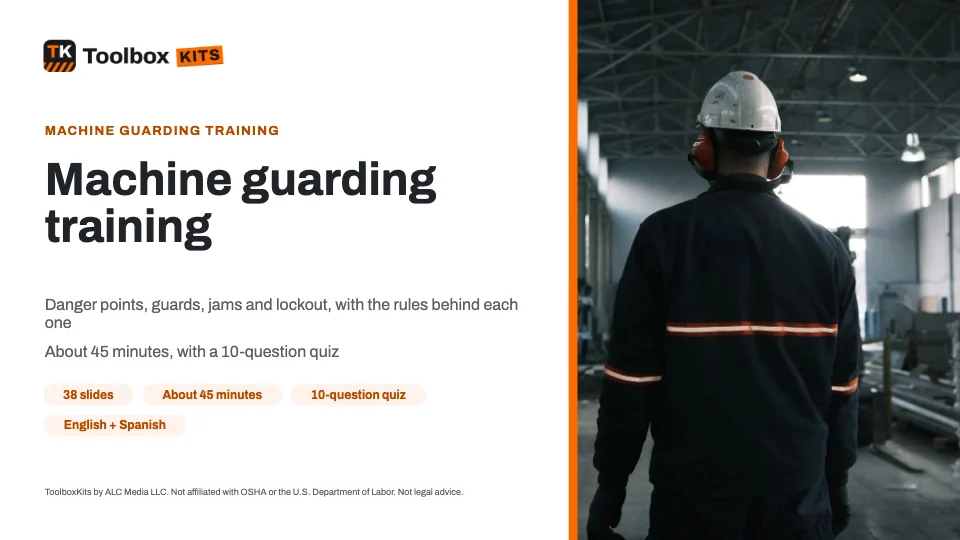 Editable PowerPoint
- Trainer guide
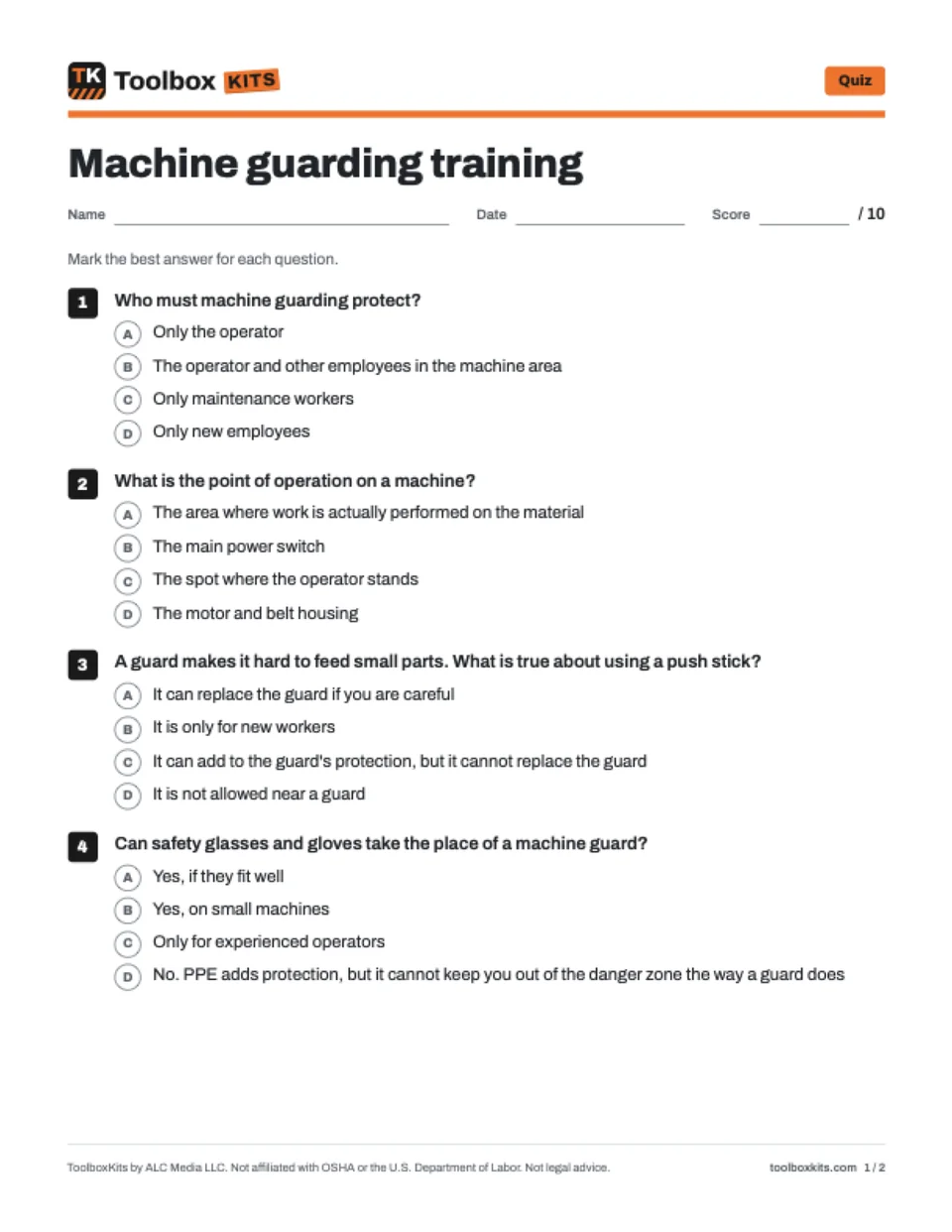 Quiz
- Answer key
 Sign-in sheet
 Certificate
- Crew handout
Try it
Try the quiz
Three questions from this topic. Pick an answer to see the right one and the OSHA paragraph.
Question 1 of 3
A machine jams and the part is stuck under the guard. What should you do?
The rule
What OSHA requires
Plain-language summary. Each line links to the exact paragraph of the regulation.
One or more methods of machine guarding must protect the operator and other employees in the machine area from hazards such as the point of operation, ingoing nip points, rotating parts, and flying chips and sparks. Examples include barrier guards, two-hand tripping devices and electronic safety devices.
“One or more methods of machine guarding shall be provided to protect the operator and other employees in the machine area”
Guards must be attached to the machine where possible, and secured elsewhere if attaching them to the machine is not possible. A guard must not create an accident hazard itself.
“The guard shall be such that it does not offer an accident hazard in itself.”
The point of operation of a machine whose operation exposes an employee to injury must be guarded. Where no specific standard applies, the guard must be designed and built to keep any part of the operator's body out of the danger zone during the operating cycle.
“The point of operation of machines whose operation exposes an employee to injury, shall be guarded.”
Special hand tools for placing and removing material may not be used in place of required guarding. They can only supplement the protection the guarding provides.
“Such tools shall not be in lieu of other guarding required by this section, but can only be used to supplement protection provided.”
In construction, power tools designed to take guards must have those guards on when in use.
“When power operated tools are designed to accommodate guards, they shall be equipped with such guards when in use.”
In construction, belts, gears, shafts, pulleys, sprockets, spindles, drums, flywheels, chains and other reciprocating, rotating or moving parts of equipment must be guarded if employees can come in contact with them or they otherwise create a hazard.
“shall be guarded if such parts are exposed to contact by employees or otherwise create a hazard”
All sprocket wheels and chains must be enclosed unless they are more than seven (7) feet above the floor or platform. This does not apply to manually operated sprockets.
“All sprocket wheels and chains shall be enclosed unless they are more than seven (7) feet above the floor or platform.”
All power-transmission equipment must be inspected at intervals not exceeding 60 days and kept in good working condition at all times.
“All power-transmission equipment shall be inspected at intervals not exceeding 60 days and be kept in good working condition at all times.”
Servicing or maintenance during normal production falls under the lockout/tagout standard when an employee must remove or bypass a guard or other safety device, or place any part of the body into the point of operation or an associated danger zone. Minor tool changes and adjustments that are routine, repetitive and integral to production, and done with alternative measures that give effective protection, are an exception.
“Servicing and/or maintenance which takes place during normal production operations is covered by this standard only if”
Where workers are exposed to eye or face hazards such as flying particles, the employer must make sure each affected employee uses appropriate eye or face protection.
“The employer shall ensure that each affected employee uses appropriate eye or face protection when exposed to eye or face hazards from flying particles”
Common questions
Questions people ask
Is there a printable machine guarding toolbox talk PDF?
Yes. This machine guarding toolbox talk is a free printable PDF in English and Spanish, with a sign-in sheet for attendance. It works as a short machine safety training PDF for a refresher, but it does not replace hands-on training on each machine. After you read it, walk the crew to one of your machines and point out its guards and danger points.
Does OSHA require a machine guarding written program?
The general machine guarding rule, 29 CFR 1910.212, says what must be guarded, but it does not spell out a written program. If guards have to be removed or bypassed for servicing, the lockout/tagout rule generally requires energy control procedures to be developed, documented and used (29 CFR 1910.147(c)(4)(i)). A short written list of each machine's guards, checks and jam procedure still helps keep everyone on the same page.
Is there a machine guarding safety training PPT?
The free talk on this page is made to be read aloud from a printout, so no projector is needed. For a longer class with a machine safety PowerPoint presentation, use the training kit option on this page, which adds slides with trainer notes, a quiz and a handout in English and Spanish.
What should a moving machinery toolbox talk cover?
Cover the danger points on your machines (the point of operation, nip points, rotating parts and flying chips), keeping guards on, what to do when a machine jams, and dressing so nothing can get caught. One or more methods of machine guarding must protect the operator and other employees in the machine area (29 CFR 1910.212(a)(1)). End by having the crew point out the guards and stop buttons on the machines they use.
Is a machine safety toolbox talk enough training to run a machine?
No. A toolbox talk is a good refresher, but each person should also get hands-on instruction on the machine they will run. Some OSHA rules set specific training duties: for mechanical power presses, the employer must train and instruct the operator in the safe method of work before starting work (29 CFR 1910.217(f)(2)), and on construction sites only employees qualified by training or experience may operate equipment and machinery (29 CFR 1926.20(b)(4)). Where lockout is used, the employer must train employees so they have the knowledge and skills to safely apply, use and remove the energy controls (29 CFR 1910.147(c)(7)(i)).
Free to share
Use this talk for free
You can print, share and adapt this talk at no cost under the Creative Commons BY-NC-SA 4.0 license. Please credit ToolboxKits with a link.