

Free 5-minute toolbox talkToolsEnglish and Spanish
Hand and power tools safety toolbox talk
A cracked handle, a missing guard or a damaged cord can lead to cuts, eye injuries, burns or shocks in a split second. What OSHA requires: Construction: all hand and power tools must be kept in a safe condition, whether the employer or the worker supplies them (29 CFR 1926.300(a)).
A five-minute talk on hand and power tool safety for your crew. It covers tool inspection, guards, cords, PPE and compressed air, with the OSHA rules behind each point.
Updated October 29, 2026 · Based on 29 CFR 1926.300, 29 CFR 1926.301, 29 CFR 1926.302, 29 CFR 1910.242
Read it out loud
Free 5-minute toolbox talk
Read it out loud to your crew. It takes about 5 minutes.
Start with a question
What is the most beat-up tool on this job right now, and why is it still in use?
Why it matters
Tools are in our hands all day, so it is easy to stop thinking about them. A cracked handle, a missing guard or a damaged cord can lead to cuts, eye injuries, burns or shocks in a split second. A quick check before you start catches these problems before they hurt someone.
Key points
Check every tool before you use it
All hand and power tools must be kept in a safe condition, whether the company or the worker supplies them. Before each use, look for cracked or loose handles, mushroomed heads, frayed cords and missing parts. If a tool is damaged, tag it out and turn it in. Tape is not a repair.
Use the right hand tool, and keep it in shape
Use the right tool for the job. A screwdriver is not a pry bar and a wrench is not a hammer. Impact tools like chisels, wedges and drift pins must be kept free of mushroomed heads, which can throw chips when struck. Store tools clean and dry, with sharp edges covered.
Guards stay on
When a power tool is designed to take a guard, it must have that guard on whenever it is in use. Never pin back a saw guard or remove a grinder guard to make a job easier. If a guard is missing, broken or sticking, the tool is out of service until it is fixed.
Respect the cord and the plug
Electric power tools must be double-insulated or grounded. Check cords for cuts and plugs for damage, and never use a grounded plug with the ground pin cut off. Never carry, hoist or lower a tool by its cord, and unplug it before changing blades, bits or accessories.
Wear the PPE the job calls for
Workers using tools who are exposed to flying, falling or abrasive objects, or to harmful dust, fumes or vapors, must be given the PPE needed to protect them. For most tool work, plan on safety glasses at a minimum, with a face shield over them for grinding or chipping.
More
Add hearing protection, gloves or a respirator when the task calls for it.
Compressed air is not a duster
Never blow dust off your skin or clothes with compressed air. , and then only with effective chip guarding and PPE. i. limit does not apply to cleaning concrete forms, mill scale and similar work. Use a brush or a vacuum instead whenever you can.
29 CFR 1910.242(b) · 29 CFR 1926.302(b)(4)
Scenario
Picture this: it is late in the day and one cut is left. The lower guard on the circular saw keeps sticking, so a worker wedges it open to finish faster. The blade binds, the saw kicks back, and with the guard pinned open there is nothing between the blade and the worker's leg. What should have happened the first time that guard stuck?
Ask the crew
- Which tools on this job are worn, damaged or missing a guard right now?
- Where do we tag out and turn in a damaged tool, and who replaces it?
- What PPE does the work we are doing this week call for?
- Are there personal tools on site that nobody has checked?
Takeaway
If a tool is damaged or missing a guard, it does not get used until it is fixed or replaced.
Trainer: ______________________ Date: ____________
Credit: ToolboxKits, https://toolboxkits.com/topics/hand-and-power-tools/ (CC BY-NC-SA 4.0)
The poster is also inside the paid kits.
Audit-ready records in 60 seconds
Fill in your crew and download a filled sign-in sheet for this talk. Everything is made in your browser. Names are never uploaded or stored.
Start a sign-off
Crew scan a QR code on their own phones, type their name and sign with a finger. You see the names arrive and download the signed sheet. Free, no account.
Kits
Get the kit
No subscription needed. Buy only the kit you need.
Toolbox talk kit
$4.99
- 5-minute talk, English PDF
- 5-minute talk, Spanish PDF
- Editable mini-deck (English and Spanish)
- One-page crew handout (English and Spanish)
- Bilingual sign-in sheet
- 3-question quiz with answer key (English and Spanish)
- One-page bilingual poster
- Audit-ready records in 60 seconds: fill in your crew and get a sign-in sheet and a certificate for every worker
Training kit
$9
Editable PowerPoint, 37 slides
- Editable PowerPoint with trainer notes on every slide
- Trainer guide PDF with timing and discussion tips
- 10-question quiz and answer key
- Sign-in sheet and certificate of completion with fillable fields
- One-page crew handout
- Full Spanish version of everything
- One-page bilingual poster
- Audit-ready records in 60 seconds: fill in your crew and get a sign-in sheet and a certificate for every worker
- Instant download
- Secure checkout by Stripe
- 30-day refund, no questions
Need many topics? All Access gives you every kit for $99 a year.
Inside the kit
See what is in the kit
What is in the kit
 Editable PowerPoint
- Trainer guide
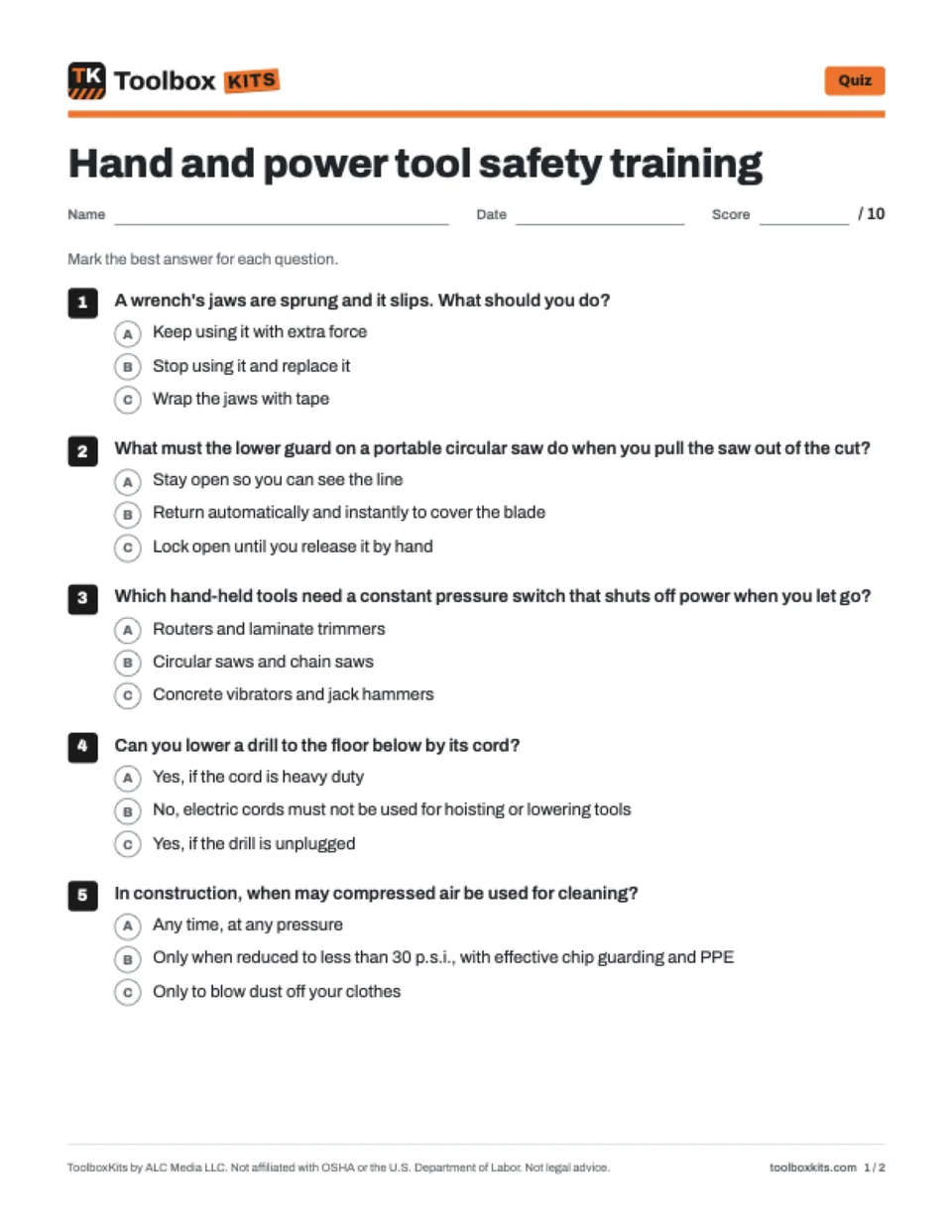 Quiz
- Answer key
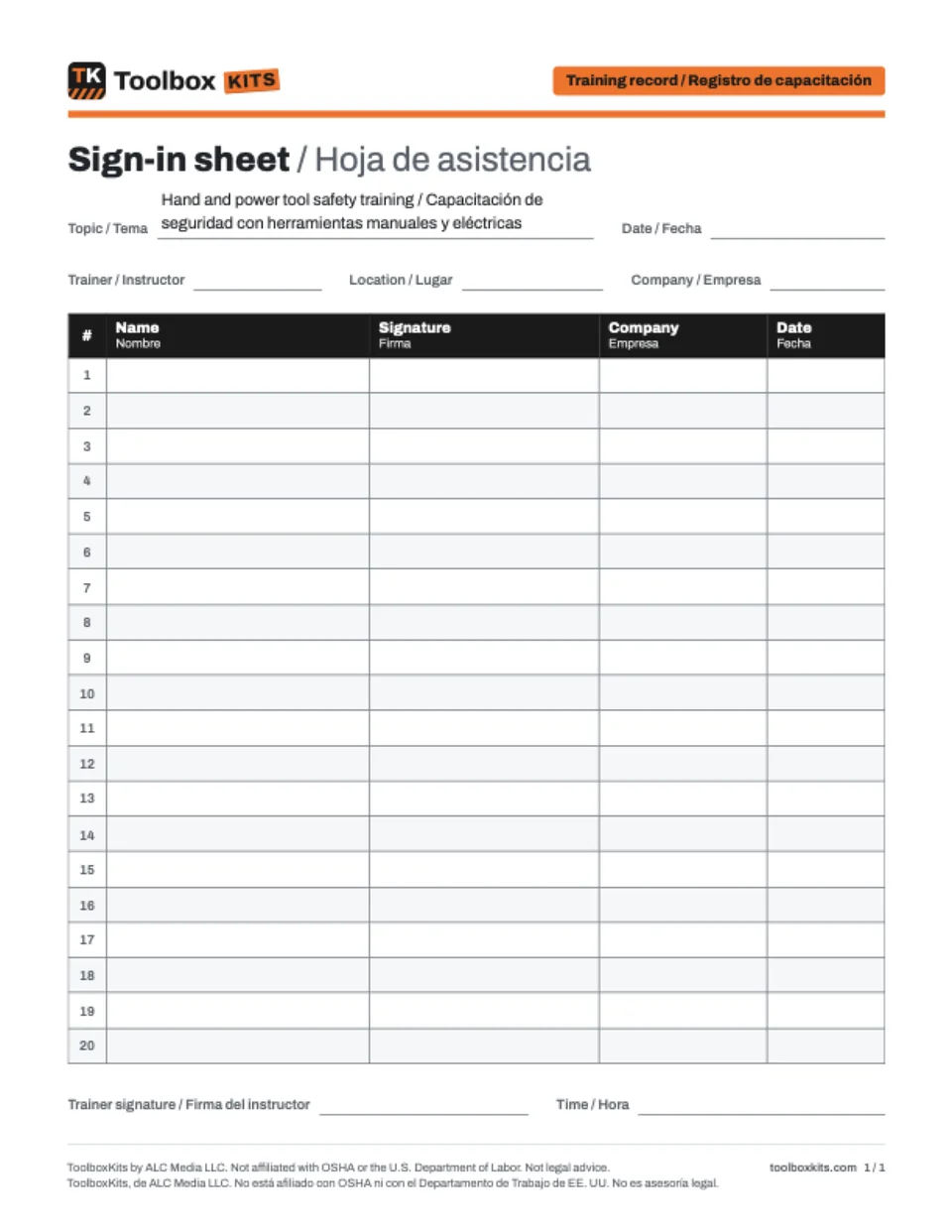 Sign-in sheet
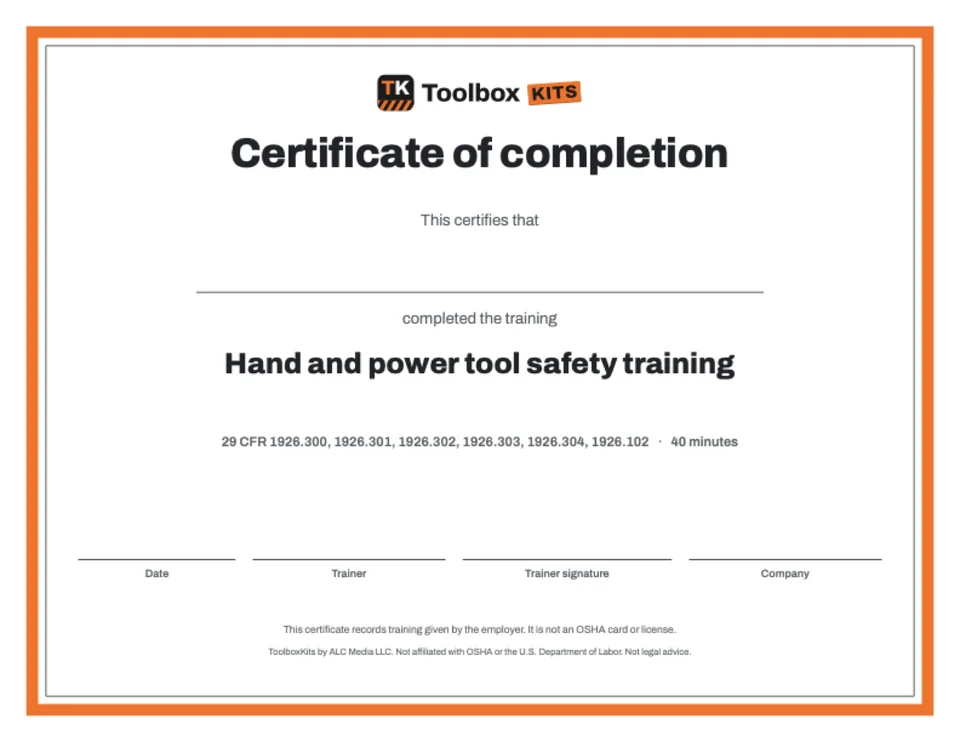 Certificate
- Crew handout
Try it
Try the quiz
Three questions from this topic. Pick an answer to see the right one and the OSHA paragraph.
Question 1 of 3
The head of a chisel is mushroomed. What should you do?
The rule
What OSHA requires
Plain-language summary. Each line links to the exact paragraph of the regulation.
Construction: all hand and power tools must be kept in a safe condition, whether the employer or the worker supplies them.
“All hand and power tools and similar equipment, whether furnished by the employer or the employee, shall be maintained in a safe condition.”
General industry: the employer is responsible for the safe condition of tools and equipment workers use, including tools workers bring themselves.
“Each employer shall be responsible for the safe condition of tools and equipment used by employees, including tools and equipment which may be furnished by employees.”
Wrenches must not be used when the jaws are sprung to the point that they slip.
“Wrenches, including adjustable, pipe, end, and socket wrenches shall not be used when jaws are sprung to the point that slippage occurs.”
Impact tools such as drift pins, wedges and chisels must be kept free of mushroomed heads.
“Impact tools, such as drift pins, wedges, and chisels, shall be kept free of mushroomed heads.”
Wooden tool handles must be free of splinters and cracks and kept tight in the tool.
“The wooden handles of tools shall be kept free of splinters or cracks and shall be kept tight in the tool.”
Power tools designed to take a guard must have the guard on whenever they are in use.
“When power operated tools are designed to accommodate guards, they shall be equipped with such guards when in use.”
Workers using tools who are exposed to falling, flying, abrasive or splashing objects, or to harmful dusts, fumes, mists, vapors or gases, must be given the PPE needed to protect them.
“shall be provided with the particular personal protective equipment necessary to protect them from the hazard”
Electric power tools must be double-insulated or grounded.
“Electric power operated tools shall either be of the approved double-insulated type or grounded in accordance with subpart K of this part.”
General industry: compressed air may be used for cleaning only when reduced to less than 30 p.s.i., and only with effective chip guarding and PPE.
“Compressed air shall not be used for cleaning purposes except where reduced to less than 30 p.s.i. and then only with effective chip guarding and personal protective equipment.”
Only workers trained in the operation of the particular powder-actuated tool in use may operate it.
“Only employees who have been trained in the operation of the particular tool in use shall be allowed to operate a powder-actuated tool.”
Who must be trained
Only employees who have been trained in the operation of the particular tool in use may operate a powder-actuated tool (29 CFR 1926.302(e)(1)). The other tool rules cited here do not add a separate training requirement; in construction, the general duty to instruct each employee in recognizing and avoiding unsafe conditions applies (29 CFR 1926.21(b)(2)).

Common questions
Questions people ask
Is there a printable hand and power tool safety toolbox talk PDF?
Yes. This talk is available as a free printable PDF in English and Spanish, with a sign-in table for your crew. Print it, read it aloud in about five minutes, and keep the signed sheet with your safety records.
What should a tool inspection safety talk cover?
Cover what to check before each use: cracked or loose handles, mushroomed heads on chisels and punches, sprung wrench jaws, damaged cords, plugs or hoses, and missing or broken guards. Show the crew how to tag out a bad tool and where to turn it in. In construction, employers must not issue or permit the use of unsafe hand tools.
Do workers need training to use power tools?
Among the construction tool rules on this page, one spells out training: only workers trained in the operation of the particular tool in use may operate a powder-actuated tool. For other tools, the general duty in construction to instruct each worker in recognizing and avoiding unsafe conditions still applies (29 CFR 1926.21(b)(2)). Show each worker how to use each tool safely, following the manufacturer's instructions, before they use it on the job.
What are the most important power tool safety rules?
Keep guards on and working, unplug before changing blades or bits, never carry or lower a tool by its cord or hose, and wear eye protection. When a power tool is designed to take a guard, it must have that guard on whenever it is in use. If a tool is damaged or a guard is missing, take the tool out of service.
Is there a hand and power tool safety training PowerPoint?
This free talk is written to be read aloud, so you do not need slides to run it. If you want a slide presentation, the training kit for this topic includes an editable PowerPoint with trainer notes, a quiz and a sign-in sheet, in English and Spanish.
Free to share
Use this talk for free
You can print, share and adapt this talk at no cost under the Creative Commons BY-NC-SA 4.0 license. Please credit ToolboxKits with a link.