

Free 5-minute toolbox talkToolsEnglish and Spanish
Power tools toolbox talk
Power tools save time, but they can cut, burn, shock and throw debris in a second. What OSHA requires: Specific OSHA rules cover tool condition, guards, grounding, cords, air tools and powder-actuated tools, and the general duty to train still applies (29 CFR 1926.21(b)(2)).
A free power tools toolbox talk. Read it aloud in about five minutes in English or Spanish. It covers guards, cords, grounding, air tools and protective equipment.
Updated October 29, 2026 · Based on 29 CFR 1926.300, 29 CFR 1926.302, 29 CFR 1910.243
Read it out loud
Free 5-minute toolbox talk
Read it out loud to your crew. It takes about 5 minutes.
Start with a question
What is the one thing you check every time before you pull the trigger on a power tool?
Why it matters
Power tools save time, but they can cut, burn, shock and throw debris in a second. Tool injuries happen when a guard is missing, a cord is damaged, the wrong tool is used or a worker is rushing. A quick check before every use takes less time than a trip to the clinic.
Key points
Inspect before every use
Look at the tool, the cord and the plug. Check that guards are in place and move freely. Do not use a tool with a cracked housing, a frayed cord or a bent plug. Tag it out and report it. Employers must provide for frequent and regular inspections of equipment by competent persons.
Keep the guards on
When power tools are designed to accommodate guards, they must be equipped with those guards when in use. Never remove or tie back a guard to work faster.
Use grounded or double insulated tools
Electric power-operated tools must either be of the approved double-insulated type or be grounded. Never cut off the grounding prong. Use a GFCI (ground fault circuit interrupter, a device that cuts the power fast) on wet or outdoor jobs, and keep cords out of water and away from sharp edges.
Never carry or hoist a tool by its cord
Using electric cords for hoisting or lowering tools is not permitted. Use a rope or a bucket. Never yank a cord to unplug a tool, and never leave a cord where people will trip on it or vehicles will run over it.
Secure air tools and wear eye protection
Pneumatic tools must be secured to the hose or whip by some positive means so they cannot disconnect by accident. Employers must make sure workers use appropriate eye or face protection when exposed to flying particles. Add hearing protection, gloves and a dust mask when the job calls for it.
Only trained people use special tools
Only employees who have been trained in the operation of the particular tool in use may operate a powder-actuated tool. If you have not been trained on a tool, do not use it. Ask your supervisor first.
Scenario
Picture this: A worker is cutting tile with an angle grinder. The guard keeps getting in the way, so he takes it off. The cord is frayed and has been wrapped in tape. He is not wearing safety glasses because they fog up. The wheel catches, kicks and flings chips toward a coworker. What was wrong with each decision, and what should he have done?
Ask the crew
- What tool on this site do you think is most dangerous, and why?
- Have you ever seen a guard removed or a cord taped up? What did you do?
- What protective equipment do you need for the tools you use?
- Who is trained on the special tools on this job?
Takeaway
Check the tool, keep the guard on, protect your eyes and use only the tools you are trained to use.
Trainer: ______________________ Date: ____________
Credit: ToolboxKits, https://toolboxkits.com/topics/power-tools/ (CC BY-NC-SA 4.0)
The poster is also inside the paid kits.
Audit-ready records in 60 seconds
Fill in your crew and download a filled sign-in sheet for this talk. Everything is made in your browser. Names are never uploaded or stored.
Start a sign-off
Crew scan a QR code on their own phones, type their name and sign with a finger. You see the names arrive and download the signed sheet. Free, no account.
Kits
Get the kit
No subscription needed. Buy only the kit you need.
Toolbox talk kit
$4.99
- 5-minute talk, English PDF
- 5-minute talk, Spanish PDF
- Editable mini-deck (English and Spanish)
- One-page crew handout (English and Spanish)
- Bilingual sign-in sheet
- 3-question quiz with answer key (English and Spanish)
- One-page bilingual poster
- Audit-ready records in 60 seconds: fill in your crew and get a sign-in sheet and a certificate for every worker
Training kit
$9
Editable PowerPoint, 30 slides
- Editable PowerPoint with trainer notes on every slide
- Trainer guide PDF with timing and discussion tips
- 10-question quiz and answer key
- Sign-in sheet and certificate of completion with fillable fields
- One-page crew handout
- Full Spanish version of everything
- One-page bilingual poster
- Audit-ready records in 60 seconds: fill in your crew and get a sign-in sheet and a certificate for every worker
- Instant download
- Secure checkout by Stripe
- 30-day refund, no questions
Need many topics? All Access gives you every kit for $99 a year.
Inside the kit
See what is in the kit
What is in the kit
 Editable PowerPoint
- Trainer guide
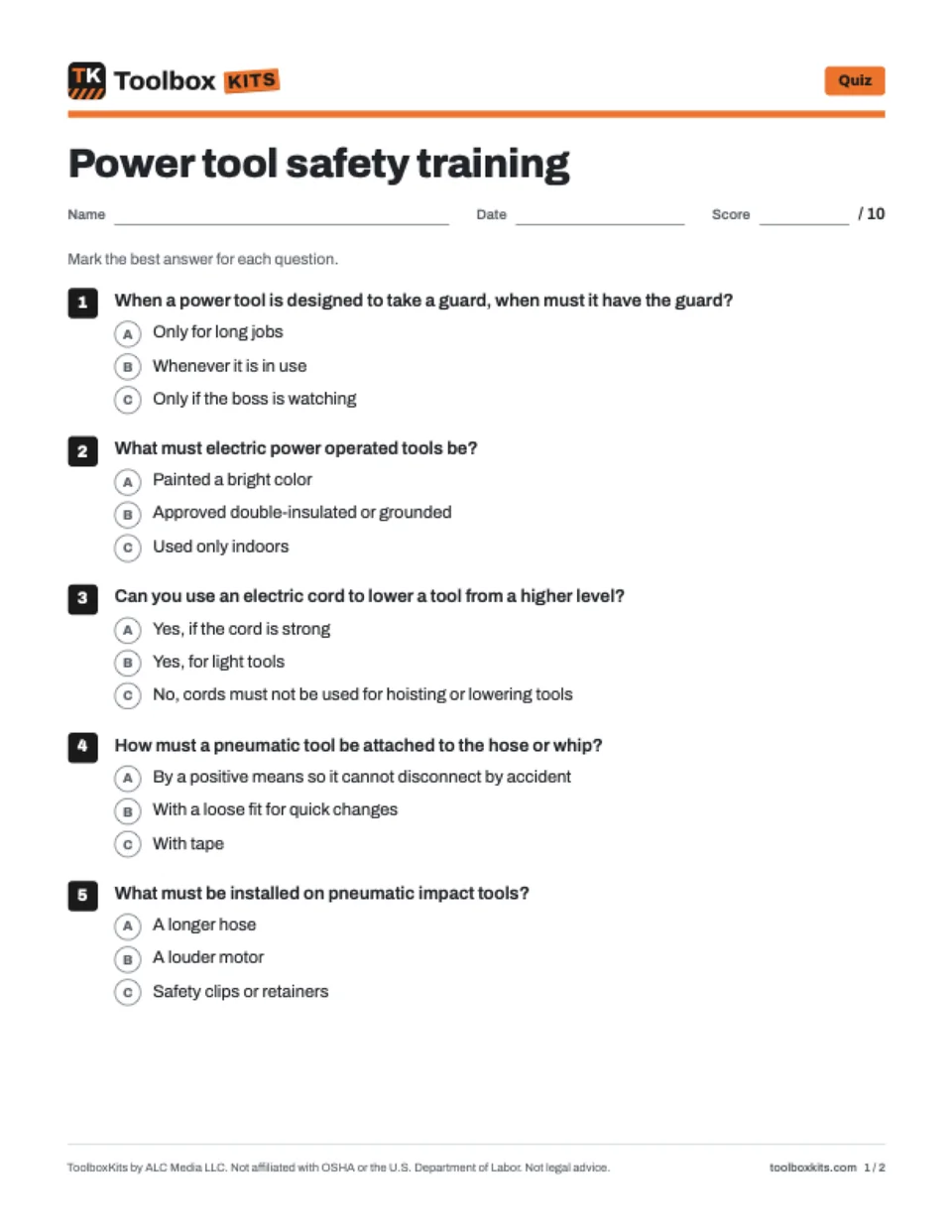 Quiz
- Answer key
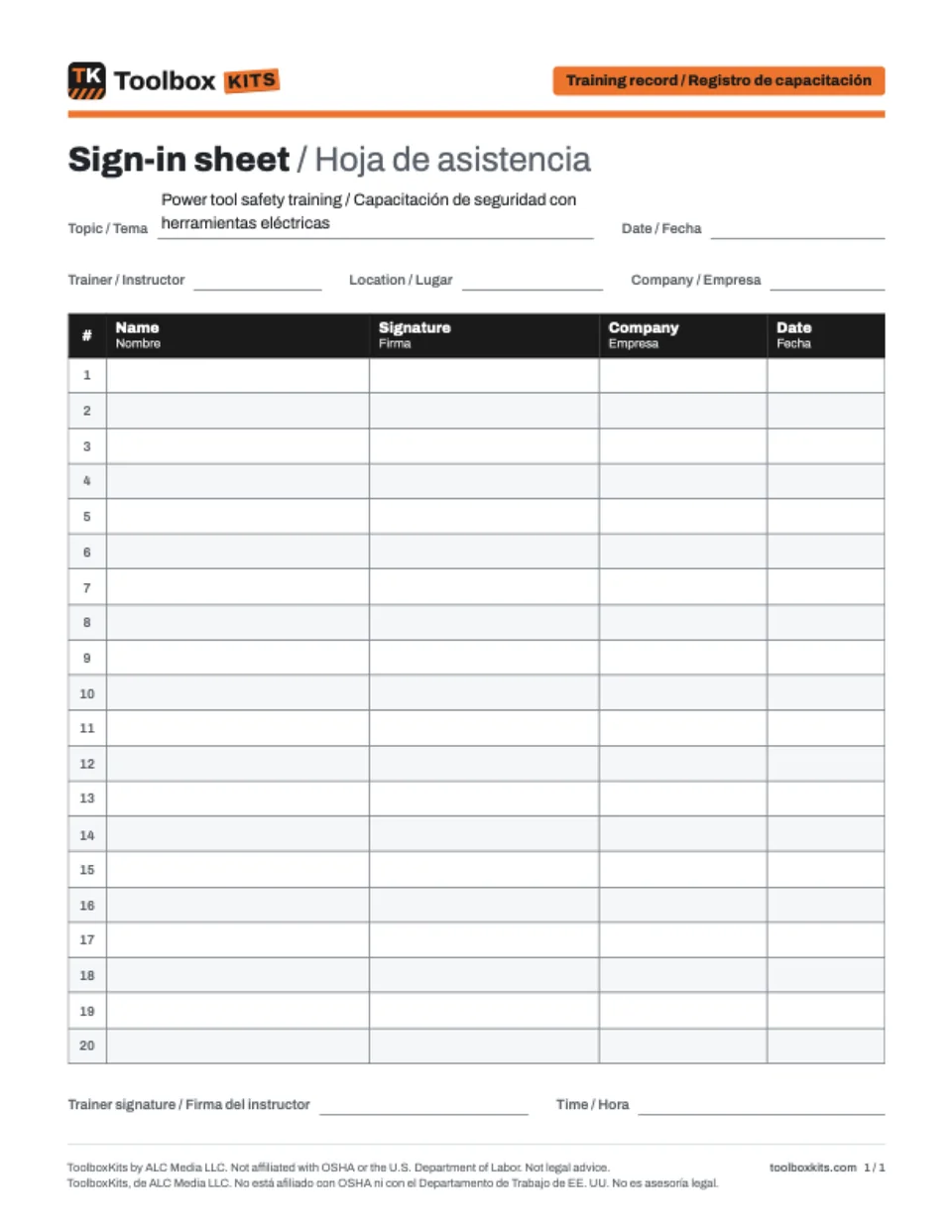 Sign-in sheet
 Certificate
- Crew handout
Try it
Try the quiz
Three questions from this topic. Pick an answer to see the right one and the OSHA paragraph.
Question 1 of 3
What must be true of electric power tools?
The rule
What OSHA requires
Plain-language summary. Each line links to the exact paragraph of the regulation.
Specific OSHA rules cover tool condition, guards, grounding, cords, air tools and powder-actuated tools, and the general duty to train still applies. In construction, the employer must instruct each employee in recognizing and avoiding unsafe conditions and the rules that apply to their work environment.
“The employer shall instruct each employee in the recognition and avoidance of unsafe conditions and the regulations applicable to his work environment to control or eliminate any hazards or other exposure to illness or injury.”
Power operated tools designed to accommodate guards must be equipped with those guards when in use.
“When power operated tools are designed to accommodate guards, they shall be equipped with such guards when in use.”
Electric power operated tools must be either the approved double-insulated type or grounded.
“Electric power operated tools shall either be of the approved double-insulated type or grounded in accordance with subpart K of this part.”
Electric cords must not be used to hoist or lower tools.
“The use of electric cords for hoisting or lowering tools shall not be permitted.”
Pneumatic power tools must be secured to the hose or whip by a positive means so they do not disconnect by accident.
“Pneumatic power tools shall be secured to the hose or whip by some positive means to prevent the tool from becoming accidentally disconnected.”
Safety clips or retainers must be installed and maintained on pneumatic impact tools so attachments are not expelled.
“Safety clips or retainers shall be securely installed and maintained on pneumatic impact (percussion) tools to prevent attachments from being accidentally expelled.”
Only trained employees may operate a powder-actuated tool, and only on the tool they were trained on.
“Only employees who have been trained in the operation of the particular tool in use shall be allowed to operate a powder-actuated tool.”
Employers must make sure each affected employee uses appropriate eye or face protection when exposed to flying particles and similar hazards.
“The employer shall ensure that each affected employee uses appropriate eye or face protection when exposed to eye or face hazards from flying particles”
In general industry, abrasive wheels, such as portable grinder wheels, must be used only on machines provided with safety guards.
“Abrasive wheels shall be used only on machine provided with safety guards”
Who must be trained
Only employees who have been trained in the operation of the particular tool in use shall be allowed to operate a powder-actuated tool (29 CFR 1926.302(e)(1)).

Common questions
Questions people ask
What should a power tools toolbox talk cover?
Cover inspecting the tool and cord, keeping guards on, grounded or double-insulated tools, cord handling, air tool hose connections, eye and hearing protection and training on special tools. Keep it to about five minutes.
Is there a power tool toolbox talk I can print?
Yes. This page is a free printable power tool toolbox talk in English and Spanish with a sign-in table. You can read it aloud from a printout or a phone.
What are the rules for portable power tools on a construction site?
Guards must be on tools designed for them, electric tools must be grounded or double insulated, cords must not be used to hoist tools, and pneumatic tools must be secured to the hose. Workers need eye protection when exposed to flying particles.
Who can use a powder-actuated tool?
Only employees who have been trained in the operation of the particular tool in use may operate a powder-actuated tool.
Can I use a tool with a damaged cord?
No. Take it out of service, tag it and report it. Electric tools must be double insulated or grounded, and a damaged cord or plug can defeat that protection.
Free to share
Use this talk for free
You can print, share and adapt this talk at no cost under the Creative Commons BY-NC-SA 4.0 license. Please credit ToolboxKits with a link.