

Free 5-minute toolbox talkHazardous energyEnglish and Spanish
Lockout tagout toolbox talk (LOTO)
Machines can start up without warning, and stored energy can be released even after the power is off. What OSHA requires: The employer must set up an energy control program made up of energy control procedures, employee training and periodic inspections (29 CFR 1910.147(c)(1)).
A free lockout tagout (LOTO) toolbox talk you can read to your crew in about five minutes, in English and Spanish. Use it as a LOTO safety talk or a quick safety moment before any servicing or maintenance.
Updated October 29, 2026 · Based on 29 CFR 1910.147
Read it out loud
Free 5-minute toolbox talk
Read it out loud to your crew. It takes about 5 minutes.
Start with a question
Have you ever reached into a machine to clear a jam, even for a second, without locking it out?
Why it matters
Machines can start up without warning, and stored energy can be released even after the power is off. Lockout tagout keeps a machine from moving or releasing energy while someone is working on it. It only works when everyone follows the same steps, every time.
Key points
Know your role: authorized or affected
An authorized employee is the person who locks out or tags out a machine to service or maintain it. An affected employee runs that machine or works in the area where the servicing is being done.
More
An affected employee becomes an authorized employee when their duties include that servicing or maintenance.
Find every energy source
Energy can be electrical, mechanical, hydraulic, pneumatic, chemical, thermal or another kind, and one machine can have several sources. Lockout goes on an energy isolating device, like a disconnect switch, a circuit breaker or a line valve.
More
Push buttons, selector switches and other control circuit devices are not energy isolating devices, so hitting the stop button is not lockout.
Follow the steps in order
Lockout procedures must be done in the same sequence every time. Prepare and know the energy, shut the machine down, isolate it from its energy sources, put your lock or tag on, relieve, disconnect or restrain stored energy, then verify the machine is isolated and de-energized.
More
Skipping a step can get someone hurt.
Verify before you touch
Before work starts, the authorized employee must verify that the machine is isolated and de-energized. A common check is to clear everyone from the area, try the normal start controls, then return them to off. Do not take anyone's word that it is dead.
Restart the right way
Before the locks come off, the work area must be checked for nonessential items, and everyone must be safely positioned or out of the way. Affected employees must be told the locks are off before the machine starts.
More
Each lock or tag is removed by the person who put it on, unless that person is not available and the employer directs its removal under a documented procedure that workers are trained on.
Respect every lock and tag
A tag is a warning device. It does not physically hold a switch or valve off the way a lock does. A tag must never be removed without permission from the person responsible for it, and it must never be bypassed or ignored.
More
If you find a lock or tag, leave it alone, never try to start the equipment, and find out who owns it.
Scenario
Picture this: A conveyor jams near the end of a shift. The operator hits the stop button and reaches in to pull out a crushed box. Nobody has locked out the disconnect. At the far end of the line, a coworker who cannot see the operator presses start to check whether the line is clear. What should have happened before anyone reached in?
Ask the crew
- Which machines in our area have more than one energy source, and where are their disconnects and valves?
- Who on this crew is authorized to lock out, and who is affected?
- What do you do if you find a lock or tag on equipment you need to use?
- Where are our lockout procedures kept, and when did you last read the one for your machine?
Takeaway
Before you reach in, lock it out, try it, and keep your key until the job is done.
Trainer: ______________________ Date: ____________
Credit: ToolboxKits, https://toolboxkits.com/topics/lockout-tagout/ (CC BY-NC-SA 4.0)
The poster is also inside the paid kits.
Audit-ready records in 60 seconds
Fill in your crew and download a filled sign-in sheet for this talk. Everything is made in your browser. Names are never uploaded or stored.
Start a sign-off
Crew scan a QR code on their own phones, type their name and sign with a finger. You see the names arrive and download the signed sheet. Free, no account.
Kits
Get the kit
No subscription needed. Buy only the kit you need.
Toolbox talk kit
$4.99
- 5-minute talk, English PDF
- 5-minute talk, Spanish PDF
- Editable mini-deck (English and Spanish)
- One-page crew handout (English and Spanish)
- Bilingual sign-in sheet
- 3-question quiz with answer key (English and Spanish)
- One-page bilingual poster
- Audit-ready records in 60 seconds: fill in your crew and get a sign-in sheet and a certificate for every worker
Training kit
$9
Editable PowerPoint, 39 slides
- Editable PowerPoint with trainer notes on every slide
- Trainer guide PDF with timing and discussion tips
- 10-question quiz and answer key
- Sign-in sheet and certificate of completion with fillable fields
- One-page crew handout
- Full Spanish version of everything
- One-page bilingual poster
- Audit-ready records in 60 seconds: fill in your crew and get a sign-in sheet and a certificate for every worker
- Instant download
- Secure checkout by Stripe
- 30-day refund, no questions
Need many topics? All Access gives you every kit for $99 a year.
Inside the kit
See what is in the kit
What is in the kit
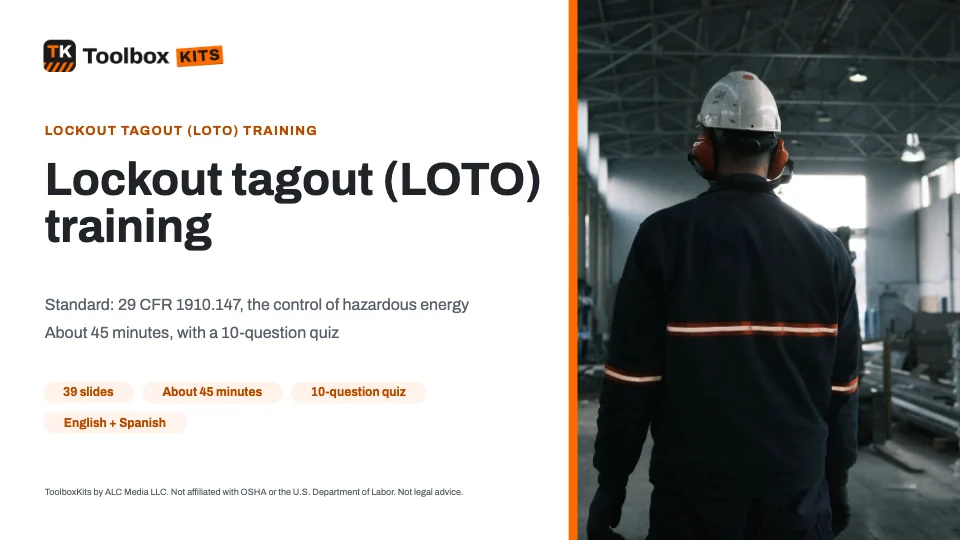 Editable PowerPoint
- Trainer guide
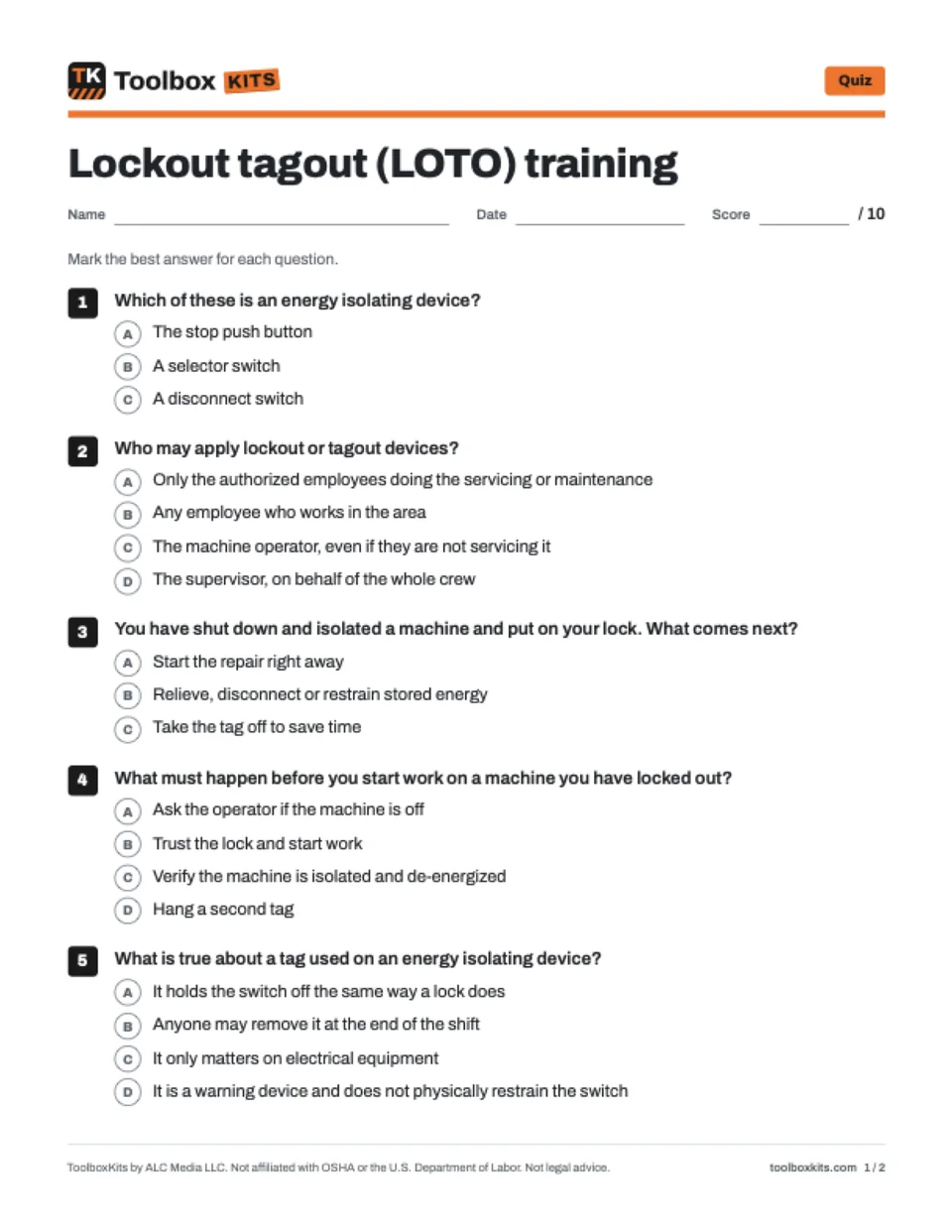 Quiz
- Answer key
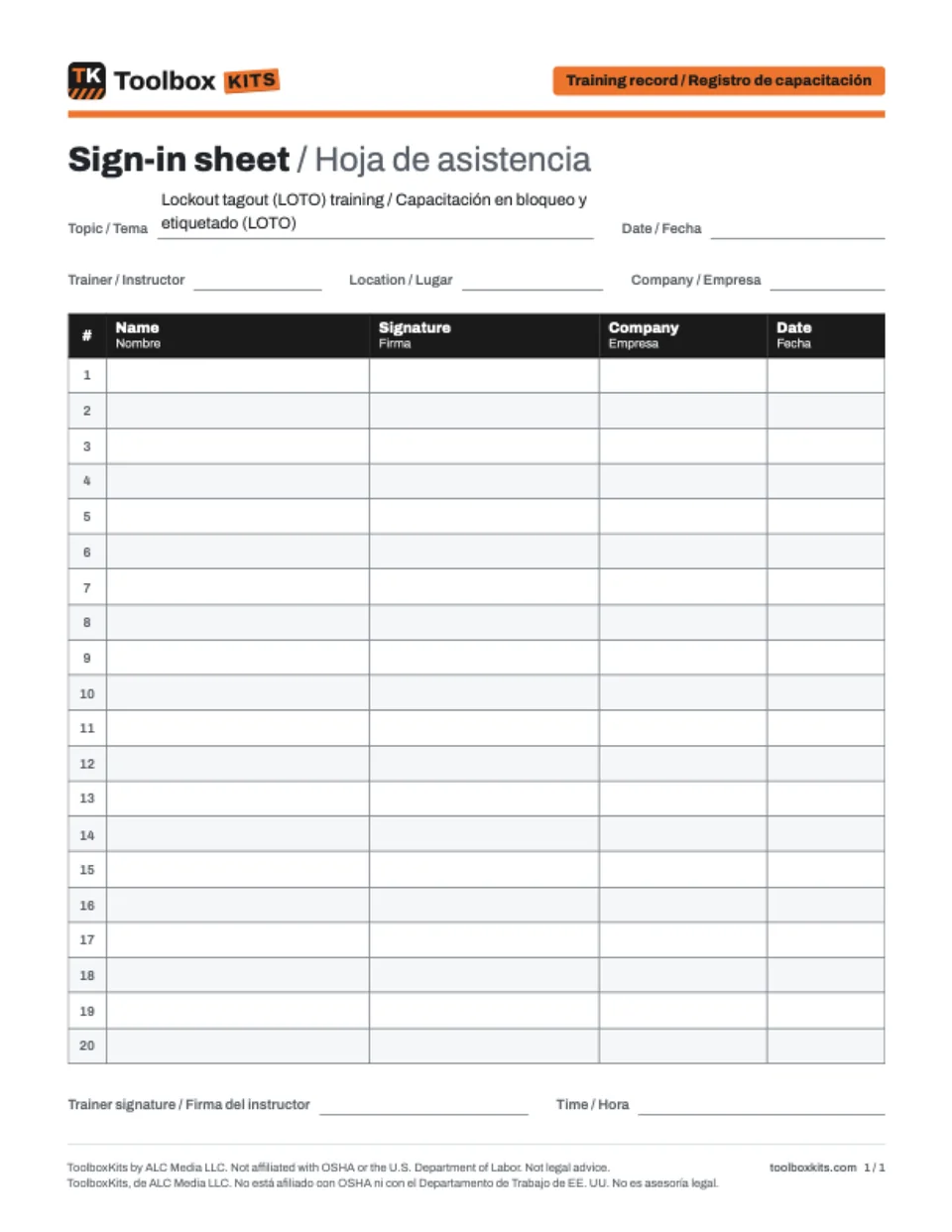 Sign-in sheet
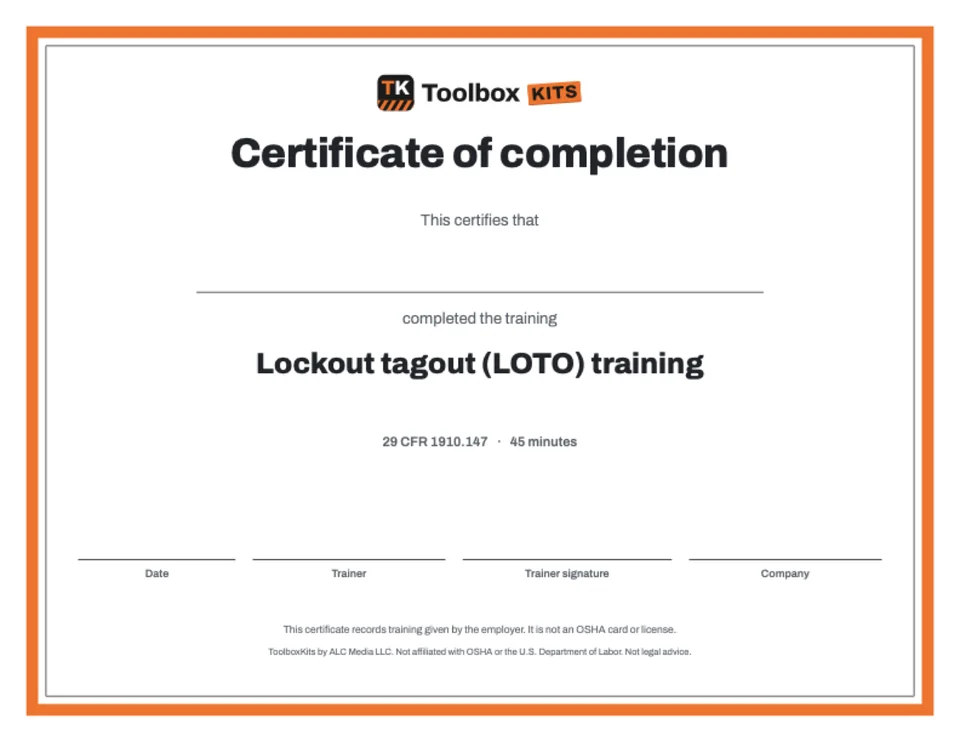 Certificate
- Crew handout
Try it
Try the quiz
Three questions from this topic. Pick an answer to see the right one and the OSHA paragraph.
Question 1 of 3
Who removes a lockout device when the job is done?
The rule
What OSHA requires
Plain-language summary. Each line links to the exact paragraph of the regulation.
The employer must set up an energy control program made up of energy control procedures, employee training and periodic inspections.
“The employer shall establish a program consisting of energy control procedures, employee training and periodic inspections”
Energy control procedures must be developed, documented and used. A machine is exempt from the documentation part only when it meets every condition listed in the rule, such as having a single energy source.
“Procedures shall be developed, documented and utilized for the control of potentially hazardous energy”
Only the authorized employees who are doing the servicing or maintenance may apply lockout or tagout.
“Lockout or tagout shall be performed only by the authorized employees who are performing the servicing or maintenance.”
Before starting work, the authorized employee must verify that the machine is isolated and de-energized.
“the authorized employee shall verify that isolation and deenergization of the machine or equipment have been accomplished”
Each lock or tag must be removed by the employee who applied it. If that employee is not available, it may be removed only under the direction of the employer, using a specific removal procedure that has been developed, documented and trained on.
“Each lockout or tagout device shall be removed from each energy isolating device by the employee who applied the device.”
Each authorized employee must be trained to recognize the hazardous energy sources, the type and magnitude of energy in the workplace, and the methods to isolate and control it.
“Each authorized employee shall receive training in the recognition of applicable hazardous energy sources”
All other employees who work, or may work, in an area where lockout or tagout may be used must be told about the procedure and that attempts to restart or re-energize locked or tagged out equipment are prohibited.
“the prohibition relating to attempts to restart or reenergize machines or equipment which are locked out or tagged out”
Where tags are used, workers must be trained that a tag is a warning device and does not physically restrain a switch or valve the way a lock does.
“Tags are essentially warning devices affixed to energy isolating devices, and do not provide the physical restraint on those devices that is provided by a lock.”
The employer must inspect the energy control procedure at least annually to make sure the procedure and the standard are being followed.
“The employer shall conduct a periodic inspection of the energy control procedure at least annually”
The lockout tagout standard does not cover construction and agriculture employment.
Who must be trained
Every authorized employee must be trained to recognize hazardous energy sources, the type and magnitude of energy in the workplace, and how to isolate and control it. Every affected employee must be instructed in the purpose and use of the energy control procedure. All other employees who work, or may work, in an area where lockout or tagout may be used must be told about the procedure and that attempts to restart or re-energize locked or tagged out equipment are prohibited. (29 CFR 1910.147(c)(7)(i)(A) to (C))
When to retrain
Authorized and affected employees must be retrained when their job assignments change, when a change in machines, equipment or processes brings a new hazard, or when the energy control procedures change. Retraining is also required when a periodic inspection shows, or the employer has reason to believe, that a worker's knowledge or use of the procedures falls short. The employer must certify that training is done and kept up to date, with each employee's name and training dates. (29 CFR 1910.147(c)(7)(iii) and (c)(7)(iv))

Common questions
Questions people ask
Does OSHA require employers to establish a written energy control program?
Yes, the energy control procedures must be documented. OSHA requires an energy control program made up of energy control procedures, employee training and periodic inspections (29 CFR 1910.147(c)(1)), and the procedures must be developed, documented and used (29 CFR 1910.147(c)(4)(i)). The only exception to documenting them is a machine that meets every condition listed in that paragraph, such as a single energy source and no potential for stored or residual energy.
What goes in a written lockout tagout program?
The procedures must clearly and specifically outline the scope, purpose, authorization, rules and techniques for controlling hazardous energy, and how compliance is enforced. They must include a statement of intended use, steps for shutting down, isolating, blocking and securing machines, steps for placing, removing and transferring locks and tags, and requirements for testing that the controls work (29 CFR 1910.147(c)(4)(ii)). Each of these must be specific, not generic. The program also needs employee training and periodic inspections (29 CFR 1910.147(c)(1)).
What should a LOTO awareness toolbox talk cover for workers who do not lock out?
Affected employees must be instructed in the purpose and use of the energy control procedure (29 CFR 1910.147(c)(7)(i)(B)). Everyone else who works where lockout may be used must be told about the procedure and that attempts to restart or re-energize locked or tagged out equipment are prohibited (29 CFR 1910.147(c)(7)(i)(C)). This talk covers the basics of both and what to do when you find a lock or tag, but it does not replace instruction on your site's own procedures.
Is there a printable lockout tagout toolbox talk PDF?
Yes. This talk is available as a free printable PDF in English and Spanish, with a sign-in sheet for your crew. Print it, read it aloud, and keep the signed sheet with your training records. You can share it under a Creative Commons BY-NC-SA license with a credit link back to this page.
Is there a lockout tagout training PowerPoint?
Yes. The ToolboxKits lockout tagout training kit includes a PowerPoint deck in English and Spanish with trainer notes, plus a quiz with an answer key, a handout and a sign-in sheet. It is built from the text of 29 CFR 1910.147 and is not produced or endorsed by OSHA.
Free to share
Use this talk for free
You can print, share and adapt this talk at no cost under the Creative Commons BY-NC-SA 4.0 license. Please credit ToolboxKits with a link.