

Free 5-minute toolbox talkSeasonal and holidaysEnglish and Spanish
Labor Day safety toolbox talk
The holiday also marks the end of summer, with long travel, cookouts and still-hot days. What OSHA requires: OSHA has no specific standard for Labor Day safety; the general duty to train still applies. In construction, the employer must instruct each employee in recognizing and avoiding unsafe conditions and the rules that apply to their work environment (29 CFR 1926.21(b)(2)).
A free Labor Day safety toolbox talk for the last shift before the holiday. It honors the people who do the work and keeps them safe, in English or Spanish.
Updated October 29, 2026 · Based on 29 CFR 1926.21
Read it out loud
Free 5-minute toolbox talk
Read it out loud to your crew. It takes about 5 minutes.
Start with a question
What is one thing that helps you go home in the same shape you came to work?
Why it matters
Labor Day honors working people. The best way to honor a crew is to make sure everyone goes home safe, every day. The holiday also marks the end of summer, with long travel, cookouts and still-hot days. A few simple reminders keep the weekend and the week after it safe.
Key points
Honor the work by working safely
Safe work is respect for yourself and for the people who count on you. That means following the rules, using the right equipment and looking out for each other. Employers must train each employee in recognizing and avoiding unsafe conditions and the rules that apply to their work.
Do not rush the last shift
A short week can lead to hurrying, and hurrying leads to shortcuts. Plan the last shift so nobody is rushing on a ladder, a lift or a truck. If a task cannot be done safely before the break, let it wait.
Late summer heat is still heat
The weather may feel like it is winding down, but hot days can still make people sick. Drink water often, rest in the shade and watch for signs of heat illness in yourself and coworkers. Drinking water must be available at work.
Travel and cookouts need planning
Roads are crowded on the holiday weekend. Rest before you drive, buckle up, keep the phone down and never drive after drinking. At cookouts, keep grills outdoors and away from buildings, and keep food at a safe temperature.
Speak up about hazards and injuries
No one should feel like they have to hide a small injury or a close call. Report them. Employers must tell each employee how to report work-related injuries and illnesses. Reports help the crew fix problems before someone gets hurt.
Walk the site when you return
On the first day back, take a few minutes to look over the site, tools and equipment. Check for changes, damage or anything moved while you were gone. Fix or report it before starting.
Scenario
Picture this: It is the Friday before Labor Day. A worker has a small cut on his hand but says nothing because he does not want to slow the crew before the holiday. Over the weekend, it gets infected. On Tuesday he returns, tired, and tries to finish a rushed task. His supervisor never walked the site, so a broken ladder is still in service. What could each person have done differently?
Ask the crew
- What does working safely say about how we treat each other?
- Is there any injury or close call you hesitated to report, and why?
- How can we make speaking up easier on this crew?
- What is your plan for a safe drive this weekend?
Takeaway
The best way to honor the work is to make sure everyone goes home safe, today and after the holiday.
Trainer: ______________________ Date: ____________
Credit: ToolboxKits, https://toolboxkits.com/topics/labor-day/ (CC BY-NC-SA 4.0)
The poster is also inside the paid kits.
Audit-ready records in 60 seconds
Fill in your crew and download a filled sign-in sheet for this talk. Everything is made in your browser. Names are never uploaded or stored.
Start a sign-off
Crew scan a QR code on their own phones, type their name and sign with a finger. You see the names arrive and download the signed sheet. Free, no account.
Kits
Get the kit
No subscription needed. Buy only the kit you need.
Toolbox talk kit
$4.99
- 5-minute talk, English PDF
- 5-minute talk, Spanish PDF
- Editable mini-deck (English and Spanish)
- One-page crew handout (English and Spanish)
- Bilingual sign-in sheet
- 3-question quiz with answer key (English and Spanish)
- One-page bilingual poster
- Audit-ready records in 60 seconds: fill in your crew and get a sign-in sheet and a certificate for every worker
Training kit
$9
Editable PowerPoint, 31 slides
- Editable PowerPoint with trainer notes on every slide
- Trainer guide PDF with timing and discussion tips
- 10-question quiz and answer key
- Sign-in sheet and certificate of completion with fillable fields
- One-page crew handout
- Full Spanish version of everything
- One-page bilingual poster
- Audit-ready records in 60 seconds: fill in your crew and get a sign-in sheet and a certificate for every worker
- Instant download
- Secure checkout by Stripe
- 30-day refund, no questions
Need many topics? All Access gives you every kit for $99 a year.
Inside the kit
See what is in the kit
What is in the kit
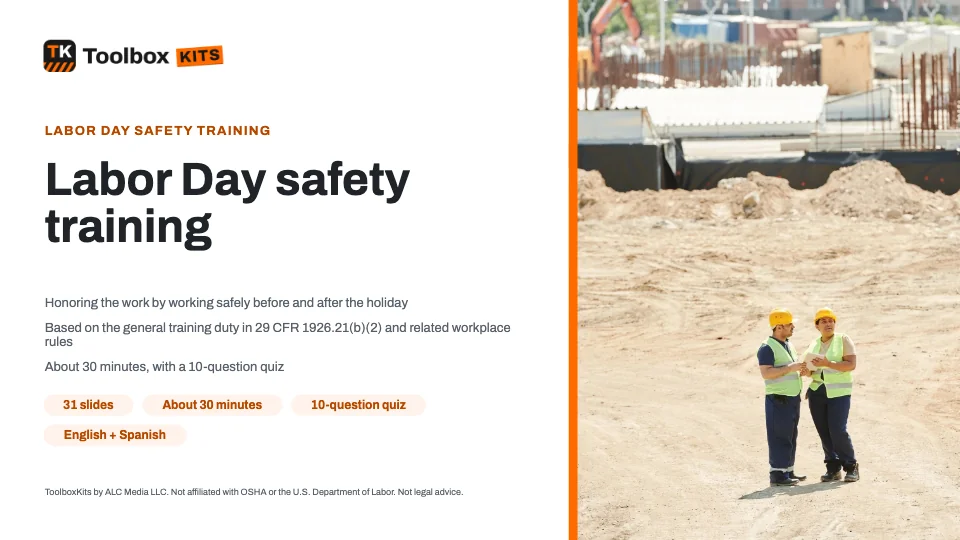 Editable PowerPoint
- Trainer guide
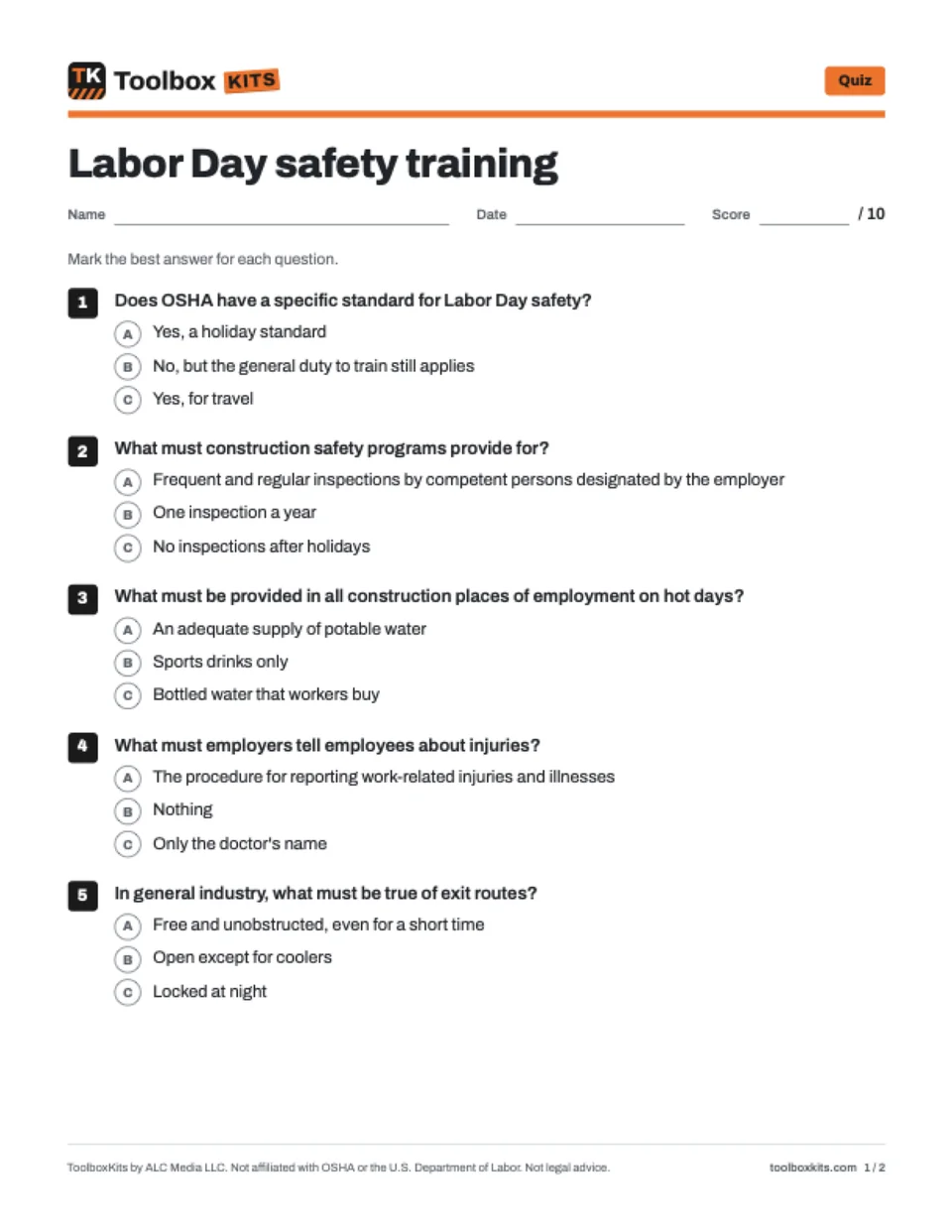 Quiz
- Answer key
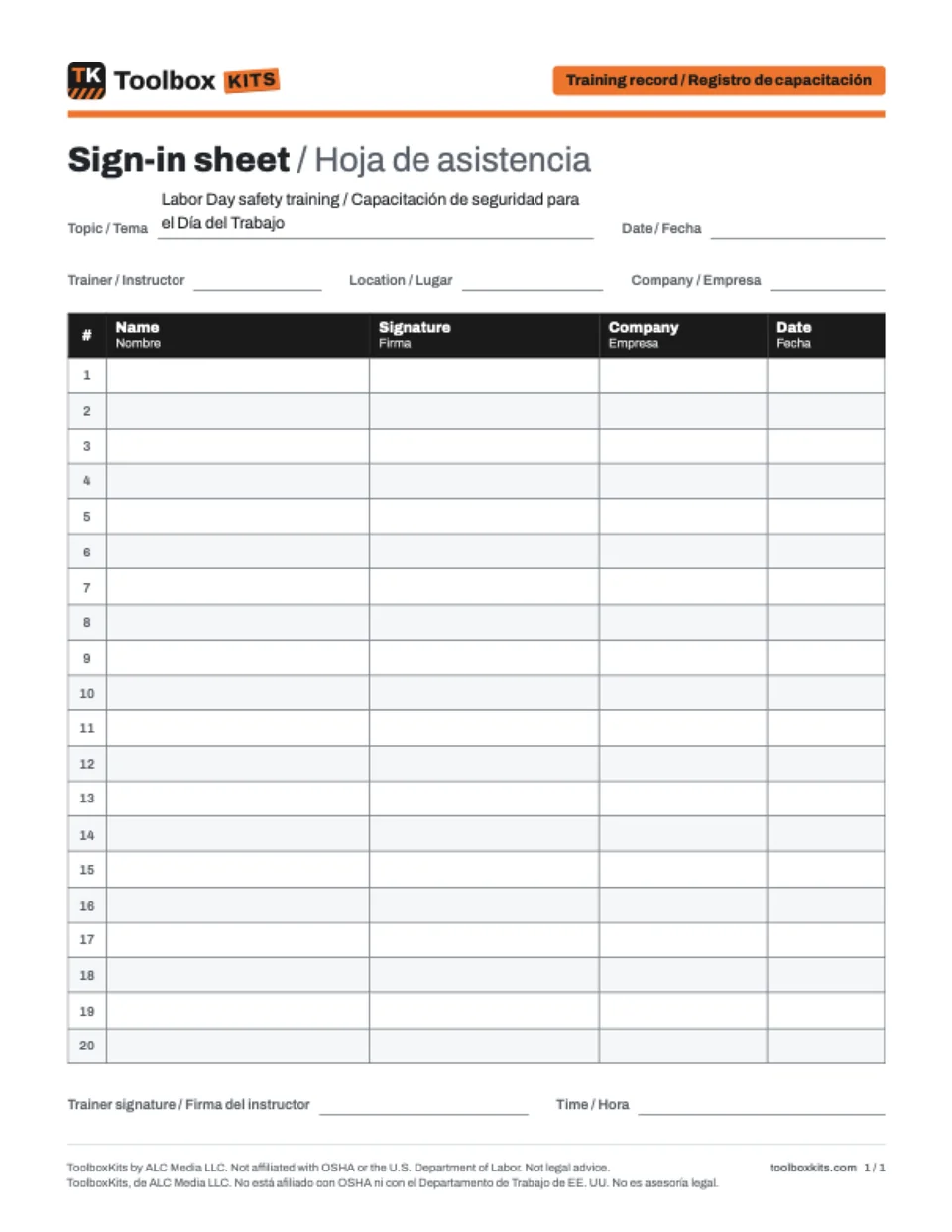 Sign-in sheet
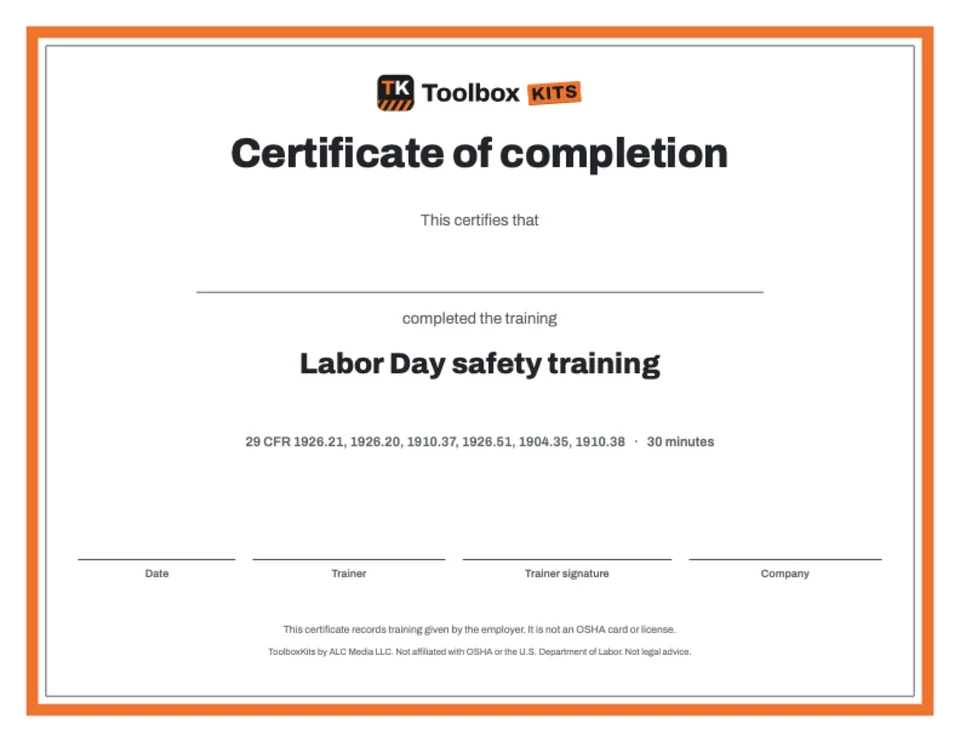 Certificate
- Crew handout
Try it
Try the quiz
Three questions from this topic. Pick an answer to see the right one and the OSHA paragraph.
Question 1 of 3
What is the best way to honor workers on Labor Day?
The rule
What OSHA requires
Plain-language summary. Each line links to the exact paragraph of the regulation.
OSHA has no specific standard for Labor Day safety; the general duty to train still applies. In construction, the employer must instruct each employee in recognizing and avoiding unsafe conditions and the rules that apply to their work environment.
“The employer shall instruct each employee in the recognition and avoidance of unsafe conditions and the regulations applicable to his work environment to control or eliminate any hazards or other exposure to illness or injury.”
In construction, the safety program must provide for frequent and regular inspections of job sites, materials and equipment by competent persons the employer designates. A walk of the site after a holiday or a change in routine is a good use of that duty.
“Such programs shall provide for frequent and regular inspections of the job sites, materials, and equipment to be made by competent persons designated by the employers.”
An adequate supply of drinking water must be provided in all places of employment in construction. Check that coolers are full and clean before a hot day or a long weekend of overtime.
“An adequate supply of potable water shall be provided in all places of employment.”
Employers must tell each employee how to report work-related injuries and illnesses. Know that procedure, and use it for small injuries and close calls too.
“You must inform each employee of your procedure for reporting work-related injuries and illnesses;”
In general industry, exit routes must be free and unobstructed. Nothing may be placed in an exit route, even for a short time, so keep decorations, tables, coolers and deliveries out of hallways and doorways that lead out.
“No materials or equipment may be placed, either permanently or temporarily, within the exit route.”
Emergency action plans must include procedures for reporting a fire or other emergency. Everyone should know who to tell and how, before something happens.
“Procedures for reporting a fire or other emergency;”
Common questions
Questions people ask
What should a Labor Day safety toolbox talk cover?
Cover honoring workers by working safely, not rushing the last shift, late summer heat, travel and cookout safety, reporting injuries and close calls, and a site walk on the first day back. Keep it to about five minutes.
Is there a Labor Day safety moment I can use?
Yes. Ask the crew what helps them go home safe each day, then share one reminder such as speaking up about close calls. This page has the full talk in English and Spanish.
Does OSHA have a rule about Labor Day or holiday weekends?
OSHA has no specific standard for Labor Day or holiday safety. The general duty to train still applies, and employers must tell employees how to report work-related injuries and illnesses.
Why talk about reporting injuries before a holiday?
People sometimes hide small injuries to avoid slowing the crew. Small problems can grow over a long weekend. A reminder that everyone should know how to report keeps problems from being hidden.
What should we check on the first day after Labor Day?
Walk the site and look at tools, ladders, cords, guards and walkways. Look for changes or damage from the break. Ask if anyone is tired, sick or sunburned, and adjust the work if needed.
Free to share
Use this talk for free
You can print, share and adapt this talk at no cost under the Creative Commons BY-NC-SA 4.0 license. Please credit ToolboxKits with a link.