

Free 5-minute toolbox talkVehicles and trafficEnglish and Spanish
Forklift pedestrian safety toolbox talk
Drivers and pedestrians both have a job to do, and when either one gets distracted, someone can get pinned, struck or crushed. What OSHA requires: The employer must make sure each powered industrial truck operator is competent to operate the truck safely, shown by successful completion of the required training and evaluation (29 CFR 1910.178(l)(1)(i)).
A free forklift and pedestrian safety talk for warehouses, docks and shops where trucks and people share space. Read it aloud in about five minutes before the shift starts.
Updated October 29, 2026 · Based on 29 CFR 1910.178
Read it out loud
Free 5-minute toolbox talk
Read it out loud to your crew. It takes about 5 minutes.
Start with a question
Where on this site do forklifts and people on foot cross paths, and who has the right of way?
Why it matters
A forklift is heavy, and the load can block the driver's view. A person on foot can step into a blind spot in an instant. Drivers and pedestrians both have a job to do, and when either one gets distracted, someone can get pinned, struck or crushed. Clear rules, clear paths and eye contact keep everyone safe.
Key points
Only trained operators drive
The employer must make sure each powered industrial truck operator is competent to operate it safely, shown by completing training and an evaluation. Training must cover pedestrian traffic in the areas where the truck will be operated. If you are not trained and authorized, you do not drive.
29 CFR 1910.178(l)(1)(i) · 29 CFR 1910.178(l)(3)(ii)(D)
Drivers: look where you are going
The driver must look in the direction of travel and keep a clear view of the path. If the load blocks your view, travel with the load trailing. Slow down and sound the horn at cross aisles and other places where vision is blocked. Keep the truck at a speed that lets you stop safely.
29 CFR 1910.178(n)(6) · 29 CFR 1910.178(n)(4) · 29 CFR 1910.178(n)(8)
Nobody under the forks and nobody riding
No person may stand or pass under the elevated part of a truck, loaded or empty. Unauthorized people may not ride on a truck. Drivers must not drive up to anyone standing in front of a bench or other fixed object.
29 CFR 1910.178(m)(2) · 29 CFR 1910.178(m)(3) · 29 CFR 1910.178(m)(1)
Pedestrians: use the walkway and stay alert
Use marked walkways and crossings. Permanent aisles and passageways must be appropriately marked. Do not walk while looking at your phone or wearing earbuds. Never assume the driver sees you. Wait until the driver looks at you and gives a clear signal before you cross.
Keep aisles and exits clear
Aisles and passageways must be kept clear, with nothing across them that could create a hazard. Fire aisles, access to stairways and fire equipment must stay clear too. Do not park pallets, carts or equipment in walkways, and watch out for wet or slippery floors, where drivers must slow down.
29 CFR 1910.178(m)(14) · 29 CFR 1910.176(a) · 29 CFR 1910.178(n)(10)
Everyone speaks up
If a driver is going too fast, a mirror is broken or a walkway is blocked, say something. Defects found when a truck is examined must be reported right away and corrected, and a truck that is unsafe must be taken out of service until it is fixed.
More
Keep one rule on the floor for everyone: if you cannot see each other, stop.
29 CFR 1910.178(p)(1) · 29 CFR 1910.178(q)(7)
Scenario
Picture this: A forklift driver is carrying a tall stack of boxes through the warehouse. The load blocks the view ahead, and he is running late. At a cross aisle, a worker walks out with his head down, reading a pick list. The driver does not sound the horn and does not slow down. What should each of them have done differently?
Ask the crew
- Where on this site do forklifts and people mix most?
- Where are our worst blind corners, and what could we do about them?
- What would you do if an operator was driving too fast?
- How do we make sure people stay out of the forklift lanes?
Takeaway
Drivers look, slow down and sound the horn; people on foot stay in marked walkways and never walk under forks.
Trainer: ______________________ Date: ____________
Credit: ToolboxKits, https://toolboxkits.com/topics/forklift-pedestrian-safety/ (CC BY-NC-SA 4.0)
The poster is also inside the paid kits.
Audit-ready records in 60 seconds
Fill in your crew and download a filled sign-in sheet for this talk. Everything is made in your browser. Names are never uploaded or stored.
Start a sign-off
Crew scan a QR code on their own phones, type their name and sign with a finger. You see the names arrive and download the signed sheet. Free, no account.
Kits
Get the kit
No subscription needed. Buy only the kit you need.
Toolbox talk kit
$4.99
- 5-minute talk, English PDF
- 5-minute talk, Spanish PDF
- Editable mini-deck (English and Spanish)
- One-page crew handout (English and Spanish)
- Bilingual sign-in sheet
- 3-question quiz with answer key (English and Spanish)
- One-page bilingual poster
- Audit-ready records in 60 seconds: fill in your crew and get a sign-in sheet and a certificate for every worker
Training kit
$9
Editable PowerPoint, 29 slides
- Editable PowerPoint with trainer notes on every slide
- Trainer guide PDF with timing and discussion tips
- 10-question quiz and answer key
- Sign-in sheet and certificate of completion with fillable fields
- One-page crew handout
- Full Spanish version of everything
- One-page bilingual poster
- Audit-ready records in 60 seconds: fill in your crew and get a sign-in sheet and a certificate for every worker
- Instant download
- Secure checkout by Stripe
- 30-day refund, no questions
Need many topics? All Access gives you every kit for $99 a year.
Inside the kit
See what is in the kit
What is in the kit
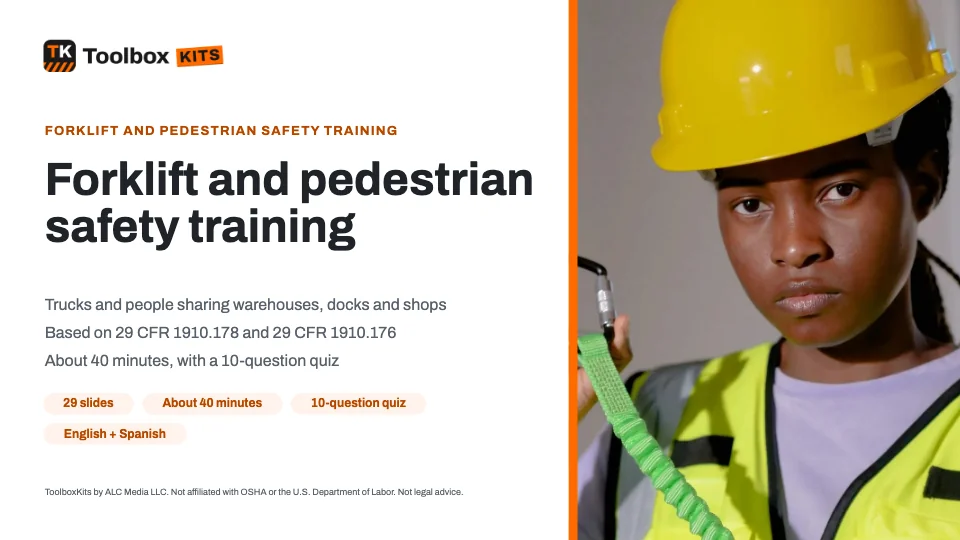 Editable PowerPoint
- Trainer guide
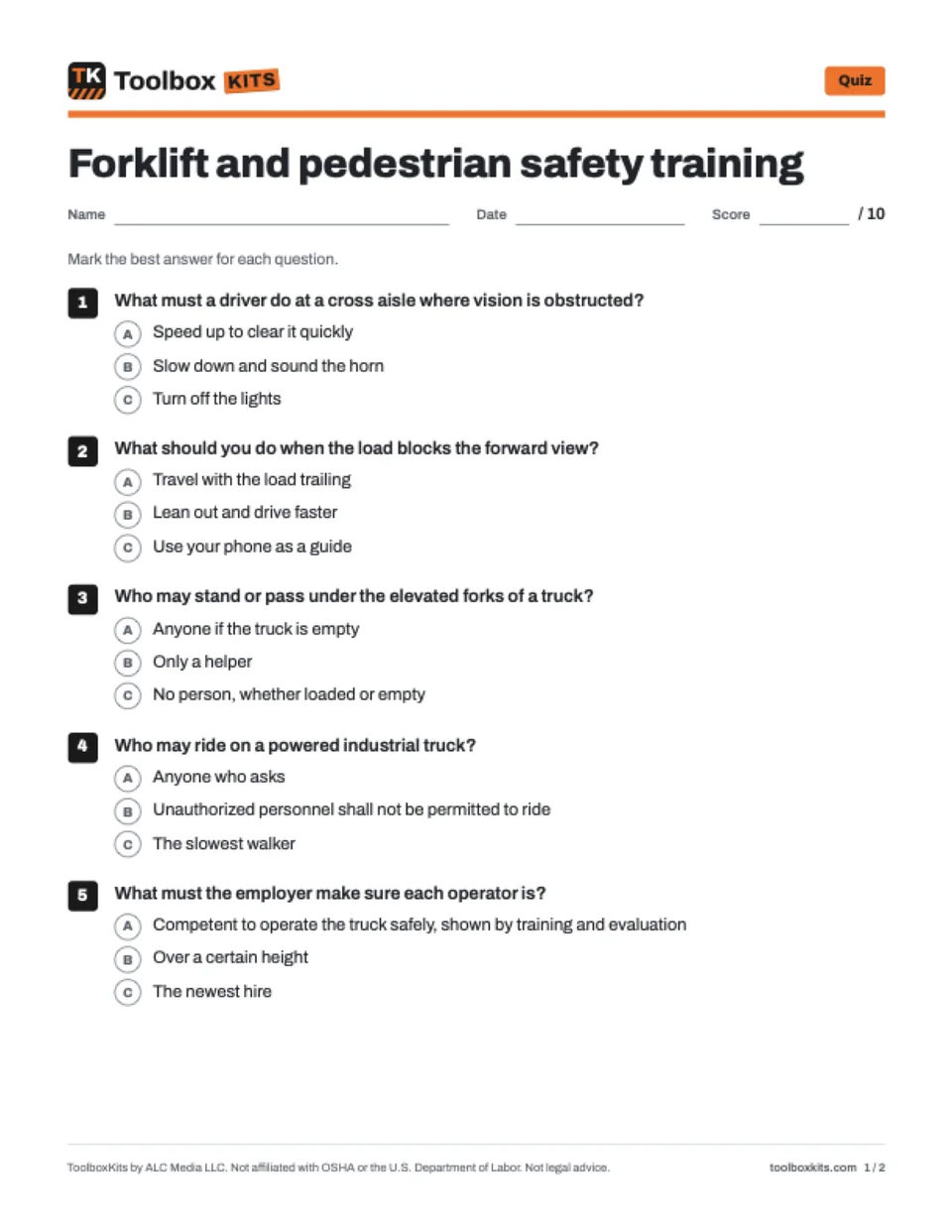 Quiz
- Answer key
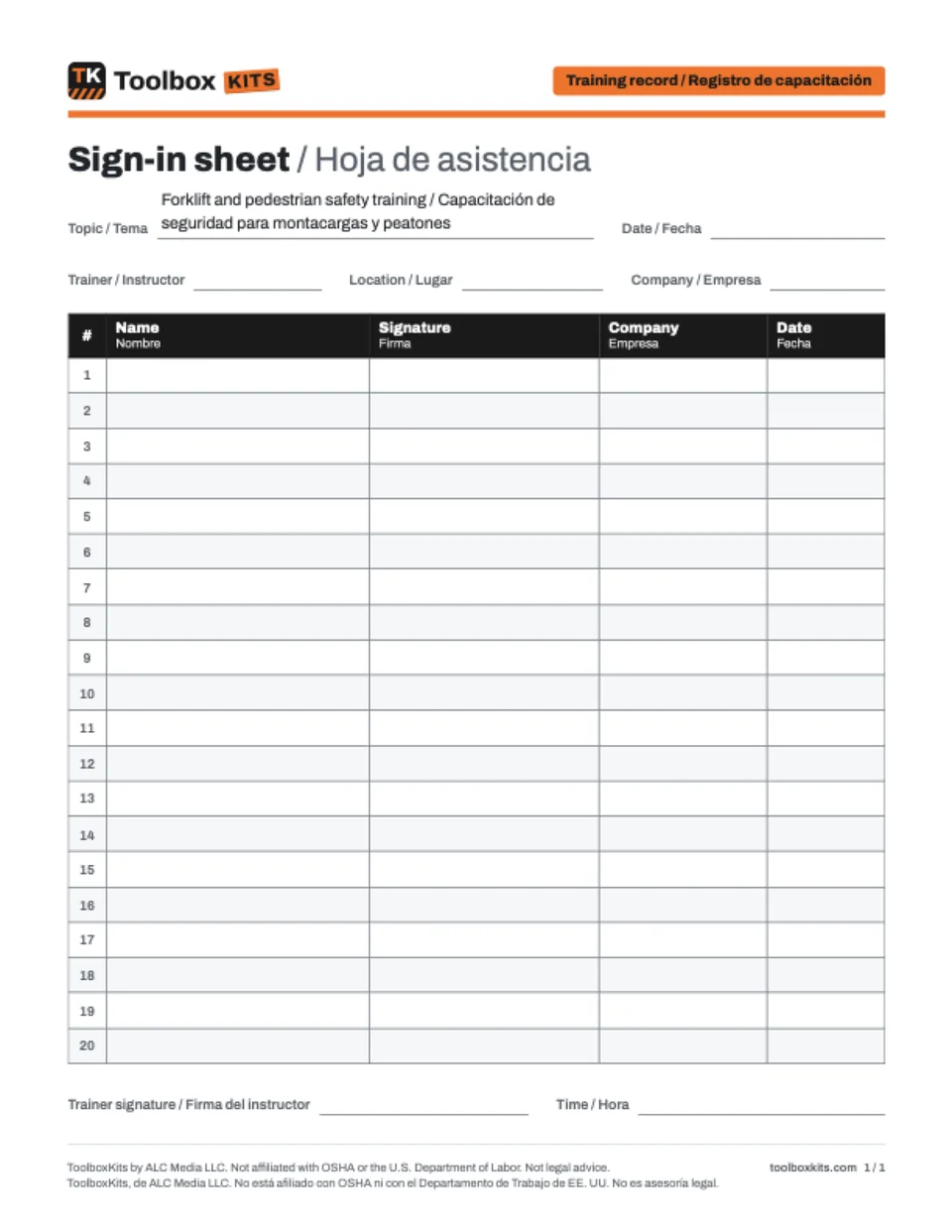 Sign-in sheet
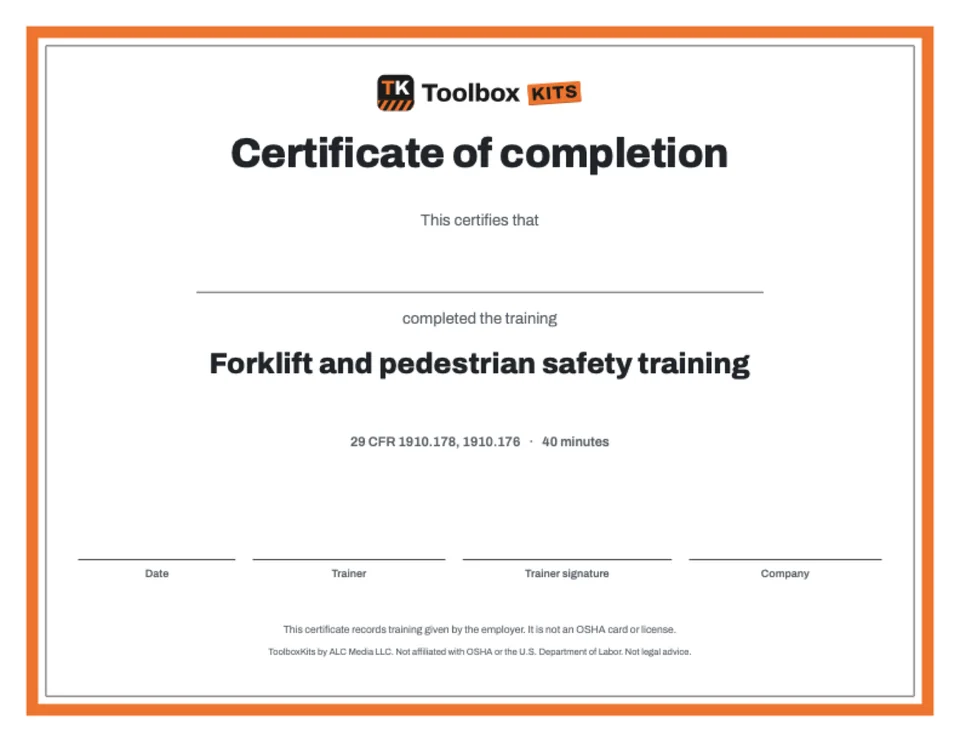 Certificate
- Crew handout
Try it
Try the quiz
Three questions from this topic. Pick an answer to see the right one and the OSHA paragraph.
Question 1 of 3
What must a driver do at a cross aisle where vision is blocked?
The rule
What OSHA requires
Plain-language summary. Each line links to the exact paragraph of the regulation.
The employer must make sure each powered industrial truck operator is competent to operate the truck safely, shown by successful completion of the required training and evaluation.
“The employer shall ensure that each powered industrial truck operator is competent to operate a powered industrial truck safely, as demonstrated by the successful completion of the training and evaluation specified in this paragraph (l).”
Operator training must cover pedestrian traffic in the areas where the truck will be operated, unless the employer can show the topic does not apply to safe operation in that workplace.
“Pedestrian traffic in areas where the vehicle will be operated;”
Drivers must look in the direction of travel and keep a clear view of the path.
“The driver shall be required to look in the direction of, and keep a clear view of the path of travel.”
Drivers must slow down and sound the horn at cross aisles and other locations where vision is obstructed. If the load blocks the forward view, the driver must travel with the load trailing.
“The driver shall be required to slow down and sound the horn at cross aisles and other locations where vision is obstructed.”
No person may stand or pass under the elevated part of any truck, loaded or empty.
“No person shall be allowed to stand or pass under the elevated portion of any truck, whether loaded or empty.”
Unauthorized personnel may not ride on powered industrial trucks.
“Unauthorized personnel shall not be permitted to ride on powered industrial trucks.”
Traffic regulations, including authorized plant speed limits, must be observed, and the truck must be kept under control at all times.
“All traffic regulations shall be observed, including authorized plant speed limits.”
Permanent aisles and passageways must be appropriately marked and kept clear and in good repair.
“Permanent aisles and passageways shall be appropriately marked.”
Operator performance must be evaluated at least once every three years.
“An evaluation of each powered industrial truck operator's performance shall be conducted at least once every three years.”
Who must be trained
The employer must make sure each powered industrial truck operator is competent to operate the truck safely, shown by successful completion of the training and evaluation in 29 CFR 1910.178(l)(1)(i). Trainees may operate a truck only under the direct supervision of a qualified trainer and where it does not endanger others (29 CFR 1910.178(l)(2)(i)).
When to retrain
Refresher training is required when an operator has been seen operating unsafely, has been in an accident or near miss, has a poor evaluation, is assigned a different type of truck, or when a workplace change could affect safe operation (29 CFR 1910.178(l)(4)(ii)). Operator performance must be evaluated at least once every three years (29 CFR 1910.178(l)(4)(iii)).

Common questions
Questions people ask
Is there a printable forklift pedestrian safety toolbox talk?
Yes. This forklift pedestrian safety toolbox talk is free to print as a PDF in English and Spanish, with a sign-in table for your crew. Read it aloud in about five minutes before the shift, and keep the signed sheet with your safety records.
What does OSHA require for pedestrian safety around forklifts?
OSHA's powered industrial truck rule (29 CFR 1910.178) requires drivers to keep a clear view of the path, slow down and sound the horn where vision is blocked, and keep people out from under raised forks. It also requires operator training that covers pedestrian traffic where the truck will be used (29 CFR 1910.178(l)(3)(ii)(D)).
Is a pedestrian safety presentation or PowerPoint available?
This free talk is written to be read aloud, so you do not need slides. For a longer forklift and pedestrian safety session, the paid training kit for this topic is an editable PowerPoint in English and Spanish with trainer notes, a quiz and a sign-in sheet. If the kit is not ready to buy yet, you can request it from this page.
Can anyone ride on a forklift?
No. Unauthorized personnel may not ride on powered industrial trucks, and a safe place to ride must be provided where riding is authorized (29 CFR 1910.178(m)(3)). Never stand or pass under raised forks either, loaded or empty (29 CFR 1910.178(m)(2)).
How can pedestrians stay safe around forklifts?
Stay in marked walkways, stay out of forklift lanes, and keep your eyes up. Make eye contact with the driver and wait for a clear signal before you cross. Never walk under raised forks. OSHA requires marked permanent aisles and passageways kept clear (29 CFR 1910.176(a)).
Free to share
Use this talk for free
You can print, share and adapt this talk at no cost under the Creative Commons BY-NC-SA 4.0 license. Please credit ToolboxKits with a link.