

Free 5-minute toolbox talkHealth and wellnessEnglish and Spanish
Toolbox talk: asbestos awareness
Asbestos is still in many older buildings, in insulation, flooring, roofing and other materials. Disturbing it can release fibers too small to see, and you can breathe them in without knowing it. What OSHA requires: All Class I, II and III asbestos work must be conducted within regulated areas (29 CFR 1926.1101(e)(1)).
A free 5-minute asbestos awareness talk for crews who work in older buildings, with the OSHA rules behind each point. It builds awareness but does not replace the asbestos training OSHA requires.
Updated October 29, 2026 · Based on 29 CFR 1926.1101, 29 CFR 1910.1001
Read it out loud
Free 5-minute toolbox talk
Read it out loud to your crew. It takes about 5 minutes.
Start with a question
If you were about to drill into old pipe insulation or pull up old floor tile, how would you know if it had asbestos in it?
Why it matters
Asbestos is still in many older buildings, in insulation, flooring, roofing and other materials. Disturbing it can release fibers too small to see, and you can breathe them in without knowing it. Those fibers can cause lung cancer, mesothelioma and asbestosis, often many years later, and smoking makes the lung cancer risk worse. You cannot tell asbestos by looking at it, so if you are not sure, stop and ask.
Key points
Know where asbestos hides
In buildings constructed no later than 1980, thermal system insulation on pipes, boilers and ducts, and sprayed or troweled-on surfacing like fireproofing and acoustical plaster, are presumed to contain asbestos.
More
Asphalt and vinyl flooring installed no later than 1980 must also be considered asbestos-containing unless an industrial hygienist determines it is not. Wallboard, roofing, siding, mastics and gaskets can contain it too.
29 CFR 1926.1101(b) · 29 CFR 1926.1101(k)(1)(i) and (g)(8)(i)(I)
Find out before you start
Before work begins, building owners must determine where asbestos-containing material is and how much is there, and employers must identify it in the areas where their crews will work. Ask for that information before you cut, drill, sand or tear out anything in an older building.
More
If you find material that might be asbestos and nobody told you about it, stop and tell your supervisor. Employers who discover asbestos-containing material on a site must tell the owner and the other employers there within 24 hours.
29 CFR 1926.1101(k)(3)(i) · 29 CFR 1926.1101(k)(2)(i) and (k)(3)(i) · 29 CFR 1926.1101(k)(4)
Never dry sweep, blow off or sand it
In construction, dry sweeping, shoveling or other dry cleanup of asbestos dust and debris is prohibited. Compressed air may not be used to remove asbestos unless an enclosed ventilation system captures the dust cloud, and sanding asbestos flooring is prohibited.
More
The rule calls for wet methods and HEPA-filtered vacuums instead, with waste going into leak-tight containers right away.
29 CFR 1926.1101(g)(3)(iii) · 29 CFR 1926.1101(g)(3)(ii) · 29 CFR 1926.1101(l)(3)(ii) · 29 CFR 1926.1101(g)(1)
Stay out of regulated areas
All Class I, II and III asbestos work must be done inside regulated areas, marked with warning signs and limited to authorized persons. Employees must not eat, drink, smoke, chew tobacco or gum, or apply cosmetics in a regulated area.
More
If you see asbestos warning signs or plastic barriers, stay out unless you are trained and authorized. Where respirators are required, filtering facepiece respirators, the disposable kind, must not be used against asbestos fibers.
29 CFR 1926.1101(e)(1) · 29 CFR 1926.1101(e)(1), (e)(3) and (k)(7)(i) · 29 CFR 1926.1101(e)(5) · 29 CFR 1926.1101(h)(3)(i)(A)
Only trained workers do asbestos work
In construction, each employee who performs Class I through IV asbestos work, or who is likely to be exposed above a permissible exposure limit, must be trained at no cost, before or at initial assignment and at least annually after that.
More
Even Class IV work, where maintenance and custodial workers contact but do not disturb asbestos, requires a course of at least 2 hours. This talk does not qualify anyone to remove, repair or disturb asbestos.
29 CFR 1926.1101(k)(9)(i) · 29 CFR 1926.1101(k)(9)(i) and (k)(9)(ii) · 29 CFR 1926.1101(b) and (k)(9)(vi)
Scenario
Picture this: Your crew is remodeling an older office building. To run new conduit, an electrician starts cutting through old pipe insulation above the ceiling, and white dust drifts down onto the floor. A laborer grabs a broom to sweep it up before lunch. What should both of them do right now, and what should have happened before anyone touched that insulation?
Ask the crew
- Which buildings or materials on our jobs could contain asbestos?
- Who do we ask for the owner's asbestos information before we start work?
- What would you do if you uncovered material that might be asbestos in the middle of a job?
- Why are a broom and a regular shop vacuum the wrong tools for asbestos dust?
Takeaway
If you are not sure whether something contains asbestos, do not touch it, stop work and ask.
Trainer: ______________________ Date: ____________
Credit: ToolboxKits, https://toolboxkits.com/topics/asbestos/ (CC BY-NC-SA 4.0)
The poster is also inside the paid kits.
Audit-ready records in 60 seconds
Fill in your crew and download a filled sign-in sheet for this talk. Everything is made in your browser. Names are never uploaded or stored.
Start a sign-off
Crew scan a QR code on their own phones, type their name and sign with a finger. You see the names arrive and download the signed sheet. Free, no account.
Kits
Get the kit
No subscription needed. Buy only the kit you need.
Toolbox talk kit
$4.99
- 5-minute talk, English PDF
- 5-minute talk, Spanish PDF
- Editable mini-deck (English and Spanish)
- One-page crew handout (English and Spanish)
- Bilingual sign-in sheet
- 3-question quiz with answer key (English and Spanish)
- One-page bilingual poster
- Audit-ready records in 60 seconds: fill in your crew and get a sign-in sheet and a certificate for every worker
Training kit
$9
Editable PowerPoint, 39 slides
- Editable PowerPoint with trainer notes on every slide
- Trainer guide PDF with timing and discussion tips
- 10-question quiz and answer key
- Sign-in sheet and certificate of completion with fillable fields
- One-page crew handout
- Full Spanish version of everything
- One-page bilingual poster
- Audit-ready records in 60 seconds: fill in your crew and get a sign-in sheet and a certificate for every worker
- Instant download
- Secure checkout by Stripe
- 30-day refund, no questions
Need many topics? All Access gives you every kit for $99 a year.
Inside the kit
See what is in the kit
What is in the kit
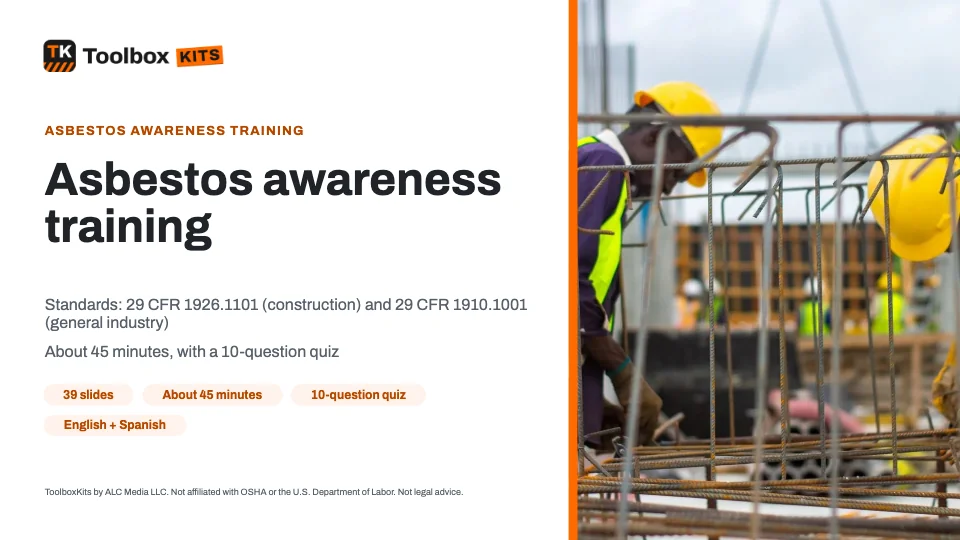 Editable PowerPoint
- Trainer guide
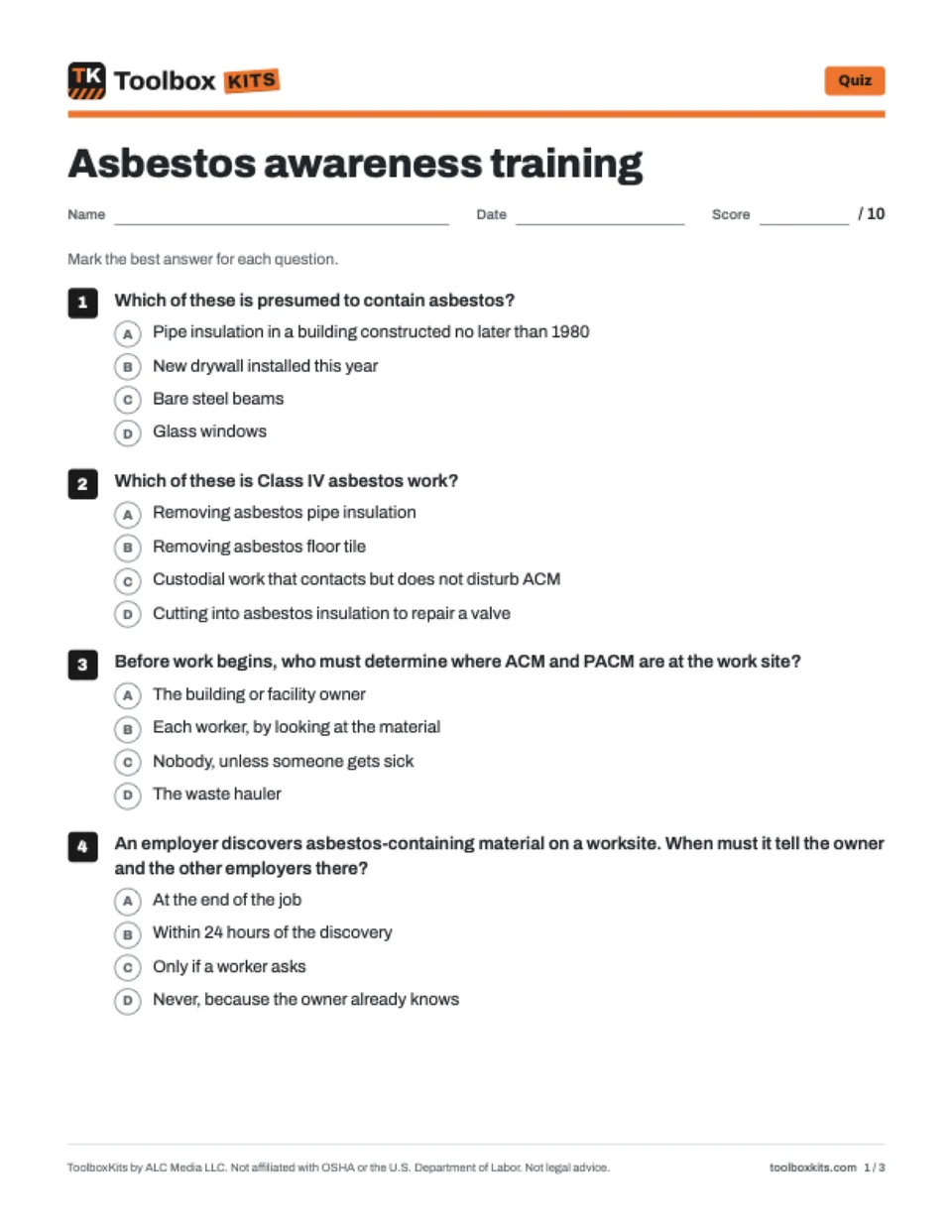 Quiz
- Answer key
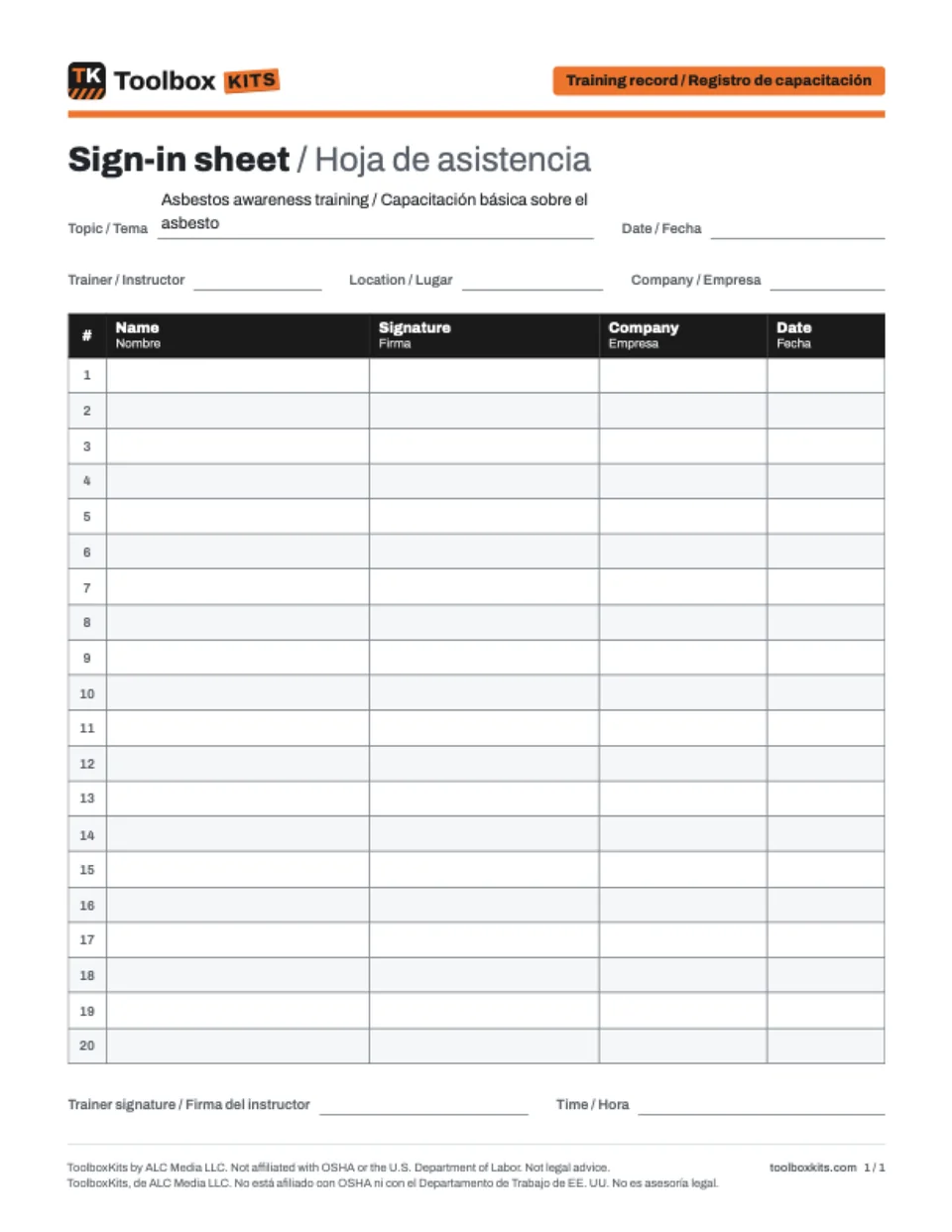 Sign-in sheet
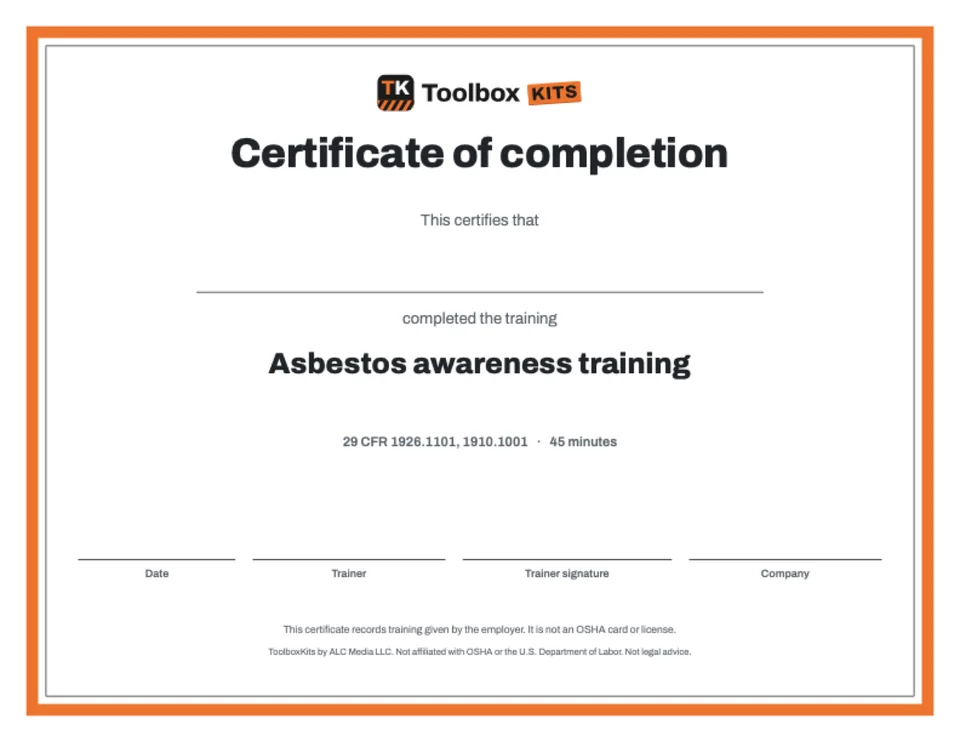 Certificate
- Crew handout
Try it
Try the quiz
Three questions from this topic. Pick an answer to see the right one and the OSHA paragraph.
Question 1 of 3
In buildings constructed no later than 1980, how are thermal system insulation and sprayed or troweled-on surfacing material treated?
The rule
What OSHA requires
Plain-language summary. Each line links to the exact paragraph of the regulation.
In construction, no employee may be exposed to airborne asbestos above 0.1 fiber per cubic centimeter of air as an 8-hour time-weighted average, or above 1.0 fiber per cubic centimeter averaged over a 30-minute sampling period (29 CFR 1926.1101(c)(2)). The same limits apply in general industry (29 CFR 1910.1001(c) and (c)(2)).
“The employer shall ensure that no employee is exposed to an airborne concentration of asbestos in excess of 0.1 fiber per cubic centimeter of air as an eight (8) hour time-weighted average (TWA)”
Before work begins, building and facility owners must determine the presence, location and quantity of asbestos-containing material (ACM) and presumed asbestos-containing material (PACM) at the work site. Employers must also identify it before their employees start work in those areas (29 CFR 1926.1101(k)(3)(i)).
“Before work subject to this standard is begun, building and facility owners shall determine the presence, location, and quantity of ACM and/or PACM at the work site”
Any employer who discovers ACM or PACM on a worksite must tell the owner, and the other employers of employees working there, about its presence, location and quantity within 24 hours of the discovery.
“shall convey information concerning the presence, location and quantity of such newly discovered ACM and/or PACM to the owner and to other employers of employees working at the work site, within 24 hours of the discovery.”
All Class I, II and III asbestos work must be conducted within regulated areas. Access must be limited to authorized persons (29 CFR 1926.1101(e)(3)), and warning signs must be displayed at each location where a regulated area is required (29 CFR 1926.1101(k)(7)(i)).
“All Class I, II and III asbestos work shall be conducted within regulated areas.”
Employees must not eat, drink, smoke, chew tobacco or gum, or apply cosmetics in a regulated area. The same rule applies in general industry (29 CFR 1910.1001(e)(5)).
“The employer shall ensure that employees do not eat, drink, smoke, chew tobacco or gum, or apply cosmetics in the regulated area.”
In construction, dry sweeping, shoveling or other dry cleanup of dust and debris containing ACM or PACM must not be used, regardless of measured exposure levels. Compressed air must not be used to remove asbestos unless it is used with an enclosed ventilation system designed to capture the dust cloud (29 CFR 1926.1101(g)(3)(ii)).
“Dry sweeping, shoveling or other dry clean-up of dust and debris containing ACM and PACM.”
In construction, in all asbestos operations and regardless of exposure levels, the employer must use HEPA-filtered vacuums to collect asbestos dust and debris, wet methods unless they are shown to be infeasible, and prompt cleanup and disposal in leak-tight containers. Roofing work follows its own procedures (29 CFR 1926.1101(g)(8)(ii)).
“in all operations covered by this section, regardless of the levels of exposure”
Where respirators are required, the employer must provide respirators selected under 29 CFR 1910.134 and must not select or use filtering facepiece respirators against asbestos fibers. HEPA filters must be provided for powered and non-powered air-purifying respirators (29 CFR 1926.1101(h)(3)(i)(B)).
“employers must not select or use filtering facepiece respirators for use against asbestos fibers.”
In construction, the employer must train each employee who is likely to be exposed above a PEL and each employee who performs Class I through IV asbestos operations, at no cost to the employee. Training must be given before or at the time of initial assignment and at least annually after that (29 CFR 1926.1101(k)(9)(ii)), and Class IV training must take at least 2 hours (29 CFR 1926.1101(k)(9)(vi)).
“The employer shall train each employee who is likely to be exposed in excess of a PEL, and each employee who performs Class I through IV asbestos operations, in accordance with the requirements of this section.”
In general industry, employees who do housekeeping work in areas where ACM or PACM is present must get an asbestos awareness course at no cost, at least once a year. It must cover the health effects of asbestos, where ACM and PACM are in the building, how to recognize damage and deterioration, the housekeeping requirements and the proper response to fiber release episodes.
“Each such employee shall be so trained at least once a year.”
Who must be trained
In construction, each employee who is likely to be exposed in excess of a PEL and each employee who performs Class I through IV asbestos operations (29 CFR 1926.1101(k)(9)(i)). In general industry, each employee exposed at or above the PEL and/or excursion limit (29 CFR 1910.1001(j)(7)(i)), plus an awareness course for employees who do housekeeping in areas with ACM or PACM (29 CFR 1910.1001(j)(7)(iv)).
When to retrain
Training must be given before or at the time of initial assignment and at least annually after that (29 CFR 1926.1101(k)(9)(ii) in construction, 29 CFR 1910.1001(j)(7)(ii) in general industry). In general industry, housekeeping employees in areas with ACM or PACM must take the awareness course at least once a year (29 CFR 1910.1001(j)(7)(iv)).
Common questions
Questions people ask
Is there a printable asbestos awareness toolbox talk PDF?
Yes. This asbestos awareness talk is free, and you can print it as a PDF in English or Spanish with a sign-in table. Use it before jobs in older buildings and whenever suspect material turns up.
Can I use this as an asbestos toolbox talk template?
Yes. Read it as written, then add the details for your site: what the owner's asbestos information shows, where any regulated areas are and who to call if suspect material turns up. Keep the signed sign-in sheet as your record of who attended.
Does a toolbox talk count as OSHA asbestos awareness training?
No. In construction, even Class IV work needs a training course of at least 2 hours that covers where asbestos-containing materials are located and how to recognize damage, deterioration and delamination (29 CFR 1926.1101(k)(9)(vi)). Workers who do Class I, II or III work need the specific training set out in 29 CFR 1926.1101(k)(9)(iii) to (v). A toolbox talk is a good refresher between those courses, not a replacement.
Do we need a written asbestos awareness program?
OSHA's asbestos standards do not call for a separate written awareness program, but some things must be in writing. Asbestos must be included in your hazard communication program, which must be written (29 CFR 1926.1101(k)(1)(ii) and 29 CFR 1910.1200(e)(1)), and written training materials, including a copy of the standard, must be readily available to affected employees at no cost (29 CFR 1926.1101(k)(10)(i)). In general industry, a written compliance program is required where the exposure limits are exceeded (29 CFR 1910.1001(f)(2)(i)).
What should an asbestos safety talk cover?
Cover where asbestos may be found on your jobs, its health effects, why you stop and ask before touching suspect material, and the practices that are prohibited on construction work, like dry sweeping. OSHA's asbestos training content list also includes the relationship between smoking and asbestos in producing lung cancer, and the meaning of required signs and labels (29 CFR 1926.1101(k)(9)(viii)).
Free to share
Use this talk for free
You can print, share and adapt this talk at no cost under the Creative Commons BY-NC-SA 4.0 license. Please credit ToolboxKits with a link.