

Free 5-minute toolbox talkExcavation and trenchingEnglish and Spanish
Trenching and excavation safety toolbox talk
A cave-in can bury or crush a worker before they can react, and a coworker who jumps in to help can be caught by the next collapse. What OSHA requires: Each worker in an excavation must be protected from cave-ins by an adequate protective system (29 CFR 1926.652(a)(1)).
A five-minute trenching and excavation safety talk for your crew. It covers cave-in protection, utilities, spoil piles, ladders, daily inspections, water and bad air, with the OSHA rules cited to the paragraph.
Updated October 29, 2026 · Based on 29 CFR 1926.651, 29 CFR 1926.652
Read it out loud
Free 5-minute toolbox talk
Read it out loud to your crew. It takes about 5 minutes.
Start with a question
If this trench wall started to slide right now, what would protect you, and how would you get out?
Why it matters
Soil is heavy, and a trench wall can give way with little or no warning. A cave-in can bury or crush a worker before they can react, and a coworker who jumps in to help can be caught by the next collapse. These rules keep the walls off people and give everyone a way out.
Key points
No protection, no entry
Every worker in an excavation must be protected from cave-ins by an adequate protective system, such as sloping, benching, shoring or a trench shield.
More
The only exceptions are excavations entirely in stable rock, or less than 5 feet deep where a competent person has examined the ground and found no sign of a possible cave-in. Not sure it is protected? Stay out and ask.
29 CFR 1926.652(a)(1) · 29 CFR 1926.652(a)(1)(i) and (ii)
Find the utilities before you dig
Before an excavation is opened, the estimated location of underground utilities such as sewer, telephone, fuel, electric and water lines must be determined.
More
Utility companies or owners must be asked to locate their lines before digging, and the exact location must be found by safe and acceptable means as you get close. Calling 811 connects you to the local one-call center.
29 CFR 1926.651(b)(1) · 29 CFR 1926.651(b)(2) and (b)(3)
Keep the edges clear
Keep spoil piles, materials and equipment at least 2 feet back from the edge, or hold them back with retaining devices, or both. Never stand under loads handled by lifting or digging equipment.
More
When mobile equipment works near the edge and the operator cannot clearly see it, a warning system such as barricades, hand or mechanical signals, or stop logs must be used. Workers exposed to public traffic must wear a warning vest or other high-visibility garment.
29 CFR 1926.651(j)(2) · 29 CFR 1926.651(e) · 29 CFR 1926.651(f) · 29 CFR 1926.651(d)
Always have a way out
Trenches 4 feet or more deep must have a stairway, ladder, ramp or other safe way out, so no one travels more than 25 feet sideways to reach it. Move the ladder as the work moves.
More
In a trench box, you must be protected from cave-ins while getting in and out, and no one may be inside while it is installed, removed or moved vertically.
29 CFR 1926.651(c)(2) · 29 CFR 1926.652(g)(1)(iii) and (iv)
A competent person checks it every day
When workers will be exposed, a competent person must inspect the excavation, nearby areas and protective systems daily before work, as needed during the shift, and after every rainstorm or other hazard-increasing event.
More
A competent person can spot existing and predictable hazards and is authorized to fix them promptly. If they find signs of a possible cave-in or other hazards, exposed workers must be removed until it is safe. If you see cracks, bulging walls or water seeping in, get out and tell them.
29 CFR 1926.651(k)(1) · 29 CFR 1926.650(b) · 29 CFR 1926.651(k)(2)
Watch for water and bad air
Do not work in an excavation with standing or rising water unless adequate precautions are in place, such as water removal, special support or shield systems, or a harness and lifeline.
More
Where low oxygen or a hazardous atmosphere exists or could reasonably be expected, such as in a landfill, the air must be tested before anyone enters an excavation more than 4 feet deep. Crews usually test with a gas monitor.
29 CFR 1926.651(g)(1)(i) · 29 CFR 1926.651(h)(1)
Scenario
Picture this: a crew is laying pipe in a chest-deep trench. The trench box is a few feet behind them, the only ladder is at the far end, and the spoil pile sits right at the edge. It rained hard overnight, and nobody has checked the walls. One worker steps out ahead of the box to grab a fitting. What is wrong, and what must happen before anyone goes back in?
Ask the crew
- Who is our competent person today, and what do they check?
- What protective system are we using, and where does it stop protecting us?
- What do you do if you see cracks at the edge or water seeping in?
- Where is the nearest ladder or ramp to your work spot?
Takeaway
Never enter an unprotected trench, keep the edges clear, and always know your way out.
Trainer: ______________________ Date: ____________
Credit: ToolboxKits, https://toolboxkits.com/topics/trenching-excavation/ (CC BY-NC-SA 4.0)
The poster is also inside the paid kits.
Audit-ready records in 60 seconds
Fill in your crew and download a filled sign-in sheet for this talk. Everything is made in your browser. Names are never uploaded or stored.
Start a sign-off
Crew scan a QR code on their own phones, type their name and sign with a finger. You see the names arrive and download the signed sheet. Free, no account.
Kits
Get the kit
No subscription needed. Buy only the kit you need.
Toolbox talk kit
$4.99
- 5-minute talk, English PDF
- 5-minute talk, Spanish PDF
- Editable mini-deck (English and Spanish)
- One-page crew handout (English and Spanish)
- Bilingual sign-in sheet
- 3-question quiz with answer key (English and Spanish)
- One-page bilingual poster
- Audit-ready records in 60 seconds: fill in your crew and get a sign-in sheet and a certificate for every worker
Training kit
$9
Editable PowerPoint, 38 slides
- Editable PowerPoint with trainer notes on every slide
- Trainer guide PDF with timing and discussion tips
- 10-question quiz and answer key
- Sign-in sheet and certificate of completion with fillable fields
- One-page crew handout
- Full Spanish version of everything
- One-page bilingual poster
- Audit-ready records in 60 seconds: fill in your crew and get a sign-in sheet and a certificate for every worker
- Instant download
- Secure checkout by Stripe
- 30-day refund, no questions
Need many topics? All Access gives you every kit for $99 a year.
Inside the kit
See what is in the kit
What is in the kit
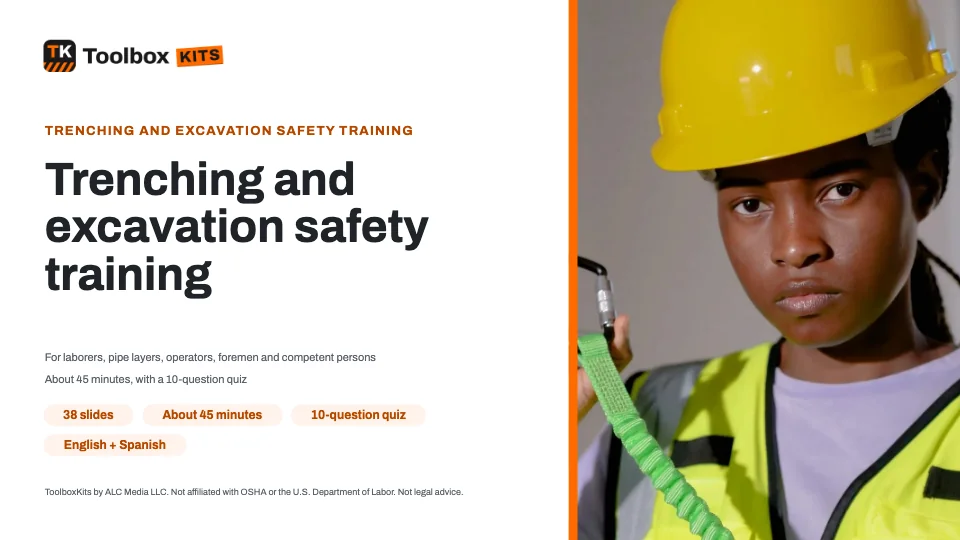 Editable PowerPoint
- Trainer guide
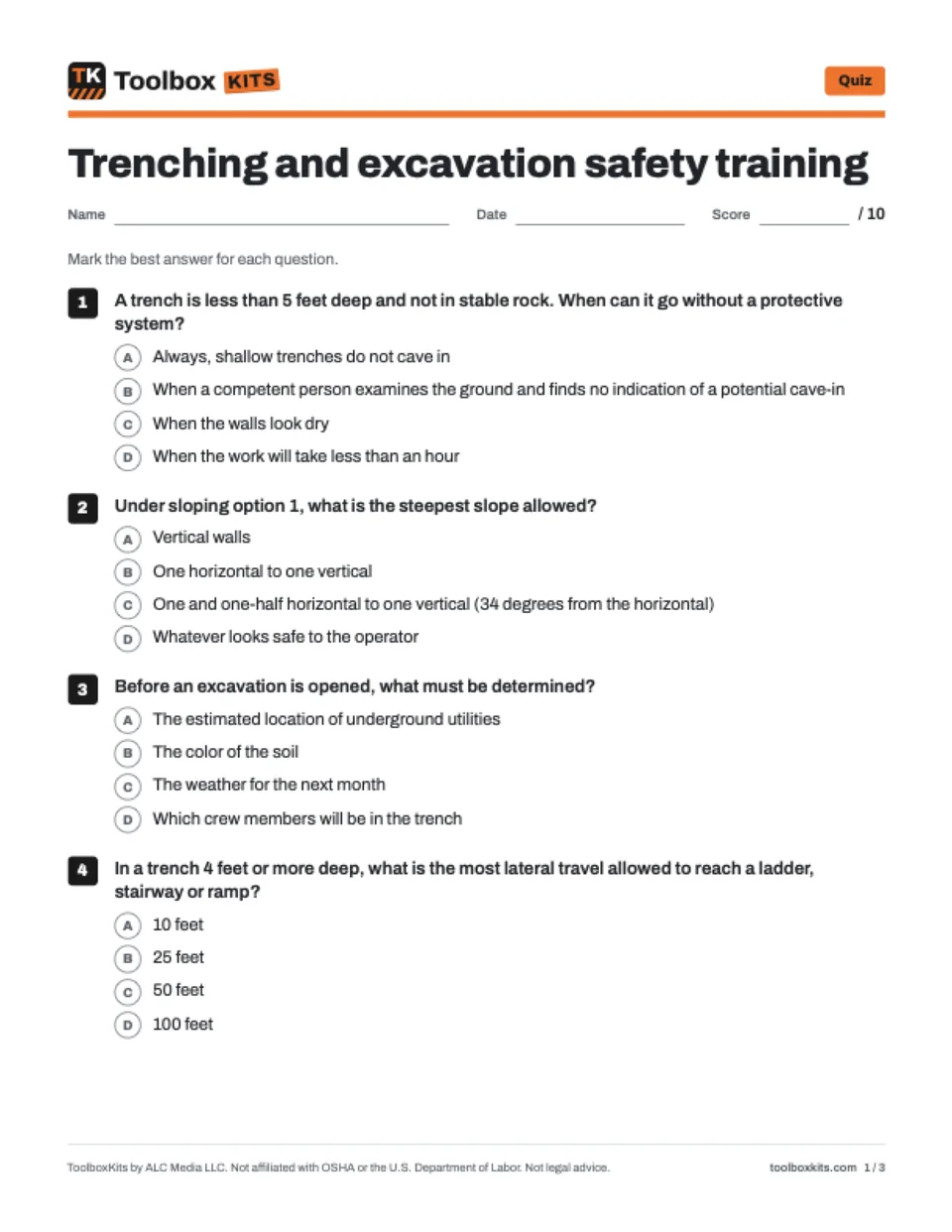 Quiz
- Answer key
 Sign-in sheet
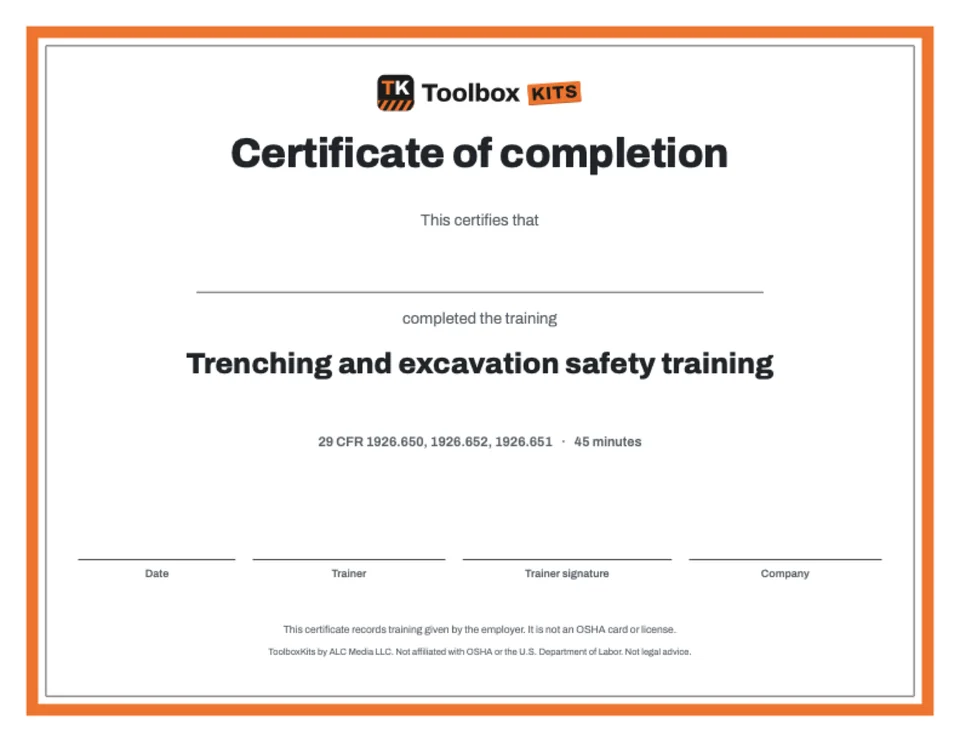 Certificate
- Crew handout
Try it
Try the quiz
Three questions from this topic. Pick an answer to see the right one and the OSHA paragraph.
Question 1 of 3
A trench is 6 feet deep in soil, not stable rock. What is required before anyone goes in?
The rule
What OSHA requires
Plain-language summary. Each line links to the exact paragraph of the regulation.
Each worker in an excavation must be protected from cave-ins by an adequate protective system. The exceptions are excavations made entirely in stable rock, or less than 5 feet deep when a competent person examines the ground and finds no indication of a possible cave-in (29 CFR 1926.652(a)(1)(i) and (ii)).
“Each employee in an excavation shall be protected from cave-ins by an adequate protective system designed in accordance with paragraph (b) or (c) of this section”
Under the first sloping option, excavations must be sloped no steeper than one and one-half horizontal to one vertical (34 degrees from the horizontal). Steeper slopes need one of the other options in the standard, such as appendices A and B, other tabulated data or a design by a registered professional engineer (29 CFR 1926.652(b)(2), (b)(3) and (b)(4)). The slope needed to prevent a cave-in varies with factors such as soil type, environmental conditions and surcharge loads (29 CFR 1926.650(b)).
“Excavations shall be sloped at an angle not steeper than one and one-half horizontal to one vertical (34 degrees measured from the horizontal)”
No one may be inside a shield (trench box) while it is being installed, removed or moved vertically.
“Employees shall not be allowed in shields when shields are being installed, removed, or moved vertically.”
Before an excavation is opened, the estimated location of underground utilities such as sewer, telephone, fuel, electric and water lines must be determined.
“shall be determined prior to opening an excavation”
Trench excavations 4 feet or more deep must have a stairway, ladder, ramp or other safe means of egress, placed so workers travel no more than 25 feet sideways to reach it.
“located in trench excavations that are 4 feet (1.22 m) or more in depth so as to require no more than 25 feet (7.62 m) of lateral travel for employees”
Workers must be protected from excavated or other materials and equipment that could fall or roll into the excavation, by keeping them at least 2 feet from the edge, by using retaining devices, or by both if necessary.
“placing and keeping such materials or equipment at least 2 feet (.61 m) from the edge of excavations”
When workers can reasonably be expected to be exposed, a competent person must inspect excavations, the areas next to them and protective systems daily, before work starts and as needed during the shift, and after every rainstorm or other hazard-increasing event. If hazards are found, exposed workers must be removed until it is safe (29 CFR 1926.651(k)(2)).
“An inspection shall be conducted by the competent person prior to the start of work and as needed throughout the shift.”
No one may work in an excavation where water has accumulated or is accumulating unless adequate precautions have been taken to protect them from the hazards of the water.
“Employees shall not work in excavations in which there is accumulated water, or in excavations in which water is accumulating, unless adequate precautions have been taken to protect employees against the hazards posed by water accumulation.”
Where low oxygen or a hazardous atmosphere exists or could reasonably be expected, such as in landfill areas or near stored hazardous substances, the air must be tested before anyone enters an excavation more than 4 feet deep.
“the atmospheres in the excavation shall be tested before employees enter excavations greater than 4 feet (1.22 m) in depth”
No one may be under loads handled by lifting or digging equipment, and workers must stand away from vehicles being loaded or unloaded.
“No employee shall be permitted underneath loads handled by lifting or digging equipment.”
Common questions
Questions people ask
Is there a printable excavation safety toolbox talk PDF?
Yes. This trenching and excavation talk is free to print as a PDF in English and Spanish, with a sign-in table for your crew. Read it aloud in about five minutes before work starts and keep the signed sheet with your safety records.
What is the difference between a trench and an excavation?
An excavation is any man-made cut, cavity, trench or depression in the earth's surface formed by removing earth. A trench is a narrow excavation, generally deeper than it is wide, and no more than 15 feet wide at the bottom. OSHA's construction excavation rules cover both, because excavations are defined to include trenches (29 CFR 1926.650(a)).
What are the OSHA excavation shoring requirements?
Each worker in an excavation must be protected from cave-ins by an adequate protective system, such as sloping, benching, shoring or a shield. The exceptions are excavations entirely in stable rock, or less than 5 feet deep where a competent person finds no indication of a possible cave-in (29 CFR 1926.652(a)(1)(i) and (ii)). Shoring and shields must follow a design option in the standard, such as the manufacturer's tabulated data, other tabulated data or a design by a registered professional engineer (29 CFR 1926.652(c)). When the manufacturer's data is used, it must be kept in writing at the jobsite while the system is being built (29 CFR 1926.652(c)(2)(iii)).
What topics should an excavation safety meeting cover?
Cover cave-in protection, underground utilities, ladders and ramps, spoil piles and equipment near the edge, water, hazardous atmospheres and the competent person's daily inspections. Pick one or two for each short meeting so the crew can talk them through. For a quick excavation safety moment, read the scenario on this page and ask one question.
Is there a trenching and excavation safety training PowerPoint?
This talk is written to be read aloud at the trench, so you do not need slides. For a longer session, the paid training kit for this topic is an editable PowerPoint in English and Spanish with trainer notes, a quiz and a sign-in sheet. If the kit is not ready to buy yet, you can request it from this page.
Free to share
Use this talk for free
You can print, share and adapt this talk at no cost under the Creative Commons BY-NC-SA 4.0 license. Please credit ToolboxKits with a link.