

Free 5-minute toolbox talkConfined spacesEnglish and Spanish
Confined space toolbox talk
Confined spaces can look harmless from the outside. What OSHA requires: Construction: before work starts at a site, a competent person must identify every confined space the crew may work in, and which of them are permit spaces (29 CFR 1926.1203(a)).
A five-minute confined space talk for your crew. It covers how to spot confined spaces, what OSHA requires before entry, and why nobody goes in after a downed worker without a plan.
Updated October 29, 2026 · Based on 29 CFR 1910.146, 29 CFR 1926.1203, 29 CFR 1926.1207
Read it out loud
Free 5-minute toolbox talk
Read it out loud to your crew. It takes about 5 minutes.
Start with a question
If a coworker stopped answering at the bottom of a manhole right now, what would you do first?
Why it matters
Confined spaces can look harmless from the outside. The air inside can be short on oxygen or hold toxic or flammable gas you may not see or smell, and loose material like sand or grain can bury a worker. When someone goes down, the natural reaction is to rush in and help, and that can turn one victim into two.
Key points
Know a confined space when you see one
Tanks, vaults, pits, manholes, silos and crawl spaces have a few things in common. You can get inside, the ways in and out are limited, and they are not built for people to stay in.
More
On a construction site, a competent person must identify every confined space the crew may work in before work starts, and flag which ones are permit spaces.
A danger sign means stay out
Permit spaces have serious hazards, and exposed workers must be told where they are and what the danger is, by danger signs or another equally effective way. If you are not authorized to enter, you stay out, even to grab a tool or take a quick look.
More
Keep covers and barriers in place so nobody walks in by mistake.
Test the air before anyone goes in
Your nose and eyes cannot tell you if the air is safe, so test it before anyone goes in. When testing the air, test for oxygen first, then combustible gases and vapors, then toxic gases and vapors. Ask to see the readings, and if the monitor alarms, get out.
Read the permit before you go in
Entry into a permit space is planned on paper first. Before entry begins, the entry supervisor named on the permit must sign it to authorize entry. The permit should show the hazards, the controls, the test results, who is inside and how to call rescue.
More
If what you see does not match the permit, stop.
The attendant stays outside
The attendant is posted outside the space and keeps an accurate count of who is inside. They stay in contact with the entrants, order everyone out when conditions turn dangerous, and call rescue as soon as entrants may need help. They stay outside until relieved by another attendant.
Never go in after a downed worker
If an entrant collapses, every instinct says go in after them. Without the right training, air supply and equipment, you can become the next victim. In construction, confined space training must teach workers who are not authorized to do entry rescues about the dangers of trying one.
More
Call for rescue, use the retrieval line from outside if one is rigged, and keep everyone else out.
Scenario
Picture this: your crew is replacing a pump in a vault that has been closed up for weeks. The lid is off, the air smells fine, and a worker climbs down to grab a dropped wrench before anyone tests the air. Moments later, the worker stops answering. Their partner starts down the ladder to help. What should have happened before anyone climbed down, and what should the partner do right now?
Ask the crew
- Which spaces on this job could be confined spaces, and which ones are marked as permit spaces?
- Who on this crew is trained as an entrant, an attendant or an entry supervisor?
- How do we call rescue from this site, and who answers?
- What would make you stop work and get everyone out of a space?
Takeaway
Test the air, get the entry authorized, keep someone watching from outside, and never go in after a downed worker without a rescue plan.
Trainer: ______________________ Date: ____________
Credit: ToolboxKits, https://toolboxkits.com/topics/confined-spaces/ (CC BY-NC-SA 4.0)
The poster is also inside the paid kits.
Audit-ready records in 60 seconds
Fill in your crew and download a filled sign-in sheet for this talk. Everything is made in your browser. Names are never uploaded or stored.
Start a sign-off
Crew scan a QR code on their own phones, type their name and sign with a finger. You see the names arrive and download the signed sheet. Free, no account.
Kits
Get the kit
No subscription needed. Buy only the kit you need.
Toolbox talk kit
$4.99
- 5-minute talk, English PDF
- 5-minute talk, Spanish PDF
- Editable mini-deck (English and Spanish)
- One-page crew handout (English and Spanish)
- Bilingual sign-in sheet
- 3-question quiz with answer key (English and Spanish)
- One-page bilingual poster
- Audit-ready records in 60 seconds: fill in your crew and get a sign-in sheet and a certificate for every worker
Training kit
$9
Editable PowerPoint, 39 slides
- Editable PowerPoint with trainer notes on every slide
- Trainer guide PDF with timing and discussion tips
- 10-question quiz and answer key
- Sign-in sheet and certificate of completion with fillable fields
- One-page crew handout
- Full Spanish version of everything
- One-page bilingual poster
- Audit-ready records in 60 seconds: fill in your crew and get a sign-in sheet and a certificate for every worker
- Instant download
- Secure checkout by Stripe
- 30-day refund, no questions
Need many topics? All Access gives you every kit for $99 a year.
Inside the kit
See what is in the kit
What is in the kit
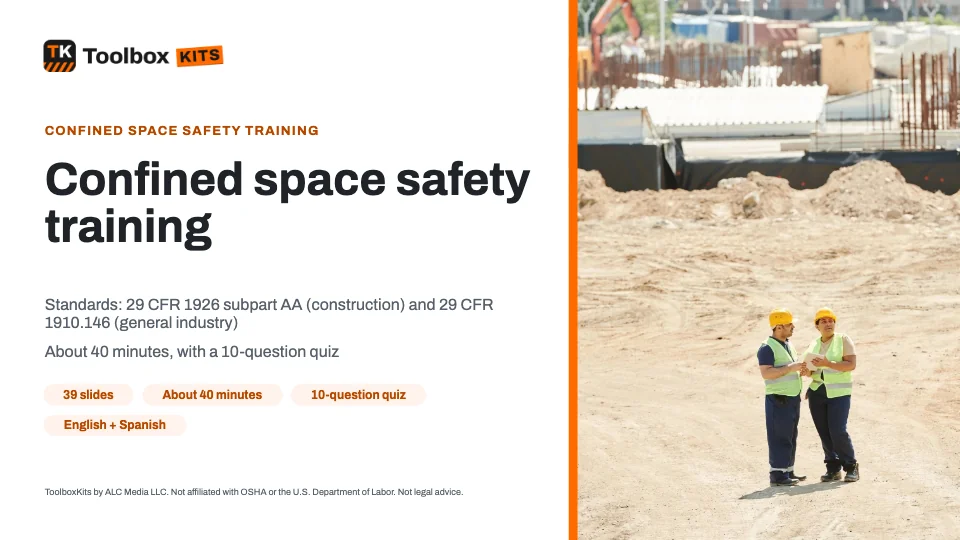 Editable PowerPoint
- Trainer guide
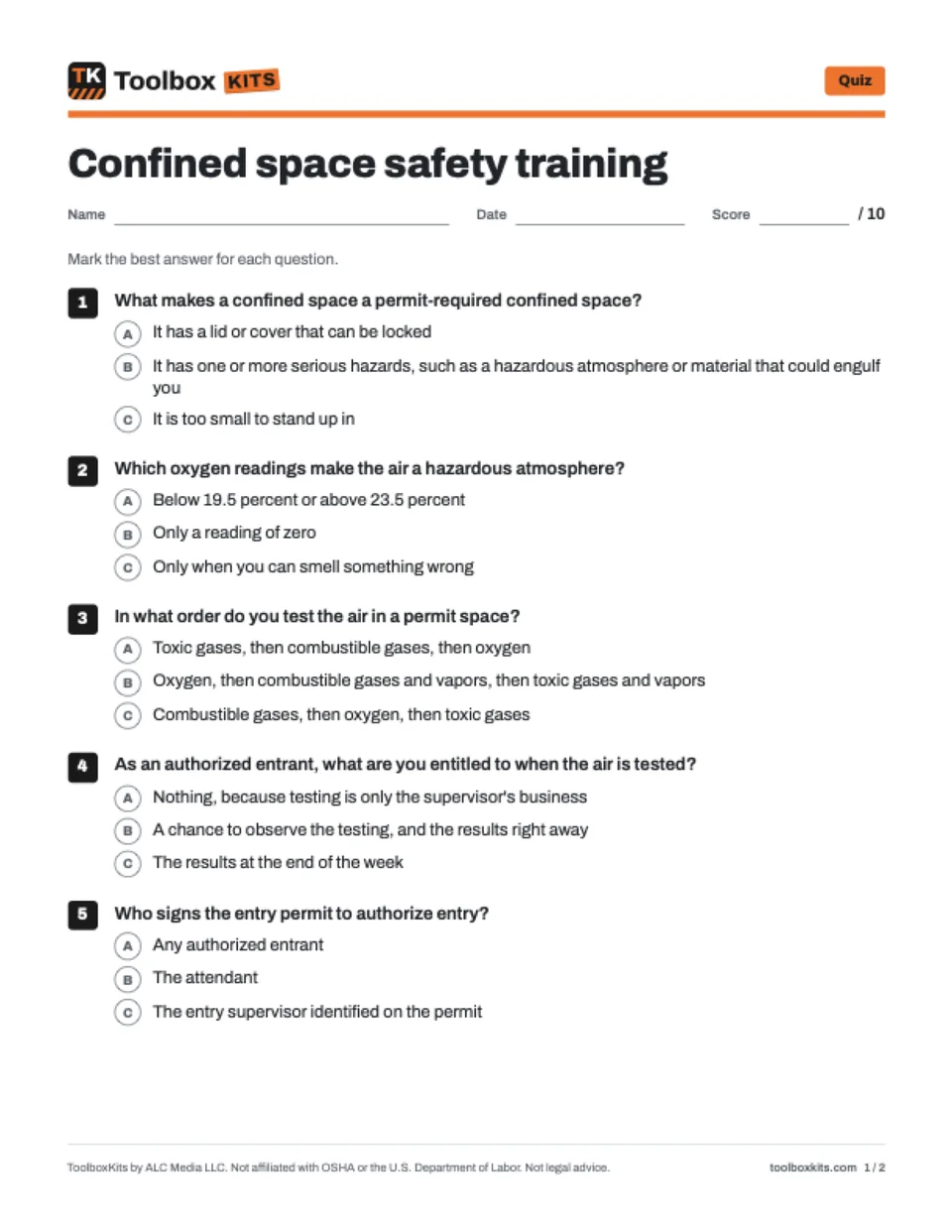 Quiz
- Answer key
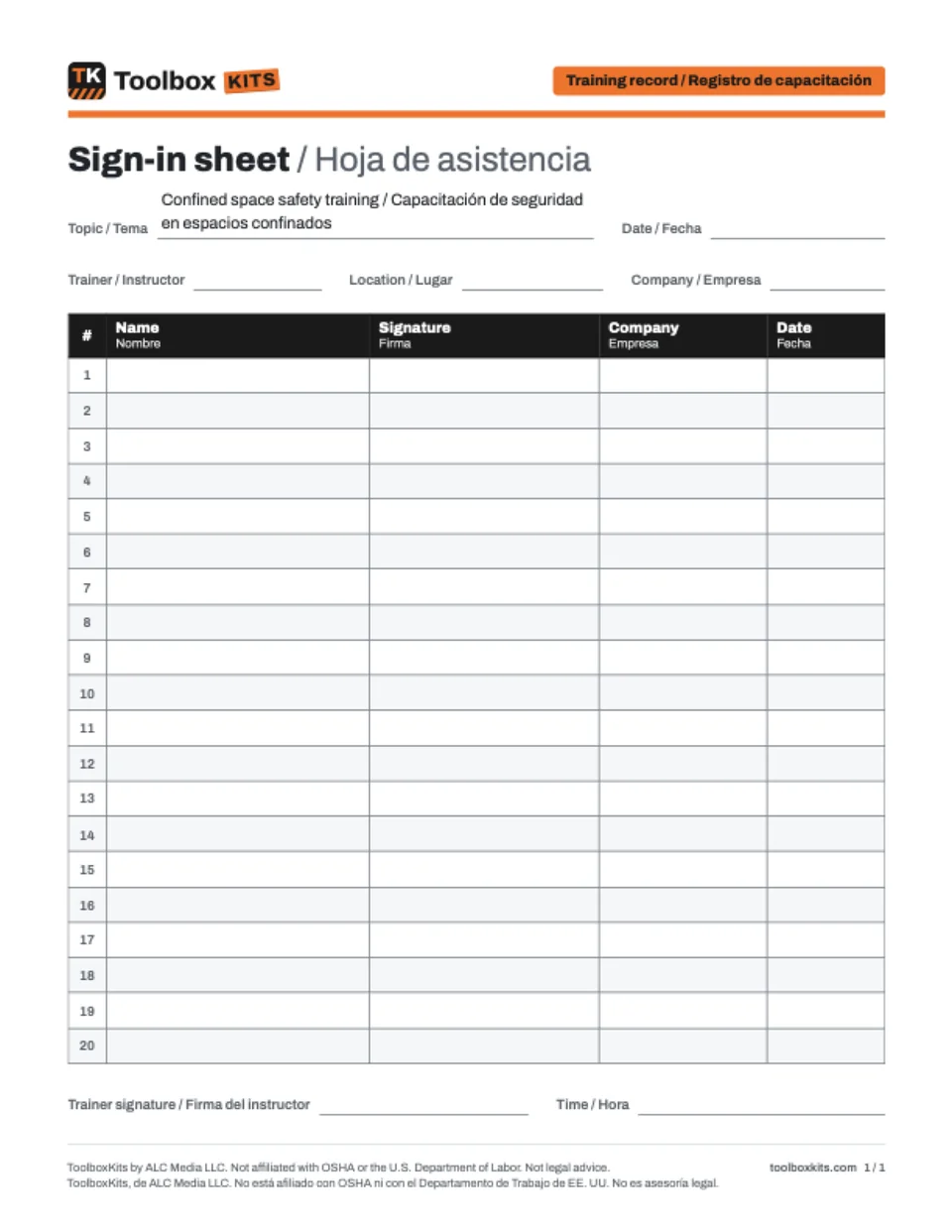 Sign-in sheet
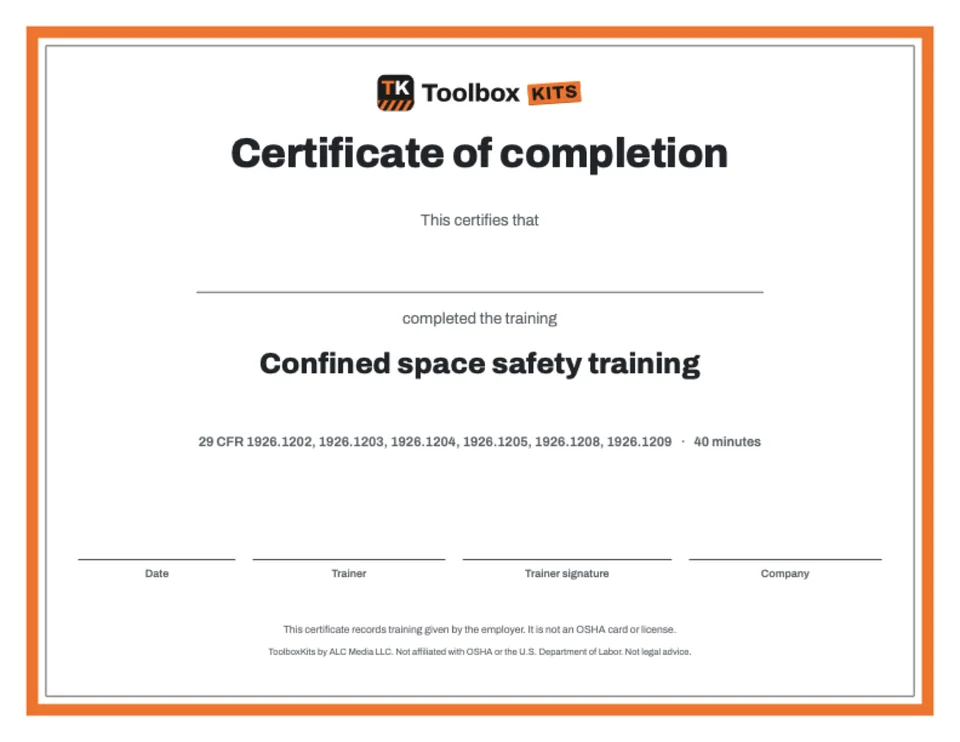 Certificate
- Crew handout
Try it
Try the quiz
Three questions from this topic. Pick an answer to see the right one and the OSHA paragraph.
Question 1 of 3
When testing the air in a permit space, what do you test for first?
The rule
What OSHA requires
Plain-language summary. Each line links to the exact paragraph of the regulation.
Construction: before work starts at a site, a competent person must identify every confined space the crew may work in, and which of them are permit spaces.
“each employer must ensure that a competent person identifies all confined spaces in which one or more of the employees it directs may work, and identifies each space that is a permit space”
Workers must be told where each permit space is and the danger it poses, by danger signs or another equally effective way.
“Inform exposed employees by posting danger signs or by any other equally effective means, of the existence and location of, and the danger posed by, each permit space”
An employer that has not authorized its workers to enter a permit space must take effective measures to keep them out.
“must take effective measures to prevent those employees from entering that permit space”
Construction: if workers will enter a permit space, the employer must have a written permit space program in place at the site, open to workers for inspection before and during entry.
“The written program must be made available prior to and during entry operations for inspection by employees and their authorized representatives.”
General industry: if workers will enter permit spaces, the employer must develop and implement a written permit space program.
“If the employer decides that its employees will enter permit spaces, the employer shall develop and implement a written permit space program that complies with this section.”
The employer must provide the equipment needed for safe entry and rescue at no cost to workers, such as air monitors, ventilation, communication gear, PPE, lighting and ladders, and make sure it is used properly.
“at no cost to each employee, maintain that equipment properly, and ensure that each employee uses that equipment properly”
When testing the air, test for oxygen first, then combustible gases and vapors, then toxic gases and vapors.
“When testing for atmospheric hazards, test first for oxygen, then for combustible gases and vapors, and then for toxic gases and vapors”
At least one attendant must be stationed outside the permit space for the whole entry.
“Provide at least one attendant outside the permit space into which entry is authorized for the duration of entry operations”
The employer must have procedures for calling rescue and emergency services, rescuing entrants, and keeping unauthorized people from attempting a rescue.
“for preventing unauthorized personnel from attempting a rescue”
Construction: confined space training must be given in a language and vocabulary each worker can understand.
“In both a language and vocabulary that the employee can understand”
Who must be trained
Construction: each employee whose work is regulated by the confined spaces standard must be trained, at no cost to the employee (29 CFR 1926.1207(a)), including authorized entrants, attendants, entry supervisors and people who test or monitor the air (29 CFR 1926.1204(h)). General industry: all employees whose work is regulated by the permit-required confined spaces standard (29 CFR 1910.146(g)(1)).
When to retrain
Training must be given again before a change in assigned duties, whenever a change in permit space entry operations presents a hazard the worker has not been trained on, and when there are signs of deviations from entry procedures or gaps in the worker's knowledge or use of them (29 CFR 1926.1207(b)(3) to (b)(5); 29 CFR 1910.146(g)(2)(ii) to (iv)).

Common questions
Questions people ask
Is there a printable confined space toolbox talk PDF?
Yes. This talk is available as a free printable PDF in English and Spanish, with a sign-in table for your crew. Print it, read it aloud in about five minutes, and keep the signed sheet with your safety records.
Does a confined space toolbox talk count as OSHA training?
Not by itself. In construction, OSHA requires training that gives each worker the understanding, knowledge and skills to do their assigned confined space duties safely, at no cost to the worker. A toolbox talk is a good refresher and a way to spot gaps, but it does not replace that training.
When do you need a written confined space program?
You need a written permit space program if any of your workers will enter a permit space. In construction, it must be in place at the site and available for workers and their representatives to inspect before and during entry. A template can be a starting point, but the program should match your actual spaces, hazards and crew.
What topics should a confined space toolbox talk cover?
Cover how to spot confined spaces and permit spaces, air testing, the roles of entrant, attendant and entry supervisor, the entry permit, and how rescue works on your site. Most of all, cover why nobody goes in after a downed worker without a plan. If your crew needs more depth, give each topic its own talk.
Can I use this as a confined space safety moment?
Yes. For a short safety moment, read the scenario out loud and ask one of the discussion questions. It works well before any shift with work near tanks, vaults, manholes or pits.
Free to share
Use this talk for free
You can print, share and adapt this talk at no cost under the Creative Commons BY-NC-SA 4.0 license. Please credit ToolboxKits with a link.