

Training kit, $9
Situational awareness training PowerPoint
An editable 39-slide PowerPoint to run situational awareness training in about 45 minutes, with trainer notes, a trainer guide, a 10-question quiz, a sign-in sheet and a certificate. In English and Spanish.
- Instant download
- Secure checkout by Stripe
- 30-day refund, no questions
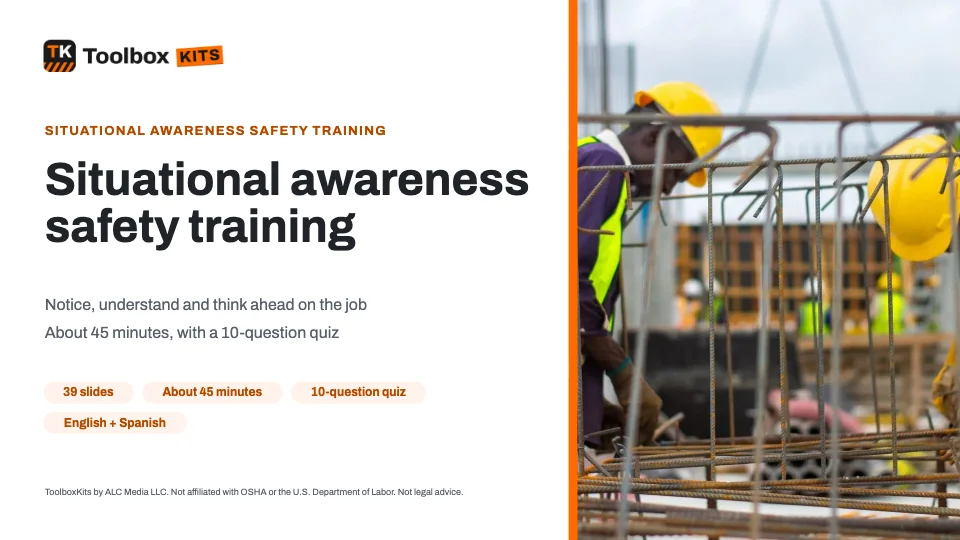
PREVIEW
Real slides from the deck
Six of the 39 slides, exactly as they open in PowerPoint. Tap one to see it larger.
What is in the kit
- 39-slide editable PowerPoint with trainer notes on every slide
- Trainer guide for a 45-minute class, with the agenda and the materials list
- 10-question quiz and answer key
- Crew handout with the dos and don'ts
- Sign-in sheet and certificate of completion
- Everything in English and Spanish, in one zip file
CONTENTS
What the slides cover, in order
The topics of the deck in the order you teach them, with the OSHA citation each slide carries. Then 10 quiz slides, one question each.
- Situational awareness safety training
- What you will learn today
- The hazard: losing track of what is around you
- Notice, understand, think ahead
- What pulls your attention away
- Where awareness breaks down on the job
- Rule: the duty to train · 29 CFR 1926.21(b)(2)
- Rule: signs, tags and traffic control · 29 CFR 1926.200(a)
- Rule: backing vehicles and machines · 29 CFR 1926.601(b)(4)
- Rule: forklifts and people on foot · 29 CFR 1910.178(n)(4)
- Rule: crane swing areas · 29 CFR 1926.1424(a)(3)(i)
- Rule: stay out from under loads · 29 CFR 1926.651(e)
- Rule: power lines you cannot always see · 29 CFR 1926.416(a)(3)
- Rule: see and be seen · 29 CFR 1926.651(d)
- Rule: conditions change, so inspections repeat · 29 CFR 1926.20(b)(2)
- Step by step: the start-of-shift scan
- Step by step: moving around equipment on foot · 29 CFR 1926.1424(a)(3)(i)
- Step by step: reset when something changes
- Step by step: warning a coworker
- Checklist: awareness before and during the job
- Common mistakes and what to do instead
- Scenario exercise: the morning after the storm
- Scenario: what should have happened · 29 CFR 1926.601(b)(4)
- Recap: what to remember
- Thanks for your time. Please sign in.
TRAINER GUIDE
How the class runs
The trainer guide splits the 45 minutes like this. The notes on each slide say what to say.
| Minutes | What happens |
|---|---|
| 3 | Slides 1 and 2: welcome, sign-in sheet and goals |
| 6 | Slides 3 to 6: the hazard, the three steps, distractions and where awareness breaks down |
| 13 | Slides 7 to 15: the rules on training, signs, backing vehicles, forklifts, crane swing areas, loads, power lines, visibility and inspections |
| 9 | Slides 16 to 20: step by step habits and the awareness checklist (do the start-of-shift scan as a short walk, or with the site map) |
| 2 | Slide 21: common mistakes |
| 5 | Slides 22 and 23: scenario exercise in small groups, then the debrief |
| 1 | Slide 24: recap |
| 5 | Slides 25 to 34: the crew answers the paper quiz, then go over each question |
| 1 | Slide 35: closing, sign-in sheet and handouts |
What you need
- Slides on a screen, or printed copies for each person
- Sign-in sheet
- 10-question quiz and answer key, one quiz per person
- Crew handouts and certificates
- A site map or sketch showing equipment routes, crane swing areas, excavations, overhead lines and walkways
- Photos of work areas on this site taken today, if you have them
- Flip chart or whiteboard and markers
- A safe route for a short walk-around, if time and the site allow
Tips from the guide
- Use your own site in every example: name the real equipment routes, blind spots and swing areas.
- Ask open questions like 'What changed today?' instead of yes or no questions.
- Let newer workers answer first, then ask the most experienced person what they would add.
QUIZ
3 of the 10 quiz questions
Pick your answer, then open it. The kit's answer key has them all.
A forklift driver comes to a cross aisle and cannot see around the rack. What must the driver do?
- Speed up to clear the aisle quickly
- Slow down and sound the horn
- Keep going at the same speed
- Raise the load to see over it
Show the answer
B. Drivers must slow down and sound the horn at cross aisles and other locations where vision is obstructed.
A parked forklift has its empty forks raised. May you walk under the forks to reach a shelf?
- Yes, because the forks are empty
- Yes, if the engine is off
- No, no one may stand or pass under the elevated portion, loaded or empty
- Yes, if the driver is in the seat
Show the answer
C. No person may stand or pass under the elevated portion of any truck, whether loaded or empty.
It rained hard overnight. When must a competent person inspect the excavation your crew will work in?
- Before work starts, and after every rainstorm or other hazard-increasing event
- Only once a week
- Only if someone reports a problem
- Only after the crew is already in the trench
Show the answer
A. A competent person must inspect excavations daily before work starts, as needed during the shift, and after every rainstorm or other hazard-increasing event.
PAPERWORK
Sign-in sheet, quiz and certificate
Ready to print. The certificate is a record of completion, not an OSHA card or license.
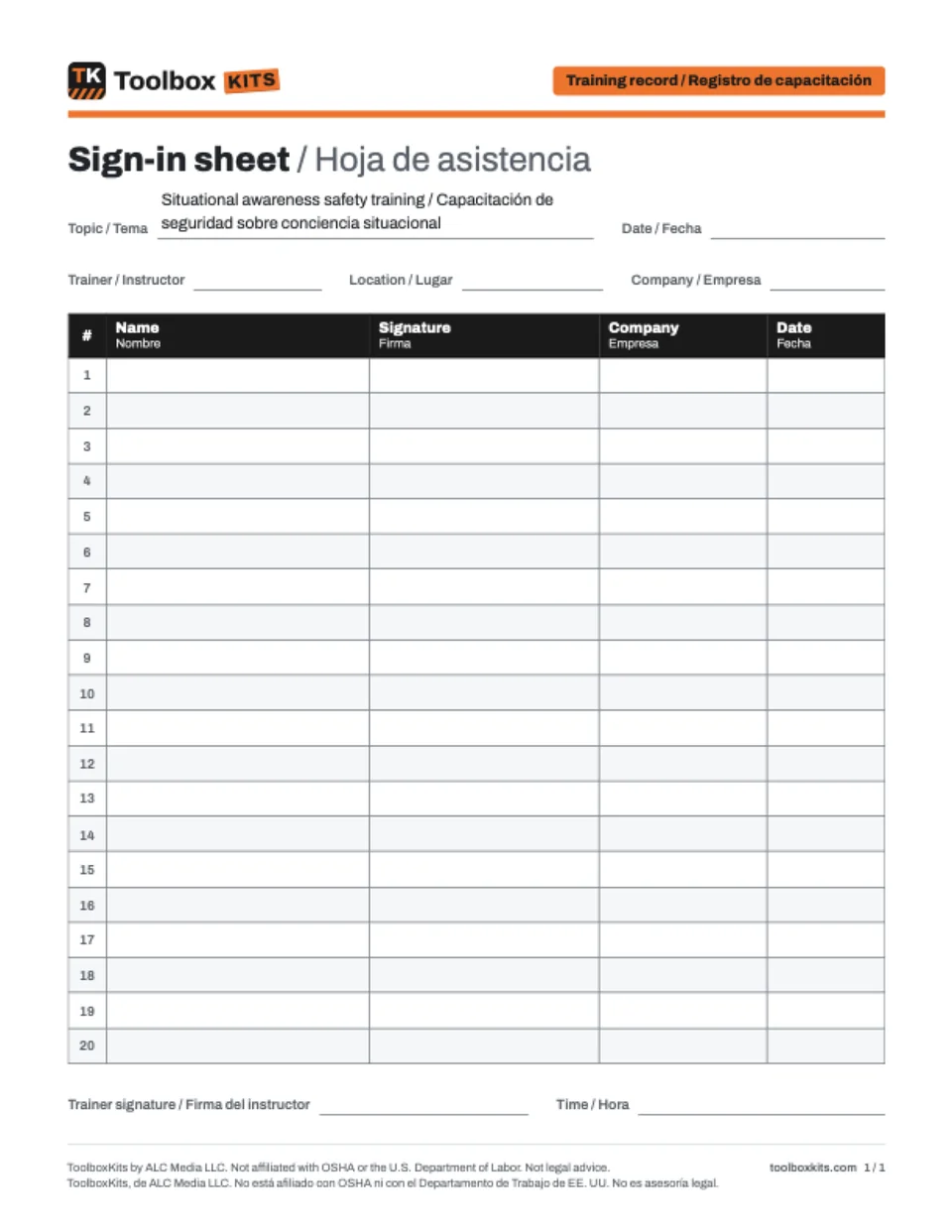
Sign-in sheet
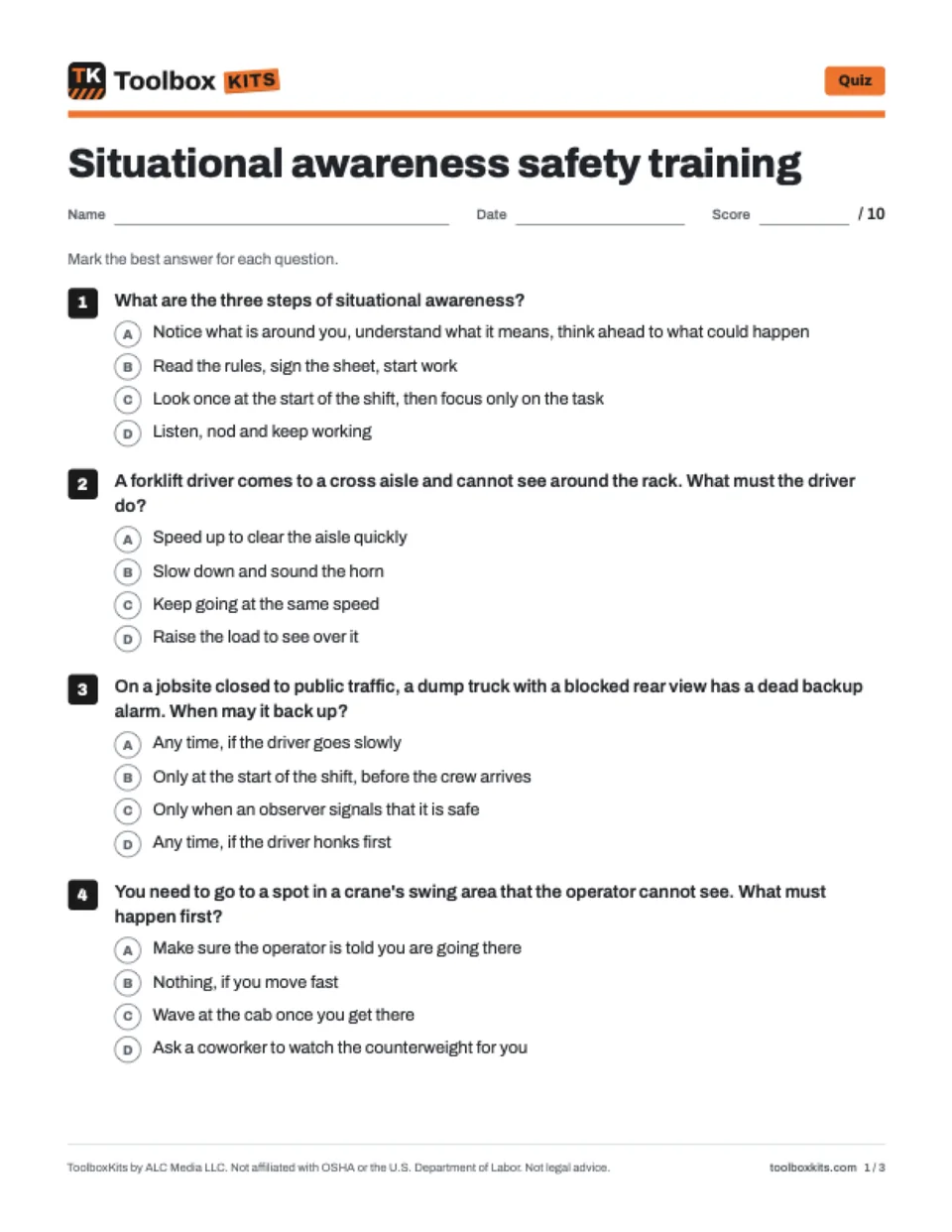
Quiz
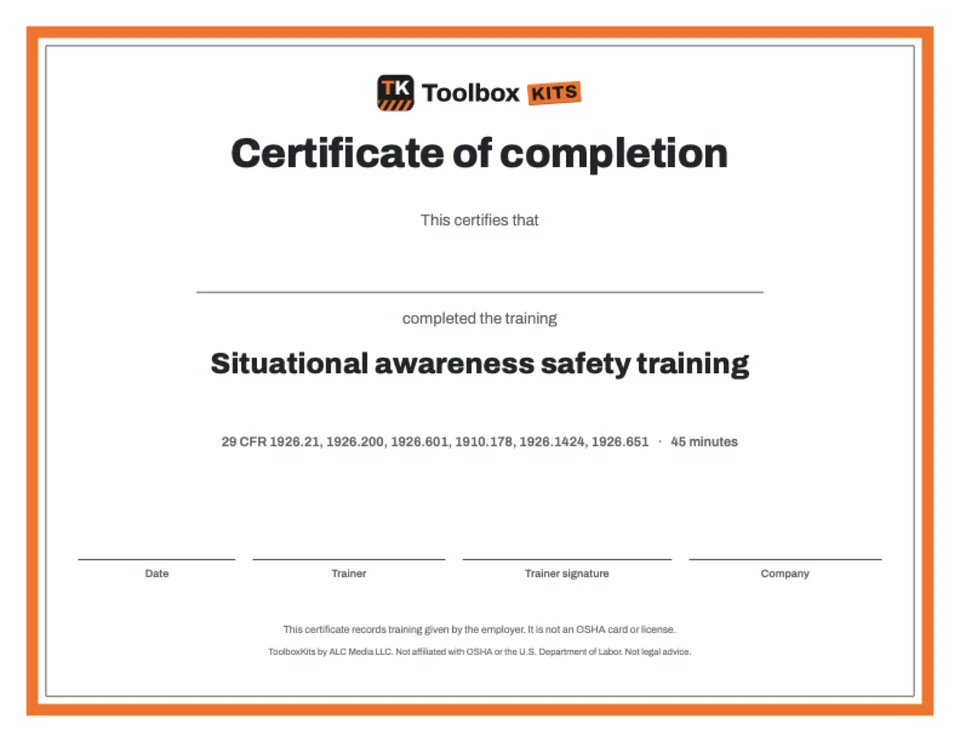
Certificate
WHO IT IS FOR
Who it is for and how long it takes
For the supervisor, foreman or safety lead who has to train a crew on situational awareness and wants to walk in ready. The class takes about 45 minutes with the quiz. Run it in English or Spanish: the kit has both.
Used in: construction, general industry, warehousing, manufacturing, landscaping, healthcare, restaurants, oil and gas.
Only need a short talk? The 5-minute talk on this topic is free, in English and Spanish. Free situational awareness toolbox talk
OSHA standards cited in the kit
Each citation points to the paragraph of the rule in the eCFR. This is how the kit writes them:
- 29 CFR 1926.21 Safety training and education29 CFR 1926.21(b)(2)
- 29 CFR 1926.200 Accident prevention signs and tags29 CFR 1926.200(a)
- 29 CFR 1926.601 Motor vehicles29 CFR 1926.601(b)(4)
- 29 CFR 1910.178 Powered industrial trucks29 CFR 1910.178(n)(4) · 29 CFR 1910.178(m)(2)
- 29 CFR 1926.1424 Work area control29 CFR 1926.1424(a)(3)(i)
- 29 CFR 1926.651 Specific excavation requirements29 CFR 1926.651(e) · 29 CFR 1926.651(d) · 29 CFR 1926.651(k)(1)
- 29 CFR 1926.416 General requirements29 CFR 1926.416(a)(3)
- 29 CFR 1926.20 General safety and health provisions29 CFR 1926.20(b)(2)
Situational awareness training kit
$9
Pay once and download right away. No subscription. If it does not work for you, you get a refund within 30 days, no questions asked. Refund policy