

Training kit, $9
Safety culture training PowerPoint
An editable 36-slide PowerPoint to run safety culture training in about 45 minutes, with trainer notes, a trainer guide, a 10-question quiz, a sign-in sheet and a certificate. In English and Spanish.
- Instant download
- Secure checkout by Stripe
- 30-day refund, no questions
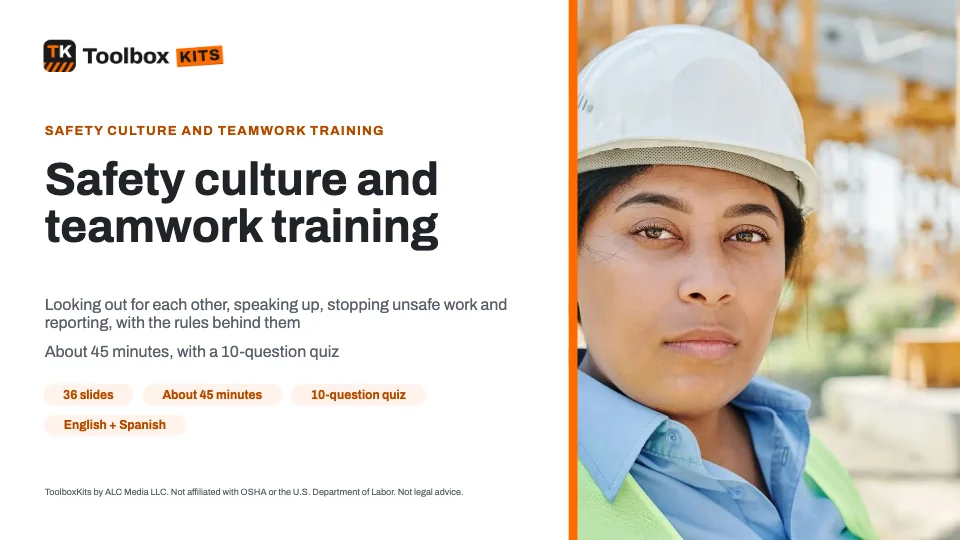
PREVIEW
Real slides from the deck
Six of the 36 slides, exactly as they open in PowerPoint. Tap one to see it larger.
What is in the kit
- 36-slide editable PowerPoint with trainer notes on every slide
- Trainer guide for a 45-minute class, with the agenda and the materials list
- 10-question quiz and answer key
- Crew handout with the dos and don'ts
- Sign-in sheet and certificate of completion
- Everything in English and Spanish, in one zip file
CONTENTS
What the slides cover, in order
The topics of the deck in the order you teach them, with the OSHA citation each slide carries. Then 10 quiz slides, one question each.
- Safety culture and teamwork training
- What you will learn today
- The hazard: when people stay quiet
- Strong culture or weak culture: what you see
- Why people stay quiet, and what helps
- The rules behind a safety culture
- Rule: the duty to train · 29 CFR 1926.21(b)(2)
- Rule: safety programs and inspections · 29 CFR 1926.20(b)(2)
- Rule: unsafe equipment and PPE · 29 CFR 1926.20(b)(3)
- Rule: when OSHA requires a stop · 29 CFR 1926.1419(j)
- Rule: reporting injuries without fear · 29 CFR 1904.35(b)(1)
- Rule: your rights when you speak up · 29 CFR 1904.36
- Doing it right, step by step
- Step by step: warn a coworker
- Step by step: take a warning well
- Step by step: stop the job
- Step by step: report a close call
- Step by step: bring a new worker in
- For foremen and leads: set the tone
- Checklist: daily habits of a strong crew
- Common mistakes and what to do instead
- Scenario exercise: the pour before the rain
- Scenario: what should have happened · 29 CFR 1926.501(b)(1)
- Recap: what to remember
- Thank you. Look out for each other
TRAINER GUIDE
How the class runs
The trainer guide splits the 45 minutes like this. The notes on each slide say what to say.
| Minutes | What happens |
|---|---|
| 3 | Slides 1 and 2: welcome, sign-in sheet and goals |
| 6 | Slides 3 to 5: the hazard, strong and weak culture, and why people stay quiet, using the flip chart |
| 9 | Slides 6 to 12: the rules on training, inspections, unsafe equipment, stopping work, injury reporting and your rights |
| 11 | Slides 13 to 19: step by step, with role-plays for warning a coworker and taking a warning |
| 2 | Slides 20 and 21: daily checklist and common mistakes |
| 6 | Slides 22 and 23: scenario exercise in small groups, then the debrief |
| 1 | Slide 24: recap |
| 6 | Slides 25 to 34: the crew answers the paper quiz, then go over each question |
| 1 | Slide 35: closing, sign-in sheet and handouts |
What you need
- Slides on a screen, or printed copies for each person
- Sign-in sheet
- 10-question quiz and answer key, one quiz per person
- Crew handouts and completion certificates
- Flip chart or whiteboard and markers
- Our injury and close call reporting procedure, and the tags we use for unsafe equipment
- Our company stop work policy, if there is one
- The location of the OSHA notice for this crew, to point out during slide 12
Tips from the guide
- Use tasks and situations from this job for every example.
- Never ask anyone to name a coworker who took a shortcut. Talk about tasks and conditions, not people.
- When someone admits they stayed quiet or took a shortcut, thank them and ask what got in the way.
QUIZ
3 of the 10 quiz questions
Pick your answer, then open it. The kit's answer key has them all.
A coworker tells you your lanyard is not clipped in. What is the best response?
- Tell them to mind their own business
- Stop, clip in and thank them
- Finish the task first, since you are almost done
- Report them for distracting you
Show the answer
B. Stopping to fix it and saying thanks keeps you safe and keeps people speaking up. This is good practice, not an OSHA rule.
In construction, who must make the frequent and regular inspections of job sites, materials and equipment?
- Any worker who has time
- Competent persons designated by the employer
- Only OSHA inspectors
- The newest worker on the crew
Show the answer
B. 1926.20(b)(2) says safety programs must provide for frequent and regular inspections of the job sites, materials and equipment by competent persons designated by the employer.
Under OSHA's recordkeeping rule, when is a procedure for reporting injuries not reasonable?
- When it uses a paper form
- When it would deter or discourage a reasonable employee from accurately reporting
- When reports go to the foreman first
- When it is explained at orientation
Show the answer
B. 1904.35(b)(1) says a procedure is not reasonable if it would deter or discourage a reasonable employee from accurately reporting a workplace injury or illness.
PAPERWORK
Sign-in sheet, quiz and certificate
Ready to print. The certificate is a record of completion, not an OSHA card or license.
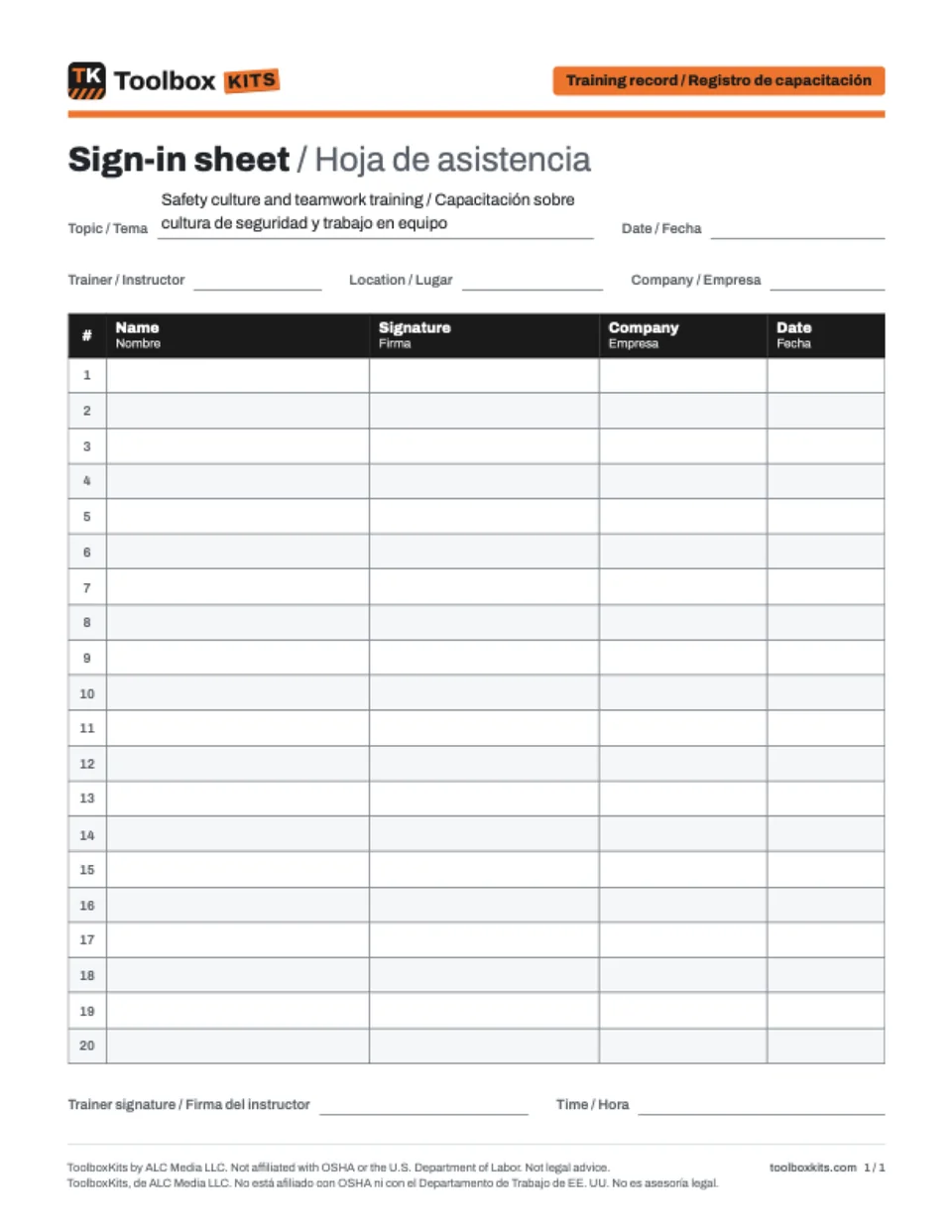
Sign-in sheet
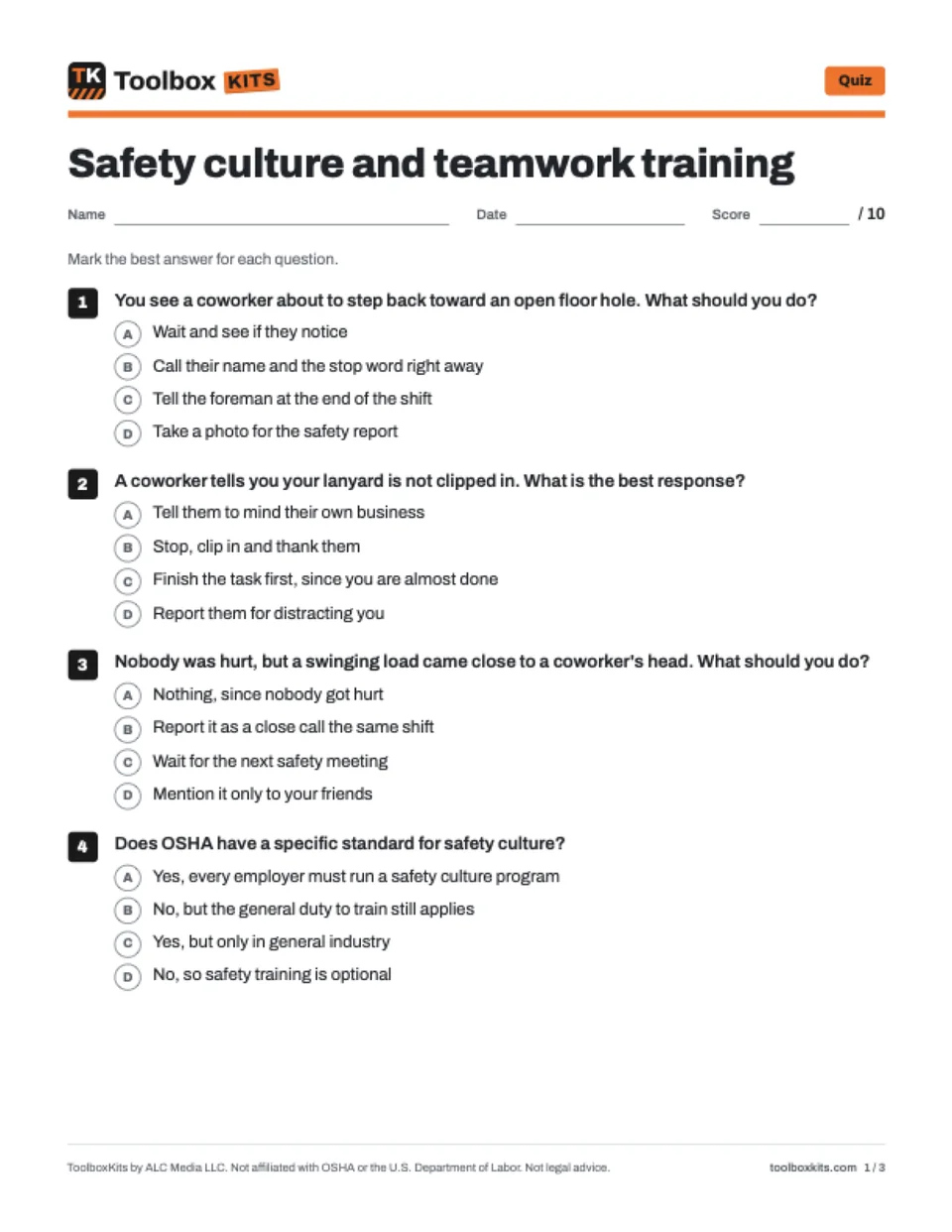
Quiz
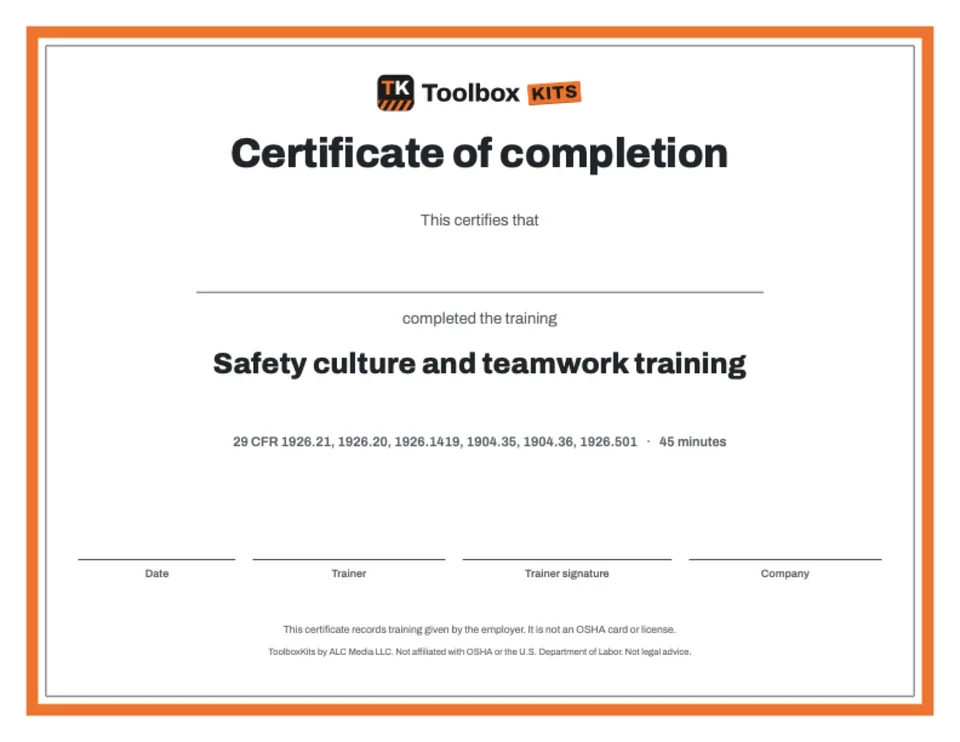
Certificate
WHO IT IS FOR
Who it is for and how long it takes
For the supervisor, foreman or safety lead who has to train a crew on safety culture and wants to walk in ready. The class takes about 45 minutes with the quiz. Run it in English or Spanish: the kit has both.
Used in: construction, general industry, warehousing, manufacturing, landscaping, healthcare, restaurants, oil and gas.
Only need a short talk? The 5-minute talk on this topic is free, in English and Spanish. Free safety culture toolbox talk
OSHA standards cited in the kit
Each citation points to the paragraph of the rule in the eCFR. This is how the kit writes them:
- 29 CFR 1926.21 Safety training and education29 CFR 1926.21(b)(2)
- 29 CFR 1926.20 General safety and health provisions29 CFR 1926.20(b)(2) · 29 CFR 1926.20(b)(3) · 29 CFR 1926.20(b)(4)
- 29 CFR 1926.1419 Signals, general requirements29 CFR 1926.1419(j)
- 29 CFR 1904.35 Employee involvement29 CFR 1904.35(b)(1) · 29 CFR 1904.35(b)(1)(iv)
- 29 CFR 1904.36 Prohibition against discrimination29 CFR 1904.36
- 29 CFR 1926.501 Duty to have fall protection29 CFR 1926.501(b)(1)
- 29 CFR 1926.416 General requirements29 CFR 1926.416(e)(1)
- 29 CFR 1926.1417 Operation29 CFR 1926.1417(y)
Safety culture training kit
$9
Pay once and download right away. No subscription. If it does not work for you, you get a refund within 30 days, no questions asked. Refund policy