

Training kit, $9
Behavior-based safety training PowerPoint
An editable 34-slide PowerPoint to run behavior-based safety training in about 45 minutes, with trainer notes, a trainer guide, a 10-question quiz, a sign-in sheet and a certificate. In English and Spanish.
- Instant download
- Secure checkout by Stripe
- 30-day refund, no questions
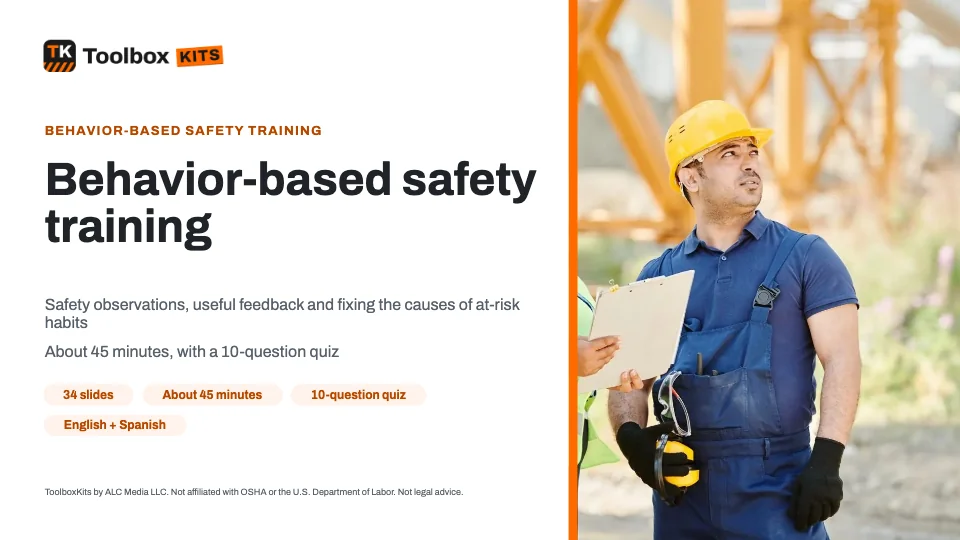
PREVIEW
Real slides from the deck
Six of the 34 slides, exactly as they open in PowerPoint. Tap one to see it larger.
What is in the kit
- 34-slide editable PowerPoint with trainer notes on every slide
- Trainer guide for a 45-minute class, with the agenda and the materials list
- 10-question quiz and answer key
- Crew handout with the dos and don'ts
- Sign-in sheet and certificate of completion
- Everything in English and Spanish, in one zip file
CONTENTS
What the slides cover, in order
The topics of the deck in the order you teach them, with the OSHA citation each slide carries. Then 10 quiz slides, one question each.
- Behavior-based safety training
- What you will learn today
- The hazard: at-risk habits and what drives them
- Activators, behavior and consequences
- What you see, and what may be behind it
- Rule: the duty to train · 29 CFR 1926.21(b)(2)
- Rule: inspections, and observations the rules already require · 29 CFR 1910.147(c)(6)(i)
- Rule: unsafe equipment and PPE · 29 CFR 1926.20(b)(3)
- Rule: when what you see calls for retraining · 29 CFR 1910.178(l)(4)(ii)
- Rule: injury reporting stays open · 29 CFR 1904.35(b)(1)
- Step by step: before the observation
- Step by step: watch the work
- Step by step: the feedback conversation
- Step by step: fill out the observation card
- Step by step: follow up and fix the cause
- For foremen and leads: make it work
- Common mistakes and what to do instead
- Scenario exercise: the observation that backfired
- Scenario: what should have happened
- Recap: what to remember
- Thanks for your time. Please sign in.
TRAINER GUIDE
How the class runs
The trainer guide splits the 45 minutes like this. The notes on each slide say what to say.
| Minutes | What happens |
|---|---|
| 3 | Slides 1 and 2: welcome, sign-in sheet and goals |
| 6 | Slides 3 to 5: the hazard, the ABC model and what may be behind a shortcut, using the flip chart |
| 9 | Slides 6 to 10: the rules on training, inspections, unsafe equipment, retraining and injury reporting |
| 10 | Slides 11 to 16: step by step, with a short practice observation and a feedback role-play |
| 2 | Slide 17: common mistakes |
| 6 | Slides 18 and 19: scenario exercise in small groups, then the debrief |
| 1 | Slide 20: recap |
| 7 | Slides 21 to 30: the crew answers the paper quiz, then go over each question |
| 1 | Slide 31: closing, sign-in sheet and handouts |
What you need
- Slides on a screen, or printed copies for each person
- Sign-in sheet
- 10-question quiz and answer key, one quiz per person
- Crew handouts and certificates
- Blank observation cards for each person, plus clipboards and pens
- Flip chart or whiteboard and markers
- A real task nearby that the crew can watch safely for a few minutes
- Our injury and close call reporting procedure, and the tags we use for unsafe equipment
Tips from the guide
- Use tasks from this job for every example, and let the crew pick which shortcuts to talk about.
- Never ask anyone to name a coworker they saw taking a shortcut. Talk about tasks and conditions, not people.
- When someone admits a shortcut, thank them and ask what made the safe way hard. Do not blame.
QUIZ
3 of the 10 quiz questions
Pick your answer, then open it. The kit's answer key has them all.
In the ABC model, what is an activator?
- What happens after the behavior
- What comes before the behavior and prompts it
- A type of PPE
- The person doing the observation
Show the answer
B. Activators come before a behavior and prompt it, like a sign, a rush job or a missing tool. Consequences come after.
An observation finds a grinder on a construction site with its required guard missing. What must happen?
- Keep using it carefully until the job is done
- Do not use it. Tag it as unsafe, lock its controls or remove it
- Let only experienced workers use it
- Note it on the card and keep working
Show the answer
B. In construction, equipment that does not comply with an applicable requirement must not be used, and must be tagged, have its controls locked or be physically removed.
In general industry, who performs the periodic inspection of a lockout procedure?
- The same worker who uses the procedure
- An authorized employee other than the ones using the procedure
- Any visitor to the site
- Nobody, because it is optional
Show the answer
B. The periodic inspection must be performed by an authorized employee other than the ones using the energy control procedure being inspected.
PAPERWORK
Sign-in sheet, quiz and certificate
Ready to print. The certificate is a record of completion, not an OSHA card or license.
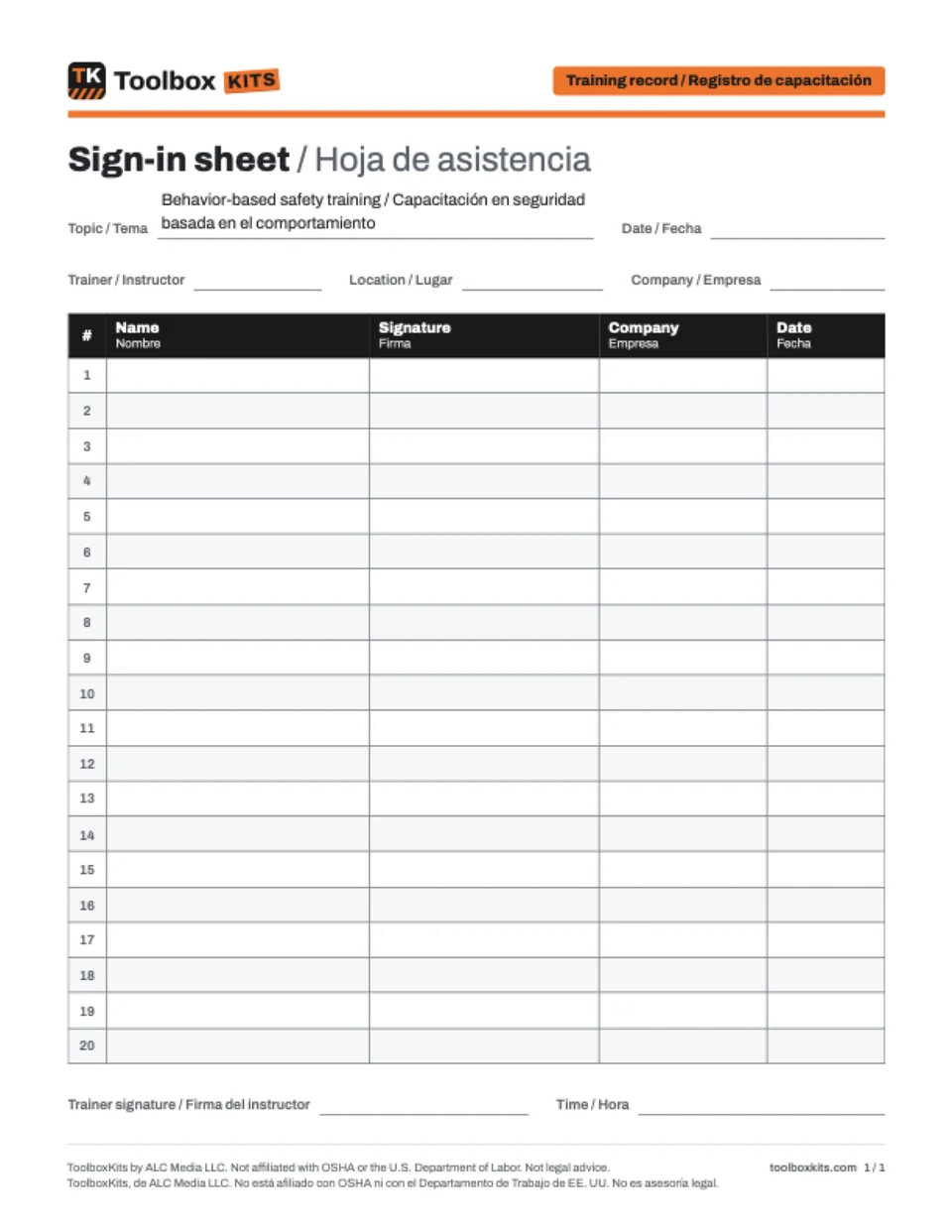
Sign-in sheet
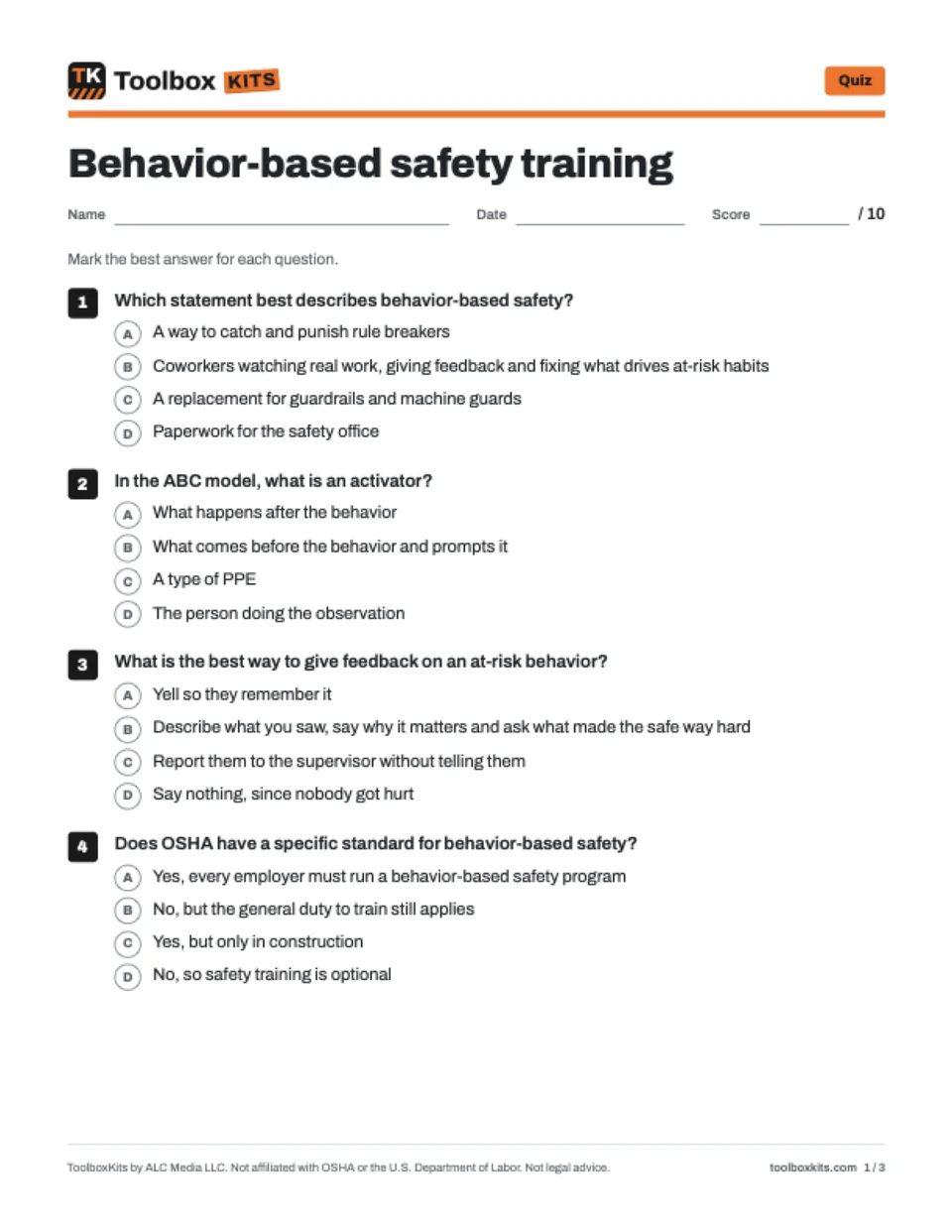
Quiz
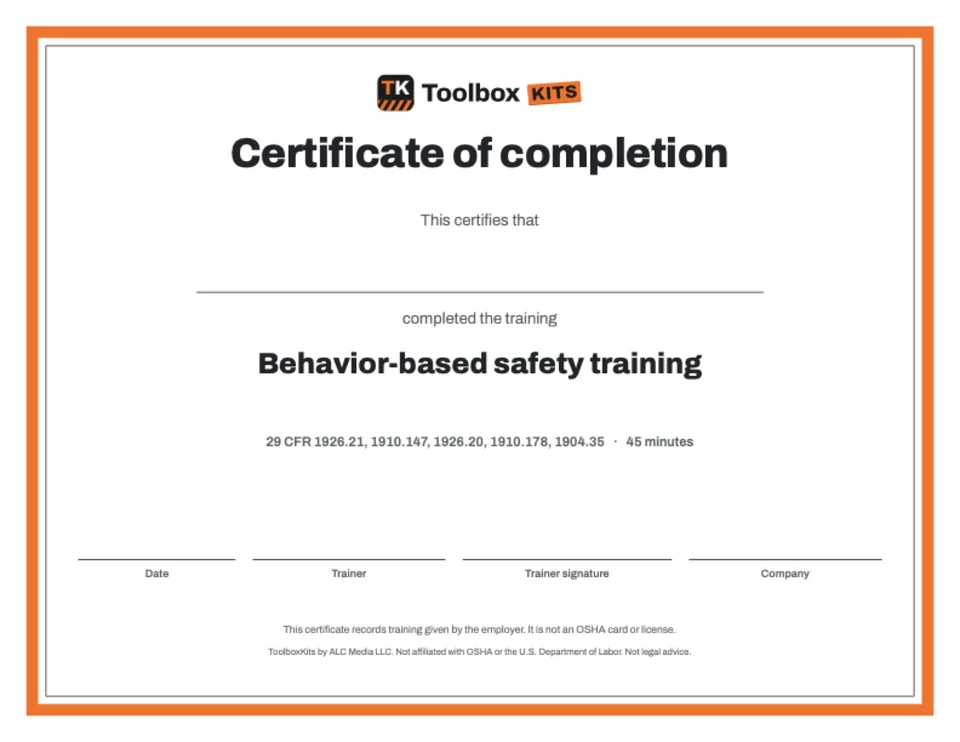
Certificate
WHO IT IS FOR
Who it is for and how long it takes
For the supervisor, foreman or safety lead who has to train a crew on behavior-based safety and wants to walk in ready. The class takes about 45 minutes with the quiz. Run it in English or Spanish: the kit has both.
Used in: construction, general industry, warehousing, manufacturing, landscaping, healthcare, restaurants, oil and gas.
Only need a short talk? The 5-minute talk on this topic is free, in English and Spanish. Free behavior-based safety toolbox talk
OSHA standards cited in the kit
Each citation points to the paragraph of the rule in the eCFR. This is how the kit writes them:
- 29 CFR 1926.21 Safety training and education29 CFR 1926.21(b)(2)
- 29 CFR 1910.147 The control of hazardous energy (lockout/tagout)29 CFR 1910.147(c)(6)(i) · 29 CFR 1910.147(c)(6)(i)(A)
- 29 CFR 1926.20 General safety and health provisions29 CFR 1926.20(b)(3) · 29 CFR 1926.20(b)(4)
- 29 CFR 1910.178 Powered industrial trucks29 CFR 1910.178(l)(4)(ii) · 29 CFR 1910.178(l)(4)(ii)(A)
- 29 CFR 1904.35 Employee involvement29 CFR 1904.35(b)(1) · 29 CFR 1904.35(b)(1)(iv)
Behavior-based safety training kit
$9
Pay once and download right away. No subscription. If it does not work for you, you get a refund within 30 days, no questions asked. Refund policy