

Training kit, $9
Line of fire training PowerPoint
An editable 32-slide PowerPoint to run line of fire training in about 40 minutes, with trainer notes, a trainer guide, a 10-question quiz, a sign-in sheet and a certificate. In English and Spanish.
- Instant download
- Secure checkout by Stripe
- 30-day refund, no questions
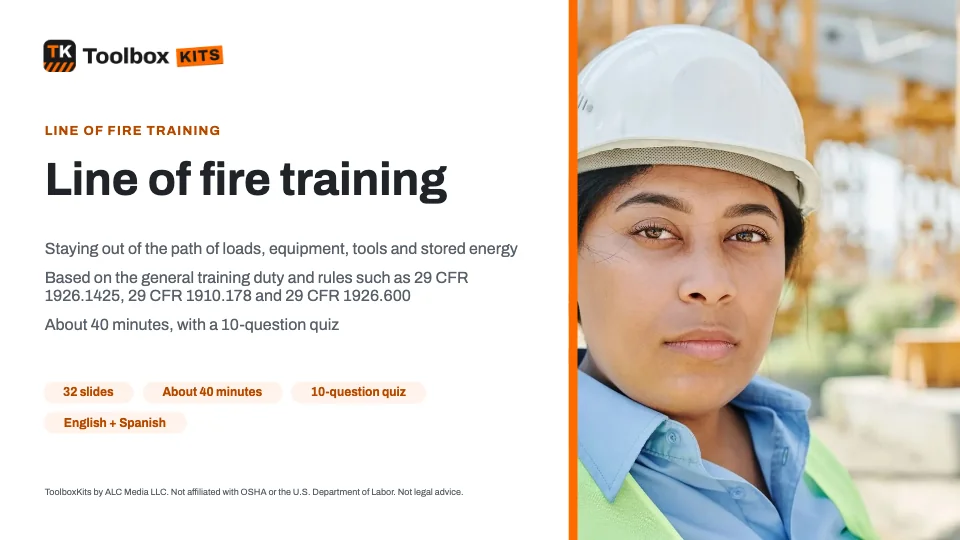
PREVIEW
Real slides from the deck
Six of the 32 slides, exactly as they open in PowerPoint. Tap one to see it larger.
What is in the kit
- 32-slide editable PowerPoint with trainer notes on every slide
- Trainer guide for a 40-minute class, with the agenda and the materials list
- 10-question quiz and answer key
- Crew handout with the dos and don'ts
- Sign-in sheet and certificate of completion
- Everything in English and Spanish, in one zip file
CONTENTS
What the slides cover, in order
The topics of the deck in the order you teach them, with the OSHA citation each slide carries. Then 10 quiz slides, one question each.
- Line of fire training
- What you will learn today
- The hazard: the path something takes when it lets go
- What the rules say: no single standard · 29 CFR 1926.21(b)(2)
- Rule group: suspended loads and the fall zone · 29 CFR 1926.1425(b)
- Rule group: forklifts, blocked equipment and jacks · 29 CFR 1910.178(m)(2)
- Rule group: swing zones and backing equipment · 29 CFR 1926.1424(a)(2)(ii)
- Rule group: stored energy, tools and guards · 29 CFR 1926.302(b)(1)
- How to do it right: plan where you stand
- How to do it right: loads and crane work
- How to do it right: vehicles and equipment
- How to do it right: tension, pressure and moving parts
- Line of fire checklist
- Common mistakes
- Scenario exercise: the pump skid
- Scenario debrief: what should have happened
- Recap
- Sign in before you go
TRAINER GUIDE
How the class runs
The trainer guide splits the 40 minutes like this. The notes on each slide say what to say.
| Minutes | What happens |
|---|---|
| 4 | Welcome, sign-in, objectives and the hazard |
| 13 | The rules: loads, forklifts and blocking, swing and backing, stored energy and guards |
| 8 | Doing it right: plan, loads and crane, vehicles, tension and moving parts, and the checklist |
| 2 | Common mistakes |
| 5 | Scenario exercise in small groups, then the debrief |
| 1 | Recap |
| 6 | Quiz: 10 questions, then go over the answers |
| 1 | Closing: sign-in check, handouts and certificates |
What you need
- Slide deck on a screen or printed slides
- Your site's job safety analysis or pre-task plan form
- A strap or chain and a hook for demonstration, not under load
- A site map showing swing zones, equipment paths and walkways
- Printed quizzes, answer key and pens
- Crew handouts, one per worker
- Sign-in sheet and certificates of completion
Tips from the guide
- Walk a real task with the crew and point out the lines of fire together.
- Say which rule book applies, construction or general industry, each time they differ.
- Fill in a pre-task plan as a group for a job coming up this week.
QUIZ
3 of the 10 quiz questions
Pick your answer, then open it. The kit's answer key has them all.
In general industry, when may a person stand or pass under the elevated portion of a forklift?
- When the forks are empty
- When the operator says it is okay
- Never, whether the truck is loaded or empty
Show the answer
C. No person shall be allowed to stand or pass under the elevated portion of any truck, whether loaded or empty.
What must happen before anyone works under equipment held up by a jack or hoist on a construction site?
- It must be substantially blocked or cribbed
- The operator must stay in the cab
- Nothing if the job is quick
Show the answer
A. Heavy machinery or parts held aloft shall be substantially blocked or cribbed to prevent falling or shifting before employees work under or between them.
In construction, how must pneumatic power tools be connected to the hose?
- Secured by some positive means to prevent accidental disconnection
- Pushed on by hand
- Taped on
Show the answer
A. Pneumatic power tools shall be secured to the hose or whip by some positive means.
PAPERWORK
Sign-in sheet, quiz and certificate
Ready to print. The certificate is a record of completion, not an OSHA card or license.
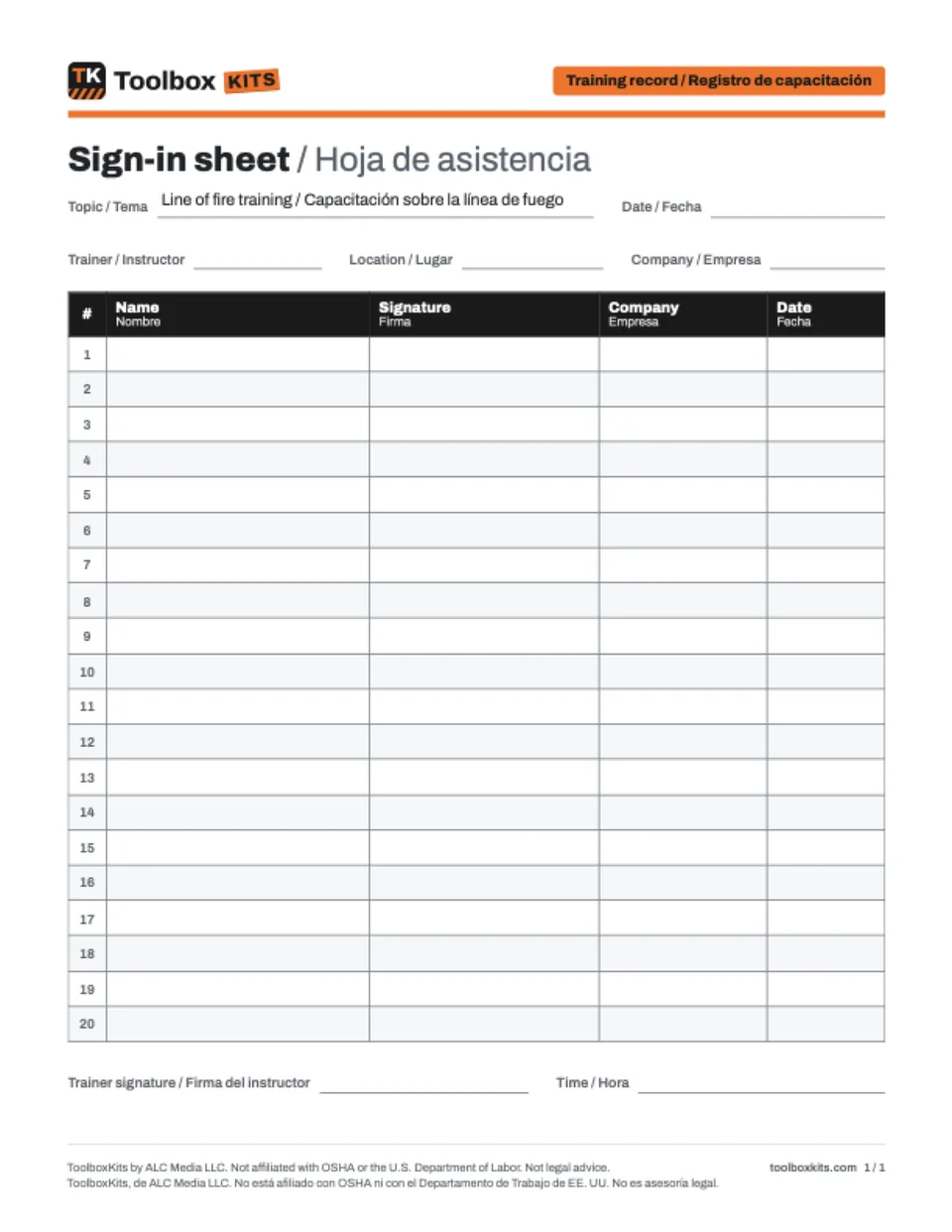
Sign-in sheet
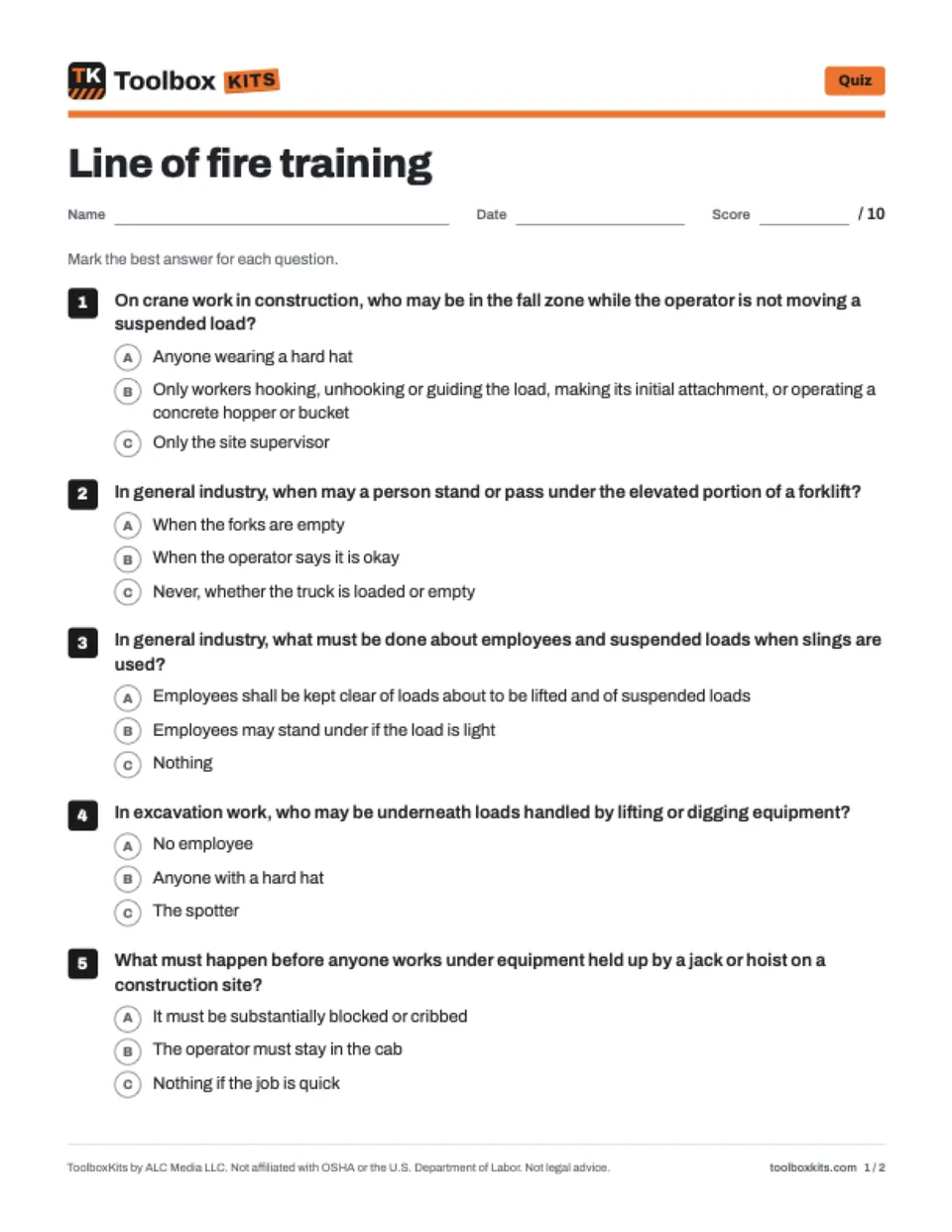
Quiz
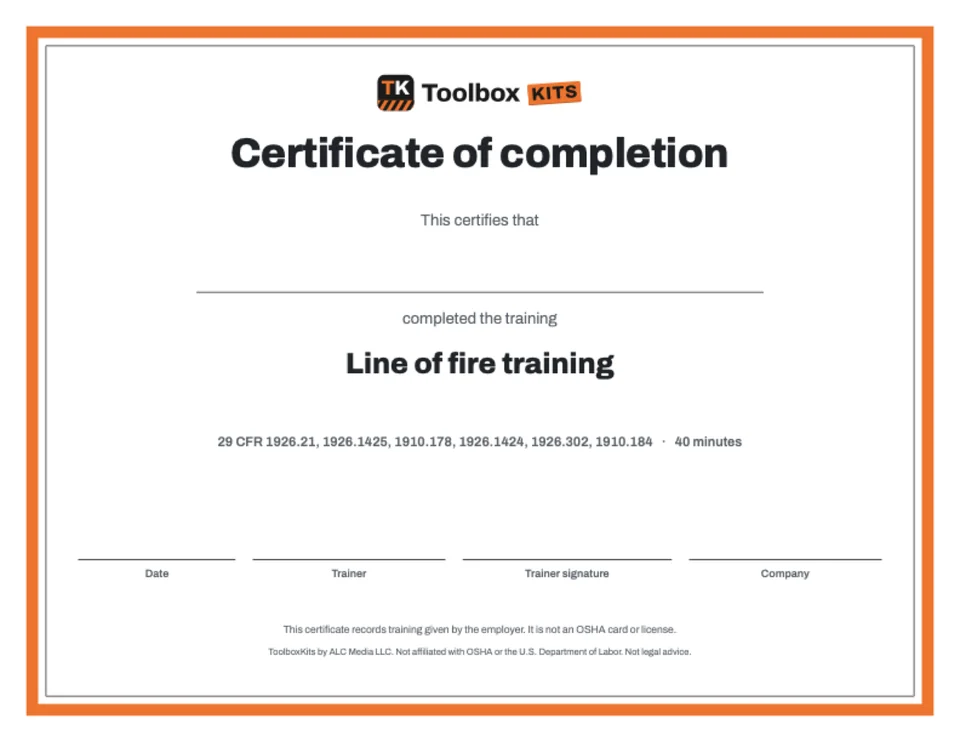
Certificate
WHO IT IS FOR
Who it is for and how long it takes
For the supervisor, foreman or safety lead who has to train a crew on line of fire and wants to walk in ready. The class takes about 40 minutes with the quiz. Run it in English or Spanish: the kit has both.
Used in: construction, oil and gas, manufacturing, general industry.
Only need a short talk? The 5-minute talk on this topic is free, in English and Spanish. Free line of fire toolbox talk
OSHA standards cited in the kit
Each citation points to the paragraph of the rule in the eCFR. This is how the kit writes them:
- 29 CFR 1926.21 Safety training and education29 CFR 1926.21(b)(2)
- 29 CFR 1926.1425 Keeping clear of the load29 CFR 1926.1425(b)
- 29 CFR 1910.178 Powered industrial trucks29 CFR 1910.178(m)(2)
- 29 CFR 1926.1424 Work area control29 CFR 1926.1424(a)(2)(ii) · 29 CFR 1926.1424(a)(3)(i)
- 29 CFR 1926.302 Power-operated hand tools29 CFR 1926.302(b)(1)
- 29 CFR 1910.184 Slings29 CFR 1910.184(c)(9)
- 29 CFR 1926.651 Specific excavation requirements29 CFR 1926.651(e)
- 29 CFR 1926.600 Equipment29 CFR 1926.600(a)(3)(i)
- 29 CFR 1926.602 Material handling equipment29 CFR 1926.602(a)(9)(ii)
Line of fire training kit
$9
Pay once and download right away. No subscription. If it does not work for you, you get a refund within 30 days, no questions asked. Refund policy