

Training kit, $9
Electrical safety training PowerPoint
An editable 38-slide PowerPoint to run electrical safety training in about 40 minutes, with trainer notes, a trainer guide, a 10-question quiz, a sign-in sheet and a certificate. In English and Spanish.
- Instant download
- Secure checkout by Stripe
- 30-day refund, no questions
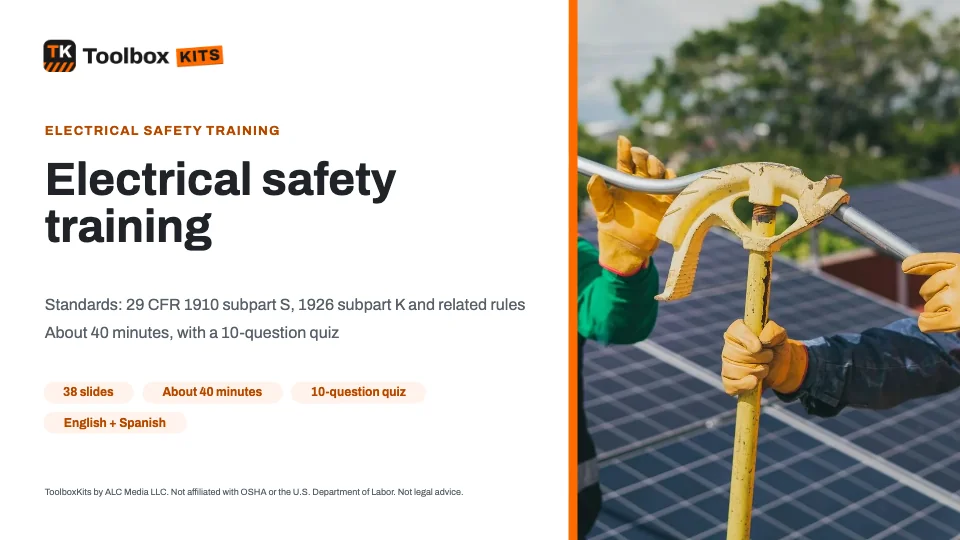
PREVIEW
Real slides from the deck
Six of the 38 slides, exactly as they open in PowerPoint. Tap one to see it larger.
What is in the kit
- 38-slide editable PowerPoint with trainer notes on every slide
- Trainer guide for a 40-minute class, with the agenda and the materials list
- 10-question quiz and answer key
- Crew handout with the dos and don'ts
- Sign-in sheet and certificate of completion
- Everything in English and Spanish, in one zip file
CONTENTS
What the slides cover, in order
The topics of the deck in the order you teach them, with the OSHA citation each slide carries. Then 10 quiz slides, one question each.
- Electrical safety training
- What you will learn today
- How electricity hurts you
- Qualified and unqualified workers · 29 CFR 1910.331(a)
- Electrical training is required · 29 CFR 1910.332(a)
- Deenergize first, then work · 29 CFR 1910.333(a)(1)
- Lockout and tagging: shut it down the right way · 29 CFR 1910.333(b)(2)
- Lockout and tagging: verify, then restore power · 29 CFR 1910.333(b)(2)
- Cords and plug-in tools in general industry · 29 CFR 1910.334(a)
- Cords and temporary wiring on construction sites · 29 CFR 1926.405(a)(2)(ii)(J)
- GFCIs and assured grounding on construction sites · 29 CFR 1926.404(b)(1)(i)
- Breakers, fuses and interlocks · 29 CFR 1910.334(b)(2)
- Overhead lines: look up and stay back · 29 CFR 1910.333(c)(3)
- Water, ladders and metal · 29 CFR 1910.334(a)(5)(i)
- Panels, warning signs and protective gear · 29 CFR 1910.303(g)(1)(ii)
- Step by step: before you plug in · 29 CFR 1910.334(a)(2)(i)
- Step by step: setting up temporary power · 29 CFR 1926.416(b)(2)
- Step by step: when something is wrong · 29 CFR 1910.334(a)(2)(ii)
- If someone gets shocked
- Common mistakes and what to do instead
- Scenario exercise: end of the shift
- Scenario: what should happen · 29 CFR 1910.333(b)(2)
- Recap: what to remember
- Thanks for your time. Please sign in.
TRAINER GUIDE
How the class runs
The trainer guide splits the 40 minutes like this. The notes on each slide say what to say.
| Minutes | What happens |
|---|---|
| 3 | Slides 1 and 2: welcome, sign-in sheet and goals |
| 4 | Slides 3 to 5: how electricity hurts you, qualified workers and training |
| 13 | Slides 6 to 15: the rules, with the cord, GFCI and lock demonstrations |
| 6 | Slides 16 to 19: step by step, including what to do if someone gets shocked |
| 2 | Slide 20: common mistakes |
| 5 | Slides 21 and 22: scenario exercise in small groups, then the debrief |
| 1 | Slide 23: recap |
| 5 | Slides 24 to 33: the crew answers the paper quiz, then go over each question |
| 1 | Slide 34: closing, sign-in sheet and handouts |
What you need
- Slides on a screen, or printed copies for each person
- Sign-in sheet
- 10-question quiz and answer key, one quiz per person
- Crew handouts and certificates
- A good extension cord and a damaged one tagged out of service
- A GFCI receptacle or portable GFCI to show the test button
- A lock, tag and breaker lockout device like the ones used on site
- Flip chart or whiteboard and markers, if you have them
Tips from the guide
- Ask about this job: where the temporary power is, which panels you use and where the lines run.
- Pass the good and damaged cords around and let the crew find the defects themselves.
- When someone shares a close call, thank them and ask what would have prevented it. Do not blame.
QUIZ
3 of the 10 quiz questions
Pick your answer, then open it. The kit's answer key has them all.
A circuit was switched off but not locked or tagged out. How must you treat it?
- As deenergized
- As energized
- As safe once the lights go out
Show the answer
B. Parts that are deenergized but not locked or tagged out under the rule must be treated as energized parts.
In general industry, when must extension cords and plug-in tools be visually inspected?
- Once a year
- Only when they stop working
- Before use on any shift
Show the answer
C. Cords and plug-in equipment must be visually inspected before use on any shift, unless they stay connected and are not exposed to damage.
You are unqualified and on a ladder near an unguarded, energized overhead line of 50kV or below to ground. How close may you and your tools get?
- No closer than 10 feet
- Close enough to touch it with a dry tool
- Any distance, if the line looks covered
Show the answer
A. Unqualified persons working in an elevated position must keep themselves and the longest conductive object at least 10 feet from unguarded, energized lines of 50kV or below to ground.
PAPERWORK
Sign-in sheet, quiz and certificate
Ready to print. The certificate is a record of completion, not an OSHA card or license.
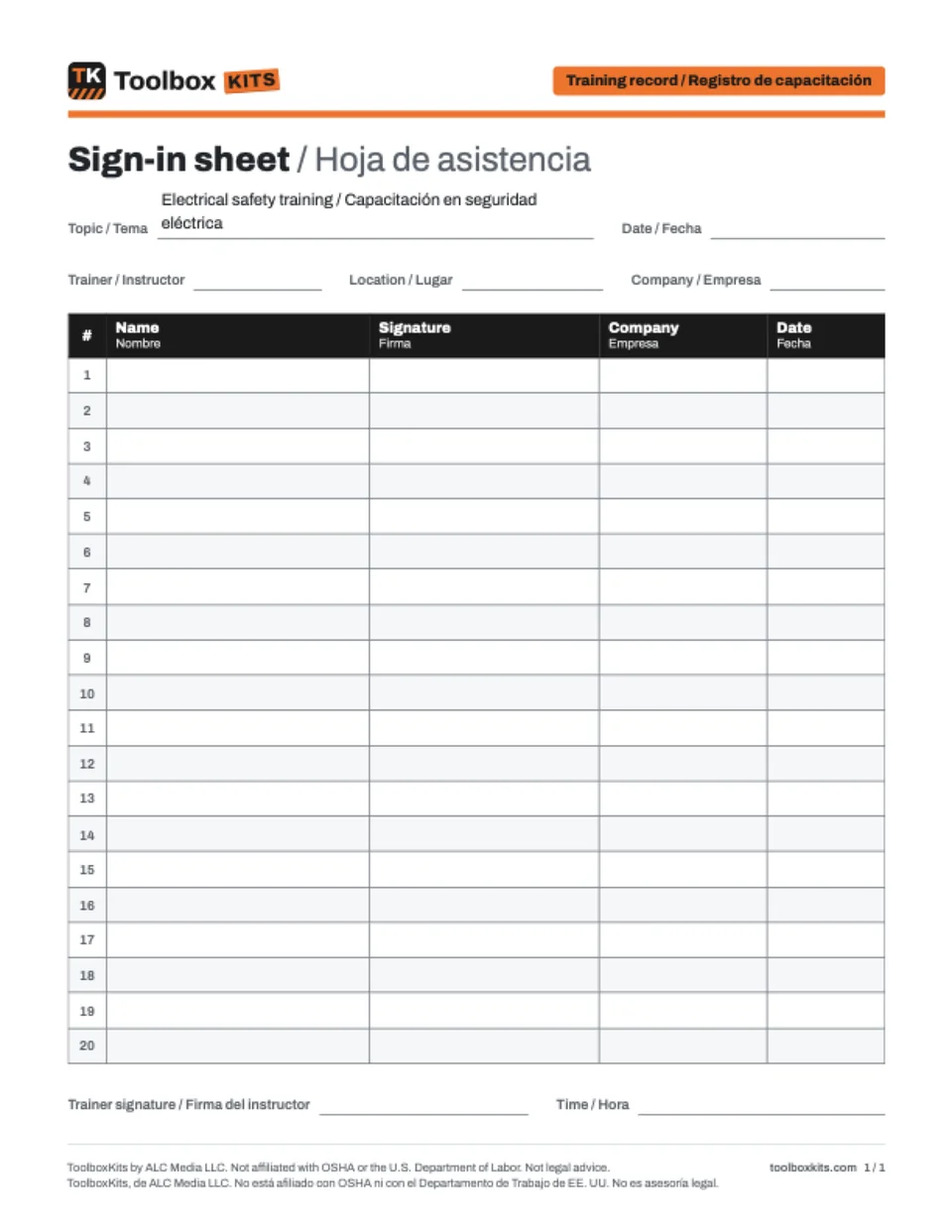
Sign-in sheet
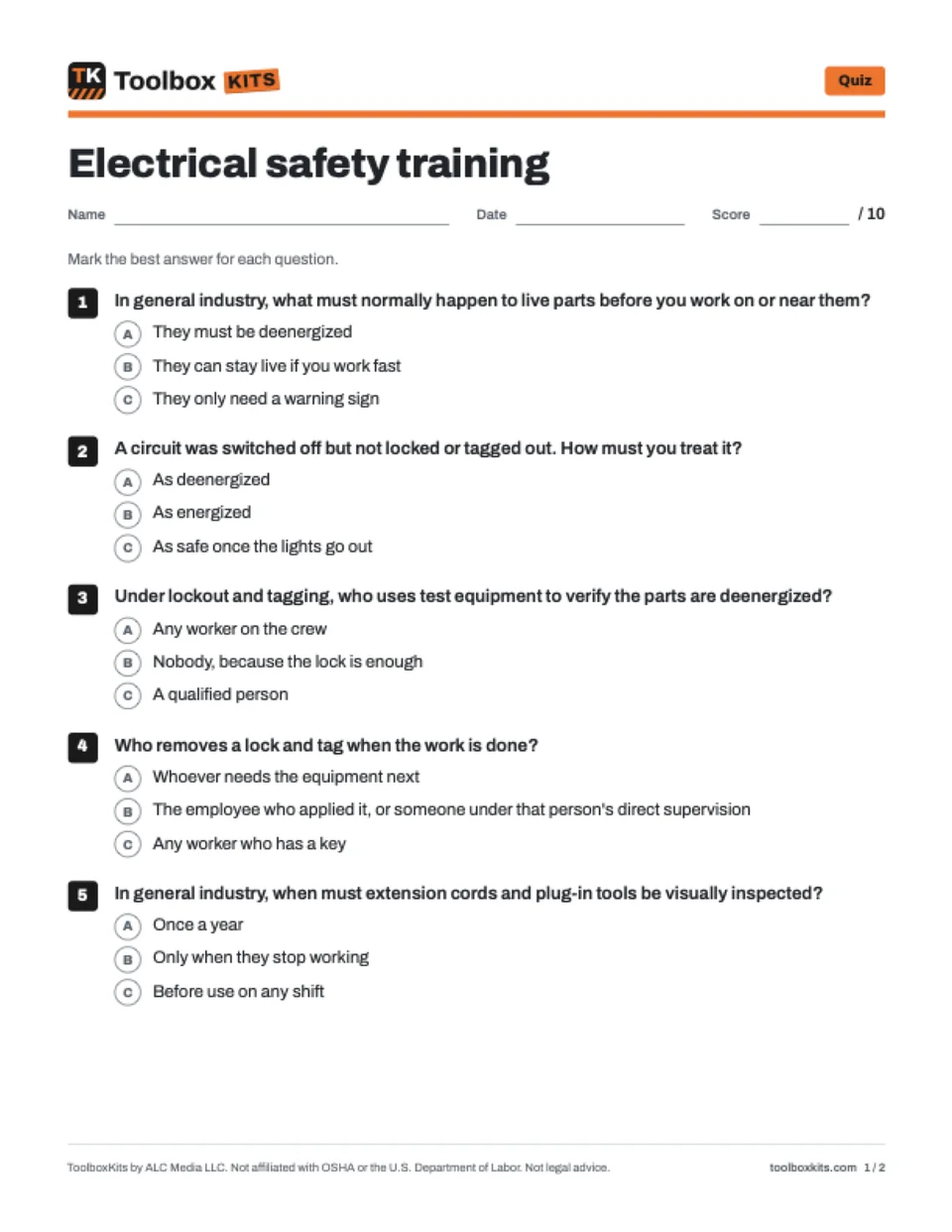
Quiz
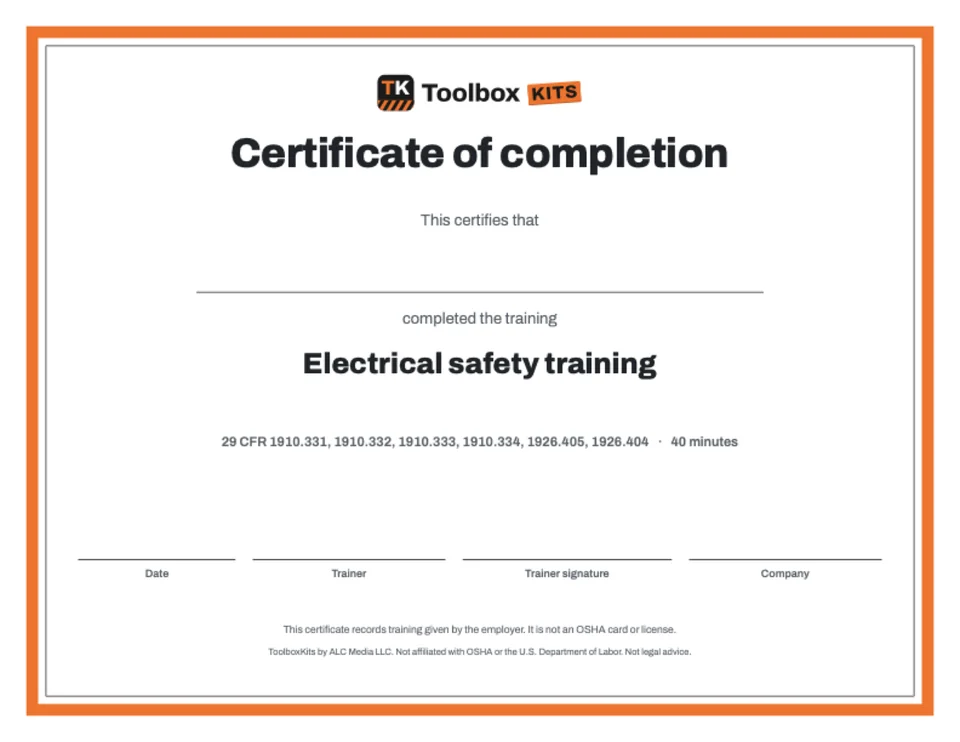
Certificate
WHO IT IS FOR
Who it is for and how long it takes
For the supervisor, foreman or safety lead who has to train a crew on electrical safety and wants to walk in ready. The class takes about 40 minutes with the quiz. Run it in English or Spanish: the kit has both.
Used in: construction, general industry, warehousing, manufacturing, landscaping, healthcare, restaurants, oil and gas.
Only need a short talk? The 5-minute talk on this topic is free, in English and Spanish. Free electrical safety toolbox talk
OSHA standards cited in the kit
Each citation points to the paragraph of the rule in the eCFR. This is how the kit writes them:
- 29 CFR 1910.331 Scope29 CFR 1910.331(a)
- 29 CFR 1910.332 Training29 CFR 1910.332(a)
- 29 CFR 1910.333 Selection and use of work practices29 CFR 1910.333(a)(1) · 29 CFR 1910.333(b)(2) · 29 CFR 1910.333(c)(3) · 29 CFR 1910.333(b)(1) · 29 CFR 1910.333(b)(2)(iv)(B) · 29 CFR 1910.333(b)(2)(v)(C) · 29 CFR 1910.333(c)(3)(i)(A) · 29 CFR 1910.333(c)(7)
- 29 CFR 1910.33429 CFR 1910.334(a) · 29 CFR 1910.334(b)(2) · 29 CFR 1910.334(a)(5)(i) · 29 CFR 1910.334(a)(2)(i) · 29 CFR 1910.334(a)(2)(ii)
- 29 CFR 1926.405 Wiring methods, components, and equipment for general use29 CFR 1926.405(a)(2)(ii)(J)
- 29 CFR 1926.404 Wiring design and protection29 CFR 1926.404(b)(1)(i) · 29 CFR 1926.404(b)(1)(ii)
- 29 CFR 1910.303 General29 CFR 1910.303(g)(1)(ii)
- 29 CFR 1926.416 General requirements29 CFR 1926.416(b)(2)
Electrical safety training kit
$9
Pay once and download right away. No subscription. If it does not work for you, you get a refund within 30 days, no questions asked. Refund policy