

Training kit, $9
Laboratory safety training PowerPoint
An editable 35-slide PowerPoint to run laboratory safety training in about 45 minutes, with trainer notes, a trainer guide, a 10-question quiz, a sign-in sheet and a certificate. In English and Spanish.
- Instant download
- Secure checkout by Stripe
- 30-day refund, no questions
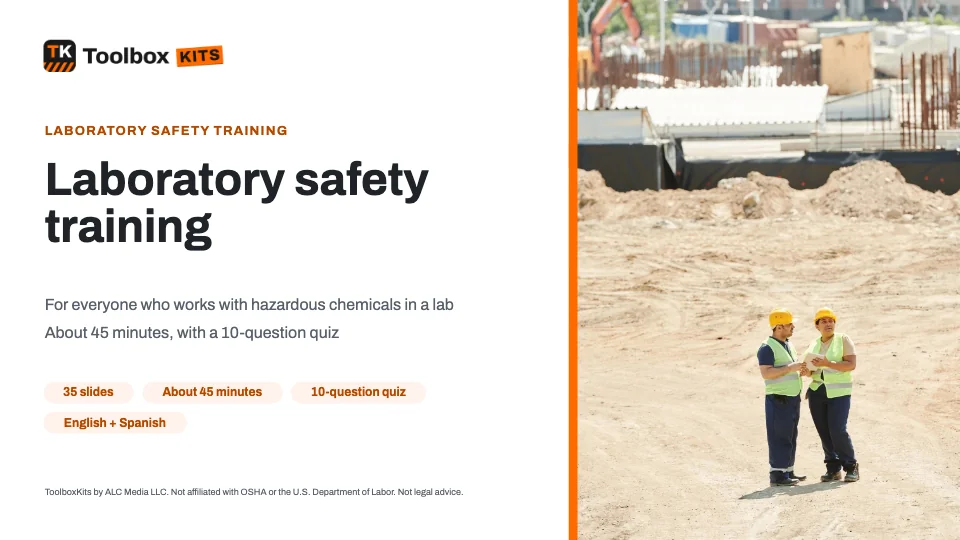
PREVIEW
Real slides from the deck
Six of the 35 slides, exactly as they open in PowerPoint. Tap one to see it larger.
What is in the kit
- 35-slide editable PowerPoint with trainer notes on every slide
- Trainer guide for a 45-minute class, with the agenda and the materials list
- 10-question quiz and answer key
- Crew handout with the dos and don'ts
- Sign-in sheet and certificate of completion
- Everything in English and Spanish, in one zip file
CONTENTS
What the slides cover, in order
The topics of the deck in the order you teach them, with the OSHA citation each slide carries. Then 10 quiz slides, one question each.
- Laboratory safety training
- What you will learn today
- The hazard: what lab chemicals can do · 29 CFR 1910.1450(b)
- The rules · 29 CFR 1910.1450(a)(1)
- Rule: who the lab standard covers · 29 CFR 1910.1450(a)(1)
- Rule: the chemical hygiene plan · 29 CFR 1910.1450(e)(1)
- Rule: what else the plan must cover · 29 CFR 1910.1450(e)(3)
- Rule: particularly hazardous substances · 29 CFR 1910.1450(e)(3)(viii)
- Rule: labels, SDSs and chemicals made in the lab · 29 CFR 1910.1450(h)(1)(i)
- Rule: fume hoods and other protective equipment · 29 CFR 1910.1450(e)(3)(iii)
- Rule: eye, face and hand protection · 29 CFR 1910.133(a)(1)
- Rule: PPE training and respirators · 29 CFR 1910.132(f)(1)
- Rule: food, drink and hygiene · 29 CFR 1910.141(g)(2)
- Rule: eyewash, showers and first aid · 29 CFR 1910.151(c)
- Rule: training and information · 29 CFR 1910.1450(f)(1)
- Rule: exposure monitoring and medical consultation · 29 CFR 1910.1450(g)(1)(iii)
- Step by step: before you start a procedure
- Step by step: working with chemicals
- Step by step: spills, splashes and exposures
- Checklist: before you start and before you leave
- Common mistakes and what to do instead
- Scenario exercise: the late-day transfer
- Scenario: what should have happened · 29 CFR 1910.151(c)
- Recap: what to remember
- Thanks for your time. Please sign in.
TRAINER GUIDE
How the class runs
The trainer guide splits the 45 minutes like this. The notes on each slide say what to say.
| Minutes | What happens |
|---|---|
| 3 | Slides 1 and 2: welcome, sign-in sheet and goals |
| 3 | Slide 3: what lab chemicals can do, with examples from this lab |
| 15 | Slides 4 to 16: the rules on scope, the chemical hygiene plan, labels and SDSs, fume hoods, PPE, food and drink, eyewash and first aid, training, and medical consultation |
| 8 | Slides 17 to 20: step by step and the checklist (pass around the SDS, goggles and gloves) |
| 2 | Slide 21: common mistakes |
| 5 | Slides 22 and 23: scenario exercise in small groups, then the debrief |
| 1 | Slide 24: recap |
| 7 | Slides 25 to 34: the group answers the paper quiz, then go over each question |
| 1 | Slide 35: closing, sign-in sheet and handouts |
What you need
- Slides on a screen, or printed copies for each person
- Sign-in sheet
- 10-question quiz and answer key, one quiz per person
- Handouts and certificates
- A copy of your chemical hygiene plan and one SOP from this lab
- A real SDS and a labeled container for a chemical the lab uses
- The eye protection, face shield and gloves your lab uses, plus the glove maker's chart
- A floor plan showing the eyewash, safety shower, spill kit, fire extinguishers and exits
- Flip chart or whiteboard and markers
Tips from the guide
- Hold the session in or next to the lab if you can, so people can point to the real hood, eyewash and spill kit.
- Use chemicals and procedures from this lab in every example, not generic ones.
- Have people find sections 2, 4, 7 and 8 on a real SDS with their own hands (29 CFR 1910.1200(g)(2)).
QUIZ
3 of the 10 quiz questions
Pick your answer, then open it. The kit's answer key has them all.
Who is the chemical hygiene officer?
- An employee designated by the employer and qualified by training or experience to give technical guidance on the chemical hygiene plan
- An OSHA inspector assigned to the lab
- The chemical supplier's sales representative
- Whoever happens to be working that day
Show the answer
A. The chemical hygiene officer is an employee designated by the employer and qualified by training or experience to give technical guidance on developing and carrying out the plan.
A byproduct forms during your procedure, and nobody knows its composition. How must it be treated?
- As harmless until it is tested
- As hazardous, with the chemical hygiene plan applied
- As ordinary trash
- As exactly the same as the starting chemicals
Show the answer
B. If a byproduct's composition is not known, the employer must assume it is hazardous and implement the chemical hygiene plan.
Can you keep your lunch in a lab area that is exposed to toxic chemicals?
- Yes, if it is in a sealed container
- Yes, on the top shelf only
- No, food and drinks must not be stored in an area exposed to a toxic material
- Yes, if a sign says it is allowed
Show the answer
C. No food or beverages may be stored in toilet rooms or in an area exposed to a toxic material.
PAPERWORK
Sign-in sheet, quiz and certificate
Ready to print. The certificate is a record of completion, not an OSHA card or license.
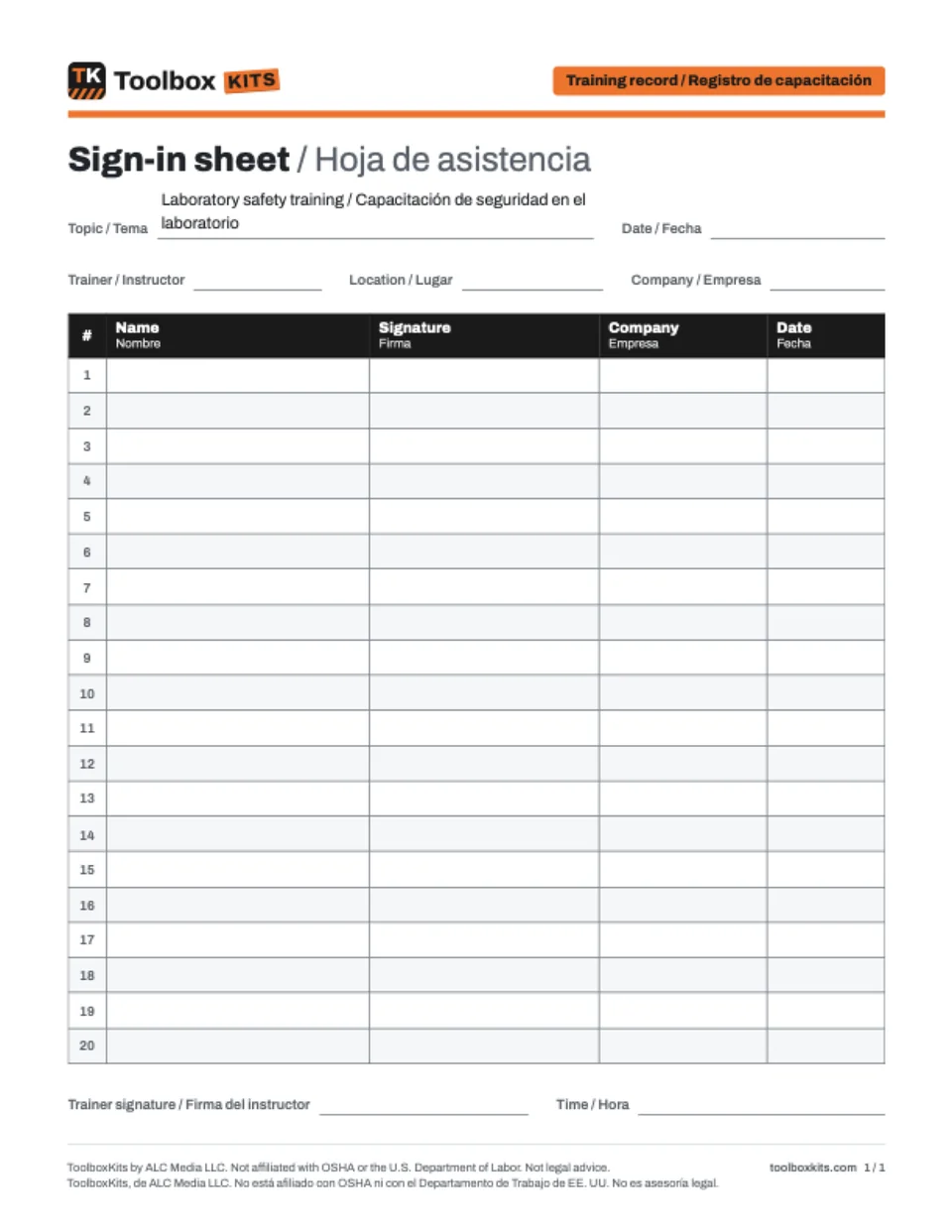
Sign-in sheet
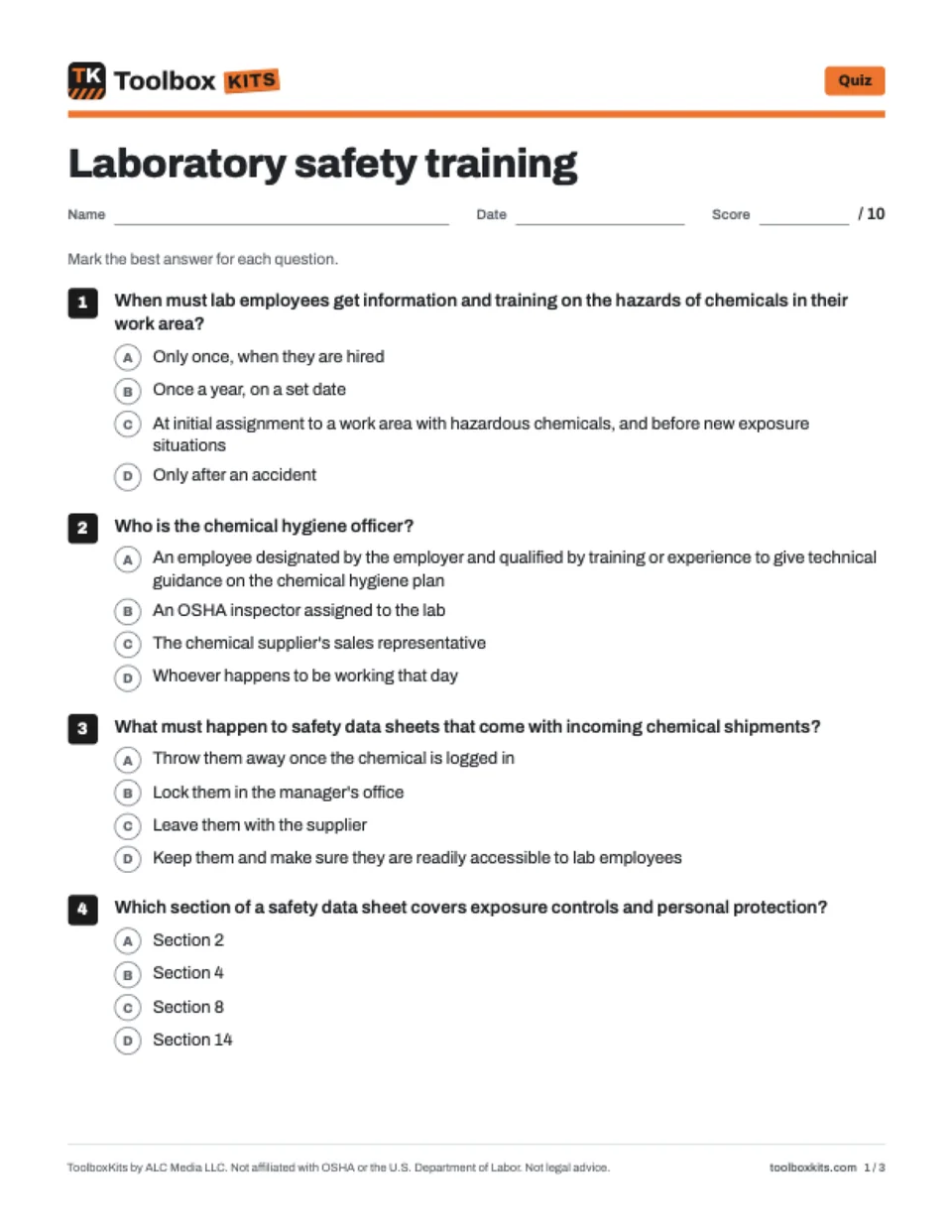
Quiz
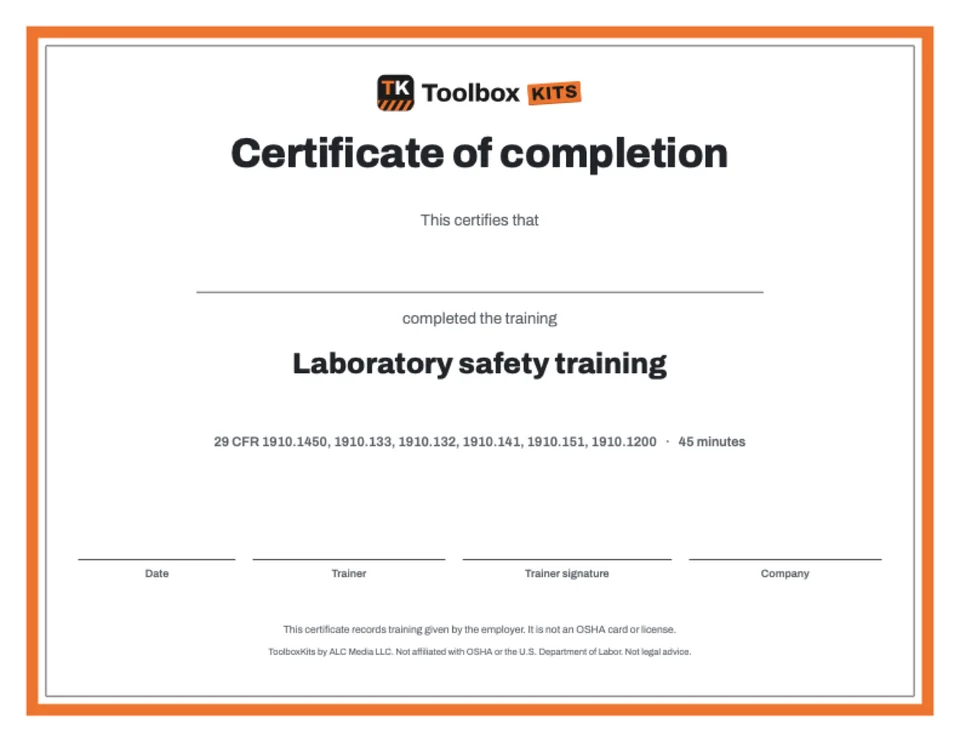
Certificate
WHO IT IS FOR
Who it is for and how long it takes
For the supervisor, foreman or safety lead who has to train a crew on laboratory safety and wants to walk in ready. The class takes about 45 minutes with the quiz. Run it in English or Spanish: the kit has both.
Used in: healthcare, general industry.
Only need a short talk? The 5-minute talk on this topic is free, in English and Spanish. Free laboratory safety toolbox talk
OSHA standards cited in the kit
Each citation points to the paragraph of the rule in the eCFR. This is how the kit writes them:
- 29 CFR 1910.1450 Occupational exposure to hazardous chemicals in laboratories29 CFR 1910.1450(b) · 29 CFR 1910.1450(a)(1) · 29 CFR 1910.1450(e)(1) · 29 CFR 1910.1450(e)(3) · 29 CFR 1910.1450(e)(3)(viii) · 29 CFR 1910.1450(h)(1)(i) · 29 CFR 1910.1450(e)(3)(iii) · 29 CFR 1910.1450(f)(1) · 29 CFR 1910.1450(g)(1)(iii) · 29 CFR 1910.1450(f)(2) · 29 CFR 1910.1450(h)(1)(ii) · 29 CFR 1910.1450(h)(2)(ii)
- 29 CFR 1910.133 Eye and face protection29 CFR 1910.133(a)(1)
- 29 CFR 1910.132 General requirements29 CFR 1910.132(f)(1)
- 29 CFR 1910.141 Sanitation29 CFR 1910.141(g)(2) · 29 CFR 1910.141(g)(4)
- 29 CFR 1910.151 Medical services and first aid29 CFR 1910.151(c)
- 29 CFR 1910.1200 Hazard communication29 CFR 1910.1200(g)(2)(viii)
Laboratory safety training kit
$9
Pay once and download right away. No subscription. If it does not work for you, you get a refund within 30 days, no questions asked. Refund policy