

Training kit, $9
Bloodborne pathogens training PowerPoint
An editable 41-slide PowerPoint to run bloodborne pathogens training in about 45 minutes, with trainer notes, a trainer guide, a 10-question quiz, a sign-in sheet and a certificate. In English and Spanish.
- Instant download
- Secure checkout by Stripe
- 30-day refund, no questions
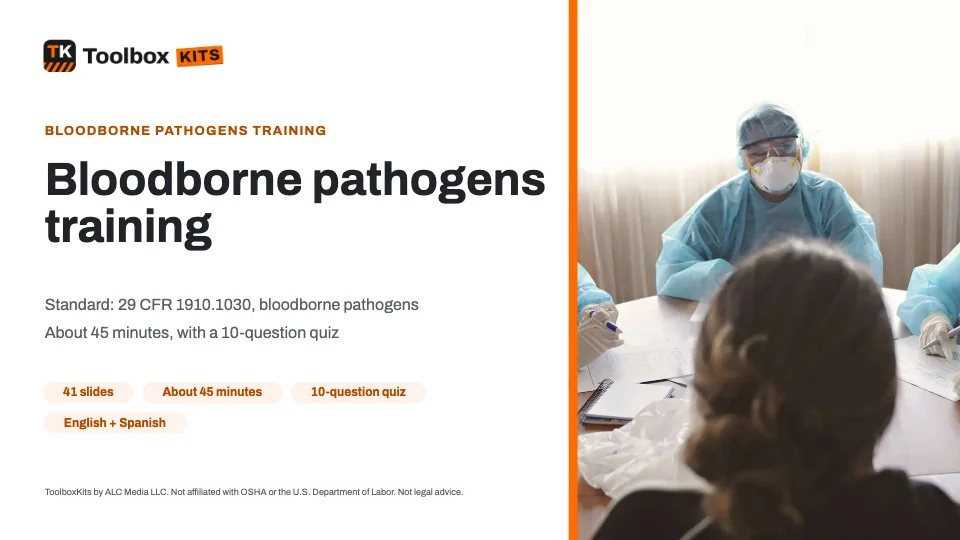
PREVIEW
Real slides from the deck
Six of the 41 slides, exactly as they open in PowerPoint. Tap one to see it larger.
What is in the kit
- 41-slide editable PowerPoint with trainer notes on every slide
- Trainer guide for a 45-minute class, with the agenda and the materials list
- 10-question quiz and answer key
- Crew handout with the dos and don'ts
- Sign-in sheet and certificate of completion
- Everything in English and Spanish, in one zip file
CONTENTS
What the slides cover, in order
The topics of the deck in the order you teach them, with the OSHA citation each slide carries. Then 10 quiz slides, one question each.
- Bloodborne pathogens training
- What you will learn today
- The hazard: germs in blood
- What to treat as infectious · 29 CFR 1910.1030(b)
- Rule: who is covered, and the exposure control plan · 29 CFR 1910.1030(c)(1)(i)
- Rule: universal precautions and controls · 29 CFR 1910.1030(d)(1)
- Rule: handwashing and hygiene · 29 CFR 1910.1030(d)(2)(v)
- Rule: needles and other sharps · 29 CFR 1910.1030(d)(2)(vii)
- Rule: PPE at no cost to you · 29 CFR 1910.1030(d)(3)(i)
- Rule: which PPE, and when · 29 CFR 1910.1030(d)(3)(x)
- Rule: gloves, and taking PPE off · 29 CFR 1910.1030(d)(3)(ix)(A)
- Rule: cleaning and decontamination · 29 CFR 1910.1030(d)(4)(ii)(A)
- Rule: laundry, waste and labels · 29 CFR 1910.1030(g)(1)(i)(A)
- Rule: the hepatitis B vaccine · 29 CFR 1910.1030(f)(2)(i)
- Rule: after an exposure incident · 29 CFR 1910.1030(f)(3)
- Rule: training and records · 29 CFR 1910.1030(g)(2)(i)
- Step by step: take off gloves the safe way
- Step by step: clean up a blood spill
- Step by step: right after an exposure
- Step by step: inspection checklist
- Common mistakes and what to do instead
- Scenario exercise: the cut at the packing table
- Scenario: what should happen · 29 CFR 1910.1030(f)(3)
- Recap: what to remember
- Thanks for your time. Please sign in.
TRAINER GUIDE
How the class runs
The trainer guide splits the 45 minutes like this. The notes on each slide say what to say.
| Minutes | What happens |
|---|---|
| 3 | Slides 1 and 2: welcome, sign-in sheet and goals |
| 5 | Slides 3 and 4: the hazard and what to treat as infectious |
| 15 | Slides 5 to 16: the rules, with our exposure control plan open for questions |
| 7 | Slides 17 to 20: step by step, with glove removal practice and the area checklist |
| 2 | Slide 21: common mistakes |
| 5 | Slides 22 and 23: scenario exercise in small groups, then the debrief |
| 1 | Slide 24: recap |
| 6 | Slides 25 to 34: the crew answers the paper quiz, then go over each question |
| 1 | Slide 35: closing, sign-in sheet and handouts |
What you need
- Slides on a screen, or printed copies for each person
- Sign-in sheet (it becomes part of the training record)
- 10-question quiz and answer key, one quiz per person
- Crew handouts and certificates
- Our written exposure control plan, and an accessible copy of 29 CFR 1910.1030
- Samples of the PPE we provide: gloves in several sizes, eye and face protection, a gown or apron and a pocket mask
- A sharps container, a red bag or labeled container, and a laundry bag
- The spill kit and the disinfectant we use, with its label
- Names and contacts for reporting exposures on each shift, and for getting the hepatitis B vaccine
Tips from the guide
- Use tasks from our own workplace for every example, and ask which PPE each one needs.
- Have everyone practice taking off gloves in front of you, not just watch.
- Never ask anyone to share their vaccine status, test results or medical history in front of the group.
QUIZ
3 of the 10 quiz questions
Pick your answer, then open it. The kit's answer key has them all.
Which statement about universal precautions is true?
- Only blood from people who look sick is infectious
- Treat all human blood as infectious, and all body fluids as infectious when you cannot tell them apart
- A coworker's blood is safe to touch
- Universal precautions are only for hospitals
Show the answer
B. Under universal precautions, all human blood is treated as if known to be infectious (29 CFR 1910.1030(b)), and when body fluids are difficult or impossible to tell apart, all body fluids are considered potentially infectious.
When must you wear a mask with eye protection, or a chin-length face shield?
- Only during surgery
- Whenever splashes, spray, spatter or droplets of blood or OPIM may be generated and eye, nose or mouth contamination can be reasonably anticipated
- Only when a supervisor is watching
- Never, because gloves are enough
Show the answer
B. Masks with eye protection, or chin-length face shields, must be worn whenever splashes, spray, spatter or droplets may be generated and eye, nose or mouth contamination can be reasonably anticipated.
When must the hepatitis B vaccine be made available to you?
- Only after an exposure
- After training and within 10 working days of initial assignment, at no cost
- After one year on the job
- Only if you pay for it
Show the answer
B. It must be made available after the required training and within 10 working days of initial assignment, unless an exception applies, and at no cost to you (29 CFR 1910.1030(f)(1)(ii)(A)).
PAPERWORK
Sign-in sheet, quiz and certificate
Ready to print. The certificate is a record of completion, not an OSHA card or license.
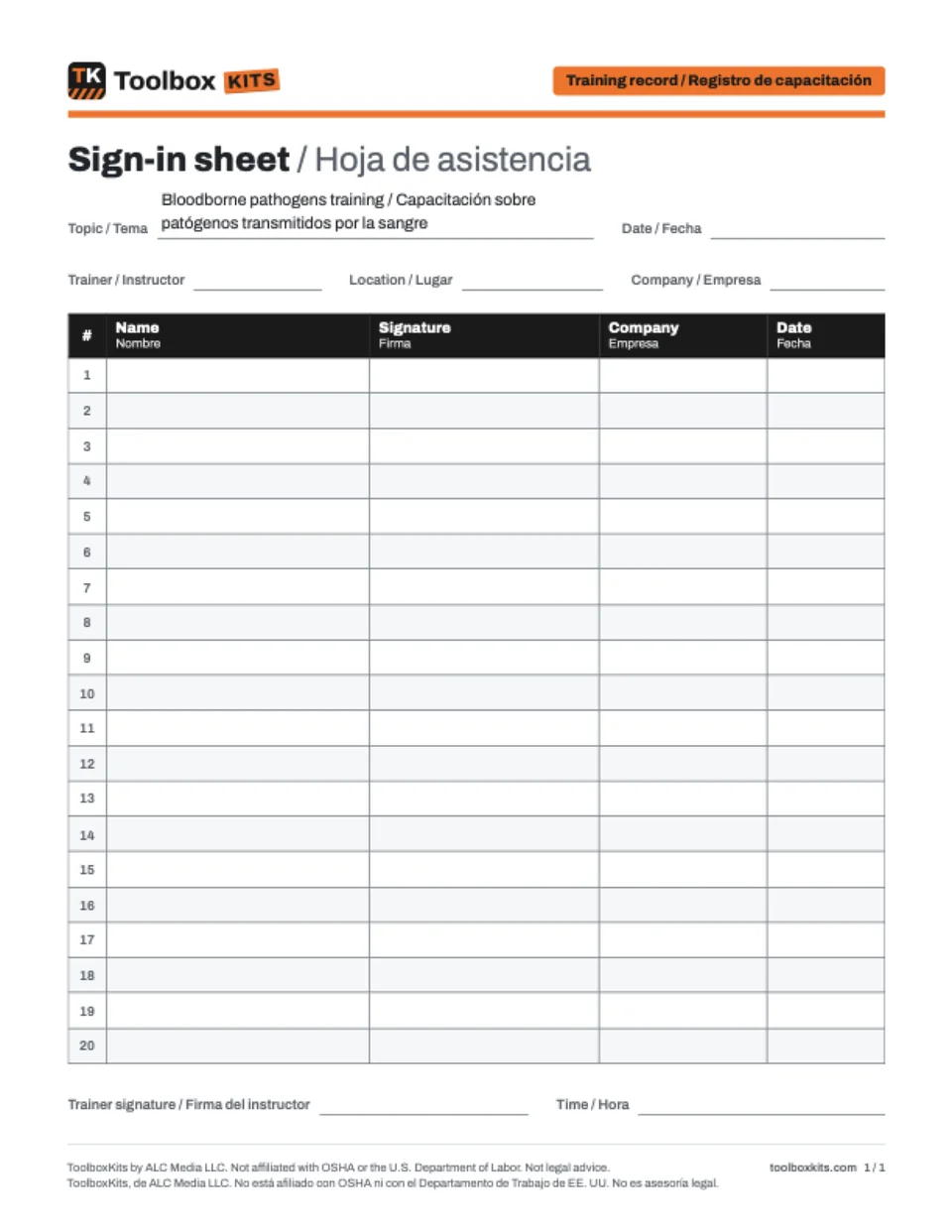
Sign-in sheet
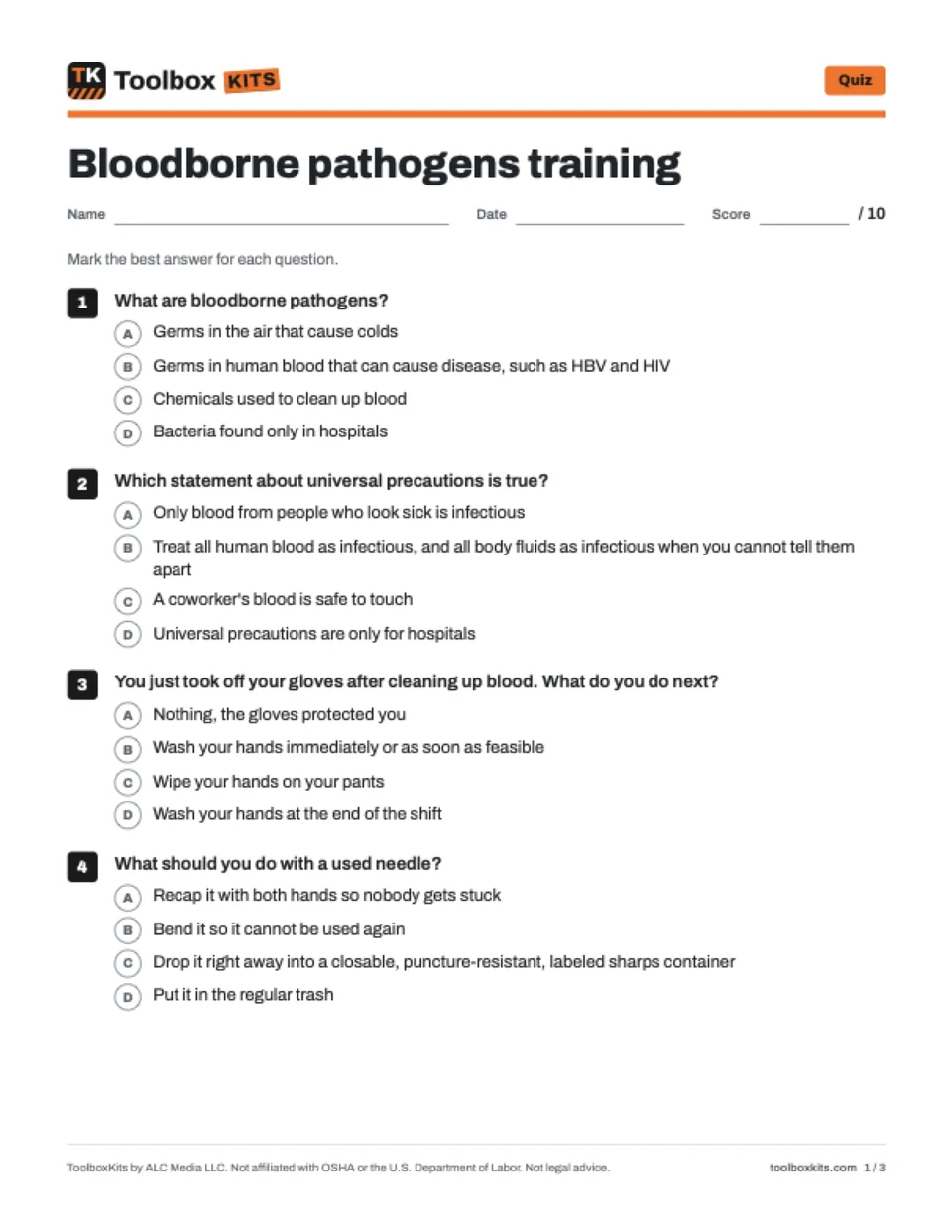
Quiz
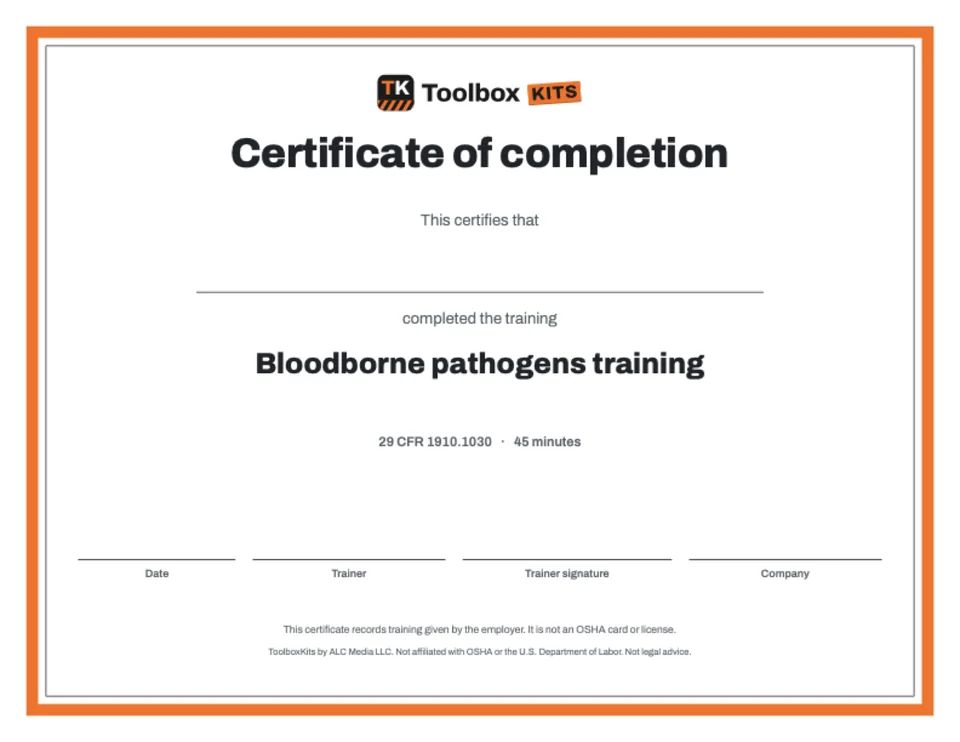
Certificate
WHO IT IS FOR
Who it is for and how long it takes
For the supervisor, foreman or safety lead who has to train a crew on bloodborne pathogens and wants to walk in ready. The class takes about 45 minutes with the quiz. Run it in English or Spanish: the kit has both.
Used in: healthcare, general industry, restaurants.
Only need a short talk? The 5-minute talk on this topic is free, in English and Spanish. Free bloodborne pathogens toolbox talk
OSHA standards cited in the kit
Each citation points to the paragraph of the rule in the eCFR. This is how the kit writes them:
- 29 CFR 1910.1030 Bloodborne pathogens29 CFR 1910.1030(b) · 29 CFR 1910.1030(c)(1)(i) · 29 CFR 1910.1030(d)(1) · 29 CFR 1910.1030(d)(2)(v) · 29 CFR 1910.1030(d)(2)(vii) · 29 CFR 1910.1030(d)(3)(i) · 29 CFR 1910.1030(d)(3)(x) · 29 CFR 1910.1030(d)(3)(ix)(A) · 29 CFR 1910.1030(d)(4)(ii)(A) · 29 CFR 1910.1030(g)(1)(i)(A) · 29 CFR 1910.1030(f)(2)(i) · 29 CFR 1910.1030(f)(3) · 29 CFR 1910.1030(g)(2)(i) · 29 CFR 1910.1030(d)(4)(iii)(A)(1) · 29 CFR 1910.1030(d)(3)(vii) · 29 CFR 1910.1030(g)(1)(i)(E) · 29 CFR 1910.1030(d)(2)(vi) · 29 CFR 1910.1030(g)(2)(iv)
Bloodborne pathogens training kit
$9
Pay once and download right away. No subscription. If it does not work for you, you get a refund within 30 days, no questions asked. Refund policy