

Training kit, $9
Hazard communication (HazCom) training PowerPoint
An editable 39-slide PowerPoint to run hazard communication (HazCom) training in about 45 minutes, with trainer notes, a trainer guide, a 10-question quiz, a sign-in sheet and a certificate. In English and Spanish.
- Instant download
- Secure checkout by Stripe
- 30-day refund, no questions
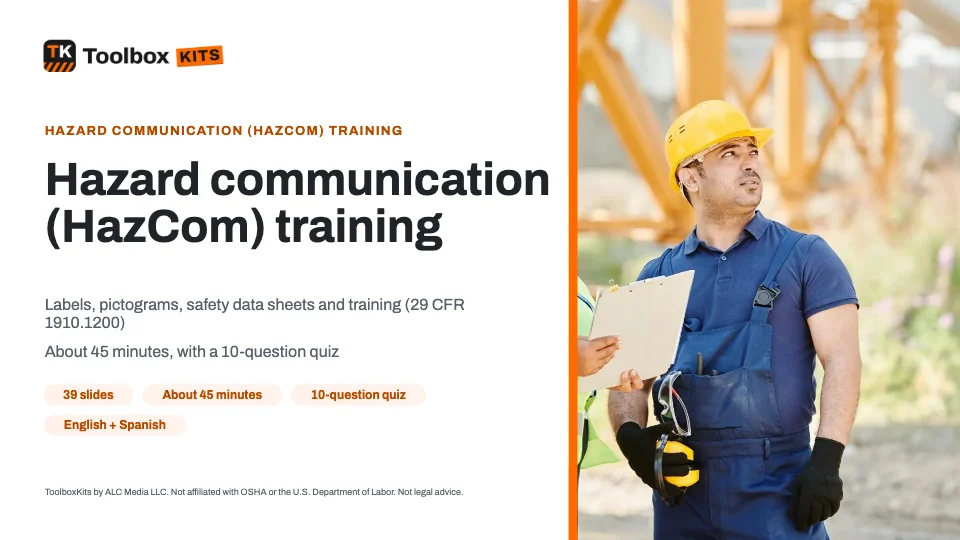
PREVIEW
Real slides from the deck
Six of the 39 slides, exactly as they open in PowerPoint. Tap one to see it larger.
What is in the kit
- 39-slide editable PowerPoint with trainer notes on every slide
- Trainer guide for a 45-minute class, with the agenda and the materials list
- 10-question quiz and answer key
- Crew handout with the dos and don'ts
- Sign-in sheet and certificate of completion
- Everything in English and Spanish, in one zip file
CONTENTS
What the slides cover, in order
The topics of the deck in the order you teach them, with the OSHA citation each slide carries. Then 10 quiz slides, one question each.
- Hazard communication (HazCom) training
- What you will be able to do
- The hazard: why hazard communication matters · 29 CFR 1910.1200(c)
- Rule: what HazCom requires · 29 CFR 1910.1200(b)(1)
- Rule: which chemicals and workers it covers · 29 CFR 1910.1200(b)(2)
- Rule: the written program · 29 CFR 1910.1200(e)(1)
- Rule: many employers, one site · 29 CFR 1910.1200(e)(2)
- Rule: labels on shipped containers · 29 CFR 1910.1200(f)(1)
- Label words and what they tell you · 29 CFR 1910.1200(c)
- The eight pictograms · 29 CFR 1910.1200(c)
- Rule: workplace labels · 29 CFR 1910.1200(f)(6)
- Rule: safety data sheets · 29 CFR 1910.1200(g)(8)
- The 16 sections of every SDS · 29 CFR 1910.1200(g)(2)
- Rule: when you get information and training · 29 CFR 1910.1200(h)(1)
- Rule: what training must cover · 29 CFR 1910.1200(h)(3)
- Rule: the updated standard and its deadlines · 29 CFR 1910.1200(j)(2)(ii)
- Step by step: before you use any chemical
- Step by step: labeling a container you fill
- Step by step: new chemicals and unlabeled containers
- Checklist: HazCom walk-through
- Common mistakes and what to do instead
- Scenario exercise: the new degreaser
- Scenario: talk it through
- Recap
- Thank you. Know your chemicals
TRAINER GUIDE
How the class runs
The trainer guide splits the 45 minutes like this. The notes on each slide say what to say.
| Minutes | What happens |
|---|---|
| 3 | Welcome, sign-in and objectives (slides 1 and 2) |
| 3 | Why hazard communication matters (slide 3) |
| 16 | The rules: scope, written program, labels, pictograms, SDSs, training and deadlines (slides 4 to 16) |
| 6 | Doing it right: before use, labeling, new chemicals and the checklist (slides 17 to 20) |
| 2 | Common mistakes (slide 21) |
| 6 | Scenario exercise in pairs or small groups, then debrief (slides 22 and 23) |
| 1 | Recap (slide 24) |
| 7 | Quiz and answer review (slides 25 to 34) |
| 1 | Closing and sign-in check (slide 35) |
What you need
- Slide deck (PowerPoint) with a screen or projector, or printed slides
- Sign-in sheet
- One handout per person
- Quiz copies, pens and the answer key
- Completion certificates
- Your written hazard communication program and chemical list
- Three or four real containers with labels, and their SDSs
- Blank workplace labels, a marker and a jug of water for the labeling demo
Tips from the guide
- Use your own written program, chemical list and real containers instead of generic examples.
- Have people race to find a section on a real SDS, and repeat until everyone is quick.
- Keep close-call stories blame-free so people keep sharing.
QUIZ
3 of the 10 quiz questions
Pick your answer, then open it. The kit's answer key has them all.
Which workers does the standard say are not covered as employees?
- Construction workers
- Warehouse workers who handle sealed containers
- Office workers who meet hazardous chemicals only in non-routine, isolated instances
- Temporary workers
Show the answer
C. The employee definition in 1910.1200(c) excludes office workers or bank tellers who meet hazardous chemicals only in non-routine, isolated instances.
What does a precautionary statement on a label tell you?
- Measures to minimize or prevent harm from exposure, or from improper storage or handling
- The price of the product
- The date the container was filled
- How many pictograms the product has
Show the answer
A. 1910.1200(c) defines a precautionary statement as recommended measures to minimize or prevent harm from exposure, or from improper storage or handling.
Which SDS section tells you what to do about a spill or leak?
- Section 1, Identification
- Section 6, Accidental release measures
- Section 9, Physical and chemical properties
- Section 14, Transport information
Show the answer
B. 1910.1200(g)(2)(vi) lists Section 6 as Accidental release measures.
PAPERWORK
Sign-in sheet, quiz and certificate
Ready to print. The certificate is a record of completion, not an OSHA card or license.
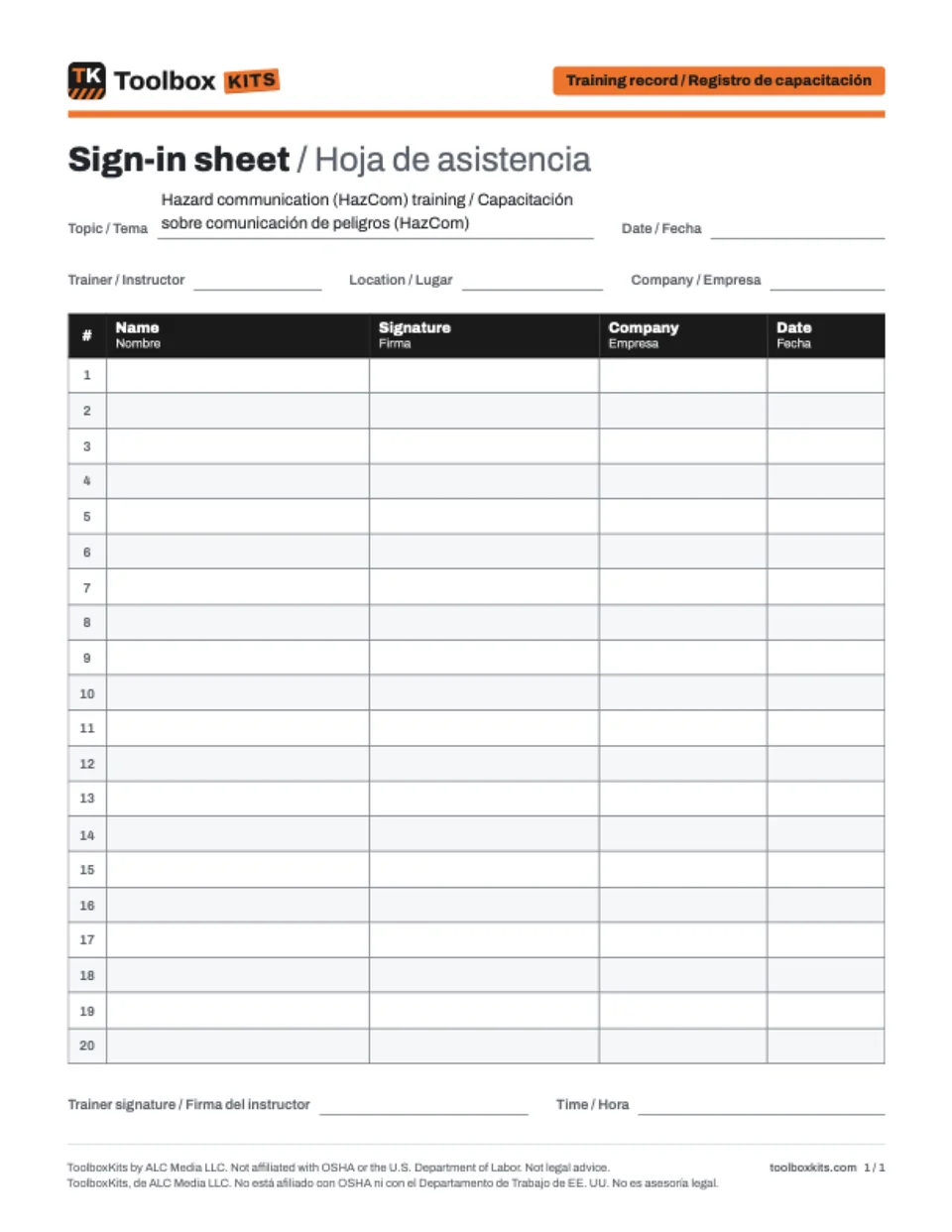
Sign-in sheet
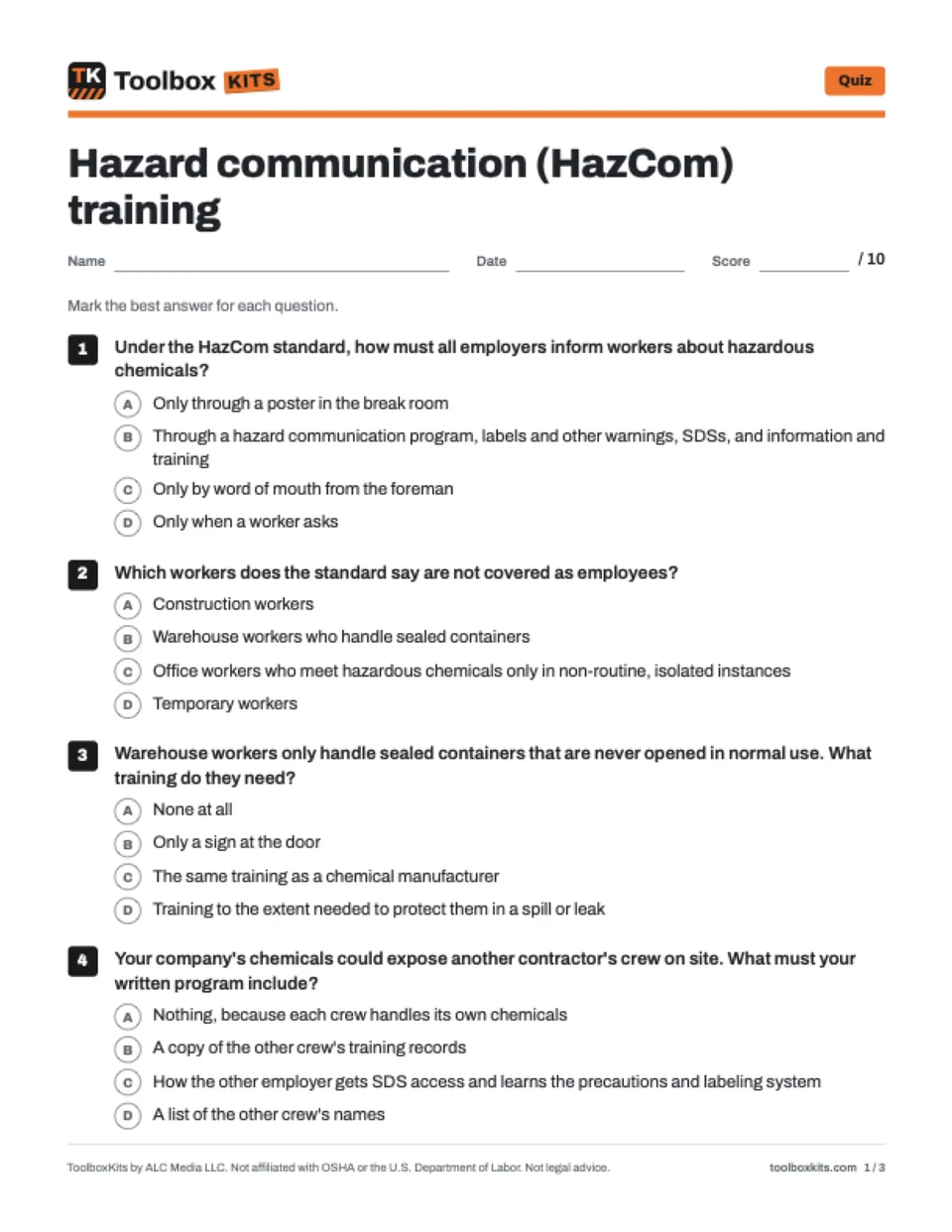
Quiz
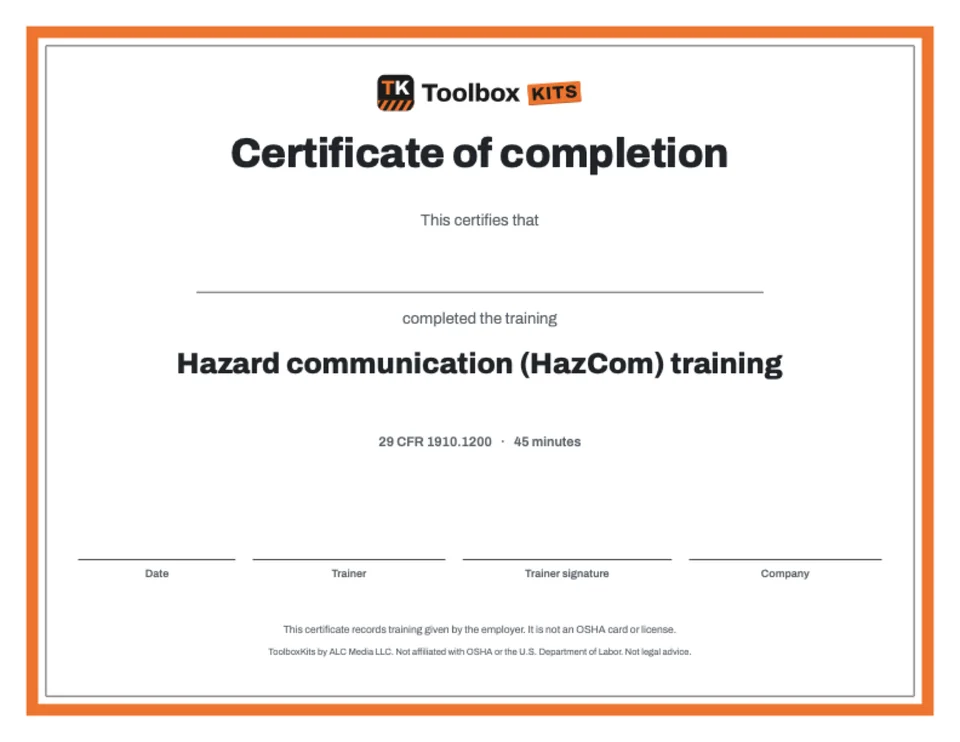
Certificate
WHO IT IS FOR
Who it is for and how long it takes
For the supervisor, foreman or safety lead who has to train a crew on hazard communication (HazCom) and wants to walk in ready. The class takes about 45 minutes with the quiz. Run it in English or Spanish: the kit has both.
Used in: construction, general industry, warehousing, manufacturing, landscaping, healthcare, restaurants, oil and gas.
Only need a short talk? The 5-minute talk on this topic is free, in English and Spanish. Free hazard communication (HazCom) toolbox talk
OSHA standards cited in the kit
Each citation points to the paragraph of the rule in the eCFR. This is how the kit writes them:
- 29 CFR 1910.1200 Hazard communication29 CFR 1910.1200(c) · 29 CFR 1910.1200(b)(1) · 29 CFR 1910.1200(b)(2) · 29 CFR 1910.1200(e)(1) · 29 CFR 1910.1200(e)(2) · 29 CFR 1910.1200(f)(1) · 29 CFR 1910.1200(f)(6) · 29 CFR 1910.1200(g)(8) · 29 CFR 1910.1200(g)(2) · 29 CFR 1910.1200(h)(1) · 29 CFR 1910.1200(h)(3) · 29 CFR 1910.1200(j)(2)(ii) · 29 CFR 1910.1200(b)(4)(iii) · 29 CFR 1910.1200(f)(10) · 29 CFR 1910.1200(g)(6)(iii) · 29 CFR 1910.1200(g)(2)(vi) · 29 CFR 1910.1200(h)(3)(i)
Hazard communication (HazCom) training kit
$9
Pay once and download right away. No subscription. If it does not work for you, you get a refund within 30 days, no questions asked. Refund policy