

Training kit, $9
Forklift safety training PowerPoint
An editable 34-slide PowerPoint to run forklift safety training in about 45 minutes, with trainer notes, a trainer guide, a 10-question quiz, a sign-in sheet and a certificate. In English and Spanish.
- Instant download
- Secure checkout by Stripe
- 30-day refund, no questions
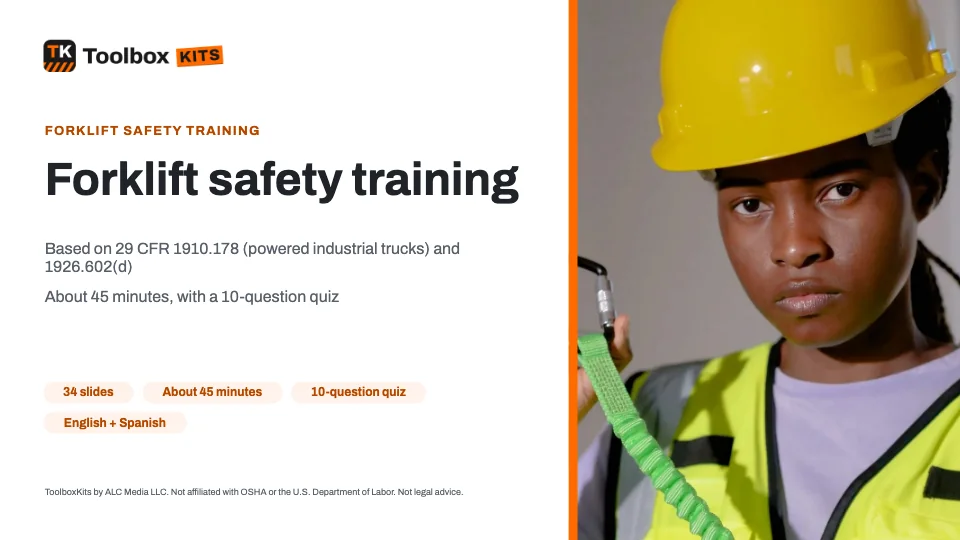
PREVIEW
Real slides from the deck
Six of the 34 slides, exactly as they open in PowerPoint. Tap one to see it larger.
What is in the kit
- 34-slide editable PowerPoint with trainer notes on every slide
- Trainer guide for a 45-minute class, with the agenda and the materials list
- 10-question quiz and answer key
- Crew handout with the dos and don'ts
- Sign-in sheet and certificate of completion
- Everything in English and Spanish, in one zip file
CONTENTS
What the slides cover, in order
The topics of the deck in the order you teach them, with the OSHA citation each slide carries. Then 10 quiz slides, one question each.
- Forklift safety training
- What you will learn today
- Why forklifts are different
- The rules
- Who may operate a forklift · 29 CFR 1910.178(l)(1)(ii)
- What operator training must include · 29 CFR 1910.178(l)(2)(ii)
- Refresher training, evaluation and certification · 29 CFR 1910.178(l)(4)(ii)
- Daily examination and out-of-service trucks · 29 CFR 1910.178(q)(7)
- Capacity and stable loads · 29 CFR 1910.178(o)(2)
- Picking up, carrying and placing loads · 29 CFR 1910.178(o)(5)
- Traveling · 29 CFR 1910.178(n)(4)
- Ramps, rail tracks, elevators and headroom · 29 CFR 1910.178(n)(7)(i)
- People on foot and riders · 29 CFR 1910.178(m)(2)
- Parking and leaving the truck · 29 CFR 1910.178(m)(5)(i)
- Fueling and battery charging · 29 CFR 1910.178(g)(1)
- The pre-shift check, step by step · 29 CFR 1910.178(q)(7)
- Handling a load, step by step
- Working around forklifts on foot · 29 CFR 1910.178(m)(2)
- Working a dock, step by step · 29 CFR 1910.178(k)(1)
- Common mistakes and what to do instead
- Scenario: what is wrong at this dock?
- Scenario debrief
- Recap · 29 CFR 1910.178(l)(1)(ii)
- Sign in before you go
TRAINER GUIDE
How the class runs
The trainer guide splits the 45 minutes like this. The notes on each slide say what to say.
| Minutes | What happens |
|---|---|
| 3 | Welcome, sign-in and what you will learn (slides 1 and 2) |
| 2 | Why forklifts are different (slide 3) |
| 15 | The rules: operators, training, the daily examination, capacity, loads, traveling, ramps, people on foot, parking, fueling and charging (slides 4 to 15) |
| 10 | Doing it right: pre-shift check at a real truck, handling a load, working on foot and working a dock (slides 16 to 19) |
| 2 | Common mistakes (slide 20) |
| 5 | Scenario exercise in small teams, then the debrief (slides 21 and 22) |
| 1 | Recap (slide 23) |
| 6 | Quiz: 10 questions, then go over the answers (slides 24 to 33) |
| 1 | Closing: sign-in check, handouts and next steps for operators (slide 34) |
What you need
- Slide deck on a screen or TV, or printed slides
- A forklift on site, parked and shut down, for the pre-shift check demo
- Your company's pre-shift checklist and the operator's manual for your trucks
- An empty pallet for the load handling demo (optional)
- A map or sketch of your building or yard showing aisles, docks and walkways
- Printed quizzes, the answer key and pens
- Handouts, one per person
- Sign-in sheet and certificates of completion
Tips from the guide
- Use a map of your own building or yard and mark the blind corners, cross aisles and docks together.
- Have an operator do the pre-shift check out loud at a real truck while the group watches and adds anything missed.
- Mix drivers and people on foot in the scenario teams so each side hears the other's view.
QUIZ
3 of the 10 quiz questions
Pick your answer, then open it. The kit's answer key has them all.
How often must each operator's performance be evaluated, at a minimum?
- At least once every three years
- Only when they are hired
- Only after an accident
Show the answer
A. An evaluation of each operator's performance is conducted at least once every three years.
Your pre-shift check finds the brakes are weak. What happens next?
- The truck comes out of service until it is restored to safe operating condition, and you report the defect
- Drive it carefully until the end of the shift
- Use it only for light loads
Show the answer
A. A truck that is defective or in any way unsafe is taken out of service until it is restored to safe operating condition.
You are driving a loaded forklift on a grade steeper than 10 percent. Which way should the load face?
- Upgrade, pointing up the slope
- Downgrade, pointing down the slope
- It does not matter on a ramp
Show the answer
A. When going up or down grades over 10 percent, loaded trucks are driven with the load upgrade.
PAPERWORK
Sign-in sheet, quiz and certificate
Ready to print. The certificate is a record of completion, not an OSHA card or license.
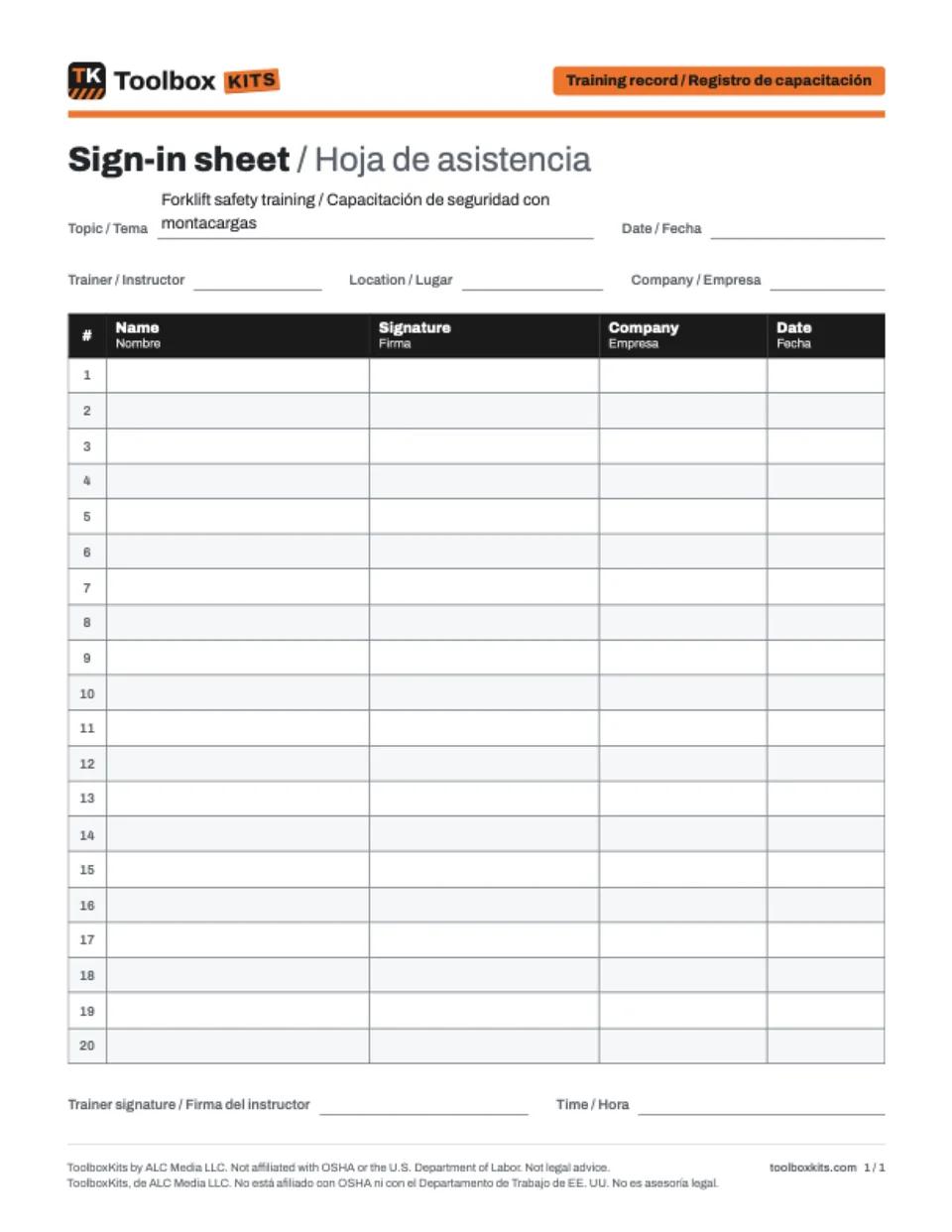
Sign-in sheet
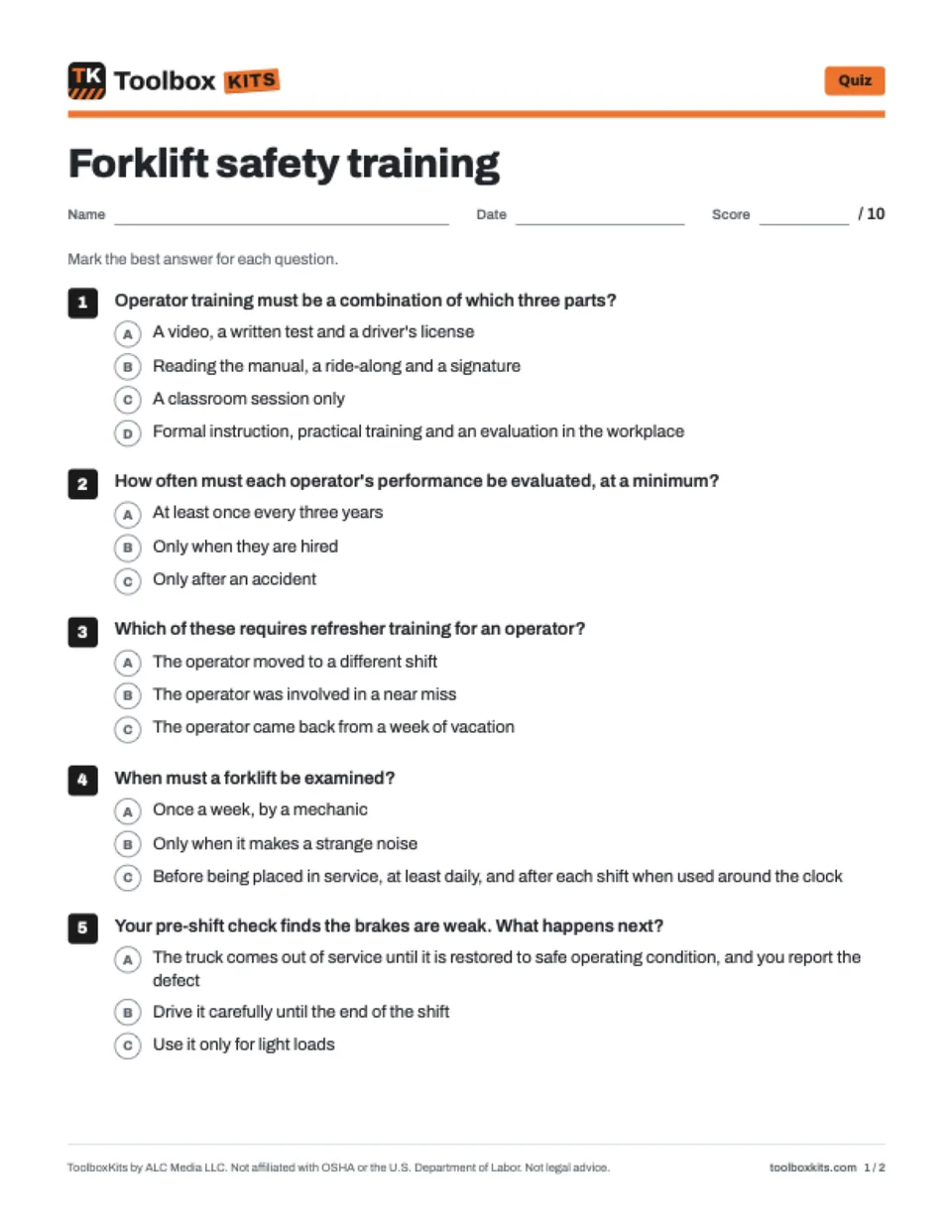
Quiz
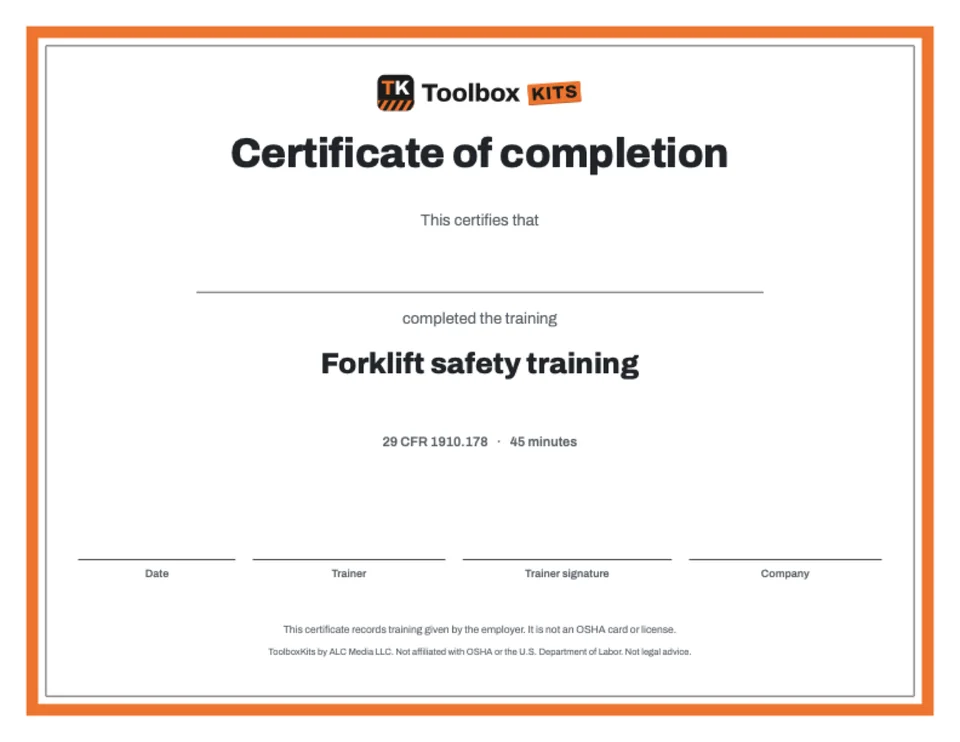
Certificate
WHO IT IS FOR
Who it is for and how long it takes
For the supervisor, foreman or safety lead who has to train a crew on forklift safety and wants to walk in ready. The class takes about 45 minutes with the quiz. Run it in English or Spanish: the kit has both.
Used in: warehousing, manufacturing, general industry, construction.
Only need a short talk? The 5-minute talk on this topic is free, in English and Spanish. Free forklift safety toolbox talk
OSHA standards cited in the kit
Each citation points to the paragraph of the rule in the eCFR. This is how the kit writes them:
- 29 CFR 1910.178 Powered industrial trucks29 CFR 1910.178(l)(1)(ii) · 29 CFR 1910.178(l)(2)(ii) · 29 CFR 1910.178(l)(4)(ii) · 29 CFR 1910.178(q)(7) · 29 CFR 1910.178(o)(2) · 29 CFR 1910.178(o)(5) · 29 CFR 1910.178(n)(4) · 29 CFR 1910.178(n)(7)(i) · 29 CFR 1910.178(m)(2) · 29 CFR 1910.178(m)(5)(i) · 29 CFR 1910.178(g)(1) · 29 CFR 1910.178(k)(1) · 29 CFR 1910.178(l)(4)(iii) · 29 CFR 1910.178(l)(4)(ii)(B) · 29 CFR 1910.178(p)(1) · 29 CFR 1910.178(o)(6) · 29 CFR 1910.178(m)(5)(ii)
Forklift safety training kit
$9
Pay once and download right away. No subscription. If it does not work for you, you get a refund within 30 days, no questions asked. Refund policy